By Szabó Zoltán József
When people talk about accessibility, they often think first of ramps, lifts, wider doorways or accessible websites. All of these matter. But in everyday life, independence often depends on much smaller things.
Can someone stand up from a chair without help? Can they shower safely? Put on their socks? Open a bottle? Eat a meal independently? Reach the toilet without assistance?
These are ordinary activities, but losing the ability to do even one of them can change the rhythm of an entire day.
This is why assistive products are about far more than replacing a lost function. The World Health Organization describes assistive technology as supporting functioning, independence, inclusion and participation. It can include everything from wheelchairs, white canes and spectacles to simple daily-living aids and digital tools. Globally, more than 2.5 billion people need at least one assistive product, and that figure is expected to rise to 3.5 billion by 2050. Egészségügyi Világszervezet
In the UK, this is not a marginal issue. The 2024–2025 Family Resources Survey found that 16.7 million people — around one in four of the population — were classified as disabled. GOV.UK
Start with the task, not the product
One of the easiest mistakes to make when choosing an aid is to begin with the product.
Which walking frame should I buy? Which shower chair is best? What kind of cutlery is suitable for a disabled person?
These are understandable questions, but they are not precise enough. A more useful starting point is: which activity is difficult, and what exactly is making it difficult?
Two people with the same diagnosis may need completely different forms of support. One may struggle with balance, another with grip strength, another with reach, fatigue or limited space at home.
The UK disability charity Scope makes a similar point: identify the task that is difficult and then work out which part of that task creates the problem. Someone who struggles to read, for example, may have difficulty seeing the words, holding the book or turning the pages. Each problem calls for a different solution. Scope
The principle is simple: a good aid should not merely match a diagnosis. It should match the person, the task and the environment in which it will actually be used.
Mobility is about more than walking
Mobility is often treated as a question of getting from one place to another. At home, however, much smaller movements can determine whether somebody remains independent.
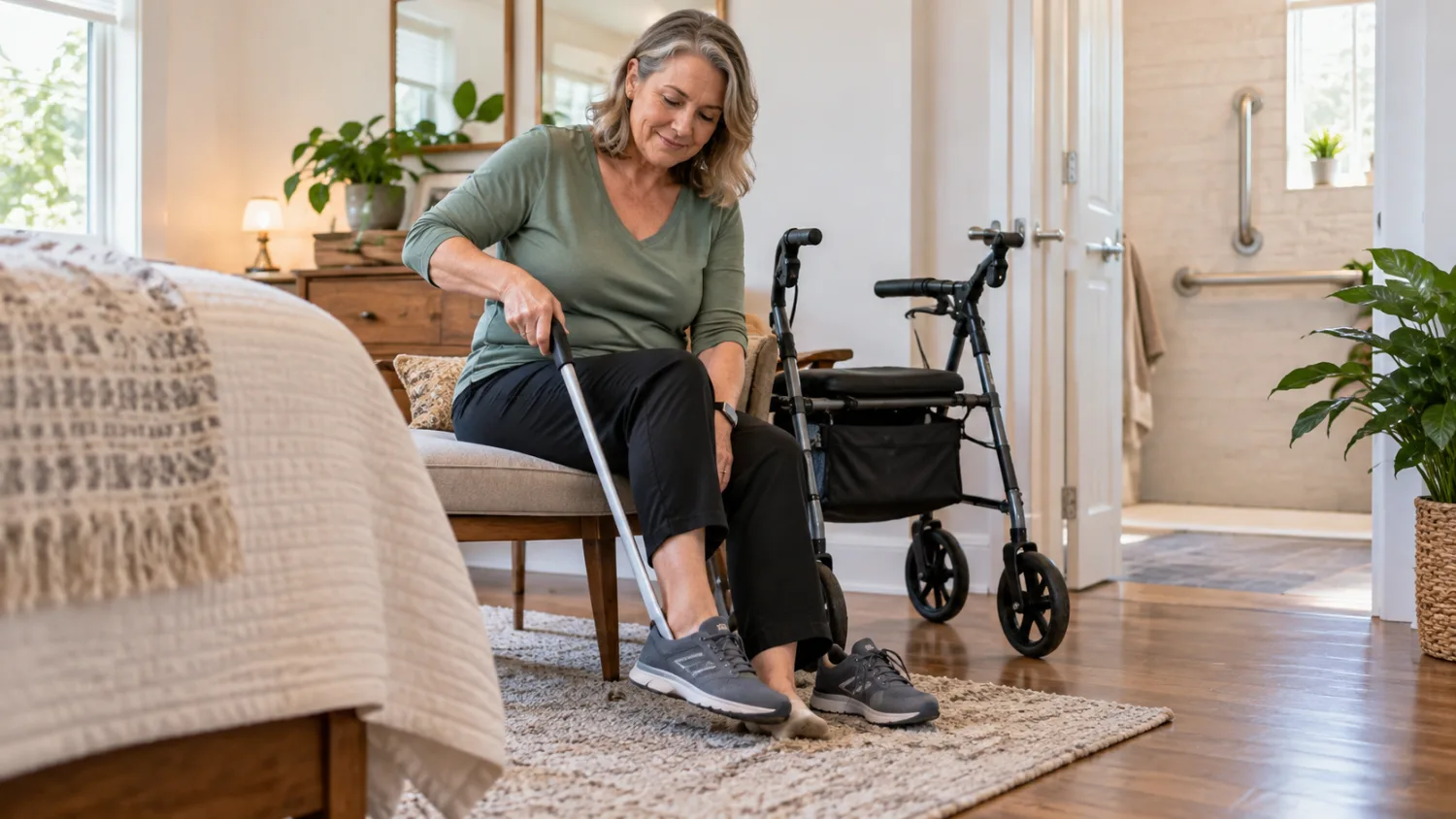
Getting out of bed. Standing up from a chair. Turning safely. Transferring to the toilet. Covering the few metres between the bedroom and the bathroom.
A walking stick, frame, rollator or wheelchair only helps if the person can actually use it well. Does it fit through the home? Can the brakes be reached comfortably? Is there enough strength and coordination to control it? Does it support the person’s remaining abilities rather than replacing them unnecessarily?
“More stable” does not automatically mean “better”. An aid that is too large, too heavy or unnecessarily complicated can create another obstacle.
For simple everyday aids, careful consideration of the task and environment may be enough. For more complex mobility equipment, transfer aids or significant home adaptations, assessment by an occupational therapist, physiotherapist or another appropriate professional can be important.
In the bathroom, small changes can have a large effect
Bathrooms are one of the clearest examples of how a relatively simple aid can make a substantial difference.
A correctly positioned grab rail, a shower chair or a raised toilet seat is not sophisticated technology. Yet one of these may be the difference between needing another person present and being able to manage independently.
The details matter.
With a grab rail, position, height and direction affect how useful it is. With a shower chair, seat height and stability matter. With a raised toilet seat, the real question is whether the person can sit down and stand up safely.
The best solution is therefore not necessarily the one with the most features. It is the one that makes a particular movement safer, more predictable and less dependent on assistance.
Dressing and eating: the less visible barriers
Reduced hand function can be much less obvious than difficulty walking, yet it can affect a surprising number of everyday activities.
Fastening a button. Putting on a shoe. Opening a bottle. Holding a fork securely.
These can seem like minor tasks until somebody can no longer perform them without help.
Sometimes a relatively simple aid is enough: a thicker handle, a non-slip surface, adapted cutlery, a long-handled aid or a dressing tool.
The aim should not be to introduce equipment for every difficulty. It should be to provide only as much support as necessary while preserving as much of the person’s own ability as possible.
Independence does not mean doing everything without support. It means having the right support so that a person can still do as much as possible for themselves.
The same environment can create completely different barriers
For me, this is not only a professional subject.
I am visually impaired, and in everyday life I use several forms of assistance: optical aids, screen magnification, strong visual contrast and other digital solutions. None of these is particularly dramatic in isolation, but together they allow me to carry out many activities independently.
My wife and business partner, Alexa, has a physical disability. As a result, we can experience exactly the same environment in completely different ways. What may be a visual or orientation problem for me can be a question of reach, hand use or physical effort for her.
That is a useful reminder of why the phrase “disabled-friendly” can be misleading if it is treated as a single standard.
Accessibility becomes genuinely useful when it reflects the abilities, limitations and priorities of the individual person.
This lived experience also influences the way we work at Értéksziget, a Hungarian medical-aids and decision-support specialist. We try to understand how an aid will be used in real life rather than looking only at its technical specifications.
Continence: a less visible part of independence
Continence is discussed less often in conversations about independent living, even though it can have a major effect on confidence, privacy and participation in everyday life.
Choosing an appropriate continence product is not simply about absorbency.
Skin protection matters. So does how easy the product is to put on and remove, how discreet it feels, how well it works with clothing, and whether the person can manage it independently.
A product with a theoretically higher capacity is not necessarily the better choice if using it means regularly needing somebody else’s help.
This is where independence becomes more than a question of physical function. It is also about dignity, privacy and how much control a person retains over their own daily routine.
A good aid should not end up in a cupboard
Even a technically excellent aid has little value if the person eventually stops using it.
There are many reasons this can happen. It may be too heavy, uncomfortable, difficult to clean, awkward to store, too conspicuous or simply unsuitable for the problem that matters most to the person.
Usability is therefore just as important as technical performance.
An aid works well when it fits naturally into the person’s routine, can be used safely in the actual environment and reduces the amount of assistance required. If it does not, the aid itself can become another task to manage.
A practical lesson from Hungary
At Értéksziget, we regularly meet people and families who arrive already looking for a specific product. Someone may have told them that they need a walking frame, a grab rail, a continence product or a particular orthosis.
Quite often, the first useful step is not choosing between products. It is clarifying the problem.
Which movement is difficult? Where will the aid be used? Which hand can operate it? Can the person stand up independently? Is somebody usually available to help? Which activity do they most want to continue doing for themselves?
Years of working with these questions have reinforced one principle again and again: good equipment selection starts with understanding, not product search.
Very often, the best aid is not the most expensive or technically advanced one. It is the one that fits a person’s real life so well that, after a few days, they stop noticing the equipment and notice instead that they can do something independently again.
Four questions worth asking before choosing an aid
Before buying even a relatively simple aid, it is worth asking four questions:
- Which everyday activity is actually difficult?
- What can the person still do independently?
- Where and how will the aid be used?
- Will it genuinely increase independence, or create another difficulty?
The best assistive products are often not spectacular. They do not have to be technologically advanced, and they do not have to be expensive.
Their value lies in giving something back in an ordinary moment: a movement, a task, a decision, or simply the confidence to say, “I can still do this myself.”
That is the point at which accessibility becomes independence.
Sources
- World Health Organization: Assistive technology Egészségügyi Világszervezet
- UK Department for Work and Pensions: Family Resources Survey, financial year 2024 to 2025 GOV.UK
- Scope UK: Finding the right equipment and assistive technology