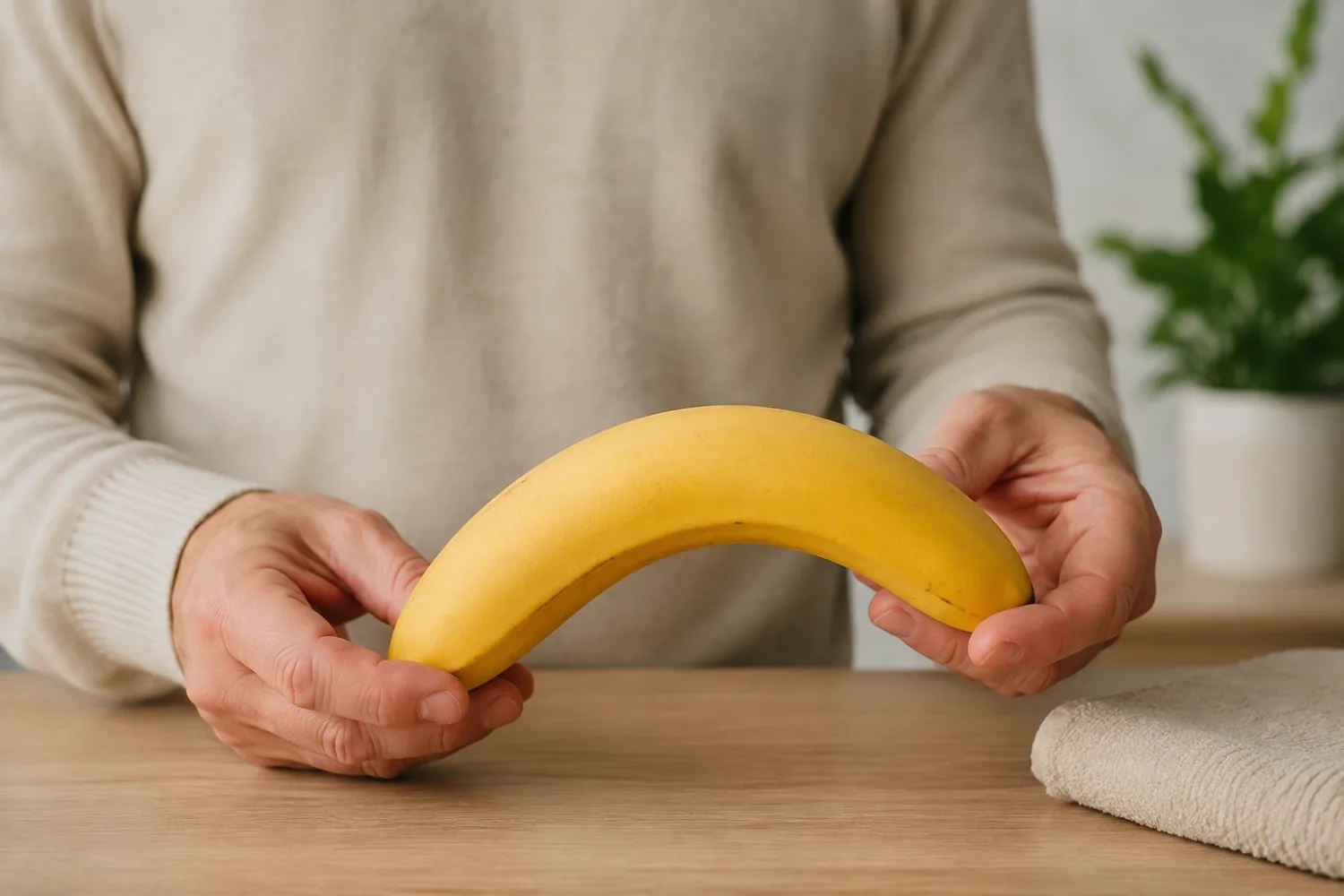
Peyronie’s disease is a condition in which fibrous scar tissue develops within the penis, causing it to bend or change shape during an erection. The bend may be upward, downward or to either side. Some men develop an indentation, narrowing, an hourglass shape or a hinge-like area rather than one simple curve.
The condition can also cause painful erections, shortening of the penis and difficulty getting or maintaining an erection. In some cases, the change is mild and does not interfere with sex. In others, penetration becomes uncomfortable or impossible.
A naturally curved penis is common and does not necessarily indicate disease. Peyronie’s disease is more likely when the curve is new, worsening or associated with a hard lump, pain, shortening or another change in shape.
Peyronie’s disease is benign. It is not cancer, it is not contagious and it is not caused by a sexually transmitted infection. However, it can have a significant effect on confidence, relationships and mental wellbeing, so symptoms are worth discussing with a GP or urologist rather than managing in silence.
Seek urgent medical help after a penile injury if you hear or feel a sudden crack, immediately lose the erection, develop rapid swelling or extensive bruising, or the penis becomes severely painful and deformed. These symptoms may indicate a penile fracture, which is different from Peyronie’s disease.
Arrange a prompt medical assessment for a new hard penile lump, a rapidly changing deformity, persistent unexplained pain, difficulty urinating, a skin ulcer or bleeding, or any concern that the change could have another cause.
See a GP or sexual-health professional if the condition is causing severe distress, relationship difficulty, anxiety or low mood. The psychological effects deserve treatment alongside the physical symptoms.
What is Peyronie’s disease?
Inside the penis are two cylinders of erectile tissue called the corpora cavernosa. These are surrounded by a strong but flexible layer called the tunica albuginea.
During an erection, the erectile tissue fills with blood and the tunica stretches. In Peyronie’s disease, an area of fibrous, scar-like tissue forms within the tunica. This area does not stretch normally, so the expanding penis bends towards the scarred side.
The scar tissue is commonly called a plaque. It may feel like:
- a firm flat area;
- a hard ridge;
- a small lump;
- a cord-like thickening;
- a broader area that is difficult to define.
The word plaque does not refer to infection, cholesterol or the type of plaque that forms on teeth. It means a localised area of fibrous tissue.
Is Peyronie’s disease cancer?
No. Peyronie’s disease is a benign connective-tissue condition and does not turn into penile cancer.
A new unexplained penile lump should still be examined because not every lump or skin change is Peyronie’s disease.
Is Peyronie’s disease contagious?
No. It cannot be passed to a partner through sex and is not caused by a sexually transmitted infection.
Is every curved penis abnormal?
No. Penises naturally vary in shape, and a mild lifelong curve may be completely normal.
Peyronie’s disease is more likely when:
- the curve developed after previously straight erections;
- the shape is changing;
- there is a palpable plaque;
- erections are painful;
- the penis has shortened or narrowed;
- sex has become difficult.
What are the symptoms of Peyronie’s disease?
The most obvious symptom is a new change in the shape of the erect penis. The appearance and severity vary considerably.
Penile curvature
The penis may bend:
- upward;
- downward;
- to the left;
- to the right;
- in more than one direction.
An upward curve is common, but any direction is possible.
The degree of curvature does not tell the whole story. A moderate bend in an awkward location may interfere with sex more than a visually larger curve that remains stable and comfortable.
Indentation and hourglass deformity
Not every case produces a smooth bend.
Other changes include:
- narrowing on one side;
- a waist-like indentation around the penis;
- an hourglass shape;
- flattening;
- a hinge point where the penis feels unstable during penetration.
These complex changes can make intercourse difficult even when the measured angle is not severe.
A hard plaque or lump
The plaque may be felt beneath the skin when the penis is soft.
It is usually:
- firm rather than fluid-filled;
- part of the deeper penile tissue;
- not attached to the surface skin;
- located along the upper, lower or side surface.
Pain
Pain is most common during the early or active phase.
It may occur:
- during erections;
- during sex;
- when the penis is touched;
- occasionally while the penis is soft.
Pain often improves with time, even when the curvature remains.
Shortening
Fibrosis can reduce the length of the erect penis.
Some men first notice shortening rather than curvature, particularly when the plaque involves a broad area.
Erectile dysfunction
Peyronie’s disease can occur alongside difficulty getting or maintaining a firm erection.
Possible reasons include:
- reduced penile blood flow;
- the deformity interfering with pressure inside the penis;
- pain;
- anxiety about performance or injury;
- diabetes or cardiovascular disease;
- other erectile-dysfunction risk factors.
Our guide to erectile dysfunction, its causes and treatment explains the wider assessment.
What causes Peyronie’s disease?
The precise cause is not always clear.
The leading explanation is that an injury to the tunica albuginea heals abnormally, producing too much scar tissue. The injury may be obvious, but it is often caused by repeated minor bending or strain that the person never noticed at the time.
Penile injury
Injury may occur during:
- vigorous sex;
- an erection bending unexpectedly;
- sport or an accident;
- another form of trauma;
- occasionally a penile procedure.
Most minor injuries heal without causing Peyronie’s disease. The condition appears to develop in people who have a particular susceptibility to abnormal scar formation.
Age
Peyronie’s disease becomes more common in middle and later adulthood, although younger men can develop it.
Age-related changes in tissue elasticity and healing may contribute.
Genetics and family tendency
Some men appear to inherit a greater tendency towards fibrotic conditions.
A family history may increase risk, but there is no routine genetic test used to diagnose Peyronie’s disease.
Dupuytren’s contracture
Peyronie’s disease is associated with Dupuytren’s disease, in which thickened tissue in the palm pulls one or more fingers inward.
Both conditions involve abnormal fibrous tissue formation.
Having one condition does not guarantee that the other will develop.
Diabetes and vascular health
Diabetes, high blood pressure, smoking and other vascular risk factors are associated with erectile dysfunction and may occur more commonly in men with Peyronie’s disease.
They may affect tissue repair and erection quality rather than directly creating every plaque.
See our guide to diabetes symptoms, testing and treatment.
Is it caused by masturbation?
Ordinary masturbation does not automatically cause Peyronie’s disease.
Any activity that forcefully bends an erect penis could potentially cause injury, but most men with Peyronie’s disease cannot identify one specific event.
Is it caused by ageing or low testosterone?
The condition becomes more common with age, but it is not simply an unavoidable feature of ageing.
Low testosterone is not considered the sole cause. Men with symptoms of testosterone deficiency should be assessed separately rather than assuming hormone treatment will correct the curvature.
The active phase and the stable phase
Peyronie’s disease is commonly described as having an active phase followed by a stable or chronic phase.
Knowing which phase the condition is in helps determine which treatments are appropriate.
The active phase
During the active phase:
- pain may be present;
- the plaque is developing;
- curvature may increase;
- shortening or indentation may progress;
- erection quality may change.
The active phase often lasts several months and may continue for approximately 12 to 18 months, although individual courses vary.
Not every man experiences continuous worsening throughout this period.
The stable phase
The condition is considered stable when:
- the curve is no longer changing;
- the deformity has remained similar for several months;
- pain has usually settled or substantially reduced;
- the plaque is no longer actively developing.
Surgical correction is normally reserved for the stable phase because operating while the shape is still changing could produce an unpredictable result. BAUS guidance on penile straightening similarly advises that surgery for Peyronie’s disease should be undertaken only once the condition is chronic and stable.
Does Peyronie’s disease always get worse?
No.
The condition may:
- remain mild and stable;
- worsen during the active phase and then stop;
- improve slightly;
- rarely resolve almost completely.
Pain is more likely to improve spontaneously than established curvature.
Should you wait before seeking help?
No. An early assessment can:
- confirm the likely diagnosis;
- document the current shape;
- identify erectile dysfunction;
- discuss traction or conservative treatment;
- exclude other causes;
- provide reassurance and psychological support.
Seeking help early does not mean surgery will be recommended.
How is Peyronie’s disease diagnosed?
A GP may recognise the symptoms and refer to urology, andrology or a specialist sexual-medicine service.
Diagnosis is usually based on history and physical examination.
Questions the clinician may ask
You may be asked:
- when the change began;
- whether the curve is worsening;
- whether erections are painful;
- whether penetration is possible;
- whether the erection is sufficiently firm;
- whether shortening or narrowing has occurred;
- whether there was an injury;
- whether you have diabetes or vascular disease;
- whether you have Dupuytren’s contracture;
- how the condition affects confidence and relationships.
Physical examination
The clinician may examine the penis while it is soft to identify:
- the position of the plaque;
- its approximate size;
- calcification or hardness;
- other penile lumps or skin changes.
Photographs of the erection
Because the curvature is most visible during an erection, the specialist may ask for private photographs taken at home.
These may include:
- a view from above;
- a view from the side;
- a view from the front.
The penis should be fully erect so that the shape can be measured accurately.
Follow the clinic’s instructions and store or transmit images only through an appropriate secure method.
Artificial erection during assessment
In some specialist clinics, medicine may be injected into the penis to create an erection.
This allows the urologist to assess:
- the angle and direction of curvature;
- indentation or hinging;
- erection quality;
- the most appropriate procedure if treatment is being planned.
Ultrasound
A penile ultrasound may assess:
- the plaque;
- calcification;
- blood flow;
- erectile function;
- other structural abnormalities.
It is not necessary for every straightforward case.
Blood tests
No blood test confirms Peyronie’s disease.
Blood tests may be used when erectile dysfunction or another health issue needs investigating, for example:
- blood glucose or HbA1c;
- cholesterol;
- testosterone where symptoms justify testing;
- kidney, liver or other health checks.
When does Peyronie’s disease need treatment?
Not every man requires active treatment.
Observation may be reasonable when:
- the curve is mild;
- pain is manageable;
- the condition is stable;
- erections remain firm;
- sex is comfortable and possible;
- the appearance is not causing significant distress.
The NHS advises seeing a GP when the penis has developed a curve, painful erections, a hard lump or difficulty with sex. Treatment options depend on how severe and troublesome the condition is.
Treatment is more likely to be considered when:
- penetration is difficult or impossible;
- erections are painful;
- curvature is worsening;
- there is severe narrowing or instability;
- erectile dysfunction is present;
- shortening is substantial;
- the condition causes severe psychological distress.
Measure function, not appearance alone
A perfectly straight penis is not required for satisfactory sex.
The aim of treatment is usually to create a functionally straighter penis, improve erection quality and reduce distress—not necessarily restore the exact appearance or length from before the condition developed.
Sex during the active phase
Sex does not necessarily have to stop.
Practical steps may include:
- using sufficient lubrication;
- choosing positions that reduce uncontrolled bending;
- avoiding forceful penetration;
- supporting the penis during entry;
- stopping if significant pain occurs;
- treating erectile dysfunction so the penis is less likely to buckle.
A partially firm erection may be more vulnerable to bending injury than a fully rigid erection.
Psychological and relationship impact
Peyronie’s disease can cause:
- embarrassment;
- avoidance of intimacy;
- fear of rejection;
- performance anxiety;
- low mood;
- relationship tension.
Psychosexual therapy or couples support can be valuable, whether or not a physical procedure is planned.
Non-surgical treatment options
Conservative treatment is usually most relevant during the active phase, when the condition is still changing, or when a man prefers not to have surgery.
Evidence for many treatments is limited or inconsistent. The European Association of Urology notes that conservative studies often produce contradictory results, making clear recommendations difficult for several therapies.
Pain relief
Anti-inflammatory painkillers such as ibuprofen may help pain during the active phase when they are medically suitable.
They do not dissolve the plaque or reliably straighten the penis.
Anti-inflammatory medicines may be unsuitable for people with:
- stomach ulcers;
- kidney disease;
- certain heart conditions;
- anticoagulant treatment;
- some forms of asthma.
Treating erectile dysfunction
PDE5 inhibitors such as sildenafil or tadalafil may be prescribed when erectile dysfunction is present.
A firmer erection can improve sexual function and reduce buckling, although these medicines do not reliably remove established scar tissue.
Do not use PDE5 inhibitors with nitrate medicines prescribed for angina.
Penile traction therapy
A traction device gently stretches the penis for a prescribed period each day.
It may help some men:
- reduce curvature modestly;
- limit loss of length;
- improve length;
- maintain tissue flexibility.
Results depend heavily on:
- the device;
- correct use;
- daily consistency;
- how long treatment continues;
- the type of deformity.
The NHS notes that traction devices may help but generally need to be used every day for several months and are not usually available through the NHS.
A device should not cause severe pain, numbness, skin damage or discoloration. Follow specialist instructions rather than improvising weights or home-made stretching methods.
Vacuum erection devices
A vacuum device draws blood into the penis and may be used for erectile dysfunction or as part of a specialist stretching programme.
Evidence for straightening Peyronie’s disease is limited, and the technique should be discussed with a urologist.
Oral tablets and supplements
Many oral treatments have been promoted, including:
- vitamin E;
- potassium para-aminobenzoate;
- colchicine;
- pentoxifylline;
- various antioxidants and supplements.
No oral medicine reliably dissolves an established Peyronie’s plaque or consistently corrects curvature.
Supplements can cause side effects and interactions, and buying them online may delay effective assessment.
Topical creams and gels
There is no strong evidence that ordinary creams or gels penetrate deeply enough to treat the plaque effectively.
Shockwave therapy
Extracorporeal shockwave therapy directs sound-wave energy towards the affected area.
It may reduce penile pain in selected men, but it has not consistently corrected curvature or reduced plaque size.
NICE guidance has historically allowed the procedure with specific governance and consent arrangements because evidence of benefit has been limited.
PRP, stem cells and unproven treatments
Platelet-rich plasma, stem cells and other regenerative injections are sometimes marketed privately.
They are not established standard treatments for Peyronie’s disease. Claims that they reliably dissolve plaques or restore the penis should be treated cautiously.
Injection treatments for Peyronie’s disease
Some medicines can be injected directly into the plaque by a specialist.
Availability differs between countries, clinics and NHS commissioning arrangements.
Collagenase injections
Collagenase clostridium histolyticum is an enzyme designed to break down collagen within the plaque.
Treatment generally involves:
- a series of injections;
- specialist manipulation or modelling;
- home stretching or traction instructions;
- careful avoidance of sexual activity for a period after treatment.
Possible side effects include:
- bruising;
- swelling;
- pain;
- blood blisters;
- rare serious injury or penile fracture.
Access in the UK is limited, and it is not a routine NHS treatment in many areas.
Verapamil injections
Verapamil has been injected into plaques in an attempt to influence scar-tissue formation.
Evidence is mixed, and improvements are not predictable.
Interferon injections
Interferon alfa-2b may reduce curvature and plaque-related symptoms in selected patients, but availability is limited and side effects can include flu-like symptoms.
Who may be suitable for injection treatment?
Suitability can depend on:
- the direction and degree of curvature;
- whether the plaque can be clearly identified;
- the presence of calcification;
- the disease phase;
- erection quality;
- the type of deformity;
- local treatment availability.
Complex hourglass or hinge deformities may respond differently from a simple curve.
Can injections completely straighten the penis?
Usually not.
The realistic goal is a meaningful reduction in curvature or improved sexual function. Some men have little response.
Surgery for Peyronie’s disease
Surgery offers the most reliable correction for severe stable deformity, but it also carries the greatest risks.
It is generally considered when:
- the condition has been stable for several months;
- pain has settled;
- the deformity prevents or severely restricts sex;
- the man understands the likely compromises;
- non-surgical treatment is unsuitable or unsuccessful.
BAUS information notes that Peyronie’s disease often causes lasting penile changes and that treatment cannot always restore function or appearance completely.
Plication or shortening procedures
Plication straightens the penis by shortening the longer side opposite the plaque.
It may be appropriate when:
- erections are otherwise firm;
- the penis has sufficient length;
- the curve is relatively straightforward;
- there is no major hourglass or hinge deformity.
Advantages include:
- a comparatively simpler operation;
- good straightening rates;
- lower erectile-dysfunction risk than grafting in many patients.
Possible disadvantages include:
- penile shortening;
- palpable stitches or knots;
- residual curvature;
- altered sensation;
- recurrence;
- erectile dysfunction.
Plaque incision or excision with grafting
In grafting surgery, the surgeon cuts or removes part of the plaque and covers the resulting defect with graft material.
It may be considered for:
- severe curvature;
- complex deformity;
- significant indentation or hourglass narrowing;
- a penis that is already substantially shortened;
- good erectile function before surgery.
Grafting may preserve more length than plication but has a greater risk of postoperative erectile dysfunction, altered sensation and other complications. It remains an established option for selected severe or complex cases with preserved erectile function.
Penile implant surgery
A penile prosthesis may be recommended when Peyronie’s disease occurs with erectile dysfunction that does not respond adequately to tablets or other treatments.
The implant produces rigidity, while additional modelling, plication or grafting may be used to correct remaining curvature.
A penile implant is permanent and replaces the natural erection mechanism. It requires detailed discussion of infection, mechanical failure, revision surgery and changes in penile sensation or appearance.
Can surgery restore the original penis?
Not always.
Even successful surgery may leave:
- some residual curvature;
- shortening;
- a palpable plaque;
- changed sensation;
- a different appearance;
- ongoing erectile difficulties.
The aim is usually a penis straight and firm enough for comfortable sexual activity.
Choosing a surgeon
Complex Peyronie’s surgery is best assessed by a urologist or andrologist with regular experience in penile reconstructive surgery.
Useful questions include:
- Which procedure do you recommend and why?
- How much shortening should I expect?
- What is my risk of erectile dysfunction?
- Could the curvature return?
- How many of these procedures do you perform?
- What happens if the result is not adequate?
Living with Peyronie’s disease
The impact is not limited to the physical bend.
Men may avoid discussing the condition for months or years because they feel embarrassed, fear examination or believe nothing can be done.
Talking to a partner
A partner may wrongly assume that avoidance of sex reflects reduced attraction.
An open explanation can reduce misunderstanding:
- the condition is physical;
- it is not contagious;
- pain or fear may affect erections;
- different positions or activities may be more comfortable;
- sexual intimacy does not have to depend entirely on penetration.
Safer sexual activity
During the active phase:
- use adequate lubrication;
- avoid positions where the penis can slip out and bend;
- move slowly;
- stop if sharp pain occurs;
- support the penis during penetration;
- seek treatment for erectile dysfunction.
Do not force the penis straight
Aggressive manual bending can injure the penis and worsen scarring.
Traction and modelling should follow a specialist-approved method rather than improvised manipulation.
Monitor changes
During the active phase, it may help to record:
- pain;
- erection firmness;
- whether sex remains possible;
- changes in shape;
- photographs at sensible intervals;
- the effect on mood and relationships.
Constant daily checking can increase anxiety. Measurements every few weeks or as advised by the clinic are usually more useful.
Mental health support
Seek help when Peyronie’s disease causes:
- persistent low mood;
- severe anxiety;
- avoidance of relationships;
- loss of self-worth;
- relationship breakdown;
- thoughts of self-harm.
A GP, psychosexual therapist or counsellor familiar with sexual-health conditions may help.
General health
Improving cardiovascular health will not remove an established plaque, but it may support erection quality.
Useful measures include:
- stopping smoking;
- managing diabetes;
- controlling blood pressure and cholesterol;
- regular physical activity;
- limiting excessive alcohol;
- maintaining a healthy weight where appropriate.
For a wider overview, see our guide to men’s health symptoms and common conditions.
Frequently asked questions about Peyronie’s disease
What is Peyronie’s disease?
It is a condition in which fibrous plaque develops in the penis and causes a new curve, indentation, shortening or another deformity during erection.
How do you pronounce Peyronie’s?
It is commonly pronounced approximately “pay-roh-NEEZ”.
Is a curved penis always Peyronie’s disease?
No. A mild lifelong curve may be normal. Peyronie’s disease usually causes a new or changing deformity, often with a plaque, pain or shortening.
Can Peyronie’s disease happen suddenly?
The curve may appear to become noticeable quite suddenly, although the scar process may have been developing for some time.
What does the plaque feel like?
It may feel like a firm ridge, flat hard area, cord or lump beneath the penile skin.
Is the plaque visible?
Usually the plaque itself is not visible through the skin, but its effect on the erect shape may be obvious.
Is Peyronie’s disease painful?
It can cause painful erections, especially during the active phase. Pain often improves as the condition stabilises.
Does the pain mean it is getting worse?
Not necessarily. Pain is associated with the active phase, but the degree of pain does not reliably predict the final curvature.
Can Peyronie’s disease cause erectile dysfunction?
Yes. Structural changes, reduced blood flow, pain and performance anxiety can all contribute.
Can Peyronie’s disease cause shortening?
Yes. Scar tissue can prevent normal expansion and make the erect penis shorter.
Can it cause an hourglass shape?
Yes. Circumferential narrowing can create an hourglass appearance or unstable hinge point.
Is Peyronie’s disease cancer?
No. It is benign and does not become cancer.
Is it an STI?
No. It is not sexually transmitted.
Can I give it to my partner?
No.
Is Peyronie’s disease caused by rough sex?
Penile trauma may contribute, but many men cannot identify a single injury. Ordinary sex does not inevitably cause the condition.
Can masturbation cause Peyronie’s disease?
Normal masturbation is not considered a routine cause. Forcefully bending an erect penis can cause injury.
Can a penis pump cause Peyronie’s disease?
Incorrect or excessive vacuum pressure can injure tissue. A medically appropriate device used correctly is less likely to cause harm.
Is Peyronie’s disease hereditary?
There appears to be a genetic susceptibility in some families, but it is not inherited in a simple predictable way.
Is it linked to Dupuytren’s contracture?
Yes. Both are fibrotic connective-tissue conditions and can occur in the same person.
Is it linked to diabetes?
Diabetes and vascular risk factors may be more common in affected men and can worsen erectile function.
Can Peyronie’s disease disappear?
Pain often improves. Established curvature may improve slightly in some men but commonly remains to some degree.
Does it always get worse?
No. It may stabilise with a mild curve, worsen during the active phase or occasionally improve.
How long does the active phase last?
It commonly lasts several months and may continue for around 12 to 18 months, although there is considerable variation.
When is the disease considered stable?
It is generally stable when the shape has stopped changing for several months and pain has settled.
Should I see a GP immediately?
Arrange an appointment for a new curve, hard plaque, pain, shortening, erectile dysfunction or difficulty having sex.
Who treats Peyronie’s disease?
A urologist, andrologist or specialist in male sexual medicine usually manages significant cases.
How is it diagnosed?
Diagnosis is usually based on symptoms, examination and photographs of the erect penis. Ultrasound is used in selected cases.
Do I need an ultrasound?
Not always. It may help assess the plaque, calcification, blood flow or a complex deformity.
Should I photograph the curvature?
A specialist may ask for private photographs from several angles. Follow secure clinic instructions.
Can tablets dissolve the plaque?
No oral medicine has consistently been shown to dissolve an established plaque or reliably straighten the penis.
Does vitamin E work?
Evidence has not shown reliable improvement in established Peyronie’s disease.
Does collagen help?
Taking collagen supplements has not been shown to reverse the scar plaque.
Can massage remove the plaque?
No. Aggressive massage or forceful bending may cause injury.
Does traction therapy work?
It may modestly improve curvature or length in some men, but it requires correct daily use over several months.
How many hours a day is traction used?
This depends on the specific device and treatment plan. Some newer devices use shorter sessions than older designs. Follow specialist and manufacturer instructions.
Can I use a vacuum pump?
It may help erection quality and is sometimes included in specialist management, but it is not a guaranteed straightening treatment.
Does shockwave therapy straighten the penis?
It may help pain in selected cases but has not reliably corrected curvature.
Are PRP injections effective?
PRP is not an established evidence-based treatment for Peyronie’s disease.
Do collagenase injections work?
They can reduce curvature in suitable men but rarely make the penis completely straight. Access in the UK is limited.
When is surgery needed?
Surgery may be considered when stable deformity makes penetration difficult or impossible or when severe erectile dysfunction is also present.
Does surgery shorten the penis?
Plication commonly causes some shortening. Grafting may preserve more length but brings a greater erectile-dysfunction risk.
Can the curve return after surgery?
Yes. Residual or recurrent curvature is possible.
Will surgery restore the original length?
Not necessarily. Surgery aims primarily to create a functional, sufficiently straight penis.
Can I still have sex?
Many men can. Lubrication, careful positioning and treatment of erectile dysfunction may help. Stop if severe pain or dangerous bending occurs.
Which sex positions are safest?
Positions where the man can control depth and direction may reduce accidental bending. Avoid situations where the penis can slip out and be forcefully bent.
Can Peyronie’s disease affect fertility?
It does not directly reduce sperm production. Fertility may be affected indirectly when intercourse or ejaculation becomes difficult.
Can it affect urination?
Peyronie’s disease usually affects erections rather than urinary flow. Difficulty urinating suggests another problem, such as prostate enlargement or urethral disease.
Can I prevent Peyronie’s disease?
There is no guaranteed prevention. Avoid forcefully bending an erect penis, use adequate lubrication and treat erection difficulties that cause buckling.
When is a penile injury an emergency?
Seek urgent care for a crack or popping sensation followed by immediate loss of erection, rapid swelling, severe bruising or deformity. These suggest penile fracture rather than ordinary Peyronie’s disease.