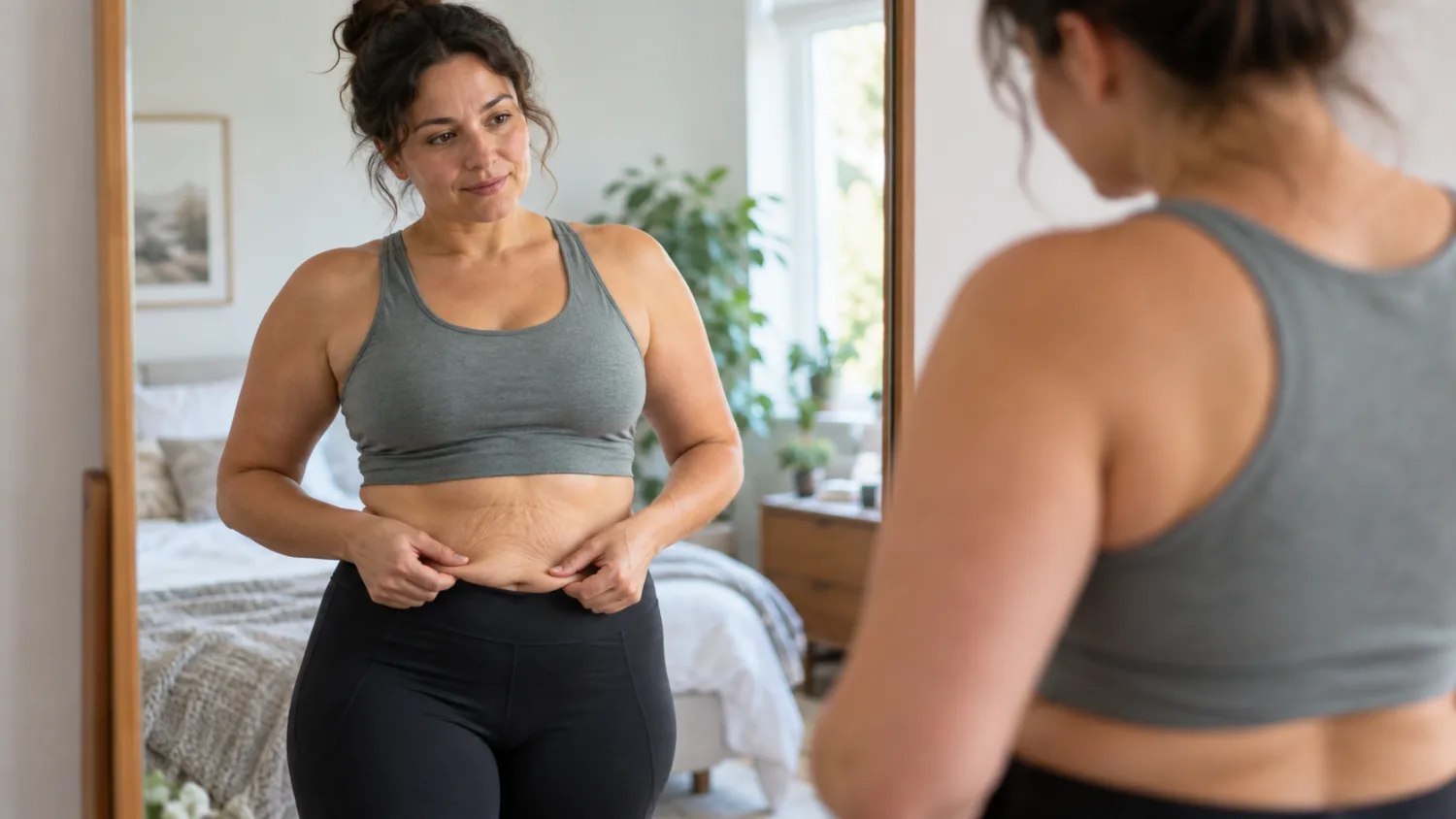
Losing a significant amount of weight can improve health, mobility and confidence, but it can also leave behind something many people do not expect: loose or excess skin.
The stomach is one of the most common areas, but loose skin can also appear on the upper arms, thighs, breasts, buttocks, neck and face. Some people notice only mild creasing or softness. Others are left with substantial folds of skin that rub, become sore or make clothing difficult to fit.
It is natural to wonder whether the skin will tighten with time, whether exercise can fix it, whether collagen supplements are worth taking, or whether surgery is the only real option.
The answer depends largely on how much weight you have lost, your age, how long the skin was stretched, genetics and the amount of remaining fat and muscle beneath the skin.
This guide explains why loose skin happens after weight loss, what may improve naturally, which treatments have realistic benefits and when excess skin removal surgery may be considered.
Why Does Loose Skin Happen After Weight Loss?
Skin is not simply a thin covering over the body. It is a living tissue containing proteins including collagen and elastin that help give it strength and elasticity.
When body size increases, the skin stretches to accommodate the extra tissue underneath it.
If the body later becomes much smaller, the skin does not always return completely to its previous size.
This is particularly common after substantial weight loss.
Chelsea and Westminster Hospital explains that loose skin often develops after significant weight loss because the skin loses elasticity and firmness. Age, genetics, how quickly weight is lost and how long somebody has carried excess weight can all affect how much the skin contracts afterwards.
Collagen and elastin also naturally decline with age. This is one reason a 25-year-old and a 55-year-old can lose the same amount of weight and see very different changes in their skin.
The amount of weight lost matters too. Losing 10kg does not usually create the same degree of excess skin as losing 50kg or 70kg.
Where Does Loose Skin Usually Appear?
It tends to appear in areas that previously stored larger amounts of fat.
Common areas include:
- the lower abdomen;
- upper arms;
- inner thighs;
- breasts and chest;
- buttocks;
- neck and jawline;
- upper and lower back.
The abdomen can be particularly noticeable because excess skin may form an overhanging fold.
After very large weight loss, several areas may be affected at the same time.
Some people describe the skin as wrinkled or crepey rather than obviously hanging. Others have genuine folds of excess tissue.
The distinction matters because mild skin laxity may improve to some extent with time or non-surgical treatments, while large amounts of excess skin generally cannot be removed without surgery.
Will Loose Skin Tighten Naturally Over Time?
Sometimes, to a degree.
The skin can continue adapting after weight stabilises, particularly after moderate weight loss and in younger people with good skin elasticity.
Changes do not happen immediately. It may take many months for the body to settle after a period of substantial weight loss.
However, there is a limit to how much stretched skin can shrink.
If somebody has lost a very large amount of weight and has significant hanging folds, waiting another six months is unlikely to make all of that skin disappear.
Factors associated with greater likelihood of persistent loose skin include:
- larger total weight loss;
- older age;
- having carried excess weight for many years;
- pregnancy as well as weight changes;
- smoking;
- significant sun damage;
- genetic differences in skin elasticity.
Cleveland Clinic notes that collagen and elastin decline with age, while smoking and excessive ultraviolet exposure can further damage these structural proteins.
If your weight is still changing quickly, it is usually too early to judge what your final body contour will look like.
Does Rapid Weight Loss Cause More Loose Skin?
Rapid weight loss is often associated with more noticeable loose skin, although speed is only one factor.
Someone who loses a substantial amount of weight quickly may notice that the volume underneath the skin disappears faster than the skin can adapt.
This has become particularly noticeable with modern weight-loss medicines such as semaglutide and tirzepatide, which can lead to substantial weight reduction in some patients.
Terms such as "Ozempic face" or "Ozempic butt" are sometimes used online, but the underlying issue is generally the weight loss itself rather than the medicine directly damaging the skin.
Rapid loss of fat can make previously stretched skin more obvious. Loss of muscle alongside fat can also make some areas appear flatter or less supported.
Cleveland Clinic similarly notes that rapid or substantial weight loss associated with GLP-1 treatment can make loose skin and facial volume changes more noticeable.
If you are using weight-loss medication, the goal should not be to deliberately slow effective treatment simply because of fear of loose skin. Instead, discuss an appropriate rate of weight loss, nutrition and muscle-preserving exercise with your clinician.
For more on these treatments, see our guide to weight-loss injections in the UK.
Can Exercise Tighten Loose Skin?
Exercise can improve how the body looks after weight loss, but it cannot literally shrink a large sheet of excess skin.
Strength training can build or preserve muscle underneath the skin. This can improve shape and fullness in areas such as the arms, shoulders, legs and buttocks.
It may therefore make mild looseness appear less noticeable.
But muscle cannot replace the large volume of fat that may have previously stretched the skin.
If there is a substantial abdominal apron or loose fold on the arms or thighs, no exercise can physically remove that skin.
This is why the NHS describes abdominoplasty as a procedure used to remove excess abdominal skin that cannot be removed through exercise.
That does not make exercise pointless. Quite the opposite.
Resistance training after weight loss can help:
- preserve lean muscle;
- improve strength;
- improve body shape;
- support bone health;
- help maintain weight loss.
Just set realistic expectations about what it can do to excess skin itself.
Do Protein, Collagen or Vitamins Help?
Good nutrition matters for healthy skin, but supplements cannot reliably remove large amounts of loose skin.
Protein
Protein is important for maintaining muscle and supporting normal tissue repair.
This becomes particularly relevant during weight loss because a significant calorie deficit can cause loss of both fat and lean tissue.
Eating enough protein while doing resistance exercise can help preserve muscle, which may improve overall body composition.
That is different from saying protein powder tightens skin.
Collagen supplements
Collagen powders and drinks are frequently marketed for loose skin.
There is some research suggesting small improvements in certain measures of skin hydration or elasticity with particular collagen products, but evidence is much weaker than the advertising often implies.
Cleveland Clinic notes that studies of collagen supplements remain limited and many have industry involvement.
Even if a supplement modestly improves skin texture, it is not going to remove several centimetres of hanging abdominal skin after major weight loss.
Vitamins
A balanced diet providing adequate vitamins and minerals supports normal skin health.
But taking high doses of vitamins when you are not deficient is unlikely to tighten loose skin.
People who have undergone bariatric surgery are a special case because vitamin and mineral deficiencies can occur after certain procedures. Follow the supplementation plan provided by your bariatric team.
Do Creams or Skin-Tightening Treatments Work?
Creams can make skin feel smoother and better hydrated, but topical products cannot remove significant excess skin.
Products containing ingredients such as retinoids may improve fine lines and skin texture in some areas, but they should not be confused with body-contouring treatment.
Non-surgical clinics also offer procedures marketed as skin tightening.
These may use technologies such as:
- radiofrequency;
- ultrasound;
- laser energy;
- microneedling with radiofrequency.
Some of these treatments can produce modest tightening in people with mild to moderate laxity.
The problem is that advertising photographs sometimes make them look like alternatives to surgery for people with major excess skin.
They are not equivalent.
A treatment that creates a small improvement in skin firmness will not remove a large abdominal fold after major weight loss.
If you are considering an aesthetic treatment, choose the provider carefully and ask what degree of improvement is realistic. Our guide to choosing a safe aesthetic clinic or practitioner covers useful checks before treatment.
When Is Surgery Used for Loose Skin?
For substantial excess skin, surgery is the most effective way of physically removing it.
This group of operations is often described as body contouring surgery after major weight loss.
Depending on the areas affected, procedures may include:
- abdominoplasty or tummy tuck;
- panniculectomy;
- arm lift;
- thigh lift;
- breast lift;
- lower body lift;
- upper body lift;
- face or neck lift.
BAPRAS explains that excess skin after major weight loss can cause more than cosmetic concerns. It can interfere with movement and exercise and contribute to irritation, boils and skin infections.
Surgery can therefore sometimes have functional benefits as well as changing appearance.
However, body-contouring surgery is major surgery.
It can involve long scars, several weeks of recovery and risks including infection, bleeding, poor wound healing, fluid collections, blood clots and asymmetry.
It is not simply a cosmetic "finishing touch" to weight loss.
When Should You Consider Excess Skin Removal?
Most surgeons prefer your weight to be relatively stable before performing major body-contouring surgery.
Operating while somebody is continuing to lose a substantial amount of weight can affect the final result.
Cleveland Clinic describes stable goal weight for at least several months as an important consideration before excess skin removal surgery.
You should also be nutritionally well enough to heal from surgery.
Smoking is particularly important because it reduces blood flow to the skin and can increase the risk of wound-healing problems.
You may want to discuss surgery if loose skin:
- causes repeated rashes or infections;
- rubs painfully when you walk or exercise;
- makes hygiene difficult;
- interferes with clothing;
- limits physical activity;
- causes substantial distress despite stable weight.
A plastic surgeon can assess whether the problem is predominantly loose skin, residual fat or a combination of both.
Can You Get Loose Skin Removal on the NHS?
Sometimes, but it is not routinely available.
The NHS states that surgery such as a tummy tuck may be used to remove excess skin after significant weight loss but is generally considered cosmetic and is therefore not usually funded routinely. Availability depends on local commissioning arrangements and individual circumstances.
Cases may be considered differently when excess skin causes significant functional or medical problems such as repeated infections, mobility difficulties or substantial impairment.
Criteria vary between areas.
A GP can tell you whether referral is possible locally.
Do not assume that having had NHS-funded bariatric surgery means the NHS will automatically fund excess skin removal afterwards.
What Can You Do If You Do Not Want Surgery?
You do not have to treat loose skin at all.
For many people it is primarily an appearance issue, and over time they become more comfortable with how their body has changed.
If surgery is not something you want, sensible approaches include:
- giving your skin time after your weight stabilises;
- maintaining a stable weight rather than repeatedly gaining and losing;
- doing resistance exercise to preserve or build muscle;
- eating enough protein and maintaining balanced nutrition;
- avoiding smoking;
- protecting exposed skin from excessive sun;
- using moisturisers if skin feels dry;
- wearing supportive clothing if folds cause discomfort.
If skin folds become damp or irritated, keep them clean and dry and seek medical advice if you develop persistent redness, soreness, broken skin, discharge or an unpleasant smell.
Repeated inflammation may need treatment rather than simply cosmetic management.
It can also help to remember that continued weight loss is not necessarily the answer once you have reached a healthy and sustainable weight.
If progress has slowed, our guide to weight-loss plateaus and what to do next explains why a stable weight can sometimes be a normal part of the process rather than a failure.
Frequently Asked Questions
How much weight do you need to lose to get loose skin?
There is no specific number. Some people notice looseness after relatively modest weight loss, while others lose a large amount with less excess skin. Age, genetics, how long you carried the weight, the area of the body and the amount lost all matter.
Will loose skin eventually tighten?
Mild looseness may improve for months after weight stabilises, particularly in younger people. Significant excess skin after major weight loss is less likely to disappear completely by itself.
How long should I wait for loose skin to tighten?
It is reasonable to allow your body time after your weight becomes stable. Skin and body composition can continue changing over many months. If you are considering surgery, a plastic surgeon will usually want your weight to have stabilised first.
Does losing weight slowly prevent loose skin?
Slower loss may give the skin more time to adapt, but it cannot guarantee that loose skin will not occur. The total amount of weight lost, age, genetics and how long the skin was stretched are also major factors.
Can weight-loss injections cause loose skin?
They can be associated with loose skin because they may lead to substantial weight loss. The issue is mainly the reduction in body volume rather than direct damage to the skin from medicines such as semaglutide or tirzepatide.
Can lifting weights get rid of loose skin?
No, but building muscle can improve the contour underneath loose skin and may make mild laxity less noticeable. Exercise cannot remove a large fold of excess skin.
Does drinking more water tighten skin?
Staying hydrated supports normal skin function, but drinking large amounts of water will not shrink significant excess skin after major weight loss.
Do collagen supplements tighten loose skin?
Evidence suggests some collagen supplements may produce modest changes in aspects of skin quality, but they do not remove substantial excess skin. Marketing claims often go beyond what the evidence can support.
Can loose skin cause medical problems?
Yes. Large skin folds can rub, trap moisture and contribute to soreness, fungal infections, boils or recurrent rashes. They can also interfere with exercise, movement and hygiene.
Can you get a tummy tuck on the NHS after weight loss?
Sometimes, but it is not routinely funded because abdominoplasty is generally considered cosmetic. Local criteria vary, and patients with significant functional or medical problems may be considered differently. Ask your GP about local referral rules.
How much does loose skin surgery cost privately in the UK?
The cost depends heavily on the procedure and extent of surgery. The NHS currently gives a broad private UK price of around £5,000 to £10,000 for abdominoplasty alone, with consultation and follow-up costs potentially additional. Multiple body-contouring procedures can cost considerably more.
Should I lose more weight before considering surgery?
That depends on your current weight, health and goals. Surgeons generally prefer patients to be near a healthy, sustainable and stable weight before major body-contouring surgery. Continuing to lose substantial weight after surgery can affect the result.
This guide provides general information rather than individual medical or surgical advice. If excess skin is causing pain, recurrent infection, mobility problems or significant distress, discuss it with a GP or appropriately qualified plastic surgeon.