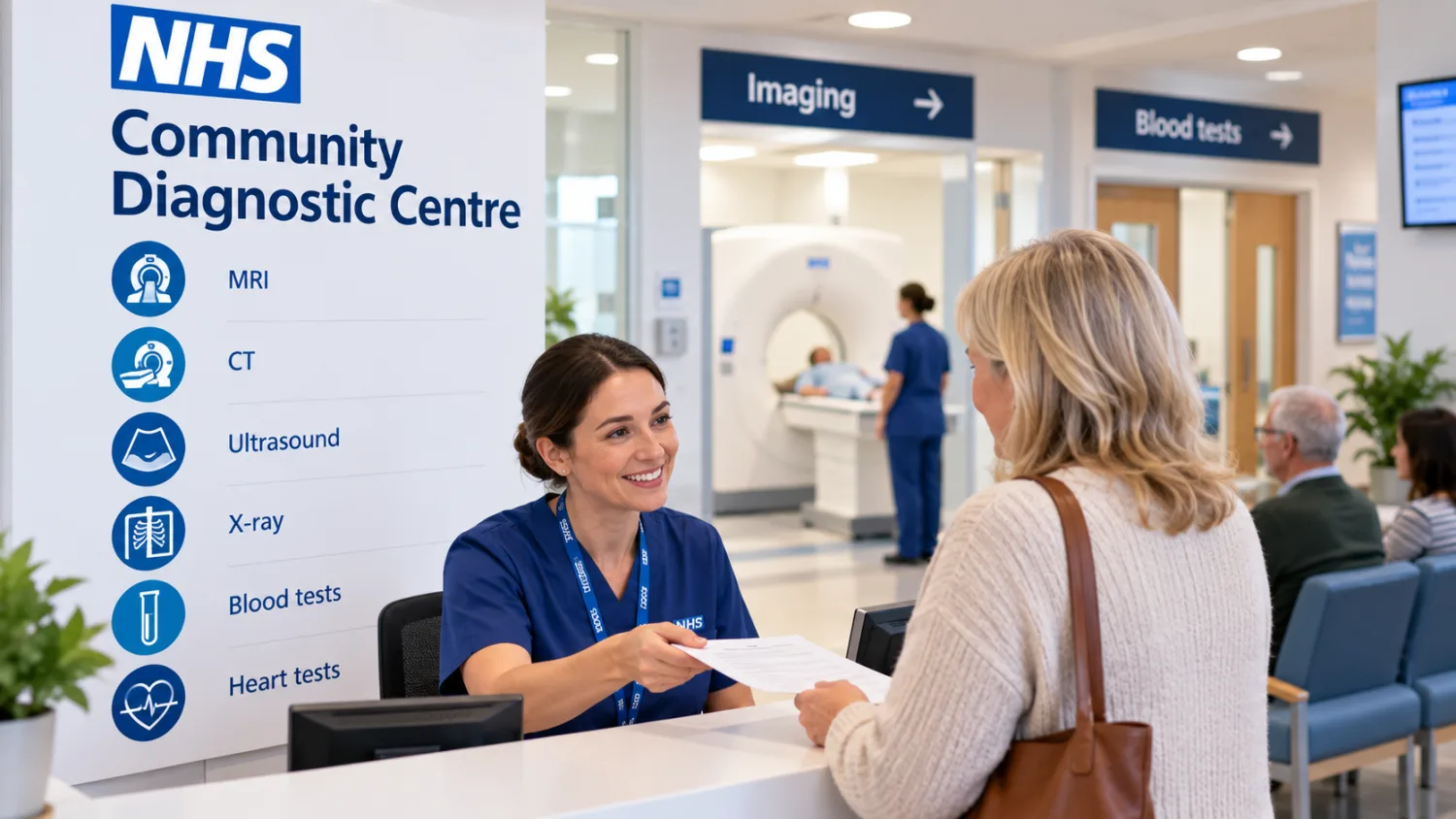
Community Diagnostic Centres are designed to make NHS tests and scans easier to access without sending every patient to a large hospital.
You may find them in community hospitals, health centres, shopping areas, retail parks or other locations away from major acute hospitals.
Depending on the centre, services can include:
- MRI scans;
- CT scans;
- ultrasound;
- X-rays;
- blood tests;
- heart tests;
- lung-function tests;
- DEXA bone-density scans;
- endoscopy;
- hearing tests;
- sleep studies.
The idea is relatively simple: if you need a diagnostic test but do not need hospital treatment at the same time, the test may be carried out somewhere more convenient.
Community Diagnostic Centres — usually shortened to CDCs — have become an increasingly important part of NHS England's strategy for reducing diagnostic waiting lists.
They do not replace hospitals, GPs or urgent-care services. They mainly provide planned diagnostic testing after a healthcare professional has decided that an investigation is needed.
This guide explains how Community Diagnostic Centres work, which tests they offer, how you get referred, what happens after your appointment and whether attending a CDC can shorten your wait.
What Is a Community Diagnostic Centre?
An NHS Community Diagnostic Centre is a facility providing diagnostic tests away from a main acute hospital.
NHS England describes CDCs as centres providing a broad range of elective diagnostics — checks, scans and tests — outside acute hospital facilities.
The programme began in 2021 and has expanded substantially since then.
The centres are intended to:
- increase NHS diagnostic capacity;
- reduce pressure on hospital departments;
- make tests more convenient for patients;
- allow GPs and other clinicians more direct access to investigations;
- help diagnose conditions sooner.
In April 2026, the government announced another £237 million for 36 new, expanded or enhanced CDCs across England.
Four new centres were included in that programme, alongside expansions to 17 existing centres and improvements to another 15.
Many CDCs now operate extended hours, including evenings and weekends.
Some are open around 12 hours a day, seven days a week.
What Tests Can You Have at a CDC?
There is no single list that applies to every centre.
A large CDC may provide a wide range of imaging, heart, respiratory and laboratory tests, while a smaller site may concentrate on a few services.
MRI scans
MRI uses magnetic fields and radio waves to produce detailed images of the body.
It can be used to investigate problems involving areas such as:
- the brain;
- spine;
- joints;
- muscles;
- pelvic organs;
- some abdominal organs.
CT scans
CT uses X-rays to produce detailed cross-sectional images.
CDCs increasingly provide planned CT investigations that previously might have required a hospital visit.
Ultrasound
Ultrasound may be used to examine:
- the abdomen;
- pelvic organs;
- kidneys;
- gallbladder;
- soft tissues;
- some vascular problems.
Cardiology tests
Some centres offer heart investigations such as:
- ECG;
- echocardiography;
- Holter or ambulatory ECG monitoring;
- ambulatory blood-pressure monitoring.
Respiratory tests
Services can include:
- spirometry;
- other lung-function testing;
- sleep studies;
- investigation of suspected respiratory conditions.
Blood tests
Many centres also contain phlebotomy services, allowing blood tests to be completed alongside other investigations.
Some larger CDCs provide DEXA scans, audiology, urology investigations and endoscopy as well.
For example, the Community Diagnostic Centre at Manchester's Withington Community Hospital opened in 2026 with services including MRI, CT, DEXA, ultrasound, cardiology, audiology, respiratory testing, blood tests, sleep studies and urology.
How Do You Get Referred to a Community Diagnostic Centre?
In most cases you cannot simply walk into a CDC and request an MRI or CT scan.
You normally need a referral from a healthcare professional.
This may come from:
- your GP;
- a hospital consultant;
- another appropriate healthcare professional;
- a community healthcare service.
NHS England has increasingly encouraged direct referral from primary care.
This is important because traditionally a GP might have needed to refer a patient to a hospital consultant before certain investigations could be requested.
Under a direct-access pathway, the GP may be able to request the diagnostic test directly.
For example:
GP → ultrasound at CDC → result returned → next clinical decision
may be quicker than:
GP → hospital outpatient appointment → consultant requests ultrasound → second appointment for results.
The exact pathway depends on the test, your symptoms and local NHS arrangements.
Our guide to how NHS hospital referrals work explains the wider referral process.
Can You Choose Which CDC You Attend?
Sometimes, but not always.
You may be offered an appointment at a particular centre because that is where your local NHS organisation provides the requested test.
In other situations, there may be more than one available location.
If your referral is managed through the NHS e-Referral Service, you may be able to book or manage the appointment using the NHS App or the Manage Your Referral service.
Availability depends on:
- your local Integrated Care Board;
- which NHS trust provides the service;
- the investigation requested;
- which centres have the required equipment;
- current waiting lists.
A CDC does not necessarily serve only patients living immediately nearby.
Some centres accept referrals from several surrounding NHS trusts or areas.
What Happens at the Appointment?
For the patient, the experience is usually similar to attending the same diagnostic department in a hospital.
Your appointment letter should explain:
- where to go;
- when to arrive;
- how long the test may take;
- whether preparation is needed;
- whether you can eat or drink beforehand;
- whether you need to temporarily adjust medication.
Preparation depends on the investigation.
For an ultrasound you may be asked to arrive with a full bladder.
For certain CT or MRI examinations you may receive contrast material.
Some tests require no preparation at all.
At the centre, staff confirm your identity and referral before performing the requested test.
You usually do not receive a full medical consultation simply because you attended a CDC.
The centre's role may be to perform the investigation and send the result back to the clinician who requested it.
When and How Do You Get the Results?
This is an important point because many patients understandably expect the person performing the scan to tell them what it shows.
Usually, that is not how the system works.
An imaging scan may need to be interpreted by a radiologist.
Heart or respiratory investigations may also need specialist analysis.
The report is then sent to the healthcare professional or clinical team that requested the investigation.
You may receive the result through:
- your GP;
- a hospital consultant;
- a specialist clinic;
- the NHS App where results are made available;
- a follow-up appointment or telephone call.
Exactly how this happens varies locally.
Before leaving, it is reasonable to ask:
“Who will give me the result, and roughly when should I expect to hear?”
If you have heard nothing after the expected period, contact the clinician who requested the test rather than assuming that no news means the result was normal.
What Is a Straight-to-Test Pathway?
One of the more important developments in the CDC programme is the expansion of straight-to-test pathways.
This means that patients with a particular symptom can sometimes go directly to a planned group of diagnostic tests without first attending a traditional hospital outpatient consultation.
NHS England's elective-care plan required systems to expand direct referral and introduce at least 10 straight-to-test pathways through CDCs by March 2026.
These pathways can vary between areas.
Examples can include investigation for symptoms such as:
- blood in the urine;
- neck lumps;
- some gastrointestinal symptoms;
- respiratory symptoms;
- suspected heart problems.
The aim is to remove unnecessary stages from the diagnostic pathway.
Manchester's Withington CDC, for example, opened with one-stop pathways for haematuria and neck lumps.
Instead of attending several separate appointments, some patients can have more of the necessary investigation organised through one pathway.
Are CDCs Just for Cancer Tests?
No.
Early cancer diagnosis is one important reason for expanding diagnostic capacity, but CDCs investigate a much broader range of conditions.
A patient might be referred because of:
- joint pain;
- abdominal symptoms;
- heart palpitations;
- breathing problems;
- suspected osteoporosis;
- hearing difficulties;
- persistent anaemia;
- urinary symptoms.
However, CDC capacity also supports cancer pathways by making imaging, endoscopy and other investigations more widely available.
In 2025, NHS England carried out almost 30 million key diagnostic tests, and Community Diagnostic Centres have contributed to the growth in capacity.
How Is a CDC Different From A&E or an Urgent Treatment Centre?
A Community Diagnostic Centre is primarily a planned diagnostic service.
It is not somewhere to attend because you suddenly become severely unwell.
| Service | Main purpose |
|---|---|
| Community Diagnostic Centre | Planned scans, tests and investigations |
| GP | Assessment, diagnosis, treatment and referral |
| Urgent Treatment Centre | Urgent but generally non-life-threatening problems |
| A&E | Serious injuries and medical emergencies |
If you develop severe chest pain, stroke symptoms, serious breathing difficulty or another medical emergency, you should not travel to your local CDC hoping to get a scan.
Use the appropriate emergency service.
Our guide to Urgent Treatment Centres vs A&E explains where different urgent problems should be taken.
If you are uncertain how urgently you need help, see our guide to NHS 111 and when to use 999 instead.
Do Community Diagnostic Centres Reduce NHS Waiting Times?
That is one of their main purposes.
The logic is that diagnostic capacity is often a bottleneck.
A hospital may have enough specialists to assess patients but too few MRI scanners, ultrasound appointments or endoscopy slots.
Building additional diagnostic capacity away from acute hospitals allows more planned tests to be performed without competing as heavily with emergency hospital demand.
There are other advantages too.
Hospital imaging departments frequently need to prioritise:
- A&E patients;
- inpatients;
- urgent cancer investigations;
- emergency scans.
A CDC primarily performing elective diagnostics is less exposed to those pressures.
However, having CDCs does not mean every test will happen immediately.
Waiting times still depend on:
- local demand;
- staffing;
- the type of test;
- equipment capacity;
- clinical urgency;
- availability in your area.
NHS England continues to publish national diagnostic waiting-time statistics, so diagnostic backlogs have not disappeared.
CDCs are additional capacity rather than a guarantee of an appointment within a particular number of days.
Are Community Diagnostic Centres Only in England?
The large national Community Diagnostic Centre programme described in this article is an NHS England programme.
Scotland, Wales and Northern Ireland organise diagnostic services through their own health systems and may use community hospitals, diagnostic hubs and similar services, but the structure and terminology are not necessarily the same.
This distinction matters when reading national waiting-time or referral information online.
If you live in England and are waiting for an investigation, your GP or referring hospital can tell you whether a Community Diagnostic Centre is available for that particular test locally.
Frequently Asked Questions
What is an NHS Community Diagnostic Centre?
It is a facility providing planned NHS tests, scans and checks away from a major acute hospital. CDCs are intended to increase diagnostic capacity and make testing more convenient.
Do you have to pay to use a Community Diagnostic Centre?
No. If you are referred through the NHS, the diagnostic test is NHS care and you do not pay for it.
Can I walk into a CDC without a referral?
Usually not for diagnostic imaging or specialist tests. Most services require a referral from a GP, hospital clinician or another appropriate healthcare professional.
Can my GP refer me directly?
For many tests, yes. NHS England has expanded direct-access diagnostic pathways so that GPs can increasingly refer patients to CDCs without a preliminary hospital consultant appointment.
Can I request an MRI at a CDC?
You can discuss whether an MRI is appropriate with your GP or specialist, but the scan generally needs to be clinically requested rather than self-booked.
Do all CDCs offer MRI and CT?
No. Services vary between centres. Larger sites may provide MRI, CT, ultrasound, cardiology and respiratory testing, while smaller sites may offer a more limited range.
Do CDCs do blood tests?
Many do, although this varies locally.
Do CDCs provide endoscopy?
Some do. Endoscopy services can include gastroscopy, colonoscopy or other investigations, but they are not available at every centre.
Are Community Diagnostic Centres open at weekends?
Many have extended opening hours and some operate seven days a week. NHS England has been expanding the model towards 12-hour daily opening, but individual centres have their own schedules.
Will a doctor tell me my scan result at the CDC?
Usually not immediately. The test is generally analysed and the report returned to the clinician who referred you, who is then responsible for discussing the result and next steps.
How quickly do CDC results come back?
It varies by test, centre and urgency. Ask the centre or referring clinician how and when you should expect the result.
Can a CDC diagnose cancer?
Investigations performed at a CDC can contribute to diagnosing or ruling out cancer, but the centre is part of a wider clinical pathway. A scan or test result may lead to further specialist assessment.
Is a CDC the same as a walk-in centre?
No. Community Diagnostic Centres primarily provide pre-arranged diagnostic investigations. Walk-in and urgent-care services assess people who need clinical treatment or advice.
Can I go to a CDC instead of A&E?
No. CDCs are not emergency departments. Serious or life-threatening symptoms should be managed through 999 or A&E as appropriate.
Can a Community Diagnostic Centre reduce my waiting time?
It may. CDCs add diagnostic capacity and can allow some patients to avoid unnecessary hospital outpatient stages, but actual waiting times still vary by area and test.
Can I ask my GP whether there is a CDC near me?
Yes. Your GP practice can tell you which local diagnostic services it can refer into and whether a CDC is an option for the investigation you need.
What happens if the scan finds something abnormal?
The result normally goes back to the clinician who requested it. They can then arrange treatment, further tests or referral to an appropriate specialist.
Is going private faster than using a CDC?
Private testing may sometimes offer an earlier appointment, but this varies considerably by area and investigation. A CDC is NHS care and does not require payment. Our guide to NHS vs private healthcare explains the wider differences in costs, access and waiting times.