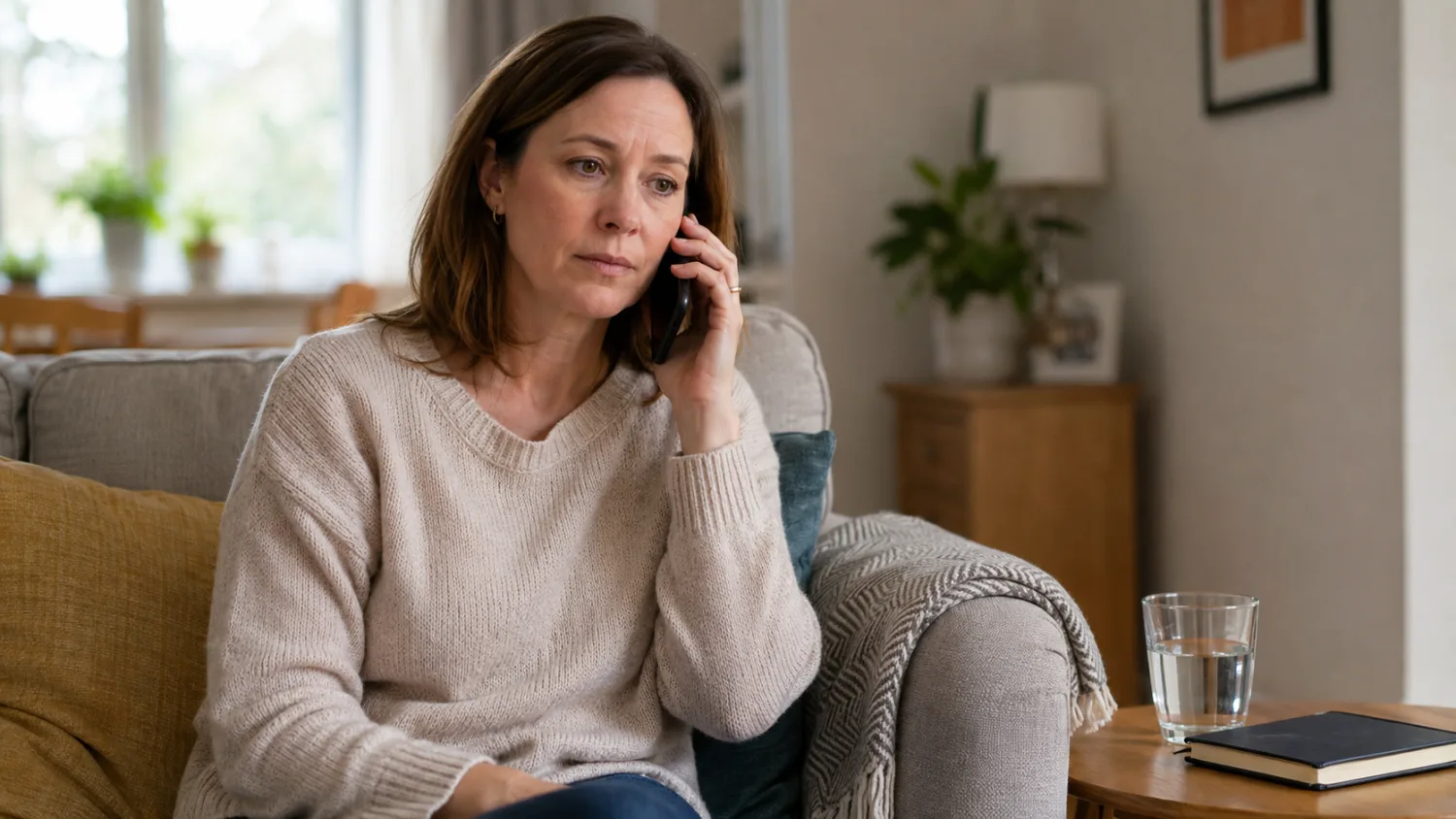
NHS 111 helps you get urgent medical advice when a problem is not immediately life-threatening and you are unsure what to do next. It can help you decide whether you need a pharmacist, GP, urgent treatment service, emergency department or care at home.
Call 999 for a life-threatening emergency. Do not contact 111 first if someone has signs of a heart attack or stroke, severe breathing difficulties, uncontrolled bleeding, or is unconscious and not breathing normally.
The 111 telephone service is free and available around the clock in England, Scotland and Wales, although each country runs its own service. Northern Ireland uses different urgent-care arrangements. England also has NHS 111 online for symptom assessment in people aged five and over.
This guide explains when to use 111, what happens when you contact it, and how to choose between urgent advice, your usual healthcare team and emergency help.
1. What is NHS 111?
NHS 111 is an urgent healthcare assessment and advice service. Its main purpose is to help identify how urgently you need care and direct you to an appropriate service.
Depending on your situation and local availability, the next step could include:
- advice about looking after yourself at home;
- help from a community pharmacist;
- contact with a GP or out-of-hours clinician;
- assessment at an urgent treatment centre or minor injuries service;
- urgent dental or mental health support;
- attendance at an emergency department;
- an emergency ambulance if the assessment identifies that need.
Contacting 111 does not automatically mean you will speak to a doctor, receive a prescription or get a face-to-face appointment. The outcome depends on the assessment. The North West Ambulance Service explains how NHS 111 directs people to care.
2. When should you use 111?
Use 111 when you need urgent advice and are uncertain about the appropriate next step. For example, you may have a new illness, an injury or worsening symptoms that you do not think should wait until your usual service is available.
It can be particularly useful when:
- you think you need urgent care but do not know where to go;
- your GP surgery is closed and the problem cannot wait;
- you are away from home or do not have a GP to contact;
- you need urgent help with a medicine;
- you are worried about someone’s symptoms and need guidance.
You do not need to know the diagnosis before asking for help. Explain what is happening, when it began and what concerns you. London Ambulance Service’s guidance on using 111 gives further examples.
If your GP surgery is open, it may be able to assess an urgent problem directly. Our guide to getting a GP appointment quickly explains how to describe your needs when contacting the practice.
3. When should you call 999 instead?
Call 999 immediately when someone may have a life-threatening illness or injury. You do not need permission from 111 to call an ambulance.
Examples include:
- suspected heart attack, such as chest pressure or tightness with sweating, breathlessness or pain spreading to the arm or jaw;
- stroke symptoms, including sudden facial drooping, arm weakness or difficulty speaking;
- severe breathing difficulty, choking or inability to speak because of breathlessness;
- unconsciousness or abnormal breathing;
- severe bleeding that will not stop;
- a severe allergic reaction with throat swelling or breathing problems;
- a serious injury or immediate danger to life.
These are examples, not a complete checklist. Follow the call handler’s instructions, including any first-aid guidance. See the NHS guidance on when to call 999.
Our guides to chest pain, stroke and TIA symptoms and severe breathlessness explain important warning signs. Do not delay emergency help to read an article.
4. How does 111 differ across the UK?
The number and service name may sound similar, but online access and local referral arrangements are not identical.
| Country | Urgent advice route | Important distinction |
|---|---|---|
| England | Call 111 or use 111.nhs.uk | Online symptom assessment is for people aged five and over |
| Scotland | Call NHS 24 on 111 | Use Scottish NHS information and local pathways |
| Wales | Call NHS 111 Wales on 111 | NHS 111 Wales has its own website and advice services |
| Northern Ireland | Contact your GP, GP out-of-hours service or local Phone First service | Do not assume England’s 111 service or website applies |
In Scotland, NHS 24 explains when to phone 111, including when you think you need A&E but the situation is not life- or limb-threatening, or need urgent help when your usual service is unavailable.
In Wales, NHS 111 Wales provides round-the-clock telephone advice alongside online health information.
In Northern Ireland, Phone First numbers, opening hours and participating services vary by area. Check nidirect’s urgent and emergency care guidance and its GP out-of-hours information.
999 is the emergency number throughout the UK.
5. Should you call 111 or use the online service?
In England, NHS 111 online asks questions about your symptoms and recommends an appropriate next step. It is a triage service, not a diagnosis, and is available for symptom assessment from age five.
It can be convenient when you can describe one main problem clearly. However, the NHS advises phoning instead when:
- the person needing symptom assessment is under five;
- there are complex problems related to an existing condition;
- you have a care plan for the current problem;
- you need help with end-of-life care.
See the NHS guide to choosing between online and telephone help.
Online assessment may result in advice, referral or an offer of a clinical callback. It is not a way to request a callback on demand or move ahead of telephone users in the clinical callback queue. The NHS explains this in how NHS 111 online works.
If a question does not fit your situation or you cannot explain an important detail, use the telephone service rather than guessing an answer.
6. What happens when you call, and what should you have ready?
A trained health adviser or clinician will ask questions to assess the situation. These may feel repetitive, but their purpose is to identify urgency and suitable care.
Be ready to explain:
- who needs help and their age;
- where they are now, including the address or postcode;
- the main symptoms and when they started;
- whether symptoms are getting worse;
- relevant conditions, medicines and allergies;
- whether pregnancy is possible;
- any recent operation, hospital treatment or existing care plan.
Have a reliable callback number available. A medication list, inhalers or medicine packaging may help you answer accurately, but do not delay urgent contact while searching for paperwork.
If you are calling for someone else, being with them helps you describe their condition and lets the adviser speak to them if appropriate. If you are not together, make that clear and provide their actual location.
Before the call ends, check that you understand where to go, how urgently to act and what changes should prompt further help.
7. What should you do while waiting for a callback?
Clinical callback priority depends on the symptoms reported, not simply the order people contacted the service. Waiting times vary, particularly during busy periods.
While waiting:
- keep your phone charged and nearby;
- make sure you can hear or receive incoming calls;
- follow the advice already given;
- monitor the person for new or worsening symptoms;
- keep a note of any important changes.
If symptoms worsen, contact 111 again so the urgency can be reassessed. If the situation becomes life-threatening, call 999 immediately rather than waiting for the callback.
Follow the service’s instructions about missed calls or delays. Repeatedly submitting the same unchanged problem online is not a reliable way to get an earlier clinical review.
Being advised to wait is not a guarantee that symptoms cannot become serious. Equally, advice to attend an urgent service should not be postponed simply because the person temporarily feels a little better.
8. Can you use 111 for babies and children?
Yes. Parents and carers can call for advice about a child. In England, phone 111 for a child under five rather than using the online symptom checker.
Describe how the child is behaving as well as the symptoms. Feeding, drinking, wet nappies or urination, breathing and responsiveness can all be important.
A baby under three months with a temperature of 38°C or above needs urgent medical advice. Do not wait for the temperature to rise further. The NHS guidance on fever in children explains age-specific warning signs.
Call 999 for emergency features such as severe breathing difficulty, blue or grey colouring, or a child who will not wake up. Trust your concern if the child seems seriously unwell: the NHS guide to urgent help for under-fives provides further advice.
For general information, see our guides to fever in children and dehydration symptoms.
9. Can 111 help with mental health, dental problems and medicines?
Urgent mental health support
In England, call 111 and select the mental health option for urgent support. You can call about yourself or someone you are worried about. See the NHS urgent mental health guidance.
In Wales, call 111 and press option 2. In Scotland, NHS 24’s 111 service also provides access to urgent mental health support. Northern Ireland has its own services, including Lifeline on 0808 808 8000.
If someone has seriously harmed themselves, taken an overdose or is in immediate danger, call 999 or seek emergency care. Do not wait for a routine mental health appointment.
Our guide to UK mental health support options explains longer-term routes.
Urgent dental problems
If you need urgent dental care and cannot reach a dentist, 111 can help identify the appropriate local route where the service operates. It cannot guarantee an available appointment or replace treatment by a dentist.
Severe swelling affecting breathing or swallowing requires emergency help. Read our guide to what counts as a dental emergency.
Running out of regular medicine
In England, the 111 online emergency prescription service can request a limited supply when you have completely run out of a regularly prescribed medicine. This is separate from the symptom checker and can be used for someone of any age.
The service sends a request for assessment; it does not guarantee a supply or issue a new prescription itself. Normal prescription charges may apply unless you are exempt. It is not a replacement for ordering routine repeats or a way to obtain antibiotics for a new illness without assessment.
10. When is a GP or pharmacist more appropriate?
NHS 111 is not intended to manage every healthcare task. Your regular practice or pharmacy is often better placed to help with ongoing care and routine requests.
| Situation | Usual starting point |
|---|---|
| A mild common illness or question about using medicine | Community pharmacist |
| Persistent symptoms or a routine review of a long-term condition | GP or usual clinical team |
| Routine repeat prescription, fit note or test-result enquiry | The practice or service responsible |
| Urgent symptoms and uncertainty about where to get help | 111 or the equivalent local urgent-care route |
| A life-threatening emergency | 999 |
Pharmacists can advise on many common illnesses, check medicines and identify when you need another service. Some can provide treatment for selected conditions under local NHS schemes. Services and eligibility differ across the UK. See the NHS guide to pharmacy support.
If you are not registered with a GP, our guide explains how GP registration works. Do not delay urgent help while arranging registration.
11. What if you need an interpreter or accessible support?
If you need help in another language, call 111 and ask for an interpreter. Tell the adviser your language and that you need support communicating.
For England’s service, accessible options include:
- Text relay: use Relay UK or a textphone to contact 18001 111;
- British Sign Language: use the NHS 111 BSL video interpreting service;
- Support from another person: someone can help you make the call and explain your communication needs.
Official details are available through other ways to contact NHS 111. Check the NHS 24 or NHS 111 Wales website for the relevant country’s accessible contact arrangements.
Tell the adviser about hearing loss, a learning disability, difficulty speaking or any other need that affects the assessment. Ask them to repeat or explain instructions if you are unsure.
12. Frequently asked questions
Is NHS 111 free?
Yes. Calls to 111 are free. However, being referred through 111 does not remove normal charges that may apply to prescriptions or dental treatment.
Is 111 open at night and on bank holidays?
Yes. The telephone services in England, Scotland and Wales operate 24 hours a day, including weekends and bank holidays.
Will I speak to a doctor immediately?
Not necessarily. A trained adviser may assess you first, with clinical advice or a callback arranged when appropriate.
Can 111 send an ambulance?
Yes, if its assessment identifies that an emergency ambulance is needed. However, call 999 directly when you already recognise a life-threatening emergency.
Can 111 book an appointment?
It may arrange an appointment or referral where local services allow. This is not guaranteed and depends on clinical need and availability.
Does a 111 referral let me skip the A&E queue?
No. Emergency departments assess and prioritise patients according to clinical urgency. A referral is not a guarantee of immediate treatment.
Can I call for someone else?
Yes. It helps to be with them, but if you are not, explain that and give their location and the information you have.
Should I contact 111 again if I get worse?
Yes. New or worsening symptoms may change the urgency of the assessment. Call 999 instead if a life-threatening emergency develops.
Can I use 111 online anywhere in the UK?
No. The symptom assessment at 111.nhs.uk is for England. Scotland, Wales and Northern Ireland have their own information and urgent-care arrangements.
What is the simplest way to remember when to use it?
Use 111 for urgent advice when you are unsure what to do; call 999 for a life-threatening emergency. For routine care, start with your GP, pharmacist or usual clinical team.