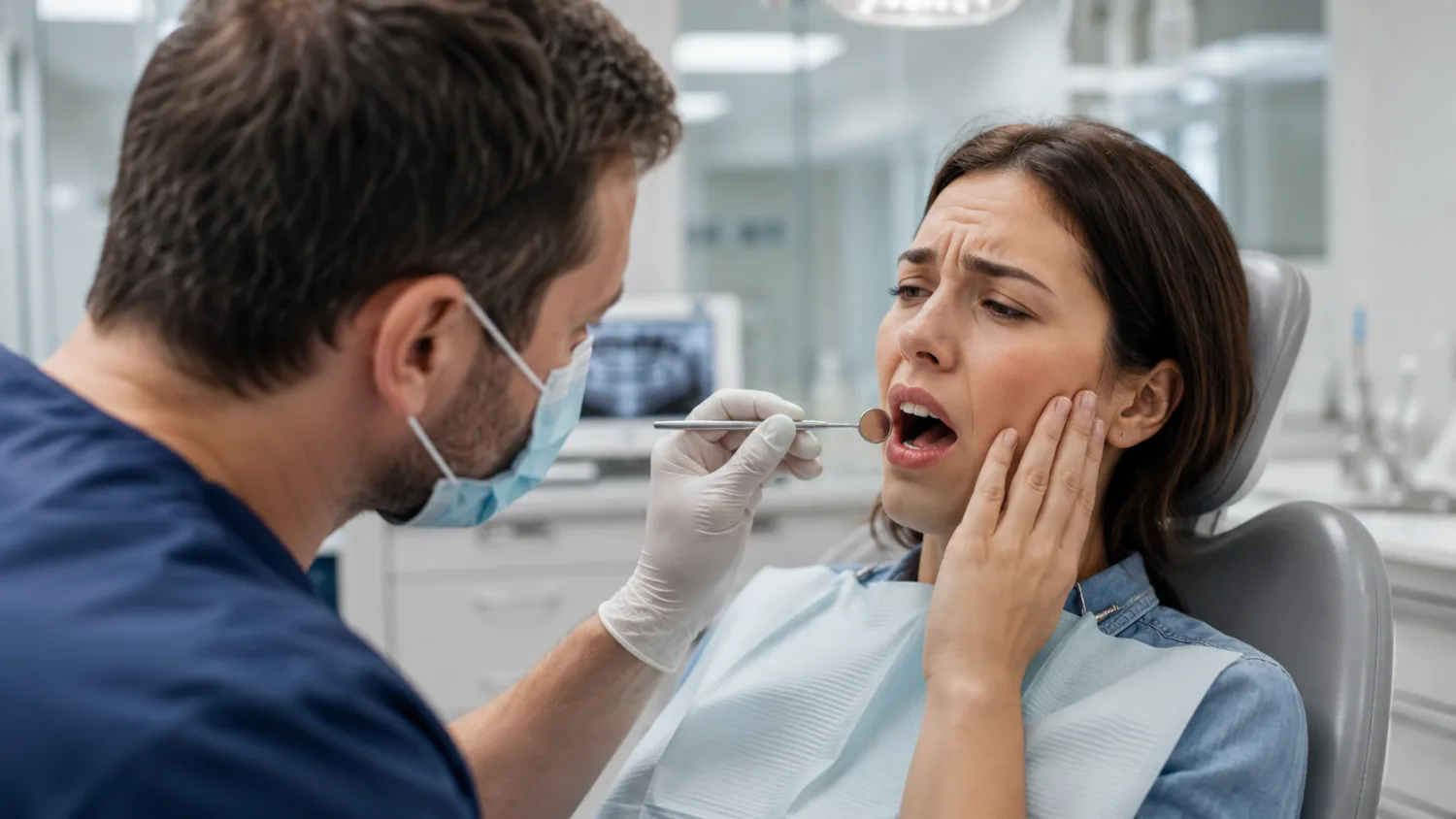
A dental emergency is any tooth, gum, mouth or jaw problem that needs urgent attention because of severe pain, infection, bleeding, injury, swelling or risk of losing a tooth. Some dental problems can wait for a routine appointment. Others need same-day advice. A few are true medical emergencies where you should go to A&E or call 999.
The difficulty is that dental symptoms can be confusing. A broken tooth may look dramatic but not need A&E. A dental abscess may seem like “just toothache” at first but can become serious if swelling spreads. A knocked-out adult tooth may be saved if action is taken quickly. Knowing where to go — dentist, NHS 111, pharmacy, GP, A&E or 999 — can make a major difference.
This guide explains what counts as a dental emergency, what to do in the most common situations, when to contact a dentist, when to use NHS 111, and when symptoms need emergency medical care.
For related symptoms, see our guides to toothache causes, relief and when to see a dentist, dental abscess symptoms and treatment, tooth decay explained, bleeding gums and gum disease, and sensitive teeth. To find local dental care, use our UK dentist directory or search dentists near me.
What counts as a dental emergency?
A dental emergency is not always about the amount of pain. Pain matters, but urgency also depends on swelling, infection, trauma, bleeding, whether an adult tooth has been knocked out, and whether breathing or swallowing is affected.
Common dental emergencies include:
- severe toothache that is not controlled with usual pain relief;
- facial, jaw, gum or neck swelling linked to a dental problem;
- a dental abscess with pus, fever, swelling or feeling unwell;
- a knocked-out adult tooth;
- a broken tooth causing severe pain or sharp injury to the mouth;
- bleeding after dental treatment that does not stop;
- injury to the teeth, lips, tongue, jaw or face;
- painful swelling around a wisdom tooth;
- a lost crown or filling causing significant pain;
- signs that a dental infection may be spreading.
Some problems are urgent but not usually life-threatening. Others need emergency medical care. The NHS advises going to A&E if toothache is associated with swelling around the eye or neck, or swelling in the mouth or neck that makes it difficult to breathe, swallow or speak. See the NHS toothache emergency advice.
Where should you go for a dental emergency?
For most urgent dental problems, the first step is to contact a dentist. If you are registered with a dental practice, call them and explain your symptoms clearly. Many practices set aside urgent appointments or can advise what to do next.
If you do not have a dentist, cannot contact one, or need help out of hours, use NHS 111 online or call 111. The NHS says you can call 111 or get help from 111 online if you need urgent dental treatment, and you should be offered urgent dental treatment within 24 hours or 7 days depending on symptoms. A knocked-out adult tooth should be offered emergency dental care within 1 hour or as soon as possible. Read the NHS guidance on emergency and urgent dentist appointments.
A GP is usually not the right place for dental emergencies. GPs cannot provide fillings, extractions, root canal treatment, dental X-rays, abscess drainage or urgent dental repair. A pharmacist may advise on pain relief or medicines, but they cannot treat the source of a dental infection or repair a tooth.
When to call 999 or go to A&E
Most dental problems are handled by dentists or urgent dental services. But some symptoms suggest a spreading infection, airway risk, serious injury or uncontrolled bleeding. These need emergency medical care.
Call 999 or go to A&E if you have:
- difficulty breathing;
- difficulty swallowing saliva;
- difficulty speaking because of swelling;
- swelling in the mouth or neck affecting breathing or swallowing;
- swelling spreading to the neck;
- swelling around the eye;
- severe facial injury or suspected broken jaw;
- heavy bleeding that will not stop;
- confusion, extreme weakness, fainting or signs of severe infection;
- a dental infection with rapidly worsening swelling or feeling seriously unwell.
If breathing, swallowing or spreading neck swelling is involved, do not wait for a routine dental appointment.
Dental emergency quick guide
| Problem | How urgent is it? | What to do |
|---|---|---|
| Severe toothache | Urgent dental problem | Call your dentist. If unavailable, use NHS 111. Go to A&E if swelling affects breathing, swallowing, speech, eye or neck. |
| Dental abscess with swelling or fever | Urgent, sometimes emergency | Seek urgent dental advice. Use NHS 111 if needed. A&E/999 if swelling spreads or breathing/swallowing is affected. |
| Knocked-out adult tooth | Emergency dental care | Put it back in if possible, or place in milk. Contact a dentist or NHS 111 immediately. |
| Knocked-out baby tooth | Urgent dental advice | Do not put it back in. Contact a dentist for advice. |
| Broken tooth with severe pain | Urgent dental problem | Save any pieces if possible, avoid chewing on it, contact a dentist urgently. |
| Small chip with no pain | Usually non-emergency | Book a routine dental appointment unless sharp edges are cutting the mouth. |
| Lost filling or crown | Urgency depends on pain | Book a dentist soon. Seek urgent advice if severe pain, swelling or exposed nerve-like pain. |
| Bleeding after extraction | Urgent if it does not stop | Bite on clean gauze or cloth. Contact dentist urgently if bleeding continues. |
| Jaw injury or suspected broken jaw | Emergency medical problem | Go to A&E or call 999, especially after trauma. |
Severe toothache: what to do
Severe toothache is one of the most common reasons people seek emergency dental care. It may be caused by deep decay, nerve inflammation, a cracked tooth, a dental abscess, gum infection, a wisdom tooth problem or trauma.
You should seek urgent dental advice if toothache:
- is severe or throbbing;
- wakes you at night;
- does not improve with usual pain relief;
- comes with swelling;
- comes with fever or feeling unwell;
- is linked with pus or a bad taste;
- makes it difficult to eat, sleep or open your mouth;
- starts after dental injury.
While waiting for care, use pain relief safely according to the packet instructions, avoid chewing on the painful side, and keep the area clean. Do not place aspirin directly on the gum, and do not take leftover antibiotics. Toothache caused by decay, infection or a crack usually needs dental treatment, not just painkillers.
For a deeper explanation of dental pain patterns, see toothache causes, relief and when to see a dentist.
Dental abscess: when it becomes urgent
A dental abscess is a pocket of pus caused by bacterial infection. It may cause intense toothache, gum pain, swelling, pus, bad taste, fever, swollen glands or difficulty opening the mouth. The NHS lists symptoms including intense toothache or gum pain, redness, sensitivity, bad taste, difficulty opening the mouth, swollen face or jaw, swollen glands and high temperature. Read the NHS dental abscess guide.
A dental abscess needs urgent dental treatment. Antibiotics alone are not usually enough because the source of infection often needs dental treatment such as drainage, root canal treatment, gum treatment or extraction.
Seek urgent dental help if you have:
- toothache with gum, jaw or facial swelling;
- pus or a bad taste from the gum;
- fever or feeling generally unwell;
- swollen glands with dental pain;
- difficulty opening the mouth;
- pain spreading to the ear, jaw or neck;
- symptoms that are worsening.
Call 999 or go to A&E if swelling affects breathing, swallowing or speech, spreads to the neck, or involves the eye area.
For a full guide, read dental abscess symptoms and treatment.
Knocked-out adult tooth: what to do immediately
A knocked-out adult tooth is one of the clearest dental emergencies. Fast action can improve the chance of saving the tooth.
The NHS says a knocked-out tooth can usually be saved by putting it back in place or placing it in milk as soon as possible before seeing a dentist. It also says you should never put a baby tooth back in. See the NHS knocked-out tooth advice.
If an adult tooth is knocked out:
- Stay calm and find the tooth.
- Hold it by the crown — the white part normally visible in the mouth. Do not touch the root.
- If dirty, rinse briefly with milk or cold running water. Do not scrub it.
- Try to put it back into the socket if the person is conscious and able to cooperate.
- Bite gently on a clean cloth or tissue to hold it in place.
- If you cannot put it back, place it in milk. If milk is not available, keep it in the person’s saliva by holding it inside the cheek, but only if they are old enough and alert enough not to swallow it.
- Contact a dentist or NHS 111 immediately.
Do not wrap the tooth in dry tissue. Do not scrub the root. Do not store it in plain water for long. Do not put a knocked-out baby tooth back in, because this can damage the developing adult tooth underneath.
Broken, chipped or cracked tooth
A broken tooth can be urgent or non-urgent depending on pain, bleeding, sharp edges, the amount of tooth lost and whether the nerve is exposed.
Seek urgent dental advice if:
- the tooth is very painful;
- a large piece has broken off;
- the tooth is bleeding from inside;
- the tooth is loose after injury;
- there is swelling or pus;
- you cannot bite normally;
- a sharp edge is cutting the tongue or cheek;
- the broken tooth follows facial trauma.
If the chip is small and there is no pain, it may be safe to wait for a routine appointment. NHS Inform says if a tooth is just chipped, you should make an appointment to see a dentist to fill or smooth it down, and this is not usually an emergency. Read NHS Inform guidance on broken or knocked-out teeth.
While waiting, avoid chewing on that side. If there is a sharp edge, orthodontic wax from a pharmacy may help protect the cheek or tongue temporarily. Do not try to file the tooth yourself.
Lost filling or lost crown
A lost filling or crown is not always an emergency, but it should be dealt with soon. The exposed tooth may be sensitive, weak or vulnerable to decay. Food can get trapped, and the tooth may break further.
Book a dental appointment if a filling or crown comes out. Seek urgent advice if there is severe pain, swelling, bad taste, pus, fever, or if the tooth has broken significantly.
If you still have the crown, keep it safe and bring it to the appointment. Do not use household glue to stick it back. Temporary dental repair kits from a pharmacy may sometimes help for a short period, but they are not a replacement for dental treatment.
Bleeding after tooth extraction or dental treatment
Some oozing after extraction is normal. Heavy bleeding, bleeding that restarts repeatedly, or bleeding that does not stop with pressure needs urgent advice.
If bleeding occurs after an extraction:
- Place clean gauze, a clean handkerchief or clean cloth over the socket.
- Bite down firmly and continuously for 20 to 30 minutes.
- Sit upright and avoid rinsing, spitting or drinking hot drinks.
- Avoid smoking or alcohol.
- If bleeding continues, contact the dentist or urgent dental service.
If bleeding is heavy, you feel faint, or it will not stop despite firm pressure, seek urgent medical advice.
Swollen face, jaw or gum
Swelling linked to dental pain can be a sign of infection. A small local gum swelling may need urgent dental care. Facial swelling, swelling under the jaw, swelling spreading into the neck, or swelling near the eye is more concerning.
Contact a dentist urgently or use NHS 111 if you have dental swelling with:
- toothache or gum pain;
- pus or bad taste;
- fever;
- swollen glands;
- difficulty opening your mouth;
- pain when chewing or swallowing;
- worsening symptoms.
Go to A&E or call 999 if swelling affects breathing, swallowing or speech, spreads to the neck, or involves the area around the eye.
Wisdom tooth emergencies
Wisdom teeth can become painful when they partly erupt through the gum and trap bacteria and food. This can cause inflammation or infection around the gum flap, sometimes called pericoronitis.
Seek dental advice if you have:
- pain at the back of the mouth;
- swelling around a wisdom tooth;
- bad taste or pus;
- pain when swallowing;
- difficulty opening your mouth;
- jaw stiffness;
- fever or feeling unwell.
Gentle cleaning and warm salt-water rinses may help mild irritation, but worsening pain, swelling, fever or difficulty opening the mouth needs urgent dental advice.
Dental trauma and facial injury
Dental trauma can involve chipped, broken, displaced or knocked-out teeth, cuts to the lips or tongue, jaw injury, or facial fractures. The right place to go depends on the injury.
Use urgent dental care for tooth injuries such as knocked-out, broken, loose or displaced teeth when there is no major facial injury. Go to A&E or call 999 if there is heavy bleeding, suspected broken jaw, loss of consciousness, severe facial injury, difficulty breathing, or injury after a serious accident.
If a tooth has moved position but not come out, do not force it back unless advised. Contact a dentist urgently.
Objects stuck between teeth
Food or objects stuck between teeth can cause pain, gum swelling and bleeding. Try gentle flossing or interdental brushing. Do not use pins, knives, needles or sharp tools, as these can damage the gum or tooth.
If the object will not come out, or the area becomes painful or swollen, book a dental appointment. Seek urgent advice if swelling, pus or severe pain develops.
Mouth ulcers, cuts and soft tissue injuries
Small mouth ulcers and minor cuts often heal on their own. However, some mouth problems need dental or medical review.
Seek advice if:
- a mouth ulcer lasts more than 3 weeks;
- an ulcer is unusually large or painful;
- you have repeated unexplained ulcers;
- a cut will not stop bleeding;
- there is swelling, pus or fever;
- you have a lump, red patch or white patch that does not heal;
- you have injury from a fall, assault or accident.
A dentist can check whether a sharp tooth, broken filling or denture is causing repeated trauma.
Braces, retainers and orthodontic emergencies
Most orthodontic problems are uncomfortable rather than dangerous. A loose bracket, broken wire or lost retainer should be handled by your orthodontist or dentist.
Temporary steps may include using orthodontic wax to cover a sharp wire, avoiding hard foods, and contacting the orthodontic practice. Do not cut wires yourself unless you have been clearly advised how to do so and it is safe. Seek urgent care if a wire is embedded in the cheek, there is significant injury, or you cannot close your mouth normally.
Denture problems
Broken dentures, sore spots and loose dentures can be painful and may affect eating. They are usually not emergencies unless they cause cuts, ulcers, infection, choking risk or severe inability to eat or drink.
Do not try to repair dentures with household glue, as it can be toxic and may damage the denture. Contact a dentist or dental technician service for repair advice.
What can you do at home while waiting for emergency dental care?
Home care can help you manage symptoms while waiting, but it should not replace dental treatment when the problem is urgent.
Use pain relief safely
Paracetamol or ibuprofen may help some dental pain. Follow the packet instructions and do not exceed the recommended dose. Ibuprofen is not suitable for everyone, including some people with stomach ulcers, kidney disease, certain heart conditions, those taking blood-thinning medication, or some people who are pregnant. Ask a pharmacist if you are unsure.
Use warm salt-water rinses for gum irritation
A warm salt-water rinse may help soothe gums and clear debris. Mix half a teaspoon of salt in a mug of warm water, rinse gently, and spit it out. Do not swallow salty water, and do not use very hot water.
Use a cold compress for swelling or injury
Apply a cold compress to the outside of the cheek for short periods. Wrap ice or a cold pack in a cloth. Do not apply ice directly to the skin.
Avoid chewing on the painful side
Stick to softer foods and avoid biting on a broken, loose or painful tooth. Avoid hard foods such as nuts, crusty bread, boiled sweets and ice.
Keep the area clean
Brush gently with fluoride toothpaste. If cleaning between the teeth is possible without severe pain, do so carefully. Do not poke swollen gums or try to drain abscesses yourself.
What not to do in a dental emergency
- Do not put aspirin directly on the gum or tooth. It can burn the soft tissue.
- Do not take leftover antibiotics. They may be unsuitable and can delay proper treatment.
- Do not try to drain an abscess yourself. This can spread infection.
- Do not pull your own tooth. This can cause serious injury, bleeding or infection.
- Do not use household glue on crowns, dentures or broken teeth.
- Do not ignore facial or neck swelling. It can be a sign of spreading infection.
- Do not put a knocked-out baby tooth back in. It can damage the adult tooth underneath.
- Do not wrap a knocked-out adult tooth in dry tissue. Keep it moist and seek emergency dental care.
Can a pharmacist help with a dental emergency?
A pharmacist can help with safe pain relief, medication advice, mouth ulcer products, temporary dental repair kits and whether a medicine is suitable for you. This can be useful while waiting for dental care.
However, a pharmacist cannot diagnose the dental cause, take X-rays, drain an abscess, repair a broken tooth, extract a tooth, provide root canal treatment or replace a lost filling permanently. If there is severe pain, swelling, pus, trauma or a knocked-out tooth, you need dental or emergency medical care.
Can a GP help with a dental emergency?
Usually no. A GP is not normally the right professional for urgent dental problems. They cannot provide dental treatment such as fillings, extractions, root canal treatment, drainage or repair of broken teeth. For urgent dental problems, contact a dentist or NHS 111.
GP or emergency medical care may be needed if symptoms suggest a wider medical problem, such as severe infection, uncontrolled bleeding, significant facial injury or swelling affecting breathing or swallowing.
NHS or private emergency dentist?
If you are registered with an NHS dentist, call your practice first. If you do not have a dentist, cannot get through, or need out-of-hours care, use NHS 111. NHS urgent dental access varies by area, and some people choose private urgent dental care if they cannot get an NHS appointment quickly or want more flexibility.
If booking privately, ask before attending:
- what the emergency consultation fee is;
- whether X-rays are included;
- whether treatment is temporary or definitive;
- the likely cost of extraction, drainage, filling or root canal treatment;
- whether follow-up is included;
- what happens if you need referral to a specialist or hospital.
You can search for local dental services through our dentist directory, use dentists near me, or browse top-rated dentist pages where available.
How to prepare when calling for urgent dental care
When you call a dentist or NHS 111, clear information helps them judge urgency. Be ready to explain:
- where the pain or problem is;
- when it started;
- whether pain is mild, moderate or severe;
- whether there is swelling, pus, fever or bad taste;
- whether you can open your mouth normally;
- whether you can swallow and breathe normally;
- whether a tooth is broken, loose, displaced or knocked out;
- whether there has been an injury or accident;
- what pain relief you have taken and when;
- your medical conditions, allergies and regular medicines;
- whether you are pregnant;
- whether you take blood thinners or have a bleeding condition.
If symptoms are worsening quickly, say so clearly. If breathing or swallowing is affected, do not wait on a routine callback — call 999.
How to prevent dental emergencies
Not every emergency can be prevented. Accidents happen. Teeth crack. Wisdom teeth flare up. But many urgent dental problems are linked to untreated decay, gum disease, old fillings, dental abscesses or delayed care.
To reduce your risk:
- brush twice daily with fluoride toothpaste;
- clean between your teeth daily;
- reduce frequent sugar exposure;
- do not ignore bleeding gums;
- book dental advice for sensitivity, holes, cracks or food trapping;
- wear a mouthguard for contact sports;
- ask about a night guard if you grind your teeth;
- repair broken fillings or crowns promptly;
- attend dental checks based on your risk.
Early dental care is usually simpler than emergency treatment. A small cavity may need a filling. A neglected cavity may become severe toothache, root canal treatment, abscess or extraction.
Frequently asked questions about dental emergencies
What is classed as a dental emergency?
A dental emergency includes severe toothache, dental abscess, facial swelling, knocked-out adult tooth, broken tooth with severe pain, uncontrolled bleeding, dental trauma, or symptoms suggesting infection is spreading. If breathing or swallowing is affected, call 999 or go to A&E.
Should I go to A&E for toothache?
Most toothache should be treated by a dentist or urgent dental service, not A&E. Go to A&E or call 999 if swelling affects breathing, swallowing or speaking, spreads to the neck, affects the area around the eye, or you feel seriously unwell.
Can NHS 111 get me an emergency dentist?
NHS 111 can advise you and direct you to urgent dental services where available, especially if you do not have a dentist or need out-of-hours help. Use NHS 111 online or call 111 for urgent dental problems that are not life-threatening.
Is a broken tooth an emergency?
It depends. A small chip with no pain can usually wait for a routine appointment. A broken tooth with severe pain, bleeding, exposed inner tooth, swelling, sharp edges cutting the mouth, or injury needs urgent dental advice.
What should I do if an adult tooth is knocked out?
Hold it by the crown, not the root. Put it back in the socket if possible. If you cannot, place it in milk and contact a dentist or NHS 111 immediately. Do not scrub the root or let the tooth dry out.
What should I do if a baby tooth is knocked out?
Do not put a baby tooth back in, as this can damage the adult tooth underneath. Contact a dentist for advice, especially if there is bleeding, pain, injury or uncertainty about whether it is a baby or adult tooth.
Is a dental abscess an emergency?
A dental abscess needs urgent dental treatment. It becomes a medical emergency if swelling affects breathing, swallowing or speaking, spreads to the neck or eye area, or you feel seriously unwell.
Can antibiotics cure a dental emergency?
Antibiotics may be used for some spreading dental infections, but they do not repair decay, drain an abscess properly, fix a cracked tooth or replace dental treatment. Do not take leftover antibiotics. Seek dental advice.
What can I do for dental pain while waiting?
Use suitable over-the-counter pain relief according to the packet instructions, avoid chewing on the painful side, rinse gently with warm salt water if helpful, and keep the area clean. Do not put aspirin on the gum or try to drain an abscess.
Can a pharmacist treat a dental emergency?
A pharmacist can advise on pain relief and temporary products, but they cannot treat the underlying dental cause. Severe pain, swelling, pus, trauma or a knocked-out tooth needs dental or emergency medical care.
What if I cannot afford emergency dental treatment?
If you need urgent dental treatment, contact your usual dentist if you have one, or use NHS 111 if you cannot access care. NHS dental charges may apply for adults unless you are exempt. Ask about costs before private treatment where possible.
Can I wait until morning with toothache?
Mild toothache may be able to wait for your dental practice to open, but severe pain, swelling, fever, pus, difficulty opening your mouth, trauma, or a knocked-out adult tooth should not wait. Use NHS 111 out of hours. Call 999 for breathing or swallowing problems.
The bottom line
Dental emergencies range from urgent toothache to life-threatening swelling. Most should be handled by a dentist or urgent dental service, but A&E or 999 is needed if swelling affects breathing, swallowing or speaking, spreads to the neck or eye area, or there is serious facial injury or uncontrolled bleeding.
If you have a dentist, call them first. If you cannot access a dentist or need out-of-hours help, use NHS 111 online or call 111. For a knocked-out adult tooth, act immediately: put it back in if possible, or store it in milk and seek emergency dental care.
To find dental services, use our UK dentist directory or search dentists near me. For related dental problems, see our guides to toothache, dental abscesses, tooth decay, sensitive teeth and bleeding gums and gum disease.
This article is for general information only and is not a substitute for professional dental or medical advice. If you have difficulty breathing or swallowing, rapidly spreading swelling, severe facial injury, uncontrolled bleeding or feel seriously unwell, call 999 or go to A&E.