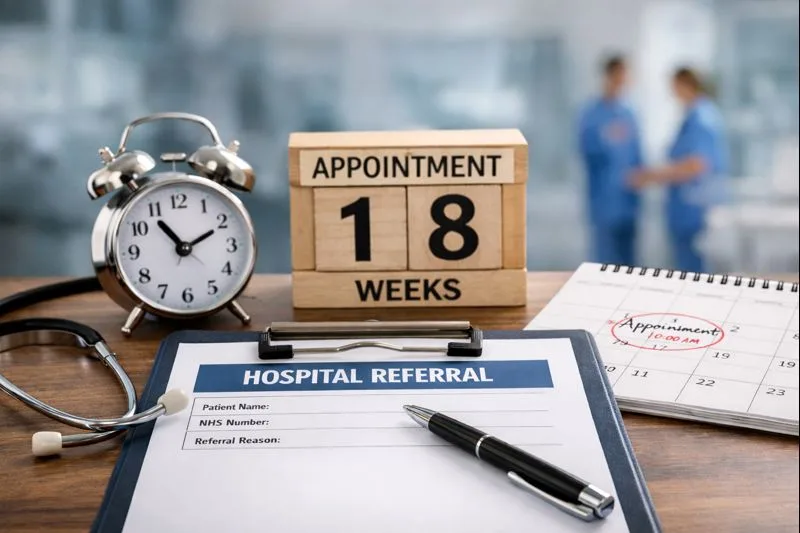
When your GP suspects you need specialist care, they may refer you to a hospital consultant or specialist service. But the process is not always straightforward, and delays can leave patients unsure who to contact, how long they should wait, or whether anything has gone wrong.
This guide explains how hospital referrals work in the UK, how waiting lists are usually managed, what referral-to-treatment rules mean, how to check your referral, and what to do if your appointment, scan or treatment is delayed.
What a hospital referral is and when it is needed
A hospital referral is when your GP, dentist, optometrist, NHS 111, urgent care service or another NHS clinician sends your medical information to a hospital or specialist service so you can be assessed.
Common reasons for referral include:
- investigating new or persistent symptoms
- diagnosing long-term conditions
- requesting specialist opinion
- arranging scans or diagnostic tests
- assessing whether surgery is needed
- accessing mental health specialist services
- investigating possible cancer symptoms through urgent suspected cancer pathways
Many NHS referrals now go through the NHS e-Referral Service, often shortened to eRS. This may allow you to choose from available hospitals, clinics or appointment slots, depending on the specialty and local availability.
If you are unsure how the GP system works, read our guide to how GP registration works in the UK. If your main issue is getting seen in the first place, see how to get a GP appointment quickly in the UK.
Referral does not always mean treatment
A referral usually means a specialist service is being asked to assess the problem. After that assessment, the specialist may recommend tests, medication, physiotherapy, monitoring, surgery, discharge back to your GP, or another referral.
In some cases, the hospital may review the referral and decide another service is more appropriate. This is why it is important to check whether your referral has been accepted, redirected or returned for more information.
When referral is essential
Some care usually requires specialist referral. This may include:
- planned surgery
- suspected cancer investigations
- cardiology assessment
- neurology assessment
- rheumatology care
- complex diagnostics
- specialist pain management
- certain mental health services
- fertility services
- specialist children’s services
If you are waiting for treatment and need support at home, our guide to home care, types of support and funding explains what help may be available. For older people or people who are no longer safe at home, see what to do if an elderly parent is not safe at home.
How the referral journey works
Although every specialty works slightly differently, the referral journey usually follows a similar pattern.
1. Your GP or clinician decides a referral is needed
After listening to your symptoms, examining you or reviewing test results, your GP may decide that you need specialist assessment. Sometimes they may try treatment first, request blood tests, arrange an X-ray or ask you to come back if symptoms persist.
2. The referral is submitted
The GP practice sends the referral electronically, often through the NHS e-Referral Service. You may receive a booking reference, password, letter, text message or online instruction so you can book or manage your appointment.
3. The hospital triages the referral
A clinician or referrals team reviews the referral and decides how urgent it is. They may accept it, redirect it, ask for more information, request tests first, or reject it if they believe another service is more appropriate.
4. You are offered an appointment
You may receive a letter, phone call, text message, NHS App notification or eRS booking instruction. In some cases you may be placed on a waiting list before an appointment date is confirmed.
5. You attend the specialist appointment
The specialist may examine you, review results, request further tests, suggest treatment, discharge you back to your GP, monitor you, or add you to a procedure or surgery waiting list.
6. The pathway continues or closes
After your first specialist appointment, you may move into a diagnostic pathway, treatment pathway, surgical waiting list, follow-up clinic, physiotherapy, medication review or discharge back to primary care.
For a broader explanation of NHS and private routes, see NHS vs private healthcare in the UK.
Waiting times, referral standards and delays
Referral waiting times vary by specialty, urgency, hospital, local capacity and whether the referral is routine, urgent or suspected cancer-related.
Routine referrals and the 18-week pathway
For many non-urgent NHS referrals, the key standard is the 18-week referral-to-treatment pathway. This means the NHS aims for patients to start consultant-led treatment within 18 weeks of referral where clinically appropriate.
However, this is a standard rather than a guarantee. Many patients wait longer, especially for high-demand services, planned operations and diagnostics.
Urgent referrals
If your GP marks a referral as urgent, it should be reviewed more quickly than a routine referral. However, urgent does not always mean immediate. The hospital still triages the referral based on clinical risk and local pathways.
Suspected cancer referrals
If your symptoms could suggest cancer, your GP may use an urgent suspected cancer referral pathway. These pathways are designed to move faster than routine referrals, with quicker specialist assessment, tests and treatment decisions where needed.
Being referred on a suspected cancer pathway does not mean you definitely have cancer. It means your symptoms meet criteria for urgent investigation.
Diagnostics and scan delays
Some delays happen not before the first appointment, but between stages. For example, you may see a consultant quickly but then wait for an MRI, CT scan, ultrasound, endoscopy or follow-up appointment.
If you are waiting for imaging, our guides to ultrasound vs CT vs MRI, what an MRI scan shows, what a CT scan shows and how to understand scan results may be useful.
Why waiting lists are long
Hospital waiting lists can be long for several reasons. These include:
- staffing shortages
- high demand for appointments and procedures
- diagnostic backlogs
- limited operating theatre capacity
- increased demand from an ageing population
- more people living with long-term conditions
- local pressure on specific specialties such as orthopaedics, dermatology, gastroenterology, neurology or mental health
Long waits do not necessarily mean your referral has been lost. But if you have not heard anything, or your symptoms are worsening, it is sensible to check.
How to check or track your referral
You can follow up through several routes. The right place to ask depends on whether the referral has been sent, accepted and triaged.
Check with your GP practice
Your GP practice can usually confirm whether the referral was sent, when it was sent, and where it was sent. They may also be able to give you a copy of the referral letter.
Check your e-Referral details
If your referral went through the NHS e-Referral Service, you may have a booking reference and password. This may allow you to book, change or view appointment options.
Contact the hospital referrals team
Once the hospital has received and accepted the referral, the hospital is usually the best place to ask about triage status, waiting times and appointment scheduling.
Check the NHS App
The NHS App may show some appointments, referrals, letters, test results or messages, depending on the hospital and local system.
Keep your contact details updated
Make sure your GP practice and hospital have your current address, phone number and email. Missed letters and outdated contact details are a common cause of avoidable delays.
Patients often assume the GP continues to monitor the referral after sending it. In practice, once the hospital has accepted the referral, appointment scheduling is usually handled by the hospital or specialist provider.
What to do if your referral is delayed
If you have waited longer than expected, or you have not heard anything, start by checking the basics before assuming the referral has been lost.
Confirm the referral was actually sent
Start with your GP practice. Ask when the referral was submitted, which hospital or service it was sent to, and whether it was marked routine, urgent or suspected cancer.
Contact the hospital
Ask whether the referral has been received, accepted and triaged. You can also ask the current expected waiting time and whether there are any booking actions you need to complete.
Ask for a copy of the referral letter
A copy can help if you need to chase the hospital, request a second opinion, use private care, or explain the situation to another clinician.
Ask whether another hospital has a shorter wait
In England, patient choice may apply for first consultant-led outpatient appointments. Different NHS trusts can have different waiting times, so it may be worth asking whether you can be referred elsewhere.
Tell your GP if symptoms worsen
If your symptoms change, become more severe or affect daily life more than before, contact your GP again. A referral may need to be updated, upgraded or redirected.
Consider a private consultation or scan
Some patients pay privately for a specialist opinion, MRI, CT, ultrasound, endoscopy or blood tests to get clarity faster. Private results can often be shared with your NHS GP or specialist team, although the NHS may still need to review whether they can use them.
This can be helpful when diagnosis is the bottleneck, but it is important to understand costs and limitations before booking. Our guide to NHS vs private healthcare in the UK explains when going private may make sense.
Escalation, patient choice and private options
If a referral is delayed, you may have options beyond simply waiting. Which option is suitable depends on urgency, symptoms, local services and whether patient choice applies.
Ask your GP to review urgency
If symptoms worsen, your GP can review whether the referral should be updated or marked as more urgent. They may also advise whether you need urgent care instead of waiting.
Contact PALS
The Patient Advice and Liaison Service, usually called PALS, can help with hospital communication problems, administrative delays, missing letters, appointment issues and concerns about care.
Make a complaint to the NHS trust
If you cannot resolve the issue through the referrals team or PALS, you can make a formal complaint to the NHS trust. NHS England provides information about NHS feedback and complaints.
Ask about alternative providers
Sometimes another NHS hospital or provider may have a shorter wait. This depends on the specialty, referral type, location and whether patient choice applies.
Use urgent care if symptoms become serious
If symptoms become severe, sudden or dangerous, do not wait for a routine referral. Use NHS 111, urgent treatment centres, A&E or 999 depending on the symptoms.
Can you choose which hospital you are referred to?
In England, patients usually have the right to choose a hospital or service for a first consultant-led outpatient appointment when referred by a GP, as long as the provider is suitable for the condition and has a contract with the NHS.
Choice may not apply in every situation. It may be limited for emergency care, urgent suspected cancer pathways, some highly specialised services, maternity, mental health services or where a particular service is not clinically appropriate.
Mental health referrals can follow different pathways. For more detail, see our guide to how to access mental health services in the UK.
Private referral pathways
Private care can shorten some parts of the journey, especially:
- specialist consultations
- diagnostic imaging
- blood tests
- endoscopy
- surgical opinions
- second opinions
Routes include self-pay, private medical insurance, employer-funded healthcare or private GP referral. Some consultants accept self-referral for certain specialties, while others require a GP referral letter.
Private results can often be sent back to your NHS GP or NHS hospital team. However, the NHS may decide whether to accept those results, whether repeat tests are needed, and whether a private opinion changes your NHS pathway.
Before paying privately, ask:
- What is included in the price?
- Are scans, blood tests, reports and follow-up charged separately?
- Will the consultant write to my NHS GP?
- Can I return to the NHS pathway afterwards?
- What happens if surgery or complications are discovered?
Referral to Treatment rules explained
The Referral to Treatment pathway, often shortened to RTT, measures the time from referral to the start of consultant-led treatment for eligible NHS care.
Important points:
- The 18-week standard usually applies to routine consultant-led treatment pathways.
- The clock can stop if treatment starts, if you are discharged, if you choose to delay, or if no treatment is needed.
- Some services and situations are not covered in the same way.
- Suspected cancer pathways have separate standards and faster processes.
- If your condition changes, the urgency of the referral may need to be reviewed.
The NHS Constitution explains patient rights and pledges in England. You can read the NHS Constitution for England for more detail.
When the clock may stop
The referral-to-treatment clock may stop for several reasons, including when treatment starts, when a clinician decides no treatment is needed, when you are discharged, or when you choose to delay treatment.
This is one reason waiting time rules can feel confusing. If you are unsure where you are on the pathway, ask the hospital appointments team or specialist secretary what stage your referral has reached.
Why referral stage matters
Waiting for a first outpatient appointment is different from waiting for a scan, follow-up appointment, surgery date or post-test review. Each stage may be handled by a different team, and delays can happen at more than one point.
When chasing, be specific: ask whether you are waiting for triage, first appointment, diagnostic test, results review, treatment decision or procedure date.
FAQ: hospital referrals in the UK
Can my GP refuse to refer me?
Yes, if they do not think a referral is clinically needed at that time. You can ask them to explain why, what to watch for, what treatment to try first, and when to come back. You can also ask whether another GP in the practice can review the decision.
How do I know if my referral has been sent?
Contact your GP practice and ask when it was sent, where it was sent and whether it went through eRS. If you have booking details, check the NHS e-Referral Service or any instructions in your letter or text message.
Who should I chase: the GP or the hospital?
If you are not sure the referral was sent, contact the GP practice. If the hospital has received and accepted it, the hospital referrals or appointments team is usually the right place to chase scheduling and waiting times.
Can I change hospital after being referred?
Sometimes. In England, patient choice may apply for first consultant-led outpatient appointments, but switching after treatment has started can be more complicated. Tests may need to be transferred or repeated.
Do referrals expire?
Some referrals may be closed if you do not book, do not attend, cannot be contacted, or if too much time passes without action. If you think this has happened, contact the GP practice or hospital.
Can I be referred to more than one specialist?
Yes, if clinically justified. For example, someone with overlapping symptoms might need gastroenterology and gynaecology input, or orthopaedics and pain management.
Can I use a private consultation while staying on the NHS list?
Often yes. Many people pay privately for a scan or opinion while remaining under NHS care. Make sure reports are shared with your NHS GP or specialist, and ask how private results affect your NHS pathway.
Will a private scan speed up my NHS treatment?
It may help clarify diagnosis, but it does not automatically move you up an NHS waiting list. NHS clinicians may review the private scan, request the images, or repeat tests if needed.
What should I do if my symptoms get worse while waiting?
Contact your GP and explain what has changed. If symptoms are sudden, severe or potentially dangerous, use NHS 111, urgent care, A&E or 999 rather than waiting for a routine appointment.
Can I complain about a long referral delay?
Yes. Start by contacting the hospital appointments team or PALS. If the issue is not resolved, you can make a formal complaint to the NHS trust.
Final takeaway
Hospital referrals are a core part of UK healthcare, but delays mean patients need to understand the pathway, who is responsible at each stage, how to check progress and when to escalate.
Start by confirming the referral was sent, then check with the hospital once it has been accepted. If symptoms worsen, ask your GP to review urgency. If waiting is affecting your quality of life, work or safety, it may also be worth asking about other NHS providers or carefully considering private options.