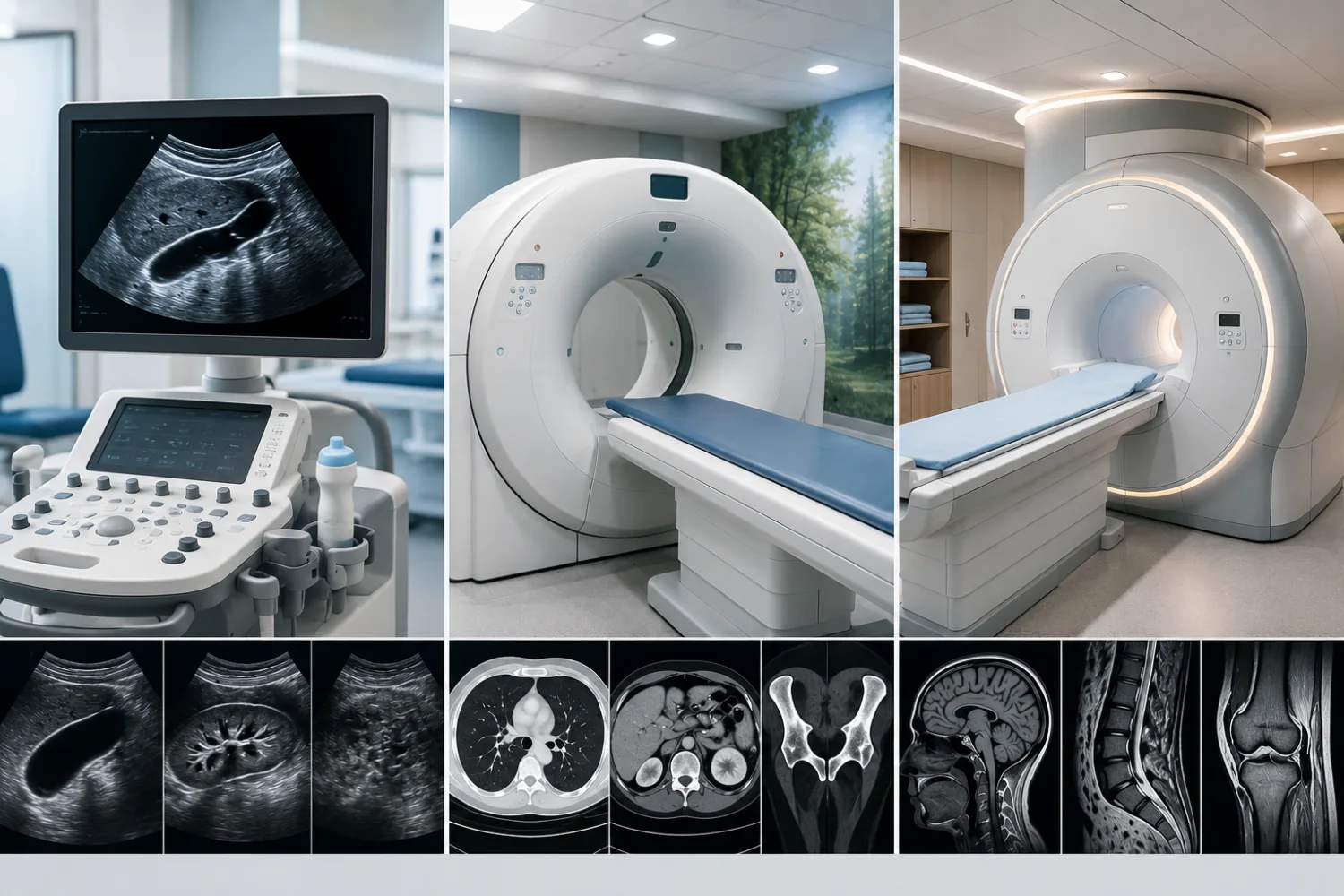
Ultrasound, CT and MRI are three of the most common medical scans used in the UK. They can all look inside the body, but they work in very different ways and are used for different questions.
If you have been referred for a scan, it is natural to wonder why that scan was chosen. Why ultrasound rather than CT? Why MRI instead of X-ray? Does CT show more than ultrasound? Is MRI always better? And if one scan is normal, does that mean everything is definitely fine?
The short answer is that no single scan is “best” for everything. Ultrasound is quick, safe and excellent for many organs close to the surface or filled with fluid. CT is fast and very useful in emergencies, cancer assessment, chest and abdominal problems, kidney stones and injuries. MRI gives highly detailed soft tissue images and is especially useful for the brain, spine, joints, pelvis, liver, bile ducts and some cancers.
This guide explains how ultrasound, CT and MRI differ, what each scan can show, what they can miss, when each is usually requested, how to prepare, and how doctors decide which scan is most appropriate.
Quick answer: Ultrasound uses sound waves and is often used for gallstones, liver, kidneys, pregnancy, pelvic organs and lumps. CT uses X-rays and is fast, making it useful for emergencies, lungs, bones, abdominal pain, kidney stones, bleeding and cancer staging. MRI uses magnets and radio waves and is best for detailed soft tissue imaging, including brain, spine, joints, pelvis, liver, bile ducts and many neurological or musculoskeletal problems.
Why different scans exist
Medical imaging is not one-size-fits-all. Different scans are better at showing different tissues and different types of disease. A scan that is excellent for one problem may be poor for another.
For example, ultrasound is often the first scan for suspected gallstones, because it can show stones inside the gallbladder very well. CT is often used for severe abdominal pain in hospital, because it can look quickly at many organs, bowel loops, blood vessels and emergency conditions. MRI is often chosen for spinal discs, brain lesions or knee ligaments, because it gives better soft tissue detail.
Doctors choose scans based on:
- your symptoms
- examination findings
- blood, urine or stool test results
- the body area involved
- how urgent the situation is
- whether radiation should be avoided
- whether contrast dye is needed
- previous scan results
- your age, pregnancy status and medical history
- whether the scan result will change treatment
This is why two people with similar symptoms may be sent for different scans.
Ultrasound, CT and MRI at a glance
| Scan | How it works | Best for | Main limitations |
|---|---|---|---|
| Ultrasound | Uses high-frequency sound waves | Gallstones, liver, kidneys, bladder, pregnancy, pelvic organs, testicles, thyroid, lumps, fluid, some blood vessels | Limited by bowel gas, body shape, deep structures and operator/viewing conditions |
| CT | Uses X-rays and a computer to create cross-sectional images | Emergencies, chest, lungs, trauma, bones, bleeding, kidney stones, abdominal pain, infection, cancer staging | Uses radiation; may need contrast dye; less soft tissue detail than MRI for some areas |
| MRI | Uses strong magnets and radio waves | Brain, spine, joints, muscles, ligaments, pelvis, prostate, liver, bile ducts, nerves, soft tissues | Takes longer; noisy; can be difficult with claustrophobia; strict metal and implant safety checks |
What is an ultrasound scan?
An ultrasound scan uses sound waves to create images of the inside of the body. A clinician or sonographer places gel on the skin and moves a handheld probe over the area being examined. The probe sends sound waves into the body and receives echoes back, which are turned into images on a screen.
Ultrasound does not use ionising radiation. It is widely used in pregnancy, abdominal symptoms, pelvic symptoms, kidney problems, gallbladder problems, lumps and blood vessel checks.
Ultrasound is often quick, accessible and safe. It can be done in hospitals, community diagnostic centres, outpatient clinics and private imaging centres.
For a full guide, read Abdominal Ultrasound: What It Shows and Why It’s Requested.
What can ultrasound show?
Ultrasound is particularly good at showing fluid-filled structures, moving structures and organs that are not hidden by gas or bone.
Ultrasound can help assess:
- Gallbladder: gallstones, sludge, inflammation, polyps and bile duct widening.
- Liver: fatty liver, cysts, some masses, liver size and some signs of scarring or bile duct problems.
- Kidneys: cysts, kidney size, swelling from obstruction and some stones.
- Bladder: bladder volume, emptying and some bladder abnormalities.
- Pelvic organs: uterus, ovaries, fibroids, ovarian cysts and some causes of pelvic pain.
- Pregnancy: fetal growth, heartbeat, position and pregnancy dating.
- Testicles: lumps, swelling, inflammation, torsion assessment and fluid collections.
- Thyroid: nodules, enlargement and cysts.
- Soft tissue lumps: cysts, lipomas, abscesses and some hernias.
- Blood vessels: blood flow, clots in veins and aneurysm screening.
What ultrasound does not show well
Ultrasound is useful, but it cannot see everything. Sound waves do not travel well through air or bone. This means bowel gas, ribs, deep tissues and body habitus can limit the view.
Ultrasound may not show well:
- many bowel problems
- stomach ulcers
- early bowel cancer
- small pancreatic lesions hidden by gas
- some kidney stones
- many causes of reflux or indigestion
- deep abdominal structures in some people
- subtle brain, spine, joint or nerve problems
A normal ultrasound can be reassuring, but it does not rule out every cause of pain, weight loss, anaemia, bowel symptoms or digestive problems.
When is ultrasound usually chosen first?
Ultrasound is often chosen first when the suspected problem involves the gallbladder, liver, kidneys, pelvis, pregnancy, testicles, thyroid, soft tissue lumps or fluid collections.
Common reasons include:
- right upper abdominal pain
- suspected gallstones
- abnormal liver function tests
- kidney pain or suspected obstruction
- blood in urine in some situations
- pelvic pain
- heavy periods with suspected fibroids
- ovarian cyst assessment
- testicular swelling or lump
- checking a soft tissue lump
- pregnancy assessment
Related guides include gallstones, liver function test results, kidney blood test results, ovarian cysts and fibroids.
What is a CT scan?
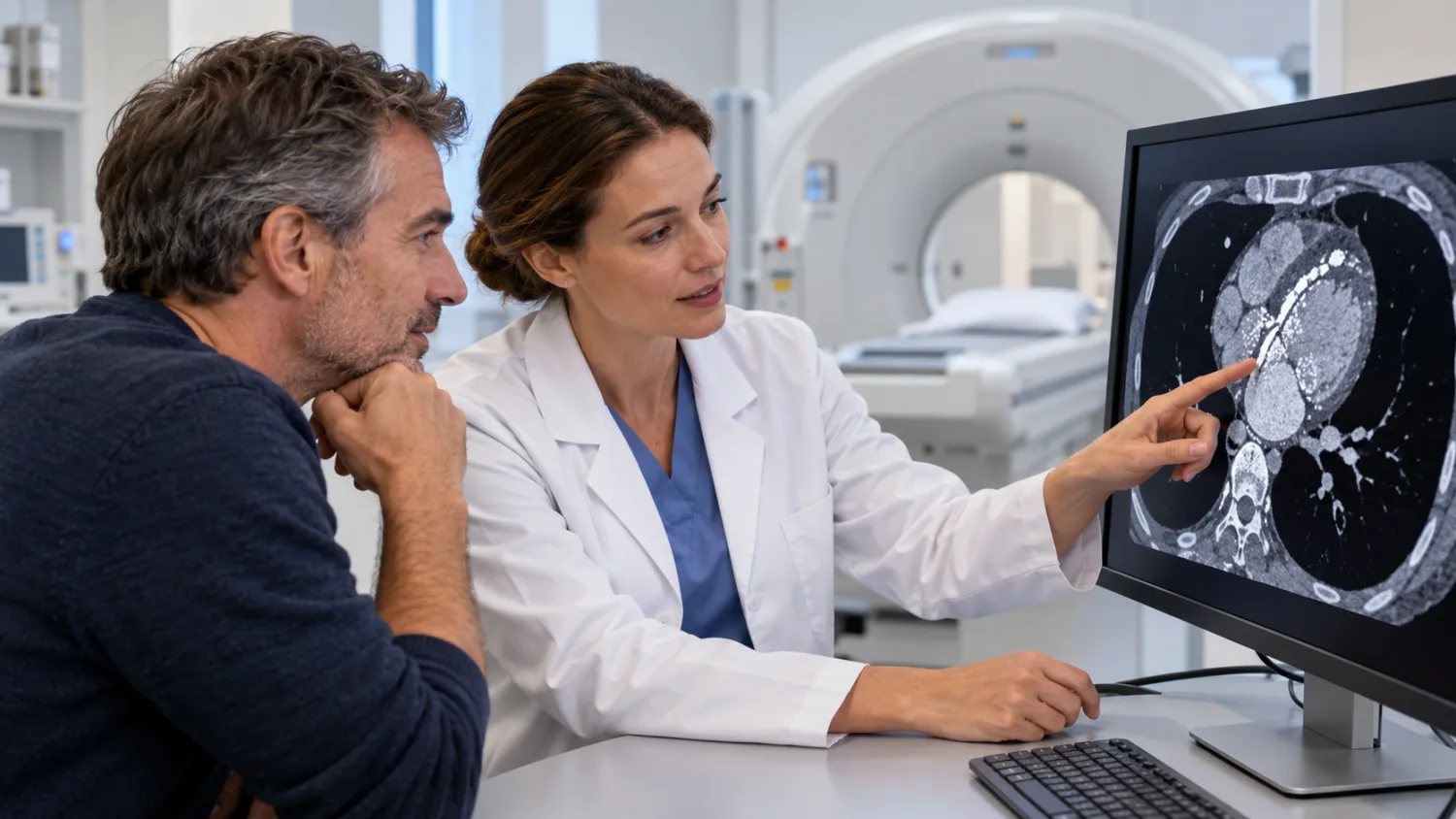
CT stands for computed tomography. A CT scanner uses X-rays taken from different angles around the body. A computer then combines the images into detailed cross-sectional pictures.
CT is fast, widely available in hospitals and excellent for many urgent problems. It can show bones, lungs, organs, blood vessels, bowel, fluid, bleeding, infection and many cancers.
The trade-off is that CT uses ionising radiation. This does not mean CT is unsafe when needed. It means the scan should be justified and used when the benefit is greater than the small radiation risk.
For a full guide, read CT Scan: What It Shows, Risks and How It Differs from MRI.
What can CT show?
CT is often the best scan when doctors need a fast overview of the inside of the body. It is especially useful in emergency care and cancer assessment.
CT can help assess:
- Brain: bleeding, swelling, some strokes, skull fractures and head injury.
- Chest: lung infection, lung cancer, blood clots, fluid, collapsed lung and chest trauma.
- Abdomen: appendicitis, diverticulitis, bowel obstruction, kidney stones, pancreatitis, abscesses and internal bleeding.
- Pelvis: pelvic masses, cancer staging, trauma and some bowel or urinary problems.
- Bones: complex fractures, trauma and surgical planning.
- Blood vessels: aneurysms, clots, narrowing, bleeding and aortic problems when CT angiography is used.
- Cancer: diagnosis, staging, monitoring and treatment response.
What CT does not show well
CT is detailed, but not perfect. It is not always the best scan for soft tissue, nerves, ligaments or subtle brain and spinal cord problems. Some conditions are better seen with MRI, ultrasound, endoscopy or colonoscopy.
CT may not be the best first test for:
- many ligament or cartilage injuries
- subtle spinal cord or nerve problems
- multiple sclerosis
- some pelvic soft tissue conditions
- early endometriosis
- stomach ulcers
- reflux damage
- flat bowel lesions or small polyps
- functional bowel conditions such as IBS
If doctors need to see inside the stomach or bowel lining, gastroscopy or colonoscopy may be more useful than CT. See Gastroscopy: When It’s Needed, What It Shows and What to Expect and Colonoscopy: Preparation, Procedure, Sedation and What to Expect.
When is CT usually chosen?
CT is often chosen when symptoms are urgent, complex or need a fast answer. It is also commonly used when staging or monitoring cancer.
Common reasons include:
- head injury
- suspected brain bleeding
- severe chest pain or suspected blood clot in the lung
- shortness of breath with concerning features
- abnormal chest X-ray
- severe abdominal pain
- suspected appendicitis
- suspected diverticulitis
- suspected bowel obstruction
- suspected kidney stones
- major trauma
- cancer diagnosis, staging or follow-up
- checking for abscess or internal infection
Related guides include chest pain, abdominal pain, diverticular disease and diverticulitis, pain when urinating and blood in stool.
What is an MRI scan?
MRI stands for magnetic resonance imaging. It uses a strong magnetic field and radio waves to create detailed images inside the body. MRI does not use X-rays.
MRI is especially useful for soft tissues. It can show the brain, spinal cord, discs, nerves, ligaments, tendons, muscles, joints, pelvis, liver, bile ducts, prostate and many cancers in high detail.
The main downsides are that MRI takes longer than CT, is noisy, can feel claustrophobic, and requires strict metal and implant safety checks because of the powerful magnet.
For a full guide, read MRI Scan: What It Shows, How to Prepare and When It’s Needed.
What can MRI show?
MRI is often chosen when soft tissue detail matters more than speed.
MRI can help assess:
- Brain: tumours, inflammation, multiple sclerosis, stroke changes, structural problems and some causes of seizures or neurological symptoms.
- Spine: slipped discs, nerve compression, spinal stenosis, spinal cord problems, infection and tumours.
- Joints: ligament tears, cartilage damage, meniscus tears, tendon injury, bone marrow changes and arthritis complications.
- Muscles and soft tissues: tears, inflammation, masses and infection.
- Pelvis: endometriosis, fibroids, ovarian masses, prostate assessment and rectal cancer staging.
- Liver and bile ducts: liver lesions, MRCP bile duct scans and pancreaticobiliary problems.
- Heart and blood vessels: selected cardiac and vascular assessments.
What MRI does not show well
MRI is powerful, but it is not automatically better for every problem. CT is often better in emergencies. Ultrasound may be better for some first-line abdominal, pelvic and pregnancy questions. X-ray may be enough for many fractures or chest symptoms.
MRI may not be ideal when:
- a very fast emergency scan is needed
- major trauma must be assessed quickly
- lung detail is the main question
- kidney stones are suspected
- a person has an unsafe implant or metal fragment
- claustrophobia is severe and cannot be managed
- the person cannot lie still long enough
- the answer requires looking directly inside the bowel or stomach lining
MRI can also show incidental findings or age-related changes that may not be causing symptoms. This is common in spine and joint imaging.
When is MRI usually chosen?
MRI is often chosen for neurological, spinal, joint, pelvic and soft tissue problems. It may also be used after ultrasound or CT when more detail is needed.
Common reasons include:
- suspected slipped disc with nerve compression
- sciatica with concerning or persistent symptoms
- brain or neurological symptoms needing detailed imaging
- suspected multiple sclerosis
- knee, shoulder, hip or soft tissue injuries
- suspected ligament or cartilage damage
- pelvic pain or suspected endometriosis
- fibroid or ovarian mass assessment
- prostate assessment
- liver lesion characterisation
- bile duct imaging with MRCP
- cancer staging or follow-up in selected cases
Related guides include lower back pain, sciatica, knee pain, endometriosis, fibroids and prostate cancer symptoms.
Which scan shows which body part best?
| Body area or problem | Often useful first scan | Why |
|---|---|---|
| Gallstones | Ultrasound | Excellent for stones in the gallbladder and bile duct clues |
| Kidney stones | CT or ultrasound | CT is often more sensitive; ultrasound may be used first in some groups |
| Liver blood test changes | Ultrasound | Good first look at liver texture, fatty change, cysts and bile ducts |
| Severe abdominal pain | CT, sometimes ultrasound | CT can quickly assess many urgent causes |
| Brain bleeding after head injury | CT | Fast and good at detecting acute bleeding and fractures |
| Multiple sclerosis | MRI | Better for brain and spinal cord lesions |
| Slipped disc or nerve compression | MRI | Shows discs, nerves and spinal canal in detail |
| Knee ligament or meniscus injury | MRI | Shows soft tissues, cartilage and ligaments |
| Lung cancer or lung nodules | CT | CT gives detailed lung images |
| Ovarian cysts | Ultrasound, sometimes MRI | Ultrasound is first-line; MRI can clarify complex findings |
| Endometriosis | Ultrasound or MRI | MRI can help assess deep disease in selected cases |
| Bowel polyps | Colonoscopy | Scans may miss small or flat polyps; colonoscopy looks directly inside |
| Stomach ulcers | Gastroscopy | Gastroscopy looks directly at the stomach lining |
Ultrasound vs CT vs MRI for abdominal pain
The right scan for abdominal pain depends on where the pain is, how severe it is, how long it has been present, and whether there are red flags such as fever, vomiting, jaundice, weight loss, blood in stool or abnormal blood tests.
For right upper abdominal pain after meals, ultrasound is often used first because gallstones are a common possibility. For severe abdominal pain in hospital, CT may be preferred because it can assess appendicitis, diverticulitis, obstruction, bleeding, infection and many other urgent causes. MRI may be used for selected liver, bile duct, pelvic or complex bowel questions.
A normal scan does not always end the investigation. Some causes of abdominal pain, such as IBS, reflux, stomach ulcers, microscopic inflammation or food intolerance, may need different tests or clinical assessment.
Ultrasound vs CT vs MRI for back pain and sciatica
For most uncomplicated lower back pain, scans are not needed at first. Many cases improve with time, movement, physiotherapy and pain relief. Imaging is more likely if there are red flags, severe or persistent nerve symptoms, weakness, suspected infection, cancer history, trauma or possible cauda equina syndrome.
If imaging is needed, MRI is usually the best scan for discs, nerves and spinal canal problems. CT may be used for bone detail, fractures or when MRI cannot be done. Ultrasound is not used to assess spinal discs or nerves.
See lower back pain, sciatica and herniated disc.
Ultrasound vs CT vs MRI for headaches and neurological symptoms
Ultrasound is not usually used for headaches or brain symptoms. CT is often used in emergency settings because it is fast and can detect bleeding, major stroke changes, swelling or skull fractures. MRI gives more detailed brain and spinal cord images and may be used for non-emergency neurological symptoms, suspected multiple sclerosis, tumours, seizures or subtle abnormalities.
Not every headache needs a scan. Red flags include a sudden “thunderclap” headache, headache with weakness or speech problems, headache with fever or stiff neck, new headache after cancer diagnosis, headache after head injury, or a new severe headache unlike previous headaches.
See headache causes and red flags, dizziness, fainting and blackouts and stroke symptoms and TIA.
Ultrasound vs CT vs MRI for chest symptoms
For chest symptoms, the first test may be an ECG, blood tests or chest X-ray rather than ultrasound, CT or MRI. CT is often used when doctors need detailed lung images or are worried about a blood clot in the lung, cancer, infection complications or aortic problems.
MRI is used for selected heart and blood vessel problems but is not usually the first scan for most acute chest symptoms. Ultrasound can be used for heart scans, called echocardiography, and for fluid around the lungs, but this is a different type of focused ultrasound.
Chest pain, sudden breathlessness, collapse or stroke-like symptoms should be assessed urgently rather than waiting for a routine scan.
Ultrasound vs CT vs MRI for cancer
There is no single “best cancer scan”. The best scan depends on the suspected cancer type and the question being asked.
- Ultrasound may be used first for thyroid lumps, testicular lumps, pelvic organs, liver, gallbladder, kidneys or soft tissue lumps.
- CT is widely used for cancer staging, chest and abdominal assessment, lung nodules, lymph nodes and treatment monitoring.
- MRI is often used for brain, spine, liver, pelvis, prostate, rectal cancer, soft tissue tumours and detailed local staging.
Some cancers require endoscopy, biopsy, mammography, PET-CT, blood tests or specialist scans. Imaging can suggest cancer, but diagnosis often needs tissue sampling or specialist review.
Ultrasound vs CT vs MRI for joints and sports injuries
For joint and sports injuries, X-ray is often used first if fracture is possible. Ultrasound can assess some tendons, muscles, fluid collections and guided injections. MRI is often best for deeper soft tissue injuries, ligaments, cartilage, meniscus tears, bone marrow changes and unexplained joint pain.
CT can show complex fractures and bone detail, but MRI is usually better for soft tissue injury.
See sports injuries, knee pain, frozen shoulder and arthritis.
Which scan is safest?
Safety depends on the person and the situation.
- Ultrasound does not use ionising radiation and is generally very safe.
- MRI does not use ionising radiation, but the magnet can be unsafe with certain implants, devices or metal fragments.
- CT uses X-ray radiation, but the dose is controlled and the scan is used when the expected benefit outweighs the small risk.
For many patients, the safest scan is the one that answers the clinical question accurately and quickly enough. Avoiding CT radiation is sensible when another scan can answer the question, but avoiding a necessary CT in an emergency can be more dangerous than the scan itself.
Radiation: ultrasound vs CT vs MRI
| Scan | Uses radiation? | What this means |
|---|---|---|
| Ultrasound | No ionising radiation | Uses sound waves |
| MRI | No ionising radiation | Uses magnets and radio waves |
| CT | Yes | Uses X-rays; dose depends on the scan type and area |
CT radiation risk is usually small when the scan is medically justified. GOV.UK provides patient information on medical radiation doses and explains that typical doses vary by examination type. GOV.UK patient dose information.
Contrast dye: ultrasound vs CT vs MRI
Some scans use contrast agents to make tissues, blood vessels or abnormalities easier to see.
- Ultrasound contrast: used in selected specialist scans, but not routine for most standard ultrasound appointments.
- CT contrast: often iodine-based and injected into a vein; commonly used for cancer staging, blood vessels, infection, inflammation and abdominal or chest CT.
- MRI contrast: often gadolinium-based and injected into a vein; used for selected brain, spine, cancer, liver, vessel or inflammation scans.
Contrast is not needed for every scan. The imaging team considers the clinical question, kidney function, allergies, pregnancy, breastfeeding and previous reactions before using it.
Which scan is fastest?
CT is usually the fastest of the three. This is one reason it is so valuable in emergency departments. The scan itself may take only a few minutes.
Ultrasound is also often quick, usually taking around 15 to 30 minutes, depending on the body area and complexity.
MRI usually takes longer. Many MRI scans take 15 to 60 minutes or more, and the patient needs to stay very still.
Which scan is best if you are claustrophobic?
Ultrasound is usually easiest for people with claustrophobia because it is done with a handheld probe in an open room.
CT is often easier than MRI because the scanner is a short, wide ring rather than a long tunnel. The scan is also quick.
MRI can be difficult for some people because the scanner is narrow, noisy and takes longer. If you are claustrophobic, tell the MRI department before the appointment. Options may include support, music, mirrors, a wider scanner, feet-first positioning for some scans, or sedation arranged in advance.
Which scan is best in pregnancy?
This depends on the clinical question and urgency. Ultrasound is commonly used in pregnancy and does not use ionising radiation. MRI may be used in pregnancy when needed and appropriate. CT may be avoided when possible, but it can still be used if urgently needed and the benefit outweighs the risk.
Always tell the imaging team if you are pregnant or might be pregnant before any scan, especially CT or scans involving contrast.
Why your doctor may request one scan after another
Sometimes one scan leads to another. This does not always mean something serious has been found. It may mean the first scan gave partial information and another scan can clarify it.
Examples include:
- Ultrasound finds a liver lesion, then MRI characterises it.
- Ultrasound is limited by bowel gas, then CT is requested.
- CT finds an incidental adrenal nodule, then follow-up imaging is arranged.
- CT shows a soft tissue mass, then MRI defines local detail.
- MRI shows a finding that needs CT to assess bone detail.
- CT suggests bowel abnormality, then colonoscopy is arranged for direct inspection and biopsy.
Further imaging is often about getting a clearer answer, not automatically bad news.
Can scans miss things?
Yes. All scans can miss things. No scan sees everything, and each scan has blind spots.
Scans may miss disease because:
- the abnormality is too small
- the disease is early
- the wrong body area was scanned
- movement blurred the images
- bowel gas blocked ultrasound views
- contrast was not used or not suitable
- the condition is microscopic or functional
- the finding is subtle and needs specialist review
This is why scan results should be interpreted alongside symptoms, examination findings, blood tests and follow-up. If red flag symptoms continue, further assessment may still be needed even after a normal scan.
Can scans show too much?
Yes. Modern scans can detect tiny incidental findings that may not be related to symptoms and may never cause harm. These findings can lead to anxiety, repeat scans or specialist appointments.
Common incidental findings include:
- small cysts
- benign liver lesions
- kidney cysts
- small lung nodules
- age-related spine changes
- gallstones without symptoms
- fatty liver
- fibroids
- ovarian cysts
Incidental does not mean imaginary, but it also does not automatically mean dangerous. Ask your clinician whether the finding explains symptoms, whether it looks benign, and whether follow-up is needed.
Why a scan may not be requested straight away
Sometimes people feel frustrated when they have symptoms but are not immediately sent for a scan. There may be good reasons for this.
A scan may not be the first step if:
- symptoms are likely to improve with time
- blood, urine or stool tests are more appropriate first
- the scan is unlikely to change treatment
- the condition is usually diagnosed clinically
- the wrong scan could give false reassurance
- the scan may find unrelated incidental abnormalities
- guidelines recommend conservative treatment first
For example, many cases of uncomplicated back pain do not need early MRI. Many cases of reflux do not need CT or MRI. Many mild viral illnesses do not need imaging at all.
Private ultrasound, CT or MRI: what to consider
Private scanning can be helpful when it is targeted, clinically justified and linked to proper follow-up. But self-referring for scans without a clear question can create confusion.
Before booking privately, ask:
- What symptom or question is the scan trying to answer?
- Is this the right scan for that question?
- Would blood tests, stool tests, X-ray or endoscopy be more useful?
- Will contrast be needed?
- Who reports the scan?
- Who explains the result?
- Will your GP receive a copy?
- What happens if an incidental finding is found?
- What happens if the scan is normal but symptoms continue?
For wider context, see NHS vs private healthcare in the UK, private GP services in the UK and how hospital referrals work.
How to understand scan results
Scan reports are written for clinicians, so they often use technical language. Words such as “lesion”, “nodule”, “degenerative change”, “indeterminate”, “limited views” or “correlate clinically” can sound alarming, but they do not always mean something serious.
When discussing results, ask:
- Was the scan normal or abnormal?
- Does the finding explain my symptoms?
- Is the finding common?
- Does it look benign or concerning?
- Do I need follow-up imaging?
- Do I need blood tests, endoscopy or specialist referral?
- What symptoms should prompt urgent help?
- What happens if symptoms continue?
Our guide to how to understand scan results explains common wording in more detail.
When to seek urgent help instead of waiting for a scan
Do not wait for a routine scan appointment if symptoms are severe, sudden or rapidly worsening.
Seek urgent medical help if you have:
- stroke symptoms, such as face drooping, arm weakness or speech problems
- severe chest pain
- sudden severe breathlessness
- collapse or fainting with serious symptoms
- severe sudden headache
- new loss of bladder or bowel control with back pain
- numbness around the genitals or saddle area
- severe abdominal pain
- vomiting blood
- black, tarry stools
- heavy bleeding
- yellow skin or eyes with severe symptoms
- confusion, fever, fast breathing or signs of sepsis
Call 999 if symptoms suggest stroke, heart attack, severe breathing problems, collapse, severe bleeding or another emergency.
Final thoughts
Ultrasound, CT and MRI are all valuable scans, but they are not interchangeable. Ultrasound is safe, quick and excellent for gallstones, liver, kidneys, pelvic organs, pregnancy, lumps and fluid. CT is fast and powerful for emergencies, lungs, bones, bleeding, abdominal pain, kidney stones and cancer staging. MRI gives excellent soft tissue detail for the brain, spine, joints, pelvis, liver, bile ducts, nerves and many complex conditions.
The best scan is not always the most expensive or most detailed one. It is the scan that answers the clinical question safely and accurately. Sometimes that is ultrasound. Sometimes it is CT. Sometimes it is MRI. Sometimes the right test is not a scan at all, but blood tests, stool tests, gastroscopy, colonoscopy or careful clinical follow-up.
If you are unsure why a scan has been requested, ask your clinician what they are looking for, how the result will change management, what the scan can and cannot show, and what happens next if the result is normal or abnormal.
For official information, see the NHS guides to ultrasound scans, CT scans and MRI scans, plus GOV.UK guidance on medical radiation patient doses.
This article is for general information only and should not replace medical advice. Always follow the instructions from your hospital, imaging department or clinician, especially about preparation, medicines, contrast dye, implants, pregnancy and follow-up.
Frequently asked questions
Which scan is best: ultrasound, CT or MRI?
There is no single best scan for everything. Ultrasound is best for many first-line abdominal, pelvic, pregnancy and lump assessments. CT is best for many urgent problems, lungs, trauma, bleeding, kidney stones and cancer staging. MRI is best for many brain, spine, joint, pelvic and soft tissue problems.
Does ultrasound show more than CT?
Not usually, but it depends on the condition. Ultrasound may be better than CT for gallstones, pregnancy, some pelvic organs, testicles and some soft tissue lumps. CT gives a wider and more detailed cross-sectional view for many chest, abdominal and emergency problems.
Is MRI better than CT?
MRI is better for many soft tissue problems, including brain, spine, joints, pelvis and nerves. CT is usually faster and often better for emergencies, lungs, bleeding, trauma, kidney stones and many abdominal problems. The best scan depends on the question.
Which scan uses radiation?
CT uses X-ray radiation. Ultrasound and MRI do not use ionising radiation.
Which scan is safest?
Ultrasound and MRI do not use ionising radiation, but MRI has strict metal and implant safety rules. CT uses radiation, but it is safe and appropriate when medically justified. The safest scan is the one that answers the clinical question with the lowest reasonable risk.
Which scan is best for abdominal pain?
It depends on the type of pain. Ultrasound is often used first for suspected gallstones or liver and kidney problems. CT is often used for severe or unclear abdominal pain, appendicitis, diverticulitis, obstruction or emergency assessment. MRI is used for selected liver, bile duct, pelvic or complex problems.
Which scan is best for back pain?
If imaging is needed for back pain with nerve symptoms or red flags, MRI is usually best because it shows discs, nerves and the spinal canal. CT may be used for bone detail or when MRI is not possible. Most uncomplicated back pain does not need early imaging.
Which scan is best for cancer?
It depends on the suspected cancer. CT is widely used for staging and monitoring many cancers. MRI is important for brain, spine, pelvis, prostate, liver and soft tissue detail. Ultrasound is often used first for thyroid, testicular, pelvic, liver, kidney or soft tissue lumps. Biopsy is often needed for diagnosis.
Can ultrasound, CT or MRI diagnose everything?
No. Scans can miss small, early, microscopic or functional conditions. Some problems need blood tests, stool tests, gastroscopy, colonoscopy, biopsy or specialist assessment.
Why would I need MRI after ultrasound?
MRI may be requested after ultrasound if the ultrasound finding needs more detail, such as a liver lesion, complex ovarian cyst, bile duct problem, pelvic condition or soft tissue mass.
Why would I need CT after ultrasound?
CT may be requested after ultrasound if the ultrasound view was limited, symptoms are severe, the diagnosis is unclear, or doctors need a wider look at the abdomen, chest, bowel, blood vessels or possible cancer.
Why would I need ultrasound after CT or MRI?
Ultrasound may be used after CT or MRI to check a specific area more closely, assess blood flow, guide a biopsy, monitor a cyst, or look at a structure that ultrasound shows well.
Which scan is quickest?
CT is usually the quickest. Ultrasound is also often quick. MRI usually takes longer and requires the patient to stay still for more time.
Which scan is best if I am claustrophobic?
Ultrasound is usually easiest because it is done in an open room. CT is usually easier than MRI because the scanner is a short ring and the scan is quick. MRI can be harder, but support and wider scanners may be available.
Can I choose which scan I get?
You can discuss preferences and concerns with your clinician, but the scan should be chosen based on the clinical question, safety and what will change management. The most detailed scan is not always the most appropriate one.