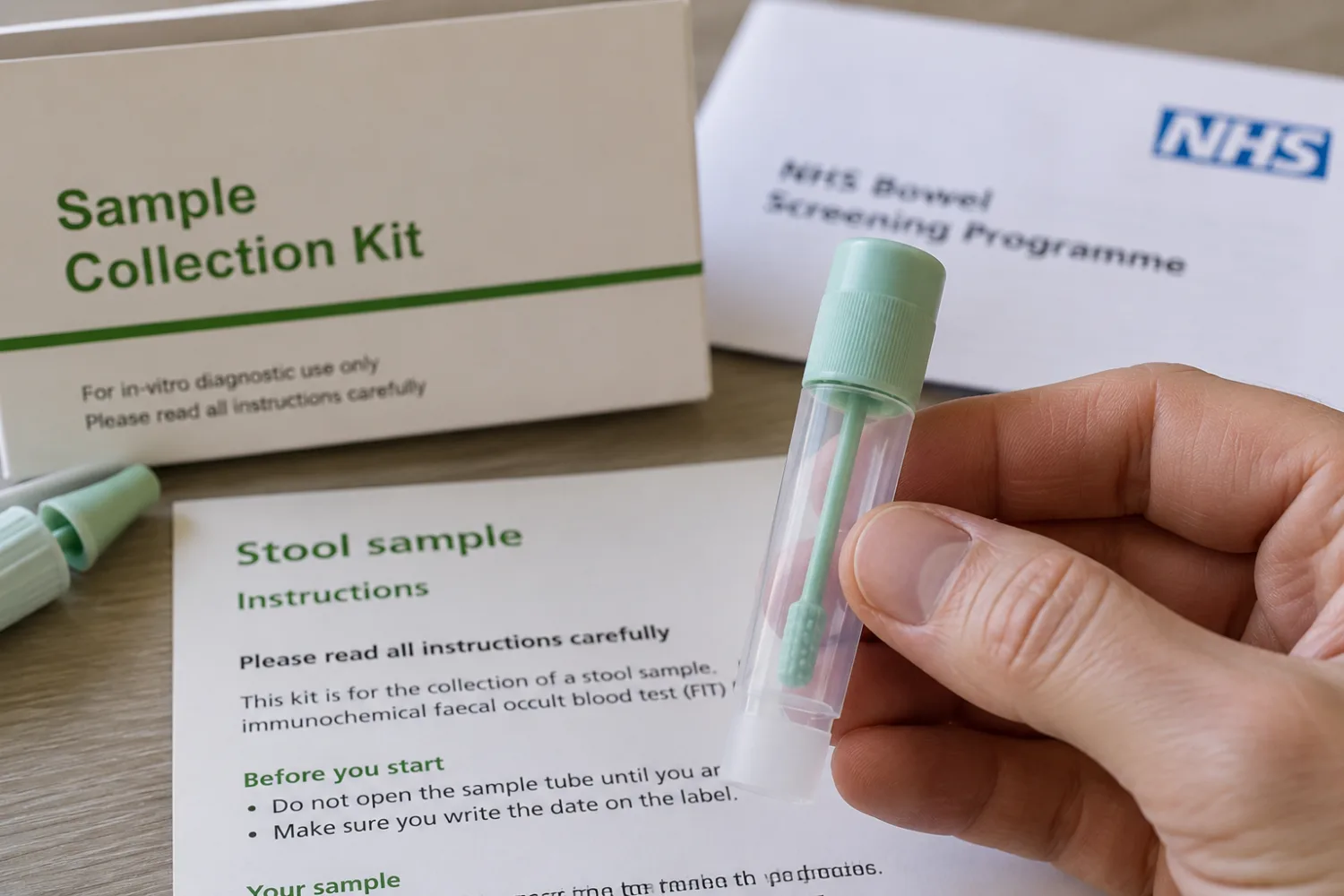
A faecal immunochemical test, usually shortened to FIT, checks a small sample of stool for tiny traces of human blood. The amount may be too small to see when you go to the toilet, but the laboratory can measure it.
FIT is commonly used in two different situations. A GP may request it when someone has bowel symptoms, such as a persistent change in bowel habits, abdominal pain, unexplained anaemia, weight loss or rectal bleeding. It is also used by NHS bowel cancer screening programmes to test people who do not have symptoms.
Although the test is often associated with bowel cancer, an abnormal FIT result does not mean that you have cancer. Blood can enter the stool for many reasons, including haemorrhoids, inflammation, polyps and other bowel conditions. Equally, a low FIT result does not prove that nothing is wrong.
The result is one part of a wider assessment. Your symptoms, examination, blood tests, age, medical history and family history all influence what should happen next.
What does a FIT test measure?
FIT looks for haemoglobin, the protein in red blood cells that carries oxygen. It uses antibodies designed to recognise human haemoglobin in a stool sample.
The result may be reported as a concentration measured in:
micrograms of haemoglobin per gram of faeces
This may appear on your result as:
- µg Hb/g;
- µg/g;
- micrograms Hb per gram of faeces; or
- micrograms of haemoglobin per gram of stool.
A result of 10 µg Hb/g, for example, means that the laboratory detected 10 micrograms of haemoglobin in each gram of the tested stool sample.
Some reports provide a precise number. Others may say that the result is below the laboratory’s reporting limit, above the measuring range, negative, positive or abnormal. Screening programme letters may simply explain whether further tests are recommended rather than showing a numerical result.
FIT is more specific to bleeding from the lower digestive tract than older guaiac faecal occult blood tests because it detects human haemoglobin and is not affected in the same way by blood contained in food. In most cases, you do not need to change your diet before collecting the sample unless your clinical team gives you particular instructions.
Why has your GP requested a FIT test?
Your GP may request a symptomatic FIT when bowel cancer is one possible explanation for your symptoms. This does not mean your doctor thinks cancer is the most likely cause. Many bowel symptoms are caused by non-cancerous conditions, but the symptoms can overlap and may need investigation.
FIT may be offered when you have:
- a persistent and unexplained change in bowel habits;
- looser stools or diarrhoea that is unusual for you;
- constipation or altered stool frequency;
- blood in the stool or bleeding from the bottom;
- unexplained abdominal pain;
- unexplained weight loss;
- iron-deficiency anaemia;
- a lump or swelling in the abdomen;
- persistent tiredness that may be related to anaemia; or
- other symptoms that make a lower-bowel investigation appropriate.
The test helps your GP estimate how urgently you may need further assessment. It is a triage test rather than a final diagnosis.
In current NICE guidance for suspected cancer referral, adults with relevant bowel symptoms should usually be referred through a suspected colorectal cancer pathway when their FIT result is at least 10 µg Hb/g.
However, NICE also states that a referral should not be delayed when there is strong clinical concern simply because a FIT result is unavailable. People with results below the threshold still need safety-netting so that persistent or worsening symptoms are not overlooked.
Symptomatic FIT and bowel screening FIT are not the same pathway
The same basic type of test is used in both settings, but the reason for testing and the interpretation of the result are different.
Symptomatic FIT
A symptomatic FIT is requested because you have symptoms or clinical findings that may require investigation. Your GP interprets the number alongside the rest of your medical assessment.
For symptomatic patients in England and Wales, NICE uses 10 µg Hb/g as the threshold at which referral through a suspected colorectal cancer pathway is recommended. Local referral processes can differ, and a clinician may refer below that number when symptoms or other findings remain concerning.
Bowel cancer screening FIT
Screening is offered to people who do not have symptoms. Its purpose is to detect possible bowel cancer or significant polyps before they cause noticeable problems.
In England, the NHS offers bowel cancer screening every two years to eligible people aged 50 to 74 who are registered with a GP. People aged 75 or over can request a screening kit rather than receiving one automatically. Screening arrangements and age ranges can differ in Scotland, Wales and Northern Ireland.
The screening threshold is not the same as the symptomatic referral threshold. NHS England announced in January 2026 that the screening threshold would be reduced from 120 to 80 µg Hb/g as part of a phased implementation intended to identify more cancers and precancerous polyps.
This does not mean that a screening result below 80 or 120 should be interpreted in the same way as a symptomatic FIT result below 10. The programmes serve different populations and use different pathways.
If you develop bowel symptoms, do not wait for your next screening invitation and do not rely on a previous normal screening result. Contact your GP. The NHS bowel cancer screening guidance explains that screening is intended for people without symptoms.
What do different symptomatic FIT results mean?
FIT results should be interpreted by the clinician who requested the test. Laboratories and local pathways may use slightly different wording, but the following guide explains the broad meaning of commonly reported results.
FIT below the laboratory detection limit
Your report might say:
- not detected;
- less than 4 µg Hb/g;
- less than 7 µg Hb/g;
- below the limit of quantification; or
- negative.
This means that the test did not detect a measurable amount of blood, or detected less than the laboratory can reliably quantify.
That is generally reassuring and makes bowel cancer less likely, particularly when your examination and blood count are also normal. It does not guarantee that your bowel is healthy or identify the actual cause of your symptoms.
FIT below 10 µg Hb/g
A result below 10 µg Hb/g is beneath the NICE threshold that would usually trigger referral through the suspected colorectal cancer pathway solely on the basis of FIT.
This result substantially lowers the likelihood of bowel cancer, but does not reduce it to zero. Some cancers do not bleed continuously, some produce very little blood and a single sample may not capture bleeding that occurs intermittently.
Conditions unrelated to cancer may also cause ongoing symptoms despite a low FIT. These include IBS, coeliac disease, inflammatory bowel disease, diverticular disease, microscopic colitis, bile acid malabsorption, infection, medication side effects and thyroid disorders.
FIT of 10 µg Hb/g or above
Under NICE guidance, a symptomatic FIT result of at least 10 µg Hb/g normally meets the threshold for referral through a suspected colorectal cancer pathway.
This is sometimes described as a positive, raised or abnormal FIT.
It means that blood was detected at or above the level used for referral. It does not mean that bowel cancer has been diagnosed. Further investigation is needed to determine where the blood came from and why it is present.
Much higher FIT results
The likelihood of a significant bowel condition generally increases as the amount of detected blood rises. A result of 100, 200 or more than 400 µg Hb/g is therefore not interpreted in the same way as a result only slightly above 10.
However, there is no FIT number that diagnoses bowel cancer by itself. Benign conditions can sometimes produce a high result, while a person with cancer can occasionally have a low result.
Your clinician may take a very high result into account when deciding the urgency and type of investigation, but a colonoscopy or another bowel examination is usually needed to establish the cause.
Unclear, invalid or unsuitable sample
Occasionally, a result cannot be produced because:
- the sampling device was not used correctly;
- too much or too little stool was collected;
- the sample was delayed, damaged or incorrectly labelled;
- the collection tube leaked;
- the sample was contaminated; or
- the result was outside the analyser’s measurable range.
An invalid result is not the same as a negative result. You may be asked to repeat the test using a new kit.
Does a positive FIT result mean bowel cancer?
No. FIT detects blood, not cancer cells.
A positive result means that enough human haemoglobin was found in the sample to justify further assessment. Possible causes include:
- bowel cancer;
- bowel polyps;
- haemorrhoids;
- an anal fissure;
- diverticular disease;
- Crohn’s disease or ulcerative colitis;
- infection or inflammation;
- bleeding from fragile blood vessels;
- another growth or abnormality within the bowel; or
- bleeding for which no significant cause is ultimately found.
Many people referred after a raised FIT do not have bowel cancer. Nevertheless, the result should be followed up because it is not possible to identify the source of the blood from FIT alone.
Do not assume that haemorrhoids fully explain a raised result without discussing it with your GP. Piles are common and can bleed, but a person can have haemorrhoids and another bowel condition at the same time. Our guide to piles and haemorrhoids explains their typical symptoms and treatment.
Similarly, visible blood in the stool deserves proper assessment even when it appears bright red or seems to follow constipation.
Can you have bowel cancer with a negative FIT?
Yes, although it is much less likely.
FIT is a highly useful test, but no diagnostic test identifies every case. A bowel cancer or polyp may:
- bleed only occasionally;
- release less blood than the test threshold;
- not be bleeding on the day the sample is collected;
- be located in a part of the bowel where haemoglobin degrades before it reaches the sample; or
- produce symptoms through narrowing or obstruction rather than bleeding.
A low result should therefore provide reassurance without ending the conversation when symptoms continue.
Contact your GP again if you have a result below 10 µg Hb/g but:
- your bowel habit remains persistently different;
- symptoms are getting worse;
- you continue to see blood;
- you lose weight without trying;
- blood tests show iron-deficiency anaemia;
- you develop a lump or increasing abdominal swelling;
- pain persists or becomes more severe;
- you frequently wake at night with bowel symptoms;
- you feel unusually weak, breathless or tired; or
- you remain concerned that the symptoms have not been explained.
NICE requires safety-netting for people with a symptomatic FIT result below 10 µg Hb/g. In practice, this means there should be a clear plan for what to do if symptoms persist, change or worsen.
A repeat FIT may sometimes be considered, but repeating the same test should not be used to delay an appropriate examination or referral when other clinical features are concerning.
What happens after an abnormal FIT result?
Your GP or screening programme should contact you and explain the next step. For someone with symptoms and a result of at least 10 µg Hb/g, this will usually involve referral to a specialist lower gastrointestinal pathway.
A suspected cancer referral is designed to make sure you are assessed promptly. It does not mean you have been diagnosed with cancer.
The hospital team may review:
- your symptoms and how long they have been present;
- the exact FIT result;
- your full blood count and iron results;
- other blood or stool tests;
- your medical and family history;
- medicines, including anticoagulants and antiplatelet medicines;
- previous colonoscopies, bowel polyps or abdominal surgery; and
- whether colonoscopy is safe and appropriate for you.
Colonoscopy
A colonoscopy is the main investigation used to look directly inside the large bowel. A flexible camera is passed through the bottom while you are given sedation, pain relief or another comfort option according to local practice and your medical needs.
During the procedure, the endoscopist may:
- inspect the lining of the colon;
- take biopsies;
- remove polyps;
- identify inflammation or diverticular disease;
- find the source of bleeding; or
- detect or rule out a tumour.
Finding a polyp does not mean you have cancer. Many polyps are benign, although certain types can develop into cancer over time and are removed as a preventive measure.
CT colonography
Some people are offered CT colonography, sometimes called a virtual colonoscopy. This uses CT images to examine the large bowel after it has been prepared and gently inflated with gas.
It may be used when conventional colonoscopy is unsuitable, incomplete or considered higher risk. If CT colonography finds a polyp or another abnormality, a standard colonoscopy may still be needed to take a biopsy or remove it.
Other investigations
Depending on your symptoms, the team may arrange further blood tests, abdominal imaging, a rectal examination or another endoscopic test. FIT mainly helps assess the lower bowel; it does not investigate every possible cause of abdominal symptoms or anaemia.
The NHS guide to bowel cancer tests and next steps explains the role of colonoscopy and other hospital investigations.
What can affect a FIT result?
FIT is designed to be relatively straightforward, but several factors may influence whether blood is present in the particular sample collected.
Intermittent bleeding
Bowel conditions do not necessarily bleed every day. A sample collected when no bleeding is occurring may produce a lower result than a sample taken on another day.
Haemorrhoids and anal fissures
Bleeding from piles or a fissure can raise FIT. This does not make the test useless and does not mean the result should be ignored. The source of bleeding still needs to be considered in the context of your other symptoms.
Menstrual or urinary blood
Blood from menstruation or the urinary tract could contaminate the stool sample. Follow the kit instructions and ask your GP surgery or screening programme whether the sample should be delayed if contamination is likely.
Anticoagulants and antiplatelet medicines
Medicines such as warfarin, apixaban, rivaroxaban, clopidogrel and aspirin can make bleeding more likely or more noticeable. However, they should not be stopped simply to collect a FIT sample unless the prescribing clinician specifically tells you to do so.
These medicines may reveal bleeding from an underlying lesion rather than being the only explanation for it.
Sample collection and delay
The amount collected, the section of stool sampled, storage conditions and the time before laboratory processing can influence sample quality. Use the collection stick as directed, place it back into the tube securely and return it according to the supplied instructions.
Upper digestive bleeding
FIT is most useful for blood coming from the colon and rectum. Haemoglobin from higher in the digestive system may break down during its journey through the gut, so FIT is not a reliable stand-alone test for a stomach ulcer or other upper gastrointestinal bleeding.
Black, sticky or tar-like stool may indicate upper digestive bleeding and needs urgent medical advice, regardless of a previous FIT result. A gastroscopy may be used when the suspected source is the oesophagus, stomach or first part of the small intestine.
How to collect a FIT sample correctly
Always follow the instructions supplied with your particular kit. The exact design can vary, but most FIT kits contain a small collection tube with a ridged sampling stick.
The usual process is:
- Write any required details and the sample date on the label.
- Prepare to catch the stool before it touches toilet water.
- Pass the stool onto clean folded toilet paper, a disposable container or the collection sheet provided with the kit.
- Open the collection tube without spilling the liquid inside it.
- Scrape the grooved tip of the stick over the stool in the places directed by the instructions.
- Collect only enough stool to cover the grooves. Do not fill the tube with stool.
- Return the stick to the tube and close it firmly.
- Place it in the protective packaging.
- Return or post it as instructed, ideally without unnecessary delay.
Try to avoid contaminating the sample with toilet water, urine, cleaning products or menstrual blood.
Do not abandon the test because your stool looks normal or because you cannot see blood. FIT is specifically designed to detect blood that may not be visible.
If you have difficulty collecting the sample because of disability, limited mobility, visual impairment or another practical problem, contact the surgery or screening helpline. They may be able to provide clearer instructions or practical support.
When should you contact a doctor urgently?
Do not wait for a FIT result when symptoms suggest significant bleeding, bowel obstruction or another medical emergency.
Call 999 or attend A&E if you have:
- heavy or continuing rectal bleeding;
- large blood clots;
- black, tar-like stool with dizziness, weakness or fainting;
- vomiting blood;
- severe or rapidly worsening abdominal pain;
- collapse, confusion or marked breathlessness;
- a swollen abdomen with repeated vomiting; or
- an inability to pass stool or wind alongside significant pain and swelling.
Contact your GP or NHS 111 promptly if bleeding is recurring, diarrhoea is persistent, you are becoming dehydrated, pain is worsening or your symptoms are making you feel generally unwell.
FIT is useful for deciding how bowel symptoms should be investigated, but it is not an emergency assessment tool.
Understanding your result in context
The most important distinction is between what FIT can tell you and what it cannot.
FIT can tell your clinical team whether human blood was detected in the tested stool sample and approximately how much was present. It can help estimate the likelihood of a significant lower-bowel condition and guide decisions about referral.
FIT cannot:
- diagnose bowel cancer;
- confirm that bleeding comes from haemorrhoids;
- rule out every bowel cancer;
- explain persistent diarrhoea or constipation;
- diagnose IBS, coeliac disease or inflammatory bowel disease;
- replace a colonoscopy when one is clinically needed; or
- guarantee that no other digestive condition is present.
A raised result is a reason for investigation, not a diagnosis. A low result is reassuring, not an instruction to ignore ongoing symptoms.
Make sure you understand:
- the exact number or wording on your report;
- whether the test was symptomatic or part of screening;
- whether further tests have been arranged;
- how and when you will receive the next result;
- which symptoms should prompt an earlier review; and
- what to do if your symptoms do not improve.
Contact the requesting service when the result appears in your NHS record but you have not received an explanation. A number without its clinical context can easily cause either unnecessary alarm or false reassurance.
Frequently asked questions
What is a normal FIT test result?
For a symptomatic FIT, a result below 10 µg Hb/g is below the NICE threshold normally used for suspected colorectal cancer pathway referral. Some laboratories describe this as negative or normal. It lowers the likelihood of bowel cancer but does not exclude it completely or explain your symptoms.
What does a FIT result of 10 mean?
A result of 10 µg Hb/g means that the test detected 10 micrograms of haemoglobin per gram of stool. Under NICE symptomatic guidance, a result at or above this level normally meets the threshold for referral through a suspected colorectal cancer pathway.
Is a FIT result above 10 always cancer?
No. A result above 10 means blood has been detected at a level that warrants further assessment. Cancer is one possible cause, but polyps, haemorrhoids, inflammation, diverticular disease and other non-cancerous conditions can also produce a raised result.
Is a very high FIT result more serious?
Higher amounts of blood are generally associated with a greater probability of significant bowel disease. Nevertheless, the number cannot identify the cause. Even a very high result is not a cancer diagnosis, and further investigation is necessary.
Can piles cause a positive FIT test?
Yes. Bleeding from haemorrhoids can raise FIT. However, it is not safe to assume that piles are the only cause, particularly when the result is raised or other symptoms are present. Follow the advice given by the clinician who requested the test.
Can an anal fissure affect FIT?
Yes. A fissure can produce bright red blood and may raise the result. The finding should still be interpreted alongside your symptoms, examination and clinical history.
Can I do FIT while taking aspirin or blood thinners?
Usually, prescribed anticoagulants or antiplatelet medicines are continued unless your clinician gives different instructions. Do not stop them yourself because doing so may increase the risk of a blood clot, stroke or another serious problem.
Can menstruation affect a FIT sample?
Menstrual blood could contaminate the sample. Check the kit instructions or ask the surgery or screening programme whether you should wait until bleeding has finished before collecting it.
Should I repeat a negative FIT if symptoms continue?
Speak to your GP rather than arranging repeated tests independently. A repeat FIT may sometimes be appropriate, but persistent symptoms may instead require blood tests, examination, referral or another investigation.
How long do FIT results take?
Turnaround varies between laboratories and services. Many symptomatic results are available within several days of the sample reaching the laboratory, while screening programmes may take longer to process and send a result letter. Contact the requesting service if you have not heard within the timeframe they provided.
Will I need a colonoscopy after a positive FIT?
Many people with a raised symptomatic or screening FIT are offered colonoscopy. CT colonography or another investigation may be used when colonoscopy is not suitable. The final choice depends on your health, symptoms, result and local pathway.
Can FIT detect polyps?
FIT does not detect the polyp itself. It can detect blood released by some polyps, but many polyps do not bleed and therefore will not necessarily produce a raised result. Colonoscopy is used to see and remove polyps.
Does a negative bowel screening test rule out bowel cancer?
No. Screening reduces the chance that an important bleeding abnormality is present, but it cannot rule out every cancer. Contact your GP if you develop bowel symptoms, even when your most recent screening result was normal.
Can FIT diagnose inflammatory bowel disease?
No. Inflammatory bowel disease can cause bleeding and therefore raise FIT, but the result cannot diagnose Crohn’s disease or ulcerative colitis. Faecal calprotectin, blood tests, colonoscopy, biopsies and imaging may be used to investigate suspected inflammatory bowel disease.
What should I do if my FIT is negative but I still see blood?
Contact your GP again. Continued visible bleeding needs assessment regardless of a previous low FIT. Seek urgent help if bleeding is heavy, you pass clots, your stool is black and tar-like, or you feel faint, weak or unwell.