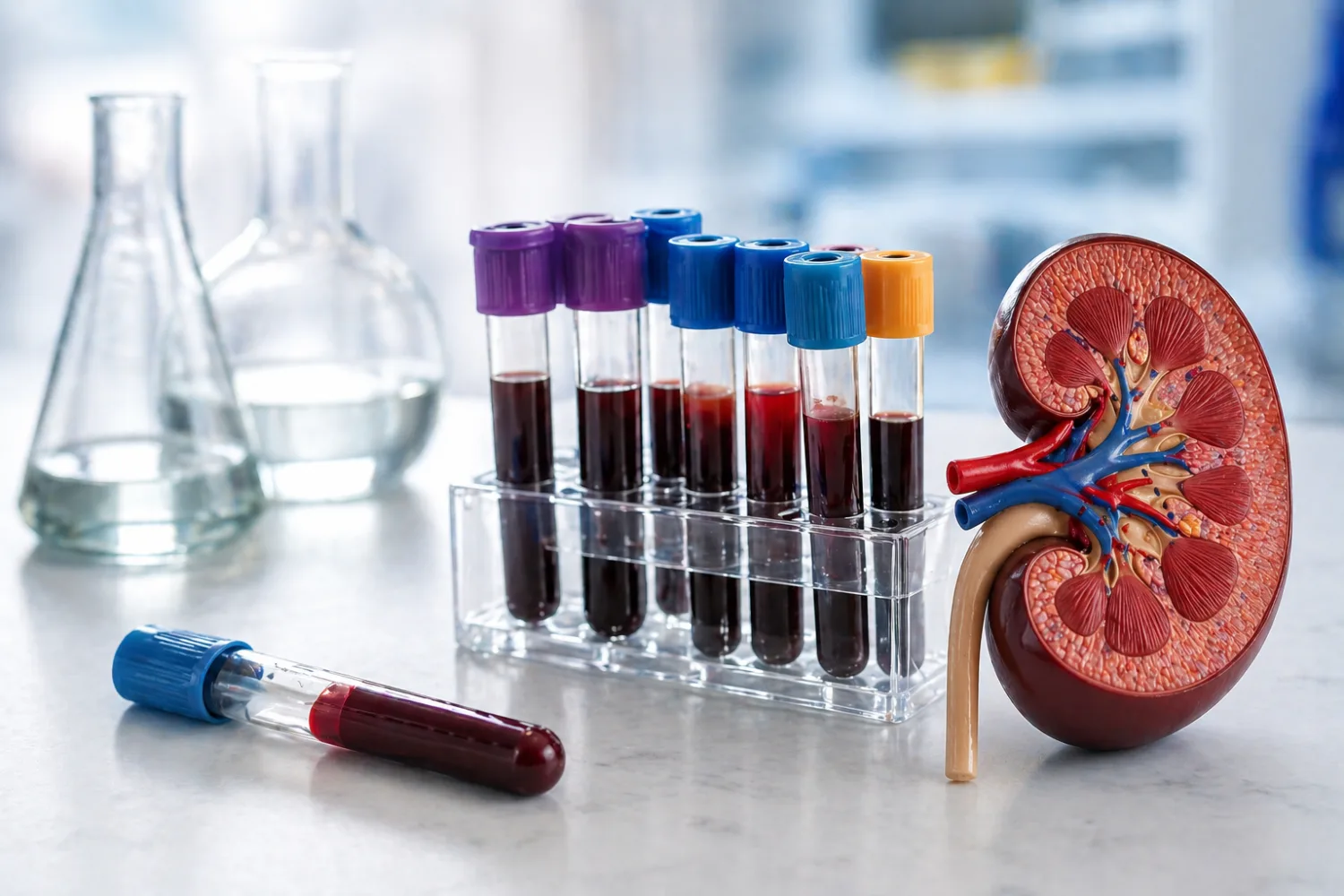
Kidney blood tests are some of the most commonly misunderstood results in medicine. A patient opens the NHS app or gets a printout from a private test and sees a creatinine that looks a bit high, an eGFR that looks a bit low, or a urea result outside the lab range. Within minutes, they are wondering if they have kidney failure.
That reaction is understandable, but it is often not accurate.
Kidney blood tests are useful because they help show how well the kidneys are filtering waste and maintaining balance in the body. But one isolated number rarely tells the whole story. The NHS guidance on chronic kidney disease diagnosis explains that the main blood test looks at creatinine and uses it to calculate an estimated glomerular filtration rate, or eGFR, which gives a measure of how well the kidneys are filtering blood.
This guide explains the kidney-related test results UK patients most often see, what they can mean, what they do not necessarily mean, and when it makes sense to follow up with a GP rather than panic over a red flag on a report.
What kidney blood tests are actually checking
The kidneys act as the body’s filtration and balancing system. They help remove waste products, regulate fluid levels, balance salts and minerals, and support blood pressure and other body functions. Kidney blood tests do not measure “kidney health” in one neat way. Instead, they look at substances that build up or change when kidney filtering is reduced, especially creatinine and urea. Blood results are often paired with a urine test called albumin-to-creatinine ratio or ACR, because kidney disease is identified using both eGFR and albumin in the urine rather than blood numbers alone. NICE says CKD is classified using a combination of eGFR and urinary albumin:creatinine ratio (ACR).
This is the first big point patients often miss: kidney assessment is usually not based on one blood result alone. Doctors often need the blood numbers, the urine findings, your blood pressure, your medical history and sometimes repeat tests over time.
Creatinine: the number people notice first
Creatinine is one of the main waste products measured when doctors check kidney function. Lab Tests Online UK explains that a creatinine test measures the level of creatinine in the blood to assess how well the kidneys are filtering waste from the body.
If creatinine rises, that often suggests the kidneys are filtering less efficiently. But this is where interpretation becomes more complicated than many people realise. Creatinine is also influenced by factors such as muscle mass, hydration and recent illness. Someone who is muscular may naturally run a higher creatinine than a smaller, less muscular person. Someone who is dehydrated may temporarily show a worse-looking result than usual. So a slightly raised creatinine does not automatically mean serious kidney disease.
A useful real-life example is the person who does a routine health check after a stomach bug, poor fluid intake and a week of anti-inflammatory tablets. Their creatinine comes back a bit high. That result matters, but it may reflect a temporary strain on the kidneys rather than long-term damage. That is one reason repeat testing is so common.
eGFR: the result that causes the most anxiety
eGFR stands for estimated glomerular filtration rate. It is a calculation based mainly on your creatinine result and personal factors such as age and sex, and it estimates how much blood the kidneys filter each minute. The NHS says healthy kidneys should usually filter more than 90 ml/min, and a lower rate can suggest chronic kidney disease depending on the wider picture.
Lab Tests Online UK notes that eGFR is an estimate of actual filtration rate rather than a directly measured value, and that it may be calculated using factors such as age, height, weight, sex and serum creatinine.
This is important because eGFR is not a perfect fixed truth. It is an estimate. It is very useful clinically, but it is still an estimate, and that means one isolated result can sometimes look worse than the overall clinical reality.
Patients often see an eGFR of 72, 68 or 59 and immediately think their kidneys are failing. That is not how doctors read it. A mildly reduced eGFR may need repeating. It may reflect age-related change, dehydration, temporary illness or natural variation. NICE visual guidance says that if eGFR is below 60 ml/min/1.73m² or ACR is 3 mg/mmol or higher, the tests should usually be repeated after 3 months to help determine whether CKD is really present.
Why a low eGFR does not always mean chronic kidney disease
This is probably the single most useful point in the whole article. Chronic kidney disease is not usually diagnosed from one blood test. NICE and NHS guidance both make clear that chronic kidney disease is identified using a combination of eGFR and urine findings, and that persistence over time matters. NICE recommends testing using eGFRcreatinine and ACR in at-risk adults, and follow-up guidance commonly relies on repeat testing after several months.
So if your eGFR is a bit below range once, that does not automatically mean you have established CKD. Doctors usually want to know whether it stays low, whether there is protein or albumin in the urine, whether you have diabetes or high blood pressure, whether the numbers are changing over time, and whether there are other risk factors or symptoms.
A one-off result is a clue. It is not always a diagnosis.
Urea: a useful but less specific marker
Urea is another waste product measured in kidney blood tests. Lab Tests Online UK explains that the urea test measures a waste product formed from protein breakdown and is used to assess kidney function and monitor kidney disease or dehydration.
Urea can be helpful, but it is generally less specific than creatinine. It can rise if kidney function is reduced, but it can also be affected by dehydration, high protein intake, bleeding in the gut and other factors. That is why doctors rarely interpret urea on its own. It tends to be more useful as part of the broader renal panel rather than as the star result.
A common pattern is someone who has both raised urea and a slightly raised creatinine after not drinking enough and feeling unwell. That may look worrying on paper, but the cause may be temporary fluid imbalance rather than chronic disease. The opposite is also true: a normal-ish urea does not cancel out a more meaningful creatinine or eGFR trend.
ACR: the urine test that often matters as much as the blood test
If blood tests are one half of kidney assessment, ACR is often the other half. The NHS urine albumin to creatinine ratio test page explains that ACR helps identify kidney disease, especially as a complication of diabetes. Lab Tests Online UK describes ACR as a urine test that compares the amount of albumin with creatinine and is used to detect early kidney damage, particularly in people with diabetes or high blood pressure.
This is why a patient with a “borderline” eGFR but a normal ACR may be managed very differently from someone with the same eGFR plus clearly raised urine albumin. Albumin in the urine suggests the kidneys may be leaking protein, which can be an important sign of kidney damage even when the blood numbers are not dramatic.
Put simply: blood tests tell doctors about filtering, while ACR helps tell them whether the kidneys are leaking protein. Both matter.
Who gets checked for kidney disease in the UK?
NICE recommends CKD testing using eGFRcreatinine and ACR in adults with risk factors such as diabetes, hypertension, previous acute kidney injury, cardiovascular disease, structural kidney tract disease, recurrent kidney stones, gout, multisystem disease, family history of end-stage kidney disease or hereditary kidney disease, and incidental haematuria or proteinuria.
That means kidney blood tests often turn up in the context of wider long-term health checks. They are not just for people with obvious kidney symptoms. In fact, many people with early CKD feel completely well, which is why these tests are so important in routine monitoring.
This article should naturally link to your existing content on high blood pressure, home blood pressure monitoring, cholesterol test results explained and how to understand blood test results, because kidney monitoring often sits inside the bigger cardiovascular-risk picture.
What “kidney function normal” usually means
If your creatinine is within range, your eGFR is comfortably normal and there is no albumin leak on urine testing, that is reassuring. But even here, it is worth understanding what “normal” does and does not mean. It means the tests did not show evidence of significantly reduced filtration or obvious kidney damage at that time. It does not mean every urinary symptom is explained, and it does not mean someone with risk factors will never need future monitoring.
This is especially relevant in people with diabetes, blood pressure problems or a past kidney injury, where normal tests now may simply mean things are stable and should continue to be monitored rather than forgotten.
What doctors look at beyond the raw numbers
Patients naturally focus on the red-arrow result. Doctors usually look at trends and patterns. They ask whether the creatinine is stable or rising, whether the eGFR has dropped gradually or suddenly, whether there is albuminuria, whether the patient has diabetes or hypertension, whether blood pressure is controlled, and whether there are medications that might affect the kidneys. NICE quality guidance notes that the frequency of GFR monitoring should be agreed with the patient and guided by CKD severity, and that ACR does not have to be measured every single time unless it is needed to assess response to proteinuria treatment.
That pattern-based approach is why two people with the same eGFR may be managed differently. One may simply need annual monitoring. Another may need medication review, blood pressure optimisation and closer follow-up.
When kidney results suggest something more serious
Kidney results matter more urgently when there is a clear decline over time, very low eGFR, significant albuminuria, or signs that kidney function is worsening quickly. Regional NHS kidney guidance notes that nephrology advice or referral is appropriate if there is a sustained decrease in GFR of 25% or more within 12 months or a sustained decrease of 15 ml/min within 12 months.
That is an important distinction. Chronic kidney disease is often slow-moving and monitored over time, but a clear drop in function is treated differently from a stable mildly abnormal result that has not changed for years.
Symptoms also matter. If kidney-related blood results come with swelling, breathlessness, severe dehydration, confusion, very low urine output or severe illness, that moves the situation out of the “routine review” category and into something more urgent.
Why dehydration can distort kidney blood tests
This is one of the most common reasons patients get confused by kidney results. Because creatinine and urea are linked to waste concentration and filtration, poor fluid intake, vomiting, diarrhoea or acute illness can temporarily worsen the numbers. Lab Tests Online UK specifically notes dehydration as one reason urea can be abnormal.
A typical example is someone who has a stomach bug, little appetite and poor fluid intake, then gets bloods taken the next day. Their kidney profile may look worse than usual. A repeat test after recovery may be much better. That is one reason doctors often repeat mildly abnormal renal blood tests rather than diagnosing chronic disease immediately.
Do medications affect kidney blood tests?
Yes, they can. NICE includes long-term NSAID use and medicines such as lithium, ciclosporin and tacrolimus among reasons people may need CKD testing.
This matters because patients often focus on disease and forget medication effects. Anti-inflammatory painkillers, some blood-pressure drugs, diuretics and other medicines can affect kidney blood tests, especially during illness or dehydration. This does not mean the medication is always “bad” or should be stopped without advice. It means the interpretation has to include the prescription history.
What happens after abnormal kidney blood tests
The next step depends on the pattern. Often, the doctor will repeat the blood test and pair it with a urine ACR if that has not already been done. They may also review blood pressure, diabetes control, medications and any symptoms. NICE’s visual summary for identifying CKD in adults supports repeating tests after 3 months when eGFR is below 60 or ACR is raised.
If the result is stable and only mildly abnormal, follow-up may simply mean periodic monitoring. If the results are worsening, strongly abnormal or associated with significant albuminuria, the patient may need more structured CKD management or specialist advice.
What patients often get wrong about kidney test results
The commonest misunderstanding is assuming that a single “low” eGFR means established kidney failure. It does not. Another common mistake is ignoring the urine result and focusing only on the blood number, even though NICE and NHS guidance rely on both eGFR and ACR for CKD assessment.
A third mistake is comparing your result with someone else’s instead of asking whether it is right for your age, body and medical context. eGFR is an estimate built around the individual, not a contest score.
The bottom line
Kidney blood tests are extremely useful, but they need context. Creatinine helps show how well the kidneys are filtering waste. eGFR estimates the filtration rate. Urea is another waste marker that can be influenced by kidney function and hydration. And ACR, although a urine test rather than a blood test, is a vital part of identifying chronic kidney disease. The NHS and NICE both make clear that kidney assessment is based on a combination of eGFR and ACR, often with repeat testing over time.
That means a mildly abnormal result is not something to ignore, but it is also not something to catastrophise. The right question is usually not “How bad is this?” but “Is this stable, does it need repeating, and what else does it mean in my wider health picture?”
Frequently asked questions
What does creatinine measure?
Creatinine is a waste product measured in the blood to assess how well the kidneys are filtering waste from the body. A creatinine test is used to detect, diagnose and monitor kidney disease or reduced kidney function.
What is eGFR?
eGFR is an estimated glomerular filtration rate. It is calculated mainly from creatinine and personal factors such as age and sex to estimate how well the kidneys are filtering blood.
Does a low eGFR always mean chronic kidney disease?
No. CKD is usually identified using both eGFR and urine ACR, and persistence over time matters. NICE guidance commonly recommends repeat testing after 3 months if eGFR is below 60 or ACR is raised.
What does urea tell you?
Urea is a waste product formed from protein breakdown. It is used to assess kidney function, but it can also be affected by dehydration and other non-kidney factors, so it is usually interpreted alongside other results.
What is ACR and why is it important?
ACR stands for albumin-to-creatinine ratio. It is a urine test used to detect albumin leak from the kidneys and is especially useful for identifying early kidney damage, particularly in diabetes and high blood pressure.
Why would my kidney blood tests be repeated?
Repeat testing helps show whether a mildly abnormal result is temporary or persistent. Guidance commonly recommends repeating eGFR and ACR after 3 months when the first result suggests possible CKD.
Can dehydration affect kidney blood tests?
Yes. Dehydration can worsen kidney-related blood results temporarily, especially urea and sometimes creatinine, which is why doctors often interpret results in the context of recent illness and fluid intake.
Who should be screened for CKD?
NICE recommends testing at-risk adults using eGFRcreatinine and ACR, including people with diabetes, hypertension, cardiovascular disease, previous acute kidney injury, recurrent kidney stones, gout and certain other risk factors.