Blood sugar results are some of the most important blood test numbers people receive, and also some of the easiest to misunderstand. A patient is told their HbA1c is “a bit high”, that they are “borderline diabetic”, that their fasting glucose was raised, or that they need another test to confirm things. Then the guessing starts. Does this mean diabetes? Is prediabetes inevitable? Why was one result high but another looked normal? And what is the difference between HbA1c, fasting glucose and finger-prick blood sugar readings?
This guide explains what the common blood sugar tests actually measure, what the usual UK cut-offs mean, why a single abnormal result does not always settle the diagnosis, and when follow-up matters. It is written for UK patients, using the same practical style as the rest of your “results explained” series.
What HbA1c actually measures
HbA1c is a blood test that reflects your average blood glucose level over the previous two to three months. Diabetes UK explains that HbA1c measures average blood glucose over that period, while Lab Tests Online UK describes it as measuring glycated haemoglobin in a blood sample to reflect longer-term glucose exposure.
This is why HbA1c is such a useful test. It does not tell you what your glucose is doing at one particular moment in the same way a finger-prick or fasting blood glucose test does. Instead, it gives a broader picture of what blood sugar has been like over time.
A practical example is the person who feels well, eats breakfast before a routine appointment and worries that this will ruin the result. For HbA1c, it does not work that way. Because it reflects an average over weeks rather than that morning alone, you do not normally need to fast for an HbA1c test. Lab Tests Online UK notes this is one of the reasons HbA1c is widely used for screening, diagnosis and monitoring.
What fasting glucose measures
Fasting plasma glucose is different. It measures your blood glucose level at that moment, after a period without food. Lab Tests Online UK says fasting is generally recommended for at least 8 hours before a fasting blood glucose test.
This means fasting glucose is more of a snapshot. It can be very useful, but it is more affected by what is happening that day. That is why someone may have a fasting glucose result that looks a bit off but an HbA1c that tells a slightly different story, or vice versa.
Why there is more than one blood sugar test
Doctors use different blood sugar tests because they answer slightly different questions. HbA1c is especially useful for screening, diagnosing and monitoring longer-term glucose control, while fasting glucose is helpful when a same-day blood sugar measurement is needed. Lab Tests Online UK explains that HbA1c is used to screen for, diagnose and monitor diabetes, while glucose tests are used to screen for, diagnose and monitor diabetes and other conditions affecting blood sugar control.
In some situations, an oral glucose tolerance test, or OGTT, may be used as well, especially when the diagnosis is still unclear or in pregnancy-related pathways. That is why patients sometimes end up needing more than one test before anyone gives a definite answer.
What HbA1c levels usually mean in the UK
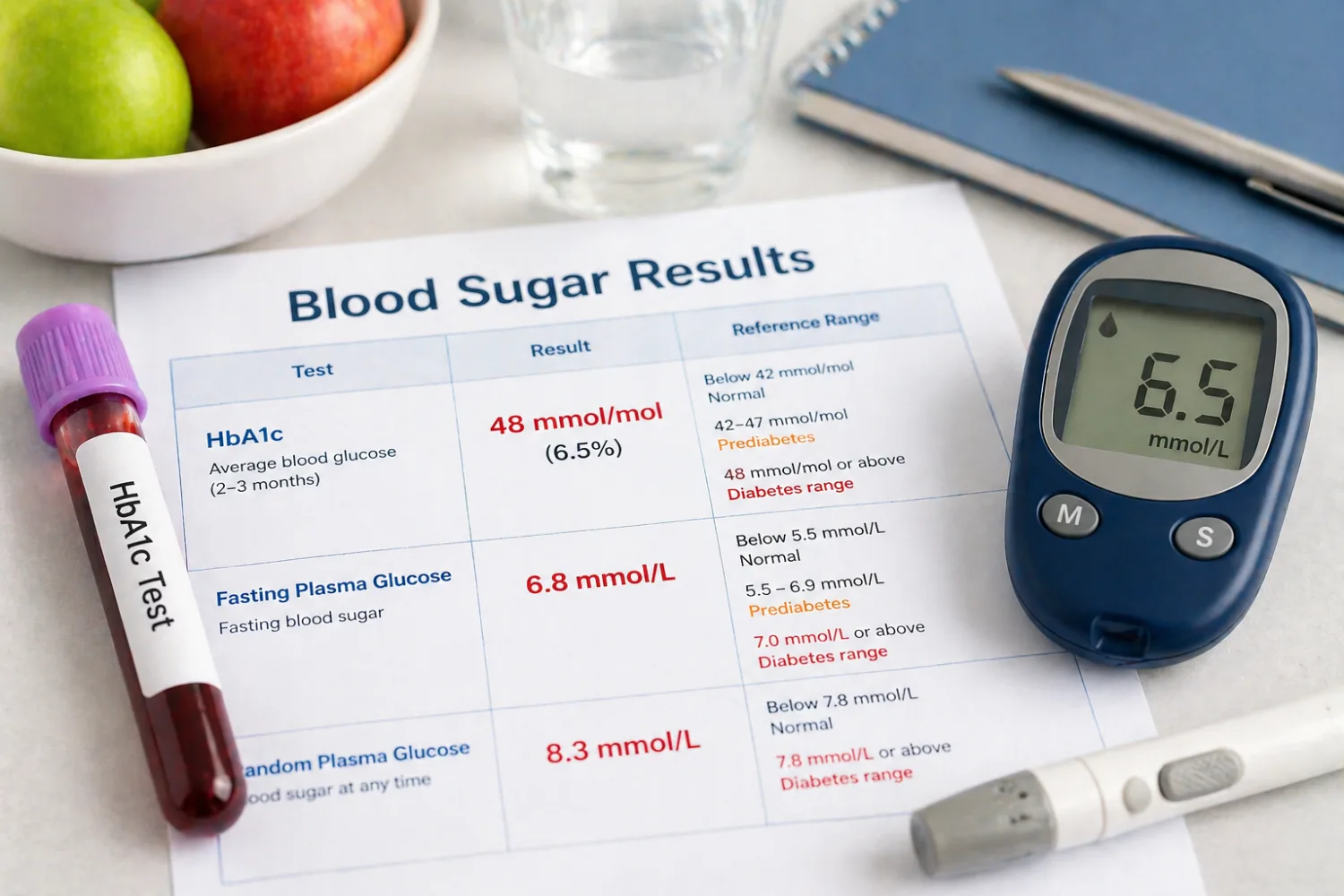
In UK guidance, an HbA1c below 42 mmol/mol is generally considered below the high-risk range, 42 to 47 mmol/mol indicates high risk / prediabetes, and 48 mmol/mol or above is in the diabetes range. NICE states that people at high risk have an HbA1c of 42 to 47 mmol/mol, and Diabetes UK says prediabetes means blood sugar levels are in that same range. Diabetes UK also notes that, for many people with diabetes, a commonly used long-term target is 48 mmol/mol (6.5%) or below, although personal targets may vary.
This is one of the most useful frameworks for patients:
Below 42 mmol/mol – usually not in the prediabetes range.
42–47 mmol/mol – prediabetes / high risk of type 2 diabetes.
48 mmol/mol or above – diabetes range, though sometimes confirmation is needed.
A person with HbA1c of 44 mmol/mol has not been told “you have diabetes”, but they have been told that blood sugar is higher than ideal and the risk of progression is increased. A person with HbA1c of 52 mmol/mol is in a different category and usually needs proper follow-up for diabetes diagnosis and management.
What prediabetes actually means
Prediabetes does not mean inevitable diabetes. It means blood sugar is higher than it should be, but not yet in the diabetes range. Diabetes UK explains that prediabetes means blood sugar levels are 42 to 47 mmol/mol on HbA1c, and NICE says people in this range are currently at high risk rather than inevitably progressing to type 2 diabetes.
This distinction matters because “borderline diabetes” often makes people panic. The more accurate interpretation is that the body is showing early difficulty with glucose control, and this is the point where lifestyle changes can have a real impact. Diabetes UK notes that changes in weight, activity and diet can help reduce blood sugar and, in some cases, return it to a non-prediabetes range.
A common real-life example is someone who feels completely well, has a routine health check, and is told their HbA1c is 43 mmol/mol. That can feel alarming, but it is often an opportunity rather than a catastrophe. It is the point where action can genuinely make a difference.
What a diabetes-range HbA1c means
An HbA1c of 48 mmol/mol or above is in the diabetes range. NICE and Diabetes UK both use this threshold in routine adult diagnosis.
But diagnosis is not always made from one isolated number in every circumstance. If someone has no symptoms, clinicians may sometimes repeat testing or use an additional glucose-based test to confirm the diagnosis, depending on the clinical picture. This is especially true if the result is only just in range or if there is any reason to question the reliability of the result.
This is similar to the logic in your other “results explained” guides: a result in the diagnostic range matters, but doctors still interpret it in context.
What fasting glucose levels usually mean
For fasting plasma glucose, UK guidance commonly treats 5.5 to 6.9 mmol/L as high-risk / prediabetes territory in prevention pathways, while 7.0 mmol/L or above is in the diabetes range. NICE states that people at high risk may have a fasting plasma glucose of 5.5 to 6.9 mmol/L, and Royal Devon diagnostic guidance uses 7.0 mmol/L and above for diabetes, 6.1 to 6.9 mmol/L for impaired fasting glucose, and 6.0 mmol/L or below as normal in routine adult cases.
This explains why a doctor may say your fasting glucose is “a bit high” even if you are not yet diabetic. The same broad principle applies as with HbA1c: there is a grey zone where glucose is too high to ignore but not yet clearly diabetes.
Why HbA1c and glucose can sometimes disagree
Patients often worry if one test looks abnormal and another looks less dramatic. But that can happen for understandable reasons. HbA1c reflects an average over weeks, while fasting glucose is a snapshot taken on one day. Lab Tests Online UK explains that HbA1c reflects the previous two to three months, while fasting glucose depends on the immediate measurement conditions and fasting period.
So someone might have a fasting glucose that is slightly raised because of a poor night, illness, stress or early glucose dysregulation, while their HbA1c has not yet fully shifted. Another person may have an HbA1c that is firmly raised because their average glucose has been high for months, even if the single fasting reading on the day was not dramatically abnormal.
What finger-prick blood sugar readings mean
Finger-prick blood sugar testing is different again. Diabetes UK explains that this kind of testing shows what your glucose level is at that moment, whereas HbA1c gives the longer-term average.
This is why someone who already has diabetes may see two very different types of result in their care. Their home readings help guide day-to-day management, while HbA1c helps show the bigger picture over the past few months. Not everyone with diabetes needs to finger-prick test regularly, but many people using certain medications do, and the two types of data complement each other rather than compete.
What doctors look at beyond the number
Patients naturally focus on the result itself. Doctors usually look at the wider pattern. They ask whether you have symptoms of diabetes, whether the result is just above or well above the threshold, whether weight, family history, blood pressure and lipids suggest insulin resistance, and whether the number is improving, stable or worsening over time.
This is why HbA1c results link naturally with the broader cardiovascular and metabolic picture. On your site, this guide should connect well with how to understand blood test results, cholesterol test results explained, high cholesterol, high blood pressure and home blood pressure monitoring.
What happens after a prediabetes result
If your HbA1c is in the 42–47 mmol/mol range, UK guidance usually focuses on lifestyle advice, weight, exercise and ongoing monitoring. NICE says people at high risk should be told they are currently at high risk rather than definitely diabetic, that the risk can be reduced, and that they should usually be offered repeat blood testing at least yearly.
That means prediabetes is a follow-up issue, not a dead-end label. A person with prediabetes should usually leave the conversation understanding two things: the result matters, and there is something useful they can do about it.
What happens after a diabetes-range result
If HbA1c or glucose is in the diabetes range, the next steps usually include proper review, sometimes repeat confirmation, and discussion about management. The exact pathway depends on symptoms, the type of diabetes suspected, and how clear-cut the results are. A very high result with classic symptoms of diabetes is a different situation from a mildly raised screening result in someone who feels well.
That is one reason patients should not try to fully interpret a diabetes-range result by themselves from the lab portal. The result is important, but what happens next depends on the clinical picture.
When HbA1c is used after diagnosis
Once diabetes has been diagnosed, HbA1c is also used as a monitoring test. Diabetes UK says it is the main blood test used to see what average glucose has been like over the previous two to three months, and NICE information for adults with type 1 diabetes notes that a commonly used target for many people is 48 mmol/mol (6.5%) or lower, though targets vary/
That means HbA1c has two jobs: helping diagnose blood sugar problems and helping track how well glucose is being controlled over time once a diagnosis already exists.
Why one result may need repeating
As with many blood tests, one abnormal result may need confirmation, especially if the person has no symptoms or the number is only just over a threshold. NICE prevention guidance specifically discusses people whose first blood test measures HbA1c of 48 mmol/mol or greater or fasting glucose of 7.0 mmol/L or above but who do not yet have a confirmed diagnosis, which is one reason repeat testing can be part of good practice.
This is not doctors being indecisive. It is normal medicine. Repeating a borderline diagnostic test helps confirm that the result is real and persistent rather than a one-off anomaly.
Questions worth asking after HbA1c or glucose results
If you have had blood sugar tests and do not understand the result, better questions usually lead to better answers.
Ask whether the result is normal, prediabetes-range or diabetes-range. Ask whether this was based on HbA1c, fasting glucose or both. Ask if the result needs repeating. Ask what this means for your long-term risk, whether you need weight, diet or activity changes, and when the test should be checked again.
Those questions are much more useful than simply asking, “Is it bad?”
The bottom line
HbA1c shows your average blood sugar over the last two to three months. Fasting glucose shows what it is doing at one moment after fasting. In UK guidance, HbA1c of 42–47 mmol/mol usually means prediabetes or high risk, while 48 mmol/mol or above is in the diabetes range. Fasting glucose has its own thresholds and is interpreted differently because it is a snapshot rather than an average.
The most useful way to think about these results is not “good” or “bad”, but “what pattern is this showing, and what do I need to do next?” For many people, especially those in the prediabetes range, that next step can make a real difference.
Frequently asked questions
What does HbA1c measure?
HbA1c measures average blood glucose over the previous two to three months. It is used to screen for, diagnose and monitor diabetes.
What HbA1c level means prediabetes?
In UK guidance, an HbA1c of 42 to 47 mmol/mol indicates prediabetes or high risk of type 2 diabetes.
What HbA1c level means diabetes?
An HbA1c of 48 mmol/mol or above is in the diabetes range, though sometimes confirmation is needed depending on the situation.
Do I need to fast for an HbA1c test?
No, not usually. HbA1c reflects average blood glucose over weeks rather than the impact of one meal on the day of the test.
Do I need to fast for a fasting glucose test?
Yes. Lab Tests Online UK says fasting is generally recommended for at least 8 hours before a fasting blood glucose test.
Can HbA1c and fasting glucose tell different stories?
Yes. HbA1c reflects a longer-term average, while fasting glucose is a single-time snapshot, so they do not always move in exactly the same way.
What happens after a prediabetes result?
Usually the focus is on lifestyle advice, weight, activity and repeat testing. NICE recommends at least yearly blood testing for people at high risk.
What HbA1c target do people with diabetes usually aim for?
Targets vary, but Diabetes UK and NICE information for adults with type 1 diabetes both use 48 mmol/mol (6.5%) or lower as a common target for many people, while recognising that some people will have different personal targets.