Home blood pressure monitoring sounds simple, and in many ways it is. You buy a machine, put the cuff on, press a button and get a number.
But the number is only useful if you measure it properly and understand what it actually means.
That is where many people run into trouble. Some people check it straight after rushing upstairs. Some take one high reading and panic. Others repeat it ten times in a row until anxiety pushes it even higher. Some buy a monitor but never learn how to sit, how long to rest, or how often to measure.
Done properly, home blood pressure monitoring can be extremely helpful. It can give a clearer picture than a one-off clinic reading, help confirm whether blood pressure is genuinely high, show whether treatment is working, and help avoid the “white coat” effect, where readings rise because of the stress of being in a medical setting.
NICE recommends confirming raised clinic readings with ambulatory blood pressure monitoring where possible, or home monitoring if ambulatory monitoring is not suitable.
This guide explains how home blood pressure monitoring works, how to do it properly, what can distort the readings, what numbers tend to mean, when to speak to your GP, and when high readings may be urgent.
Why home blood pressure monitoring matters
High blood pressure is one of the most important preventable risk factors for heart attack, stroke, kidney disease and other cardiovascular problems.
The difficulty is that it often causes no symptoms at all. Many people feel completely normal until it is picked up by chance at a GP appointment, pharmacy check, NHS Health Check or home test.
That is one reason home monitoring is so useful. It helps move blood pressure from guesswork to evidence.
If you have not already read it, our guide to high blood pressure explains the condition in more depth, including causes, treatment and longer-term risks.
Why home readings can be more useful than clinic readings
A clinic reading gives useful information, but it is only one moment in one setting.
Some people are more tense in medical environments and their blood pressure rises temporarily. Others may have the opposite problem and show acceptable clinic readings while their blood pressure runs higher in normal daily life.
Home monitoring can help because it shows what your blood pressure looks like in a more ordinary environment.
NHS and British Heart Foundation advice both support home monitoring as a practical way to measure and manage blood pressure over time.
That does not mean home readings are always perfect. They still depend on technique, timing and consistency.
What blood pressure numbers mean
A blood pressure reading has two numbers, such as 136/84 mmHg.
- The top number is the systolic pressure, the pressure when the heart pumps.
- The bottom number is the diastolic pressure, the pressure between beats.
When people monitor at home, they often want one simple answer: what number is normal and what number is dangerous?
In real life, it is more nuanced than that. A single reading matters less than a pattern. Age, medical history, diabetes, kidney disease, symptoms and overall cardiovascular risk all affect how the result is interpreted.
NICE uses different thresholds for clinic readings and home or ambulatory readings.
In general terms, home readings averaging 135/85 mmHg or above are more likely to be considered high, and for treatment targets NICE also distinguishes between people under 80 and those aged 80 or over.
Why one reading is not the whole story
A single high reading does not automatically mean you are in immediate danger.
It may reflect stress, recent activity, caffeine, poor technique, pain, anxiety, a full bladder, or simply normal variation. Blood pressure moves around during the day. That is normal.
What matters more is whether the readings are consistently high when taken properly over time.
This is one of the reasons clinicians work with averages and patterns, not one-off numbers in isolation.
Who should consider monitoring at home?
Home blood pressure monitoring is often helpful if:
- your clinic reading has been raised
- you have previously been told your blood pressure is borderline
- you are already on blood pressure treatment and want to monitor control
- you tend to get nervous at appointments
- you have diabetes, kidney disease or higher cardiovascular risk
- you have a strong family history of stroke, heart disease or hypertension
It can also be useful for people who simply want to know their baseline numbers in a more reliable way.
However, home monitoring can become unhelpful if it turns into repeated anxious checking. The aim is to collect useful information, not to create a new source of worry.
Choosing the right blood pressure monitor
Not all machines are equally useful.
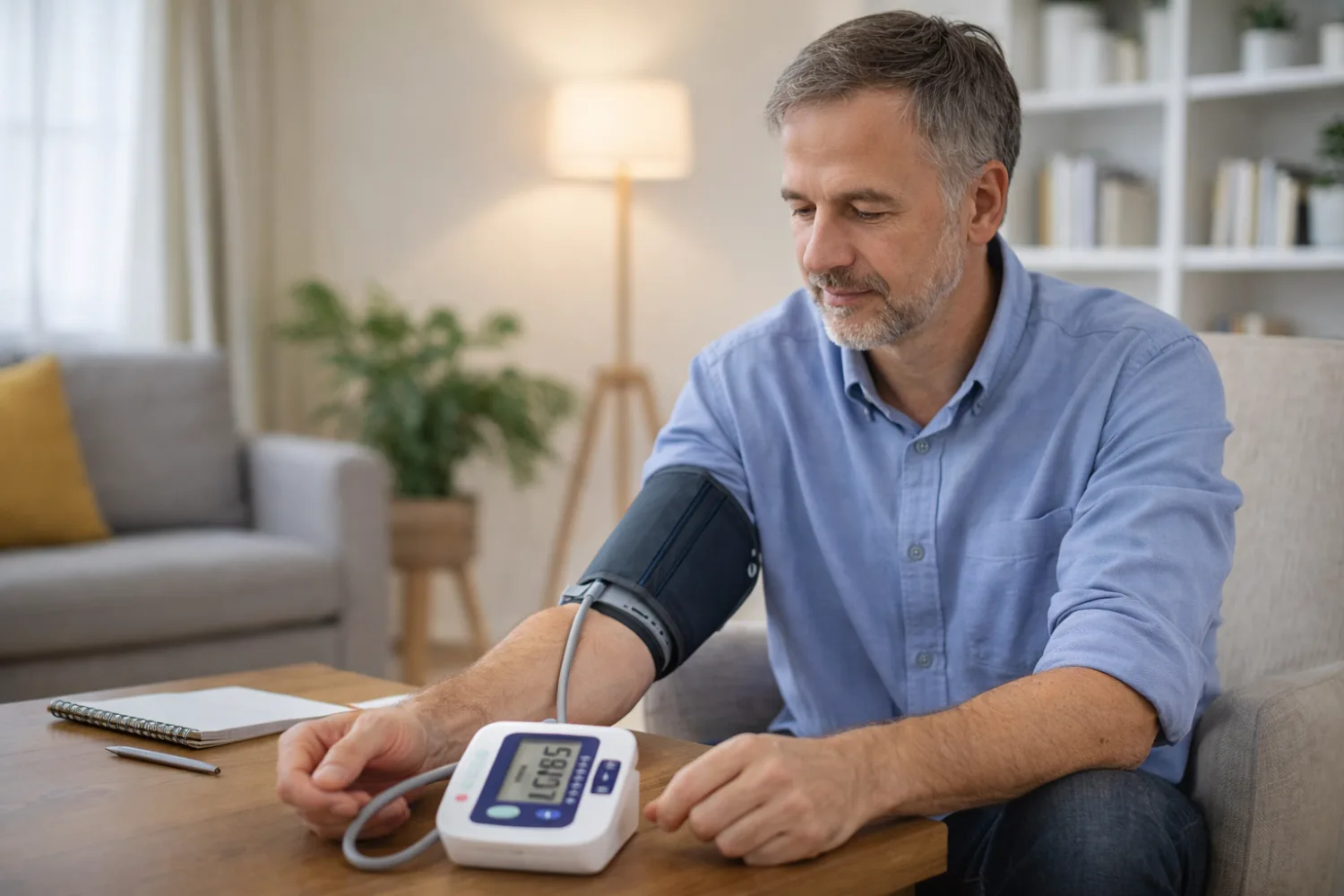
In general, an upper-arm monitor is preferred over wrist devices for most people, because it tends to give more dependable readings when used correctly.
The cuff size matters as well. If the cuff is too small or too large for your arm, the result may be misleading.
The British Heart Foundation notes that the cuff should fit snugly around the upper arm and that some people may need a different cuff size from the standard one supplied.
In practical terms, a good home monitor should be:
- an upper-arm machine rather than a wrist device where possible
- easy to use and easy to read
- used with the correct cuff size for your arm
- kept in good condition
- used according to the instructions
How to measure blood pressure properly at home
This is the part that makes the biggest difference. Technique matters more than many people realise.
Before taking a reading:
- sit on an upright chair with back support
- keep both feet flat on the floor
- rest your arm on a table so it is supported
- keep the cuff on bare skin rather than over clothing
- rest quietly for about 5 minutes first
- do not talk during the reading
NHS guidance specifically says to sit upright with back support, place your feet flat on the floor, rest your arm on a table, keep clothing away from the cuff, relax and breathe normally, and take another reading a few minutes after the first.
It is also sensible not to measure immediately after exercise, rushing around, smoking, drinking caffeine, or feeling flustered.
Those factors can all push the number up temporarily.
Common mistakes that make readings misleading
Many worrying or confusing readings come down to technique rather than a sudden medical change.
Common problems include:
- measuring too soon after walking upstairs or rushing
- talking during the test
- crossing your legs
- sitting without back support
- using the wrong cuff size
- placing the cuff over clothing
- taking only one reading and assuming it tells the whole story
- checking repeatedly because of anxiety
Blood Pressure UK also advises taking two or three readings about one minute apart, keeping still and quiet, and following the monitor instructions carefully.
How often to take readings
This is where many people either do too little or far too much.
For home blood pressure monitoring used in diagnosis, the standard UK approach is usually to take at least two readings, one minute apart, twice a day, ideally morning and evening, for four to seven days, and then average the readings apart from the first day.
This is reflected in the NICE-linked summary literature and NHS practice diaries.
In plain English, that usually means:
- take 2 readings in the morning
- take 2 readings in the evening
- repeat this over several days as advised
- record the numbers exactly as shown
Do not round them up or down, and do not throw away “bad” readings just because you do not like them.
When should you measure?
If your GP or nurse has given you specific instructions, follow those.
If you are doing a home monitoring series for assessment, the most common approach is morning and evening measurements at roughly similar times each day.
NHS advice says that when a healthcare professional has asked you to monitor at home, you should usually do it morning and evening as advised.
Try not to keep changing the routine. A consistent pattern makes the results easier to interpret.
What to record for your GP or nurse
If you are monitoring at home for a clinical reason, keep a simple diary.
It helps to record:
- the date
- the time
- the systolic and diastolic reading
- pulse, if your machine shows it
- anything relevant, such as missed medication or feeling unwell
Keep it clear and exact. Write the numbers exactly as the machine shows them.
Understanding patterns in your readings
Home monitoring is most useful when it shows a pattern over time. That pattern can help distinguish between occasional raised readings, white coat effect, masked hypertension and genuinely high blood pressure at home.
Lower at home than at the surgery
Some people have readings that are high at the surgery but lower at home.
That can happen because being in a clinical setting makes them tense. This is often called a white coat effect, and it is one of the main reasons home monitoring can be valuable.
NICE specifically discusses white coat effect and masked hypertension, and non-clinic measurements can help sort out which pattern is actually present.
That does not mean clinic readings should be ignored. It means both types of measurement can be useful in context.
High even at home
If your readings are repeatedly high at home, that is worth taking seriously, even if you feel well.
High blood pressure often causes no symptoms, but it still increases the risk of heart attack and stroke over time.
That is why home monitoring matters so much in prevention.
If stroke prevention is on your mind, our guide to stroke symptoms and TIA explains what urgent warning signs look like and why rapid action matters.
How blood pressure fits into overall cardiovascular risk
Blood pressure does not exist in isolation. A home reading becomes much more meaningful when looked at alongside:
- cholesterol levels
- smoking status
- blood sugar or diabetes risk
- kidney health
- family history
- weight and waist size
- age and overall cardiovascular risk
That is why someone with mildly raised blood pressure and no other risk factors may be managed differently from someone with the same readings plus diabetes, high cholesterol and a strong family history.
If your cholesterol has also been raised, see our guide to high cholesterol.
When to contact your GP or get urgent help
Home monitoring is not meant to replace medical advice. It is a way of collecting better information so that you and your clinician can make better decisions.
When to contact your GP
Contact your GP or practice nurse if:
- your home readings are repeatedly high over several days
- you have been asked to monitor and the average is above the range you were told to aim for
- you are already on treatment but your blood pressure still looks poorly controlled
- you are getting side effects and are thinking of stopping medication
- the readings are confusing or inconsistent and you are unsure whether technique is the problem
Do not stop prescribed blood pressure medication just because one or two readings look better. The whole point of treatment is often that it keeps them better.
When a home reading may be urgent
Very high numbers can be worrying, but the reading matters even more if it is accompanied by symptoms.
Seek urgent advice the same day if your blood pressure is very high on repeated readings, especially if this is new for you.
Some NHS practice guidance given to patients advises contacting your GP the same day, or NHS 111 when closed, if you get two or more readings in a row over 170/115 mmHg.
Call 999 immediately if a high reading is accompanied by symptoms such as:
- chest pain
- sudden severe breathlessness
- new weakness or numbness on one side
- facial droop or speech difficulty
- collapse
- severe confusion
- sudden major visual disturbance
At that point, the issue is not routine home monitoring anymore. It may be a medical emergency.
Real-life examples
“I checked it after running up the stairs and thought I had a crisis”
Andrew buys a home monitor, takes a reading immediately after getting home, and gets a high result. He panics, repeats it five times and becomes more anxious each time.
What would help: sitting quietly for five minutes, taking two properly spaced readings, and looking at the pattern over several days instead of one moment.
“Mine is always high at the surgery but better at home”
Rachel gets nervous at appointments. Her clinic reading is repeatedly raised, but her home readings are lower and more stable.
What this may show: white coat effect, which is exactly why home monitoring can be valuable.
“I felt fine, so I ignored repeated high numbers”
Michael keeps seeing raised home readings but delays doing anything because he has no symptoms.
The problem: high blood pressure is often silent.
The risk: untreated hypertension raises the chance of heart attack and stroke over time.
What to avoid
- Do not check it obsessively. Repeated anxious checking can make readings less useful.
- Do not take readings straight after rushing about.
- Do not rely on one reading alone.
- Do not use the wrong cuff size.
- Do not stop medication because you feel fine.
- Do not ignore consistently high home readings.
FAQ: home blood pressure monitoring
What is a normal home blood pressure reading?
There is no single perfect number for everyone, but home readings averaging around 135/85 mmHg or above are generally more likely to be considered high. Your own target may depend on age, health conditions and treatment plan.
How many blood pressure readings should I take at home?
If you are doing a monitoring series for diagnosis or review, you may be asked to take two readings in the morning and two in the evening for several days. Follow the plan given by your GP, nurse or pharmacist.
Should I worry about one high reading?
One high reading does not always mean an emergency. It may reflect stress, activity, caffeine, pain, anxiety or poor technique. Rest, repeat correctly, and look at the pattern. Very high readings with symptoms need urgent help.
Why is my blood pressure higher at the GP surgery?
Some people have a white coat effect, where blood pressure rises in a clinical setting. Home monitoring can help show whether readings are also high in normal daily life.
Can I stop blood pressure tablets if my home readings improve?
No. Do not stop prescribed medication without medical review. Your readings may be better because the medicine is working.
Is a wrist blood pressure monitor accurate?
Wrist monitors can be more sensitive to position and technique. For most people, an upper-arm monitor is preferred where possible.
What can make blood pressure readings falsely high?
Recent exercise, rushing, talking, crossed legs, caffeine, smoking, pain, anxiety, a full bladder, poor cuff position or the wrong cuff size can all affect readings.
When should I seek urgent help for blood pressure?
Seek urgent advice if readings are very high repeatedly, especially if this is new for you. Call 999 if a high reading comes with chest pain, severe breathlessness, weakness on one side, facial droop, speech difficulty, collapse, confusion or sudden major visual disturbance.
Final takeaway
Home blood pressure monitoring is one of the most useful ways to understand whether your blood pressure is genuinely high and whether treatment is working.
But it only helps if it is done properly.
The basics matter: use a suitable upper-arm monitor, sit correctly, rest before measuring, do not talk, take repeat readings, and look for a pattern rather than reacting to one isolated number.
If your readings are consistently high, do not ignore them just because you feel normal.
And if a very high reading comes with chest pain, stroke-like symptoms or severe breathlessness, seek emergency help immediately.