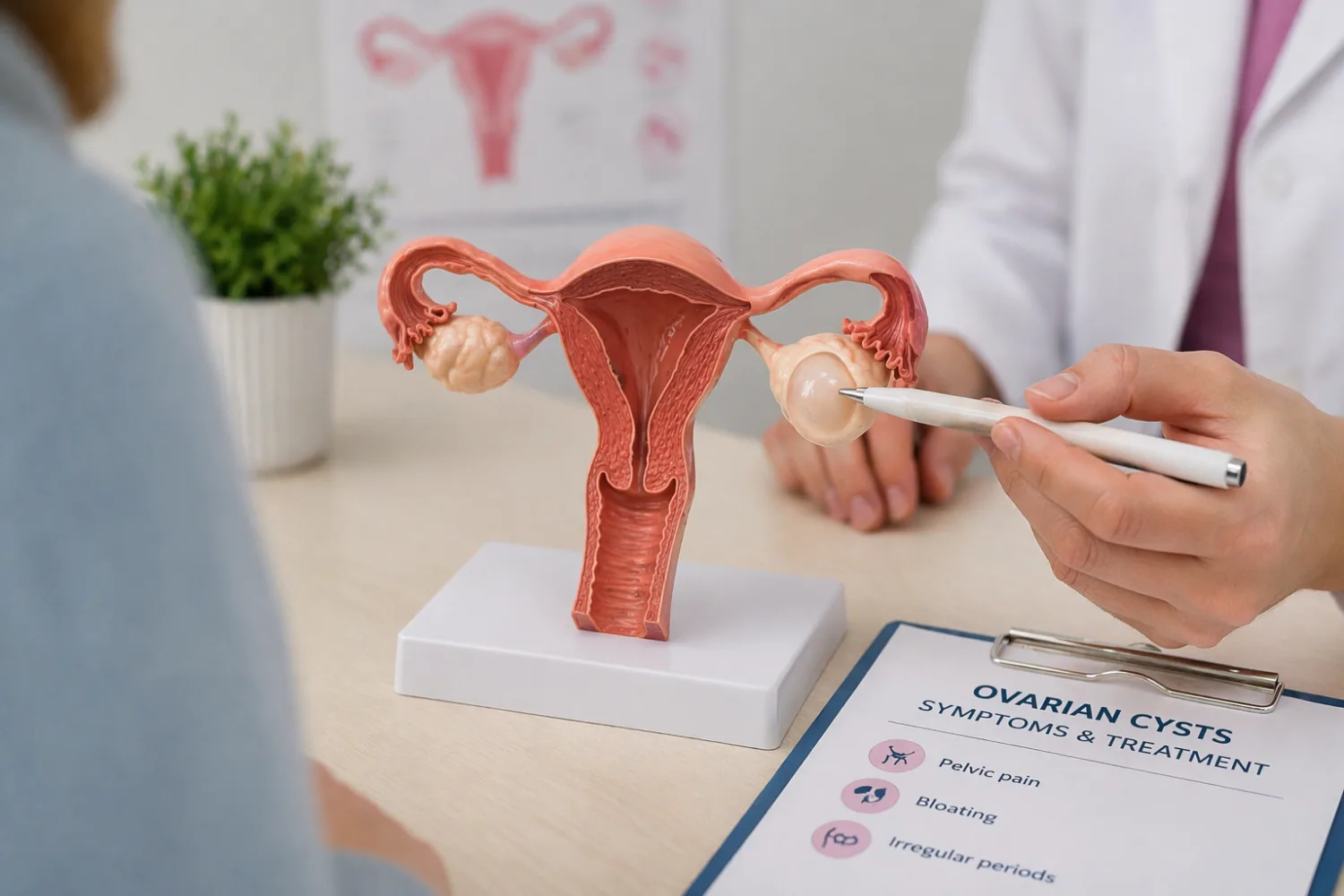
Being told you have an ovarian cyst can sound alarming, especially if it turns up after pain, bloating, a scan, or an appointment you were not expecting to become more serious. But ovarian cysts are common, and many are harmless. In fact, a lot of women only find out they have one because they had a scan for something else. Some cysts cause no symptoms at all and go away on their own. Others can cause pain, pressure, changes in periods, or occasionally more urgent problems that need quick medical attention.
What makes ovarian cysts confusing is that the phrase covers several different things. Some cysts are linked to the normal menstrual cycle. Some are related to conditions such as endometriosis or PCOS. Some need only monitoring. Some need surgery. And a few need more careful assessment because of their size, appearance or the age of the woman affected.
This guide explains what ovarian cysts are, what symptoms they can cause, how they are usually investigated in the UK, what scan results may mean, and when treatment is needed rather than simple watchful waiting.
If you want wider context around women’s health symptoms, it may help to read our guides to Women’s Health: Symptoms, Common Conditions and Treatment in the UK, Fibroids: Symptoms, Heavy Bleeding and Treatment in the UK, PCOS: Symptoms, Diagnosis and Treatment in the UK and Heavy Periods: Causes, Tests and Treatment Options in the UK.
What is an ovarian cyst?
An ovarian cyst is a fluid-filled sac that develops on or in an ovary. Some are small and simple, containing only fluid. Others are more complex and may contain blood, thicker fluid or solid areas. Some develop as part of normal ovulation and disappear by themselves. Others are linked to specific conditions or tissue types and may stay around for longer.
Most ovarian cysts before menopause are benign. That means they are not cancer. But “benign” does not always mean “irrelevant”. A cyst can still be painful, worrying, or important to follow up depending on its size, appearance and the symptoms it causes.
What do ovarian cysts feel like in real life?
Some women feel nothing at all. Others describe a dull ache low in the abdomen, a sharp pain on one side, pressure, bloating, or the feeling that something is just not right. A cyst may be noticed after pain during sex, discomfort with exercise, a sudden episode of pelvic pain, or a scan arranged for another reason.
One of the reasons ovarian cysts create so much anxiety is that symptoms can be vague. A woman may think she just feels bloated or uncomfortable. Another may blame digestive symptoms. Another may notice pain that seems to come and go and not be sure whether it is related to periods, ovulation, the bowel, or something else.
That uncertainty is common. It is also why scans are often such an important part of the diagnosis.
Common symptoms of ovarian cysts
Not every cyst causes symptoms, but when symptoms do happen, they can include:
- pain low in the abdomen or pelvis, often on one side
- bloating or a feeling of fullness
- pressure in the lower abdomen
- pain during sex
- changes in periods
- needing to pass urine more often if a larger cyst presses on the bladder
- discomfort during exercise or sudden movement
If symptoms are persistent, worsening, or keep returning, they deserve proper assessment rather than guesswork.
What kinds of ovarian cyst are there?
There are several types, but in practical terms they often fall into a few broad groups.
Functional cysts
These are linked to the normal menstrual cycle and are very common before menopause. They often disappear on their own over time without any treatment.
Endometriomas
These are cysts linked to endometriosis. They can be associated with pelvic pain, painful periods, pain during sex and fertility issues. If that pattern sounds familiar, see our guide to Endometriosis: Symptoms, Diagnosis and Treatment in the UK.
Dermoid cysts and cystadenomas
These are less directly linked to the menstrual cycle and may persist rather than disappearing naturally. Some need monitoring and some need surgery depending on size and symptoms.
Cysts linked with PCOS
PCOS is different from “having an ovarian cyst”, but it is often confused with it. PCOS involves multiple small follicles and a wider hormonal syndrome rather than one typical symptomatic cyst. If periods are irregular and acne, excess hair growth or fertility issues are also part of the picture, see our PCOS guide.
Do ovarian cysts always need treatment?
No. Many do not. This is one of the most important things to understand. A lot of cysts, especially simple cysts before menopause, are monitored and then disappear over a few months. If the cyst is small, simple in appearance and not causing significant symptoms, the safest and most sensible plan is often to watch and repeat the scan later if needed.
Treatment becomes more likely if a cyst is large, persistent, causing symptoms, looks complex on imaging, or raises concern that it may not be a simple benign cyst.
How are ovarian cysts found?
Some are found after symptoms lead to an ultrasound. Others are picked up incidentally during imaging for something else. In the UK, the main investigation is usually a pelvic ultrasound, either through the abdomen or with a transvaginal scan for a clearer view.
That scan helps answer some key questions:
- How big is the cyst?
- Is it simple and fluid-filled, or more complex?
- Is it on one ovary or both?
- Is it likely to settle on its own?
- Does it need follow-up, referral or surgery?
What does a scan actually tell you?
Most women are told they have a “simple” or “complex” cyst, but those terms are not always explained clearly. A simple cyst is usually fluid-filled and smooth-walled. These are often reassuring. A complex cyst may contain thicker material, blood, or solid areas, which does not automatically mean something dangerous but does usually mean the scan needs more careful interpretation.
Sometimes a scan suggests the cyst is likely to be a normal functional cyst that should disappear. Sometimes the report suggests a repeat scan in a few months. Sometimes it leads to referral to gynaecology for more discussion.
A scan is not there to frighten you. It is there to sort the harmless and temporary from the cysts that need closer attention.
What other tests might be done?
Depending on the situation, you may also have:
- a pregnancy test, especially if pain is sudden or pregnancy is possible
- blood tests if there are concerns about infection, anaemia, or other causes of symptoms
- tumour marker blood tests such as CA125 in selected cases, especially when the cyst looks more concerning or the woman is postmenopausal
- further imaging or specialist review if the scan findings are not straightforward
Not everyone needs all of these. The decision depends on age, symptoms, scan appearance and whether you are before or after menopause.
When are ovarian cyst symptoms urgent?
Most ovarian cysts are not emergencies, but some symptoms are a reason to seek urgent medical help. You should get help quickly if you have:
- sudden, severe pelvic pain
- pain with nausea or vomiting
- pain that makes you feel faint or collapsed
- sudden severe pain in pregnancy or when pregnancy is possible
These can happen if a cyst ruptures or if the ovary twists, which is called ovarian torsion. That is not the most common outcome, but it is one of the main reasons sudden severe one-sided pelvic pain should not be ignored.
Ovarian cyst or something else?
Pelvic symptoms can overlap with a lot of other conditions. Depending on the symptoms, doctors may also think about fibroids, endometriosis, heavy periods, bowel conditions, urinary problems, ectopic pregnancy or even vaginal infections if discharge and irritation are part of the picture. That is why the full symptom pattern matters.
If discharge, odour or irritation are part of the main concern rather than pelvic pain or pressure, our guides on Vaginal Discharge: What’s Normal, What’s Not and When to Get Checked and Thrush vs BV: Symptoms, Differences and Best Treatment may be more relevant.
When is treatment needed?
Treatment is more likely to be needed when a cyst:
- is large
- does not go away
- is causing ongoing pain or pressure
- looks complex or suspicious on scan
- may be affecting fertility or the ovary itself
Some women only need monitoring. Others need pain relief while waiting for a repeat scan. Others are advised to have surgery because the cyst is unlikely to settle or needs removal to clarify exactly what it is.
What does treatment involve?
Watchful waiting
This is often the first step for simple cysts before menopause. You may be told to repeat the scan after a period of time to make sure the cyst has disappeared or stayed stable.
Pain relief
If the main problem is discomfort, painkillers may help while the cyst is being monitored or while waiting for further review.
Surgery
If surgery is needed, it is often done by laparoscopy, sometimes called keyhole surgery. Larger, more complex or more suspicious cysts may need a different surgical approach. The aim may be to remove the cyst while preserving the ovary where possible, though that depends on the cyst and the situation.
Surgery is usually considered when the cyst is large, persistent, symptomatic, or concerning in appearance.
What about cysts after menopause?
Ovarian cysts in postmenopausal women are approached more cautiously because the risk profile is different. That does not mean every postmenopausal cyst is dangerous, but it does mean the scan findings, blood tests and follow-up decisions are handled more carefully. If you are postmenopausal and have a cyst on a scan, you should make sure the plan is clear and properly explained.
Can ovarian cysts affect fertility?
Sometimes, yes, but not always. Many ovarian cysts do not affect fertility at all. Others may matter depending on their type, size and relation to the ovary. Endometriomas, for example, can be more relevant to fertility planning than a small simple cyst that disappears by itself.
If pregnancy is a current goal, say that early in the conversation. It can influence how follow-up and treatment are planned.
What to avoid
There are a few common mistakes that make ovarian cysts more stressful than they need to be:
- assuming every cyst is serious or cancerous
- assuming every cyst will definitely go away on its own
- ignoring sudden severe pain because a scan once showed a “harmless” cyst
- not asking what type of cyst the scan suggests
- forgetting to mention if fertility matters to you
The best approach is not panic and not dismissal. It is clarity.
How to prepare for an appointment
Before a GP or gynaecology appointment, it helps to note:
- where the pain is and whether it is one-sided
- whether it comes and goes or is constant
- whether periods have changed
- whether you feel bloated or full
- whether sex or exercise makes symptoms worse
- whether you have nausea, vomiting or sudden severe episodes
- whether pregnancy is possible
Specific details make it easier for the clinician to judge how urgent the problem is and what kind of cyst is most likely.
External resources
For reliable UK information, see the NHS overview of ovarian cysts, the NHS page on ovarian cyst treatment, and the RCOG patient information on ovarian cysts before menopause.
Key takeaway
Ovarian cysts are common and many are harmless, especially before menopause. Some cause no symptoms and disappear on their own. Others can cause pelvic pain, bloating, pressure, period changes or, more rarely, urgent problems such as rupture or torsion. In the UK, ultrasound is the main way cysts are assessed, and treatment depends on the cyst’s size, appearance, persistence and effect on your life.
If you have been told you have an ovarian cyst, the most useful next question is not “Do I have one?” but “What kind is it, and what happens next?” That is where reassurance and good treatment planning usually begin.