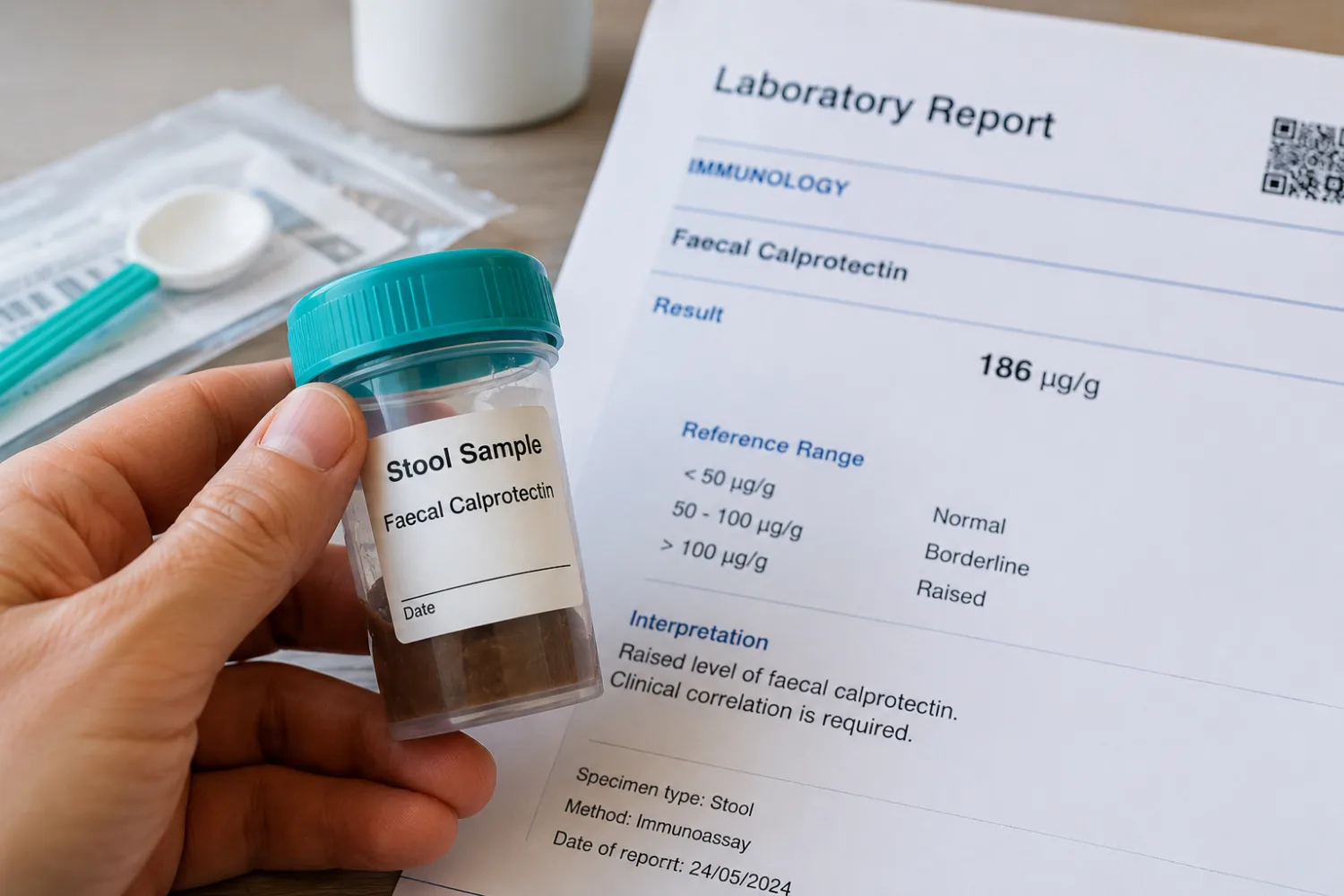
A faecal calprotectin test measures a protein released when there is inflammation inside the intestines. It is performed on a small stool sample and is commonly used to help doctors distinguish inflammatory bowel disease, such as Crohn’s disease or ulcerative colitis, from non-inflammatory conditions such as irritable bowel syndrome.
The result is usually reported as a number in micrograms per gram of stool, written as µg/g. In general, a low result makes active bowel inflammation less likely, while a high result suggests that inflammation may be present and needs further assessment.
However, faecal calprotectin is not a diagnosis. A raised result does not automatically mean that you have inflammatory bowel disease, and a normal result cannot explain every digestive symptom. Infections, medicines, bowel cancer and several other conditions can also affect the result.
The number must therefore be interpreted alongside your symptoms, age, medical history, blood tests and local laboratory guidance.
What is faecal calprotectin?
Calprotectin is a protein found mainly inside neutrophils, which are a type of white blood cell involved in inflammation. When the lining of the intestine becomes inflamed, neutrophils move into the bowel and release calprotectin. Some of this protein passes into the stool, where it can be measured.
Because calprotectin remains relatively stable in stool, it can provide useful information about inflammation without requiring an invasive procedure.
The test does not show exactly where the inflammation is or what has caused it. It acts as a marker that helps clinicians decide whether further investigation may be needed.
Faecal calprotectin is mainly associated with inflammation in the intestines. It is different from blood markers such as C-reactive protein, or CRP, which can rise because of inflammation anywhere in the body.
A person can have a raised faecal calprotectin even when their CRP is normal. Equally, a raised CRP does not necessarily mean there is inflammation in the bowel.
Why has a faecal calprotectin test been requested?
A GP or gastroenterology team may request the test when symptoms could be caused by either an inflammatory or non-inflammatory bowel condition.
Common reasons include:
- persistent diarrhoea;
- abdominal pain or cramping;
- an unexplained change in bowel habits;
- mucus in the stool;
- urgency or frequent bowel movements;
- unexplained weight loss;
- possible inflammatory bowel disease;
- symptoms that have been labelled as IBS but are not improving;
- monitoring known Crohn’s disease or ulcerative colitis; or
- checking whether bowel inflammation has improved after treatment.
The test is especially useful because IBS and inflammatory bowel disease can produce overlapping symptoms. Both may cause diarrhoea, abdominal discomfort, bloating and changes in bowel frequency.
IBS does not cause visible inflammation or damage to the bowel. Inflammatory bowel disease does. A low calprotectin result therefore makes IBS or another non-inflammatory explanation more likely, while a raised result increases concern about intestinal inflammation.
NICE recommends faecal calprotectin as an option to help distinguish inflammatory bowel disease from non-inflammatory bowel disorders when specialist assessment is being considered and cancer is not suspected. You can read the official NICE guidance on faecal calprotectin testing.
How are faecal calprotectin results reported?
The result is usually reported in micrograms of calprotectin per gram of stool:
µg/g
You may also see the unit written as:
- mcg/g;
- mg/kg; or
- micrograms per gram of faeces.
For this test, 1 mg/kg is numerically equivalent to 1 µg/g. Therefore, a result of 100 mg/kg means the same as 100 µg/g.
Reports may include a precise number, such as 42, 186 or more than 600 µg/g. Some results may instead be described as:
- normal;
- negative;
- borderline;
- equivocal;
- mildly raised;
- positive;
- high; or
- above the measuring range.
Always check the reference range printed on your own report. Different NHS areas and laboratories use different analysers and clinical pathways. Some define normal as below 50 µg/g, while others use below 100 or below 150 µg/g.
This variation does not necessarily mean one laboratory is wrong. The result may be interpreted differently depending on whether the test is being used to investigate new symptoms, monitor existing IBD, assess a child or guide a particular local referral pathway.
What do low, borderline and high results mean?
There is no single UK cut-off used by every laboratory. However, many adult primary-care pathways broadly group results into three ranges:
- below 100 µg/g: active inflammatory bowel disease is less likely;
- 100–250 µg/g: borderline or mildly raised, often requiring review or repeat testing;
- above 250 µg/g: significant bowel inflammation is more likely and gastroenterology assessment may be needed.
These figures are a practical guide rather than universal diagnostic rules. Your own report and clinician’s advice take priority.
Result below 50 µg/g
Many laboratories consider a result below 50 µg/g to be within the normal range.
This makes active inflammatory bowel disease unlikely, particularly when you do not have warning symptoms and your blood tests are normal. IBS, food intolerance, medication side effects, bile acid diarrhoea and functional digestive conditions may then be considered.
A result below 50 does not mean that your symptoms are imaginary or unimportant. It means that significant neutrophil-driven intestinal inflammation was not detected in that particular sample.
Result between 50 and 100 µg/g
Some laboratories consider this range normal, while others classify it as slightly raised or indeterminate.
Your clinician may look at:
- how long symptoms have lasted;
- whether you have diarrhoea, bleeding or weight loss;
- whether you recently had a stomach infection;
- which medicines you take;
- whether blood tests show anaemia or inflammation; and
- whether the result is rising or falling.
A repeat sample may be suggested if symptoms continue and there is no obvious explanation.
Result below 100 µg/g
Many NHS adult primary-care pathways treat a result below 100 µg/g as making inflammatory bowel disease unlikely. For example, several regional NHS pathways advise considering IBS or another non-inflammatory diagnosis when the result is under 100 and no warning signs are present.
This should not be interpreted as a guarantee that no bowel condition exists. Microscopic colitis, bile acid malabsorption, coeliac disease and some forms of small-bowel Crohn’s disease may not always produce a markedly raised result.
A low result also does not rule out bowel cancer. When symptoms suggest possible cancer, assessment may include a FIT test, blood tests, examination and referral rather than relying on calprotectin.
Result between 100 and 250 µg/g
This is often described as borderline, equivocal or mildly raised.
A result in this range can occur with inflammatory bowel disease, but it may also be caused by:
- a recent bowel infection;
- anti-inflammatory painkillers;
- proton pump inhibitors;
- diverticular disease;
- coeliac disease;
- minor inflammation;
- bleeding within the digestive tract; or
- natural variation between samples.
Many local pathways recommend repeating a borderline test after approximately two to six weeks, once temporary causes have settled and relevant medicines have been reviewed.
If the repeat result falls below the local threshold, active IBD becomes less likely. If it remains above 100 or continues to rise, gastroenterology referral may be considered.
Result above 250 µg/g
A result above 250 µg/g indicates a greater likelihood of active intestinal inflammation. Many NHS pathways advise urgent or expedited gastroenterology assessment, particularly when symptoms are significant.
Possible causes include:
- Crohn’s disease;
- ulcerative colitis;
- infectious gastroenteritis;
- diverticulitis;
- significant bowel inflammation from another cause;
- some bowel cancers or advanced polyps; or
- active inflammation in someone already diagnosed with IBD.
The result does not confirm IBD. Further tests are usually needed to establish the cause.
Very high results above 500 or 1,000 µg/g
Very high values make substantial intestinal inflammation more likely, especially when accompanied by frequent diarrhoea, bleeding, pain, fever, weight loss or anaemia.
Results above the analyser’s range may be reported as “greater than 600”, “greater than 1,000” or another laboratory limit.
There is no number that independently proves someone has Crohn’s disease or ulcerative colitis. A severe infection can also produce a very high result. Clinical review is important rather than trying to diagnose the cause from the number alone.
Why might faecal calprotectin be raised?
Calprotectin indicates inflammation, but it is not specific to one disease.
Inflammatory bowel disease
Raised calprotectin is strongly associated with active inflammatory bowel disease. Crohn’s disease can affect any part of the digestive tract, while ulcerative colitis affects the colon and rectum.
Symptoms may include persistent diarrhoea, blood or mucus, abdominal pain, urgency, weight loss and fatigue. However, symptoms and calprotectin levels do not always match perfectly. Some people have significant inflammation with relatively mild symptoms.
Bowel infection
Bacterial and viral gastroenteritis can cause a temporary rise. Testing during or shortly after diarrhoea caused by infection may therefore produce a result that appears concerning but later returns to normal.
Stool culture or other infection tests may be requested when symptoms began suddenly, followed travel, occurred after antibiotics or affected other people in the household.
Diverticulitis
Inflammation or infection of diverticula in the bowel wall can raise calprotectin. Diverticulitis may cause persistent lower abdominal pain, fever, altered bowel habits and feeling unwell.
Read more in our guide to diverticular disease and diverticulitis.
Coeliac disease
Untreated coeliac disease can sometimes raise faecal calprotectin, although the test is not used to diagnose coeliac disease. The main initial investigation is a coeliac antibody blood test while you are still eating gluten.
Bowel polyps or cancer
Bowel tumours and some large polyps can cause inflammation or bleeding and may raise calprotectin. However, calprotectin is not a bowel cancer test and must not be used to exclude cancer.
When bowel cancer is a concern, clinicians may use FIT, examination, blood tests, colonoscopy or imaging. Persistent blood in the stool, unexplained weight loss, iron-deficiency anaemia or a lasting bowel-habit change should be assessed regardless of a calprotectin result.
Other digestive conditions
Less common causes of a raised result include gastrointestinal bleeding, microscopic colitis, intestinal damage caused by medicines, inflammation following radiotherapy and certain conditions affecting the small intestine.
The test identifies that inflammation may be present. It does not tell the clinician which of these conditions is responsible.
Which medicines can affect the result?
Some medicines may increase faecal calprotectin or irritate the digestive tract.
NSAID painkillers
Non-steroidal anti-inflammatory drugs, or NSAIDs, include:
- ibuprofen;
- naproxen;
- diclofenac;
- aspirin taken for pain; and
- other anti-inflammatory painkillers.
These medicines can irritate or damage the lining of the stomach and intestines. Regular use may produce a mildly or moderately raised calprotectin result.
Low-dose aspirin prescribed to prevent heart attack or stroke should not be stopped without medical advice.
Proton pump inhibitors
Proton pump inhibitors, or PPIs, include omeprazole, lansoprazole, pantoprazole and esomeprazole. Some evidence suggests they may be associated with modestly increased calprotectin in some people.
Do not stop a prescribed PPI solely to alter a test result. Your GP may decide whether a temporary pause is safe and clinically useful before repeat testing.
Other medicines
Medicines that cause diarrhoea do not necessarily raise calprotectin, but they can complicate interpretation. Metformin, antibiotics, magnesium products, laxatives and some weight-loss medicines can all change bowel habits.
Give your clinician a complete list of prescribed medicines, over-the-counter products and supplements before the result is interpreted.
Can a normal result rule out inflammatory bowel disease?
A normal or low result makes active IBD considerably less likely, particularly when inflammation affects the colon. It is one of the test’s main clinical benefits.
However, no result is completely conclusive.
Calprotectin may be less strongly raised when:
- Crohn’s disease affects only a limited area of the small bowel;
- inflammation is mild;
- the disease is currently inactive;
- treatment has already reduced inflammation;
- the sample was taken during a quieter phase; or
- symptoms are caused by a condition that does not produce neutrophilic inflammation.
A low result should therefore be interpreted alongside warning signs.
Further assessment may still be appropriate if you have:
- visible or recurrent rectal bleeding;
- unexplained weight loss;
- iron-deficiency anaemia;
- a persistent fever;
- a lump or swelling in the abdomen;
- severe or worsening pain;
- frequent night-time diarrhoea;
- a strong family history of bowel disease;
- abnormal scans or blood tests; or
- symptoms that continue despite treatment.
A normal calprotectin result does not prove that symptoms are caused by IBS. IBS is diagnosed from the overall symptom pattern after appropriate consideration of other conditions.
What happens after a borderline or high result?
The next step depends on the level, your symptoms and whether the test was requested to diagnose a new condition or monitor existing IBD.
Repeat testing
A mildly raised or borderline result is often repeated. This can help determine whether the rise was temporary or persistent.
Before the repeat sample, your clinician may consider:
- whether you recently had gastroenteritis;
- whether infection testing is needed;
- whether NSAIDs can safely be avoided;
- whether another medicine may be affecting the result;
- whether coeliac blood tests are needed; and
- whether symptoms are improving or worsening.
A falling result may indicate that temporary inflammation is resolving. A persistently raised or rising result is more likely to lead to specialist assessment.
Blood tests
Blood tests may include:
- full blood count;
- CRP or ESR inflammation markers;
- ferritin and iron studies;
- kidney and liver function;
- albumin;
- coeliac antibodies; and
- vitamin or nutritional tests.
Normal blood tests do not necessarily exclude bowel inflammation, but abnormal results may increase concern or help identify complications.
Gastroenterology referral
A significantly raised or repeatedly abnormal result may prompt referral to a gastroenterologist. The specialist will consider the whole clinical picture rather than treating the calprotectin number as a diagnosis.
Colonoscopy
A colonoscopy uses a flexible camera to examine the large bowel. Biopsies can be taken to look for Crohn’s disease, ulcerative colitis, microscopic colitis, polyps or another cause of inflammation.
Not everyone with a raised calprotectin needs an immediate colonoscopy. The decision depends on age, symptoms, result level, blood tests and the suspected condition.
Scans or small-bowel tests
MRI, CT, ultrasound or capsule endoscopy may be considered when Crohn’s disease affecting the small intestine is suspected. Colonoscopy cannot examine most of the small bowel.
How is calprotectin used in people who already have IBD?
For someone already diagnosed with Crohn’s disease or ulcerative colitis, faecal calprotectin may be used to monitor inflammation over time.
It can help:
- assess whether symptoms may represent a flare;
- check response to treatment;
- identify inflammation before symptoms become severe;
- support decisions about treatment changes;
- reduce the need for repeated invasive procedures in some situations; and
- monitor for recurrence after surgery.
The interpretation is different from the pathway used to diagnose someone with new symptoms.
A person with established IBD may have an individual target based on previous results, disease location, treatment and endoscopy findings. A value that prompts referral in primary care may be managed differently by an IBD team that already knows the patient’s usual pattern.
One result should not usually be viewed in isolation. Trends can be more useful:
- a result falling from 800 to 180 may suggest treatment is reducing inflammation;
- a rise from 40 to 300 may suggest inflammation is returning;
- repeatedly stable low results may support disease control; and
- persistently high results may lead to treatment review or further investigation.
Do not increase steroids or change biologic treatment based only on a home or laboratory result unless your IBD team has given you a specific action plan.
How to collect the stool sample correctly
Collection kits vary, so follow the instructions supplied by your GP surgery, hospital or laboratory.
The general process is:
- Label the container with the required details.
- Pass stool into a clean disposable container or onto a collection sheet.
- Avoid mixing the sample with toilet water or urine.
- Use the spoon or sampling stick supplied to collect a small amount.
- Close the container securely.
- Place it in the specimen bag.
- Return it according to the instructions, without unnecessary delay.
You usually need only a small sample rather than filling the container.
If possible, avoid collecting it during menstrual bleeding or when there is a risk of contamination from urine. Contact the requesting service if you are unsure.
Some services allow the sample to be kept briefly in a refrigerator before return, while others provide different instructions. Do not assume that all kits can be stored in the same way.
A sample may be rejected if it is unlabelled, leaking, contaminated or collected in the wrong container. An invalid sample does not count as a normal result.
When should you seek medical help urgently?
Do not wait for a calprotectin result if you have severe symptoms.
Contact a GP or NHS 111 urgently if you have:
- persistent bloody diarrhoea;
- worsening abdominal pain;
- fever with significant bowel symptoms;
- signs of dehydration;
- rapid unintentional weight loss;
- increasing weakness or breathlessness;
- frequent diarrhoea that prevents you drinking enough; or
- a known diagnosis of IBD with symptoms of a significant flare.
Call 999 or attend A&E if you have:
- heavy or continuing rectal bleeding;
- collapse, confusion or severe weakness;
- severe or rapidly worsening abdominal pain;
- a swollen abdomen with repeated vomiting;
- an inability to pass stool or wind with significant pain;
- black, tar-like stool with dizziness or fainting; or
- vomiting blood.
Faecal calprotectin is a useful investigation, but it is not designed to assess an emergency.
Understanding your result in context
A faecal calprotectin result is most useful when it answers a specific clinical question.
For someone with new diarrhoea and abdominal pain, the question may be whether inflammatory bowel disease is likely enough to justify specialist investigation. For someone with known ulcerative colitis, it may be whether inflammation is becoming active again.
The test can help show whether intestinal inflammation is likely. It cannot:
- diagnose Crohn’s disease or ulcerative colitis by itself;
- show exactly where inflammation is located;
- identify the precise cause of inflammation;
- confirm IBS;
- rule out bowel cancer;
- replace colonoscopy or biopsy when these are needed; or
- explain every case of diarrhoea, pain or bloating.
When reviewing your result, ask:
- What reference range does this laboratory use?
- Was the test intended to investigate new symptoms or monitor existing IBD?
- Could infection or medicine have affected the number?
- Do I need repeat testing?
- Have blood tests or infection tests been arranged?
- Do my symptoms require referral despite the number?
- What should I do if symptoms get worse?
A low result is generally reassuring but should not be used to dismiss persistent warning symptoms. A high result deserves follow-up but is not, by itself, a diagnosis of a lifelong bowel disease.
Frequently asked questions
What is a normal faecal calprotectin result?
It depends on the laboratory. Some use below 50 µg/g as normal, while many UK adult primary-care pathways use below 100 µg/g as the level at which active IBD is unlikely. Check the range printed on your own report.
Is a result of 50 µg/g high?
Not necessarily. Some laboratories regard 50 as the upper end of normal, while others would treat it as a low result. The interpretation depends on the local reference range and your symptoms.
What does a result of 100 µg/g mean?
A result around 100 sits near the boundary used by many adult pathways. It may be described as mildly raised or borderline. Your clinician may review possible temporary causes and arrange a repeat sample if symptoms persist.
What does a result between 100 and 250 mean?
This range is often considered equivocal or mildly raised. IBD is possible, but infection, medicines and other digestive conditions can also cause it. Repeat testing and clinical review are commonly recommended.
Does a result above 250 mean I have IBD?
No. It indicates a greater likelihood of significant bowel inflammation and often leads to gastroenterology referral. Infection, diverticulitis and other conditions can also produce a result above 250.
Is a calprotectin result above 1,000 serious?
A result above 1,000 suggests substantial intestinal inflammation and needs prompt clinical review. It may occur with active IBD or severe bowel infection, but the number alone cannot identify the cause.
Can IBS raise faecal calprotectin?
IBS does not usually cause significant intestinal inflammation, so calprotectin is generally normal or low. A slightly raised result can occur for another reason and may need repeating before conclusions are drawn.
Can a stomach bug raise calprotectin?
Yes. Viral or bacterial gastroenteritis can cause a temporary and sometimes substantial rise. Your clinician may wait for symptoms to settle or test for infection before repeating calprotectin.
Can ibuprofen affect the result?
Yes. Ibuprofen and other NSAID painkillers can irritate the digestive tract and may raise calprotectin. Do not stop prescribed medicine without checking with a clinician.
Can omeprazole raise calprotectin?
Proton pump inhibitors such as omeprazole may contribute to a modest rise in some people. Your GP will decide whether this is relevant and whether the medicine can safely be paused before repeat testing.
Can piles cause a raised calprotectin?
Simple haemorrhoids are more directly associated with bleeding than intestinal inflammation and do not usually explain a markedly high result. However, bleeding and inflammation from other causes may occur at the same time.
Can bowel cancer raise calprotectin?
Yes, bowel cancer and some polyps can raise calprotectin. However, calprotectin is not sufficiently specific to diagnose or exclude cancer. FIT and bowel investigations are used when cancer is a concern.
Why is my calprotectin high but my colonoscopy normal?
Possible explanations include recent infection, medicine effects, inflammation that has resolved, microscopic disease requiring biopsy, or inflammation in the small bowel beyond the reach of a standard colonoscopy. Your specialist may review biopsies, repeat the test or arrange imaging.
Why do I have symptoms if my result is normal?
Many digestive conditions do not cause the type of inflammation detected by calprotectin. IBS, bile acid diarrhoea, food intolerance, coeliac disease, medicine side effects and thyroid problems can all cause symptoms with a low result.
How long does a faecal calprotectin result take?
Turnaround varies between laboratories. Many results are available within several days to around one week after the sample reaches the laboratory, although transport and administrative delays can make the total wait longer.
Can I collect a calprotectin sample during my period?
Menstrual blood could contaminate the sample. Check the instructions or ask the requesting service whether you should wait until bleeding has finished.
Should I repeat the test?
A repeat test is commonly used for borderline results or when infection or medicine may have caused a temporary rise. Do not repeat it independently as a substitute for clinical review, particularly if symptoms are worsening or warning signs are present.
Will I need a colonoscopy after a raised result?
Possibly. A persistently or substantially raised result may lead to colonoscopy, biopsies or imaging. The decision depends on your symptoms, age, blood tests, medical history and the level of the result.