Gallstones are small stone-like lumps that form in the gallbladder, a small organ under the liver that stores bile. Some people have gallstones and never know about them. Others develop episodes of severe pain, sickness, or complications that need urgent treatment. In the UK, treatment for symptomatic gallstones often involves pain relief and surgery to remove the gallbladder, called a cholecystectomy.
This guide explains what gallstones are, what gallbladder pain feels like, when symptoms may be a warning sign, how diagnosis usually works, and when surgery is more likely to be recommended. It is written for UK patients and families who want a practical, clear explanation rather than vague reassurance.
If you want a broader overview first, see Digestive Health: Symptoms, Common Conditions and Treatments. If your symptoms overlap with upper digestive discomfort, you may also find these useful: Heartburn, Acid Reflux and GORD and Stomach Ulcers: Causes, Symptoms, H. pylori and Treatment.
What are gallstones?
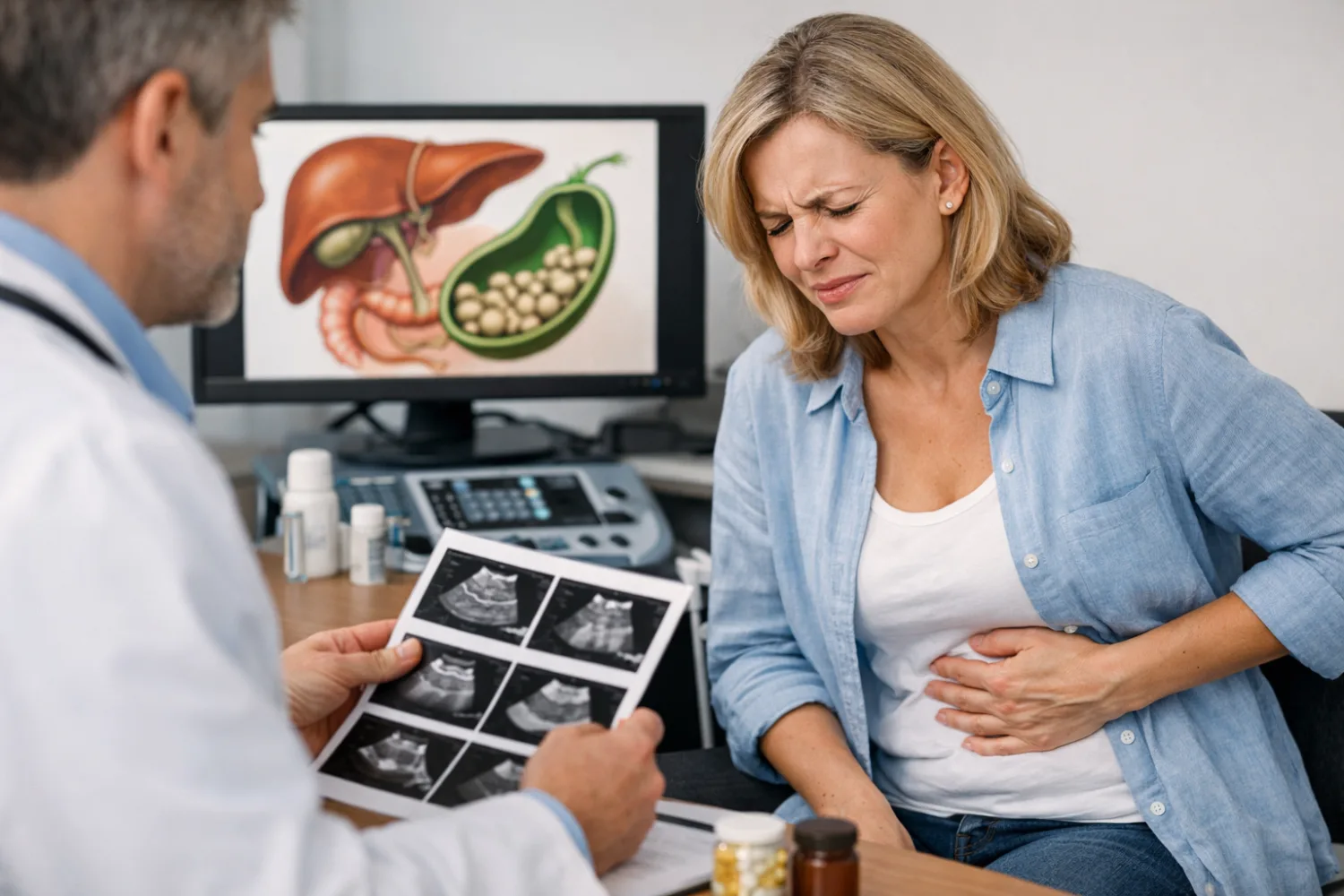
Gallstones form when substances in bile harden into stones inside the gallbladder. They can be as small as grains of sand or much larger. Many people only discover them by chance during a scan for something else. If they cause no symptoms, they often do not need treatment. NICE guidance refers to these as asymptomatic gallstones.
The problem starts when gallstones block the normal flow of bile or trigger inflammation. That is when people begin to get classic gallbladder pain, repeated attacks after meals, or more serious complications such as infection of the gallbladder, stones in the bile duct, jaundice or pancreatitis.
What does gallbladder pain feel like?
Typical gallstone pain is often described as a sudden, intense pain in the upper right side of the abdomen or in the middle upper abdomen just below the breastbone. It may spread to the back or right shoulder. It often comes on after eating, especially after a rich or fatty meal, and may last 30 minutes or longer. It is usually not relieved by going to the toilet, passing wind or being sick.
Real-life example: someone feels fine most of the day, then a couple of hours after a takeaway or restaurant meal develops a gripping pain under the right ribs that builds in waves and makes it hard to sit still. Another common pattern is night-time pain after a late heavy meal, sometimes with nausea.
Some people call this a “gallbladder attack” or “biliary colic”. Even though the word colic suggests something that comes and goes, the pain can still feel constant and severe while it is happening.
Common symptoms of gallstones
Not everyone with gallstones gets the same symptoms, but common ones include:
- pain in the upper right side or middle upper abdomen
- pain that may spread to the back or shoulder
- pain after eating
- nausea or vomiting
- bloating or discomfort after meals
- episodes that come and go over time
If a stone causes complications, symptoms may become more serious and may include fever, jaundice, much more severe pain, or signs of infection.
Can gallstones cause bloating or indigestion?
Yes, some people mainly notice upper-abdominal discomfort, nausea, bloating or a sense that fatty food “does not agree with them”. But those symptoms are not specific to gallstones. Reflux, indigestion, ulcers and other upper-digestive problems can feel similar. That is why the pattern matters. Repeated pain after meals, especially in the upper right abdomen, is more suggestive of gallstones than vague bloating alone.
Who is more likely to get gallstones?
NHS guidance notes that gallstones are more common in women, people over 40, people who are overweight, pregnant women, and people with certain medical conditions such as Crohn’s disease. Rapid weight loss can also increase the risk.
Risk factors help explain why gallstones are common, but they do not diagnose anything on their own. A thin, fit person can still get them, and someone with several risk factors may never have symptoms at all.
When gallstones become more serious
Gallstones can sometimes cause complications rather than simple intermittent pain. Important complications include:
- acute cholecystitis – inflammation of the gallbladder
- stones in the bile duct – sometimes called common bile duct stones
- jaundice – yellowing of the skin or eyes if bile flow is blocked
- cholangitis – infection in the bile ducts
- pancreatitis – inflammation of the pancreas triggered by a stone
These are the situations where gallstones move beyond being painful and become potentially urgent or dangerous.
How gallstones are diagnosed in the UK
Diagnosis usually starts with a history and examination. A GP or hospital doctor will ask where the pain is, how long it lasts, whether it happens after food, whether you have had fever or jaundice, and whether the episodes are becoming more frequent.
The most common first test for suspected gallstones is an ultrasound scan. Blood tests may also be done to look for signs of infection, inflammation, liver problems or pancreatic involvement. NICE guidance recommends ultrasound as the first-line imaging test for suspected gallbladder stones, with liver blood tests when bile duct stones may be involved.
If there is concern that stones may be in the bile duct rather than only the gallbladder, you may need further tests or specialist imaging.
When gallstones do not need treatment
If gallstones are found incidentally and you have had no symptoms, treatment is often not needed straight away. Many people never develop problems. NICE guidance distinguishes asymptomatic gallstones from symptomatic gallstone disease for exactly this reason.
This is important because seeing gallstones on a scan does not automatically mean they are the cause of every digestive symptom. Surgery is usually considered much more seriously when there is a convincing pattern of gallstone pain or complications.
What can help while waiting for treatment?
If you are waiting for specialist review or surgery, symptoms may sometimes be reduced by avoiding fatty meals and using simple pain relief such as paracetamol, or an antispasmodic such as hyoscine if advised. NHS decision-support material also suggests that fatty food can make gallstone symptoms worse.
What to avoid: repeatedly eating foods that clearly trigger attacks, assuming every episode will pass safely, or relying on internet “gallbladder flushes” and cleanses. Those are not standard evidence-based treatment.
When is surgery needed?
Surgery is more likely to be recommended when gallstones are causing repeated pain or complications. The standard operation is gallbladder removal, also called cholecystectomy. NHS guidance states that treatment for complications caused by gallstones is usually pain relief and surgery to remove the gallbladder.
In practice, surgery is often considered if:
- you have recurrent gallstone attacks
- pain is affecting daily life
- you have had acute cholecystitis
- stones are causing jaundice or bile duct problems
- gallstones have triggered pancreatitis or other complications
The aim is not simply to remove stones one by one, but to prevent the gallbladder from causing further episodes.
What is gallbladder removal surgery?
Gallbladder removal is usually done using keyhole surgery, called laparoscopic cholecystectomy. Open surgery is sometimes needed if the gallbladder is very inflamed or if keyhole surgery is not possible.
Many people worry that they will not be able to digest food properly without a gallbladder. Most people can live normally without one. Bile still flows from the liver into the gut, just not stored in the same way.
Recovery after gallbladder removal
NHS recovery guidance says many people can go home the same day as surgery, though some stay overnight. Recovery varies, but wound care, pain control and gradually returning to activity are important. Some NHS hospital guidance notes that many people return to work in around 1 to 2 weeks, depending on the type of work and how recovery goes.
Some people have temporary diarrhoea or digestive change after gallbladder removal, but many recover well and feel better overall because the attacks stop.
Possible risks and complications of surgery
Gallbladder removal is a common operation, but like any surgery it has risks. NHS guidance lists possible complications such as bile leak, stones left in the bile ducts or tummy, infection and injury to nearby structures, though serious complications are uncommon.
It is also worth knowing that a small number of people continue to have pain or digestive symptoms even after surgery, especially if another abdominal problem was also contributing. That is one reason clinicians try to make sure the pain pattern really fits gallstones before offering surgery.
When to seek urgent medical help
Seek urgent medical attention if you have:
- severe or persistent abdominal pain that is not settling
- pain with fever
- yellowing of the skin or eyes
- vomiting that will not stop
- pain with signs of infection or feeling very unwell
Pain together with fever or jaundice is especially important, because it can signal a complication rather than a simple attack.
When to see a GP
Book a GP appointment if you have repeated attacks of upper-abdominal pain, symptoms that clearly follow meals, pain under the right ribs, or unexplained nausea and bloating that seem to fit a gallstone pattern. You should also seek review if an ultrasound has already shown gallstones and you are starting to get symptoms.
If getting assessed is difficult, you may find this helpful: How to Get a GP Appointment Quickly in the UK.
Frequently asked questions
Can you have gallstones without symptoms?
Yes. Many people have gallstones found incidentally and never develop pain or complications.
What does gallstone pain usually feel like?
Usually a sudden, strong pain in the upper abdomen, often after eating, sometimes spreading to the back or shoulder, and often lasting 30 minutes or longer.
Do all gallstones need surgery?
No. Surgery is usually more relevant when gallstones cause symptoms or complications, not when they are found by chance and cause no problems.
Can fatty food trigger gallstone attacks?
Yes, fatty meals can trigger symptoms in some people and are commonly mentioned in NHS patient guidance.
How long does it take to recover from gallbladder surgery?
It varies, but many people go home the same day or after one night, and many return to work in roughly 1 to 2 weeks depending on the operation and the work they do.
Final thoughts
Gallstones are very common, and not all of them cause trouble. But when they do become symptomatic, the pattern is often quite recognisable: sudden upper-abdominal pain, often after eating, sometimes repeating over time and sometimes leading to more serious complications. The right response is not to panic, but not to ignore it either.
If symptoms fit gallstones, proper assessment can clarify whether you simply need monitoring, whether you should adjust what you eat while waiting, or whether gallbladder removal is likely to help. And if pain comes with fever, jaundice or persistent vomiting, that is a sign to seek urgent help rather than wait it out.