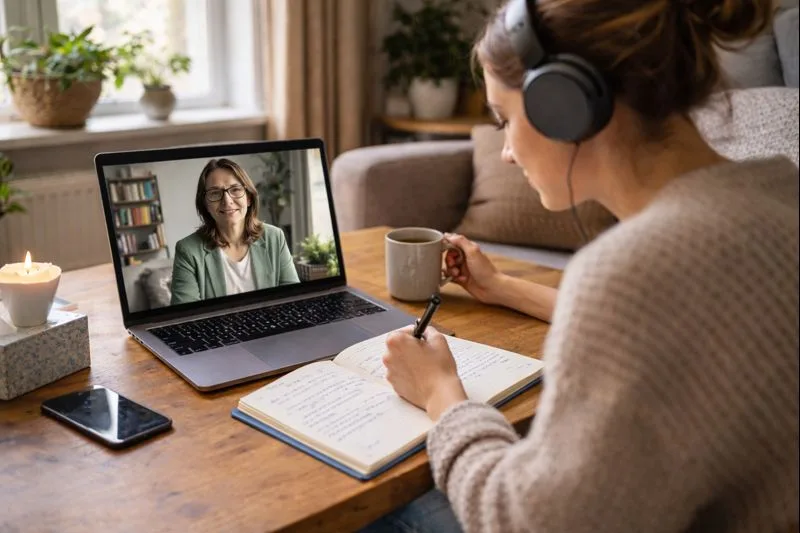
Over the past few years, online therapy has moved from a niche alternative to one of the most common ways people in the UK access mental health support. Remote counselling can be booked quickly, fits more easily around work or childcare, and can feel less intimidating than walking into a clinic for the first time.
But many people still wonder: is online therapy legitimate? How much does it cost? Do you need a GP referral? And how do you choose between dozens of platforms, directories and private therapists?
This guide explains how online therapy and counselling work in the UK, what different options cost, what to expect from a first session, when it can help, and when NHS or urgent support may be more appropriate.
What online therapy is and who it can help
Online therapy, sometimes called remote counselling, digital therapy or teletherapy, is structured mental health support delivered by video call, phone call, messaging, live chat or a combination of these.
Sessions may be provided by:
- counsellors
- psychotherapists
- clinical psychologists
- counselling psychologists
- CBT therapists
- specialist relationship, trauma, bereavement or workplace therapists
In the UK, many therapists belong to professional bodies such as the BACP, UKCP, BABCP or HCPC, depending on their role and training. It is worth checking registration or accreditation before booking, especially if you are paying privately.
What online therapy can support
Online therapy can support a wide range of issues, including anxiety, stress, mild to moderate depression, panic, confidence issues, grief, workplace pressure, parenting stress, relationship problems and burnout.
For many people, it provides a practical way to start talking to someone without waiting for a local face-to-face appointment or travelling to a clinic.
When online therapy may need extra support
For more complex conditions, such as bipolar disorder, psychosis, eating disorders, severe trauma, high-risk self-harm or suicidal thoughts, online therapy may still be useful, but it should usually sit alongside NHS, GP or specialist mental health support.
Our wider guide to how to access mental health services in the UK explains how NHS, private and crisis routes fit together.
Example: why someone might choose online therapy
Zara is 26 and works shifts in retail. Weekly in-person therapy at the same time every week is hard to fit around her rota. She joins an online therapy service where she can book video calls on her days off and message her therapist between sessions. She does not need a GP referral and is matched with someone who uses CBT techniques for anxiety.
This type of pattern is now common: flexible scheduling, remote sessions, and a mix of structured therapy and practical support between appointments.
Do you need a GP referral?
Usually, no. For most private online therapy platforms and independent therapists, you can self-refer. That means you can contact a therapist directly, book an assessment call and start therapy without asking your GP first.
This is one of the main reasons online therapy has become popular. It can be faster and more flexible than waiting for local NHS services, especially for people who want support with stress, anxiety, low mood, relationship problems or work-related pressure.
When you can book directly
You can usually book directly if you are paying privately, using a therapy platform, contacting an independent counsellor, or accessing support through a workplace or university service.
You may be asked to complete a questionnaire before the first session. This helps the therapist or platform understand what you need, whether the service is suitable, and whether there are any risk or safeguarding concerns.
When it is still worth speaking to your GP
Seeing a GP is still a good idea if:
- your symptoms are severe or worsening
- you may need medication
- you need a Fit Note for work
- you have physical symptoms alongside mental health symptoms
- you are worried about self-harm, suicidal thoughts or safety
- you may need referral to NHS specialist mental health services
If you are not currently registered with a GP, see our guide to how GP registration works in the UK.
Online therapy vs NHS Talking Therapies
The NHS offers free psychological support through NHS Talking Therapies, previously known as IAPT. These services commonly support people with anxiety, depression, panic, phobias, OCD, trauma symptoms and stress.
In many areas, you can self-refer to NHS Talking Therapies without seeing your GP first. You can search for a local service here: Find an NHS Talking Therapies service.
The main differences
The main differences are:
- NHS Talking Therapies are free, structured and evidence-based, but waiting times and session limits vary by area.
- Private online therapy is usually faster and more flexible, but you pay for it yourself unless covered by insurance, an employer or another scheme.
NHS Talking Therapies are often a good first option for mild to moderate anxiety and depression, especially if you want free support and are happy with a structured approach.
Using NHS and private therapy together
Some people use a hybrid approach. For example, they may self-refer to NHS Talking Therapies while using private online counselling for immediate support, workplace stress, relationship issues or longer-term continuity.
This can be sensible if waiting times are long, but it is still important to keep care coordinated, especially if medication, risk, diagnosis or specialist NHS support is involved.
Types of online therapy available
Online therapy is not one single format. Different services offer different styles of support, and the best fit depends on your symptoms, goals and preferences.
CBT
CBT, or Cognitive Behavioural Therapy, is structured and practical. It is commonly used for anxiety, depression, panic, intrusive thoughts, avoidance and rumination.
CBT may involve worksheets, exercises, thought records or between-session practice. It can suit people who want tools, structure and a clear focus.
Integrative counselling and psychotherapy
Integrative counselling blends different therapeutic styles and often feels more conversational. It can be useful when the issue does not fit neatly into one category, or when someone wants space to explore emotions, relationships and life stress.
Psychotherapy is often longer-term and may focus more deeply on patterns, emotions, relationships and self-understanding.
Specialist therapy options
Specialist online therapy may include:
- Couples therapy — focused on communication, conflict, trust, intimacy and relationship patterns.
- Trauma-informed therapy — support for trauma symptoms, emotional regulation, safety and coping strategies.
- Bereavement counselling — support after the death of someone close, complicated grief or major loss.
- Workplace counselling — support for stress, burnout, conflict, confidence, career pressure and boundaries.
- ADHD coaching or therapy support — practical support with organisation, emotional regulation, routines and self-esteem, although this is not the same as an ADHD diagnostic assessment.
Most services start with a questionnaire, short consultation or matching process to help identify the right therapist or approach.
How much online therapy costs in the UK
Prices vary by provider, therapist experience, location, session length and whether the service is one-to-one, platform-based or specialist.
As a rough guide:
- Independent therapist by video call: often around £40–£90 per 50-minute session.
- Clinical psychologist: often higher, sometimes around £90–£180+ per session.
- Platform-based therapy: may be charged weekly or monthly, depending on messaging, video access and plan type.
- Couples therapy: often around £60–£120+ per session.
- Low-cost or concessionary therapy: some therapists offer reduced fees for students, low-income clients or trainees working under supervision.
Online therapy can still feel expensive, but it sits in a similar bracket to other private professional healthcare services such as physiotherapy, private GP appointments or specialist assessments. The main advantage is usually access and flexibility rather than low cost.
Low-cost and free alternatives
If cost is the main barrier, consider:
- NHS Talking Therapies
- university counselling
- workplace Employee Assistance Programmes
- charities
- low-cost counselling services
- trainee therapist clinics
These options may not offer the same choice or continuity as private therapy, but they can provide a useful starting point.
Can insurance, work or university pay for online therapy?
Sometimes. A growing number of UK employers provide access to counselling through Employee Assistance Programmes, often called EAPs. These may include a limited number of free phone, video or online counselling sessions, commonly around 4–8 sessions.
Students may have access to free or low-cost counselling through university wellbeing services. Some universities also offer mental health advisers, disability support, crisis appointments and academic adjustments.
Private health insurance may cover therapy or psychology sessions, but policies vary. Some insurers require a GP referral, some allow self-referral, and some exclude long-term psychotherapy, ADHD assessments or pre-existing conditions. Always check your policy before booking if you plan to claim.
How to choose an online therapy provider
The right provider depends on what you need, how quickly you want support, and whether you prefer structure, flexibility or a specific therapist.
Decide whether you want structured therapy or open-ended support
CBT is usually more structured and goal-focused. It may involve worksheets, exercises and between-session practice. Integrative counselling or psychotherapy can feel more open, reflective and relational.
Neither is automatically better. The right choice depends on whether you want practical tools, deeper exploration, support through a life event, or help with a specific pattern such as panic, avoidance or burnout.
Check qualifications and registration
Look for clear information about the therapist’s training, professional body, experience and areas of practice. Depending on the role, relevant UK bodies may include BACP, UKCP, BABCP or HCPC.
Do not be afraid to ask a therapist about their experience with your issue. A good professional should be comfortable explaining how they work and what they can or cannot support.
Ask how matching works
Some platforms use questionnaires or algorithms to match you quickly. Others offer manual matching or let you choose a therapist yourself. Manual choice can take longer but may give you more control.
It is also worth checking whether you can switch therapist if the first match does not feel right.
Think about format
Some people prefer video because it feels closer to face-to-face therapy. Others prefer phone sessions because they feel less exposed. Messaging can be useful for reflection between sessions, but it may not feel enough if you need deeper conversation.
If privacy is difficult at home, you could use headphones, sit in a parked car, take a phone session while walking, book at a time others are out, or ask the therapist about text-based options.
Understand cancellation rules and costs
Check session length, cancellation notice, refund rules, subscription terms and whether you are charged if you miss a session.
This is especially important with platform-based therapy, where pricing may be weekly or monthly rather than per session.
Make sure the service is suitable for your level of need
If you are in crisis, at risk of harm, experiencing psychosis, severe eating disorder symptoms or complex safeguarding concerns, a general online therapy platform may not be enough on its own. NHS, GP or urgent mental health support may be needed.
What to expect from online therapy
Most people expect the first session to be about “telling the therapist everything”. In practice, it is usually more about mapping the problem and agreeing what support should focus on.
Your first session
Your therapist may ask:
- What brings you to therapy now?
- How long has this been affecting you?
- What have you tried already?
- How is it affecting sleep, work, relationships or daily life?
- Do you have any risk or safety concerns?
- What would a better outcome look like?
You do not need to prepare a perfect story. It is fine to be unsure, emotional, quiet or nervous. A good therapist will help structure the conversation.
Online sessions can feel surprisingly personal. Video is not identical to face-to-face therapy, but many people find that being in their own home makes it easier to open up.
Common concerns about online therapy
Is online therapy less effective than face-to-face therapy?
For many mild to moderate issues, online therapy can work well, especially when the therapist is appropriately trained and the format suits the person. CBT, counselling and some forms of psychotherapy can all be delivered remotely. However, online therapy may not be suitable as the only support for crisis-level or complex needs.
What if I do not click with the therapist?
This is common. The relationship matters, and it is normal to switch therapists if the fit does not feel right. You do not need to stay with the first person you speak to.
Can an online therapist prescribe medication?
Counsellors, psychotherapists and psychologists cannot usually prescribe medication. Medication decisions normally sit with GPs or psychiatrists. If you think medication may be needed, speak to your GP or a psychiatrist.
Is messaging therapy enough?
It depends on the issue and the person. Messaging can be helpful for reflection, accountability and support between sessions. For deeper work, trauma, complex emotions or urgent distress, video or phone sessions may be more suitable.
Is online therapy private?
Therapists should explain confidentiality, record-keeping and data protection before or during your first session. You also need a private space at your end where you cannot be overheard, especially if discussing sensitive topics.
How to tell if online therapy is working
Progress in therapy is often subtle at first. It may not feel like a sudden breakthrough.
Signs that therapy may be helping include:
- you avoid fewer situations
- panic spirals become less frequent or less intense
- sleep routines improve
- you set clearer boundaries
- you understand your patterns better
- you recover more quickly after difficult days
- you communicate more honestly
- life feels slightly less heavy
Therapy is not about becoming a perfect version of yourself. It is about improved functioning, self-understanding, coping and choice.
When online therapy is not enough
Online therapy platforms are not emergency services. If you are at immediate risk of harming yourself or someone else, or you feel unable to stay safe, use urgent support rather than waiting for a therapy appointment.
Safety and crisis situations
Urgent options include:
- calling 999 or going to A&E if there is immediate danger
- contacting NHS 111 for urgent advice if it is not immediately life-threatening
- using your local NHS urgent mental health helpline if available
- contacting your GP urgently during opening hours
- calling Samaritans on 116 123 if you need someone to talk to
If you are unsure which route is appropriate, our guide to accessing mental health services in the UK explains NHS, private, charity and crisis pathways in more detail.
Is online therapy worth it?
For many people, yes. Online therapy can be flexible, faster to access and less intimidating than in-person clinic appointments. It can suit people with work commitments, childcare, disability, transport barriers, social anxiety, rural access issues or unpredictable schedules.
It is not a complete replacement for NHS psychiatry, crisis teams, specialist eating disorder services or complex mental health care. But as part of the wider mental health system, it fills an important gap between waiting alone and getting support.
If the alternative is waiting months while symptoms worsen, online therapy can give people somewhere to start — and for many, somewhere to continue.
FAQ: online therapy and counselling in the UK
Do I need a GP referral for online therapy?
No, not for most private online therapy or counselling. You can usually self-refer. A GP is still useful if symptoms are severe, you may need medication, or you need NHS referral or urgent support.
How much does online therapy cost in the UK?
Many independent therapists charge around £40–£90 per session, while psychologists, couples therapy and specialist services may cost more. Some services offer subscriptions, concessions or low-cost options.
Is online therapy available on the NHS?
NHS Talking Therapies may offer remote appointments, phone sessions, video sessions or guided online support depending on the local service. You can often self-refer.
Is online therapy suitable for anxiety and depression?
Yes, it can be suitable for many people with anxiety, stress, panic, low mood or mild to moderate depression. More severe symptoms may need GP, NHS or specialist mental health support as well.
Can online therapists diagnose mental health conditions?
Some qualified psychologists or psychiatrists can diagnose within their professional scope, but many counsellors and psychotherapists focus on therapy rather than formal diagnosis. Check the clinician’s role before booking.
Can online therapy help with ADHD?
Online therapy or coaching can help with organisation, routines, emotional regulation and self-esteem, but it is not the same as a formal ADHD assessment. For diagnosis and medication, you usually need a specialist ADHD assessment.
What equipment do I need?
You usually need a phone, tablet or computer, a stable internet connection, headphones if possible, and a private space where you can talk openly.
What if I live with other people and have no privacy?
You could use headphones, sit in a parked car, take a phone session while walking, book at a time others are out, or ask the therapist about text-based options. Privacy matters, so raise this before starting.
Can online therapy replace medication?
Not always. Some people benefit from therapy alone, some from medication, and some from both. Medication decisions should be discussed with a GP or psychiatrist.
When is online therapy not enough?
Online therapy may not be enough if you are at immediate risk, suicidal, experiencing psychosis, severely unwell, unable to stay safe, or needing intensive specialist care. In those situations, urgent NHS or emergency support is more appropriate.
Final takeaway
Online therapy and counselling can be a practical, flexible way to access mental health support in the UK. It can work especially well for anxiety, stress, low mood, grief, relationship difficulties and work-related pressure.
The key is choosing a qualified therapist or reputable service, understanding the costs, knowing what online therapy can and cannot do, and using NHS or urgent support when symptoms are severe or safety is a concern.