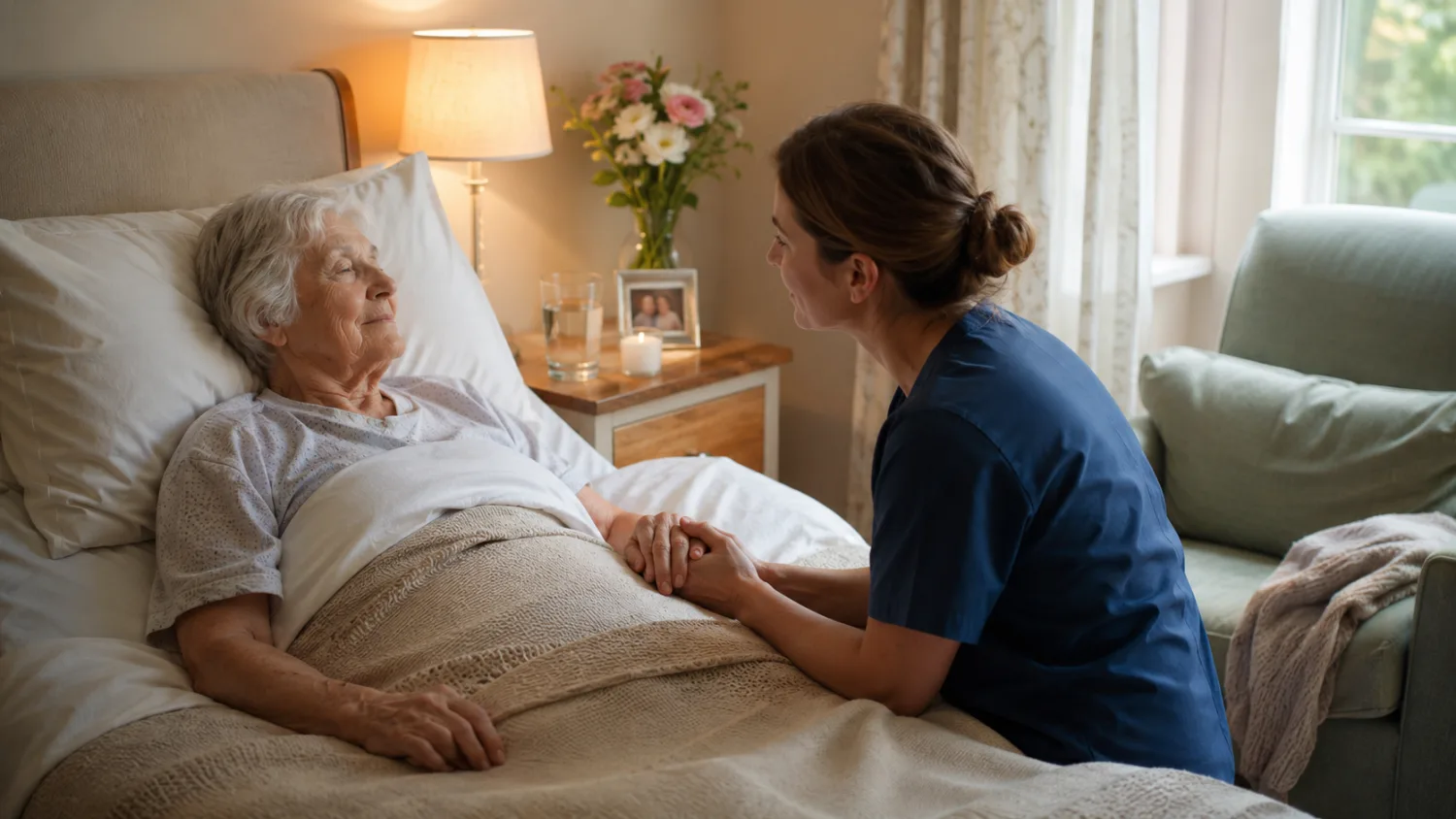
Palliative and end-of-life care in a care home is about comfort, dignity, choice and support. It is not only about the final hours or days of life. Good palliative care can begin months or even years before someone dies, especially if they are living with advanced dementia, cancer, heart failure, lung disease, Parkinson’s, stroke complications, frailty or another progressive condition.
For many families, the idea of end-of-life care in a care home can feel frightening. You may wonder whether your loved one will be comfortable, whether symptoms will be managed, whether they will be sent to hospital unnecessarily, whether family can be present, and whether staff will know what to do when the person is dying.
This guide explains what palliative and end-of-life care should look like in a care home, what questions families should ask, how advance care planning works, when NHS Continuing Healthcare fast-track funding may apply, and what signs suggest a care home is well prepared to support someone at the end of life.
If your relative needs specialist rehabilitation or has complex needs after a stroke, you may also find our guide to stroke care homes and rehabilitation support useful. You may also want to read our guides to NHS Continuing Healthcare and care home contracts.
What is palliative care?
Palliative care is care that focuses on quality of life when someone has a serious, progressive or life-limiting illness. It aims to relieve symptoms, reduce distress, support emotional and spiritual needs, help with planning, and support families as well as the person receiving care.
Palliative care is not only for cancer. It may help people with many conditions, including advanced dementia, heart failure, chronic obstructive pulmonary disease, kidney disease, neurological conditions, Parkinson’s, motor neurone disease, stroke-related disability and severe frailty.
The NHS explains that palliative care is designed to help people with life-limiting conditions have the best possible quality of life, and it can involve support from doctors, nurses and other professionals depending on the person’s needs. NHS guidance on what palliative care involves gives a helpful overview.
What is end-of-life care?
End-of-life care is support for people who are likely to be in the last months, weeks, days or hours of life. It includes physical care, symptom relief, emotional support, spiritual support, practical planning and support for family members.
Marie Curie describes end-of-life care as support for people in the last year of life, although it may be hard to know exactly when someone is entering that stage. Marie Curie’s guide to end-of-life care explains the support people may receive in the last phase of life.
In a care home, end-of-life care should help the person remain comfortable, respected and supported. It should also help families understand what is happening and what choices may be available.
Palliative care and end-of-life care are not exactly the same
The terms are often used together, but they are not identical.
Palliative care can begin earlier in a serious illness. It may run alongside treatments, rehabilitation or routine care. The focus is comfort, quality of life and support.
End-of-life care usually refers to care when someone is approaching death, especially in the last year, months, weeks, days or hours.
For example, someone with advanced Parkinson’s may receive palliative care for symptom control and planning long before they are actively dying. Someone in the final days of life may need end-of-life care focused on comfort, mouth care, pain relief, breathlessness, restlessness, family presence and avoiding unnecessary hospital transfer.
Can a care home provide good end-of-life care?
Yes, many care homes provide excellent end-of-life care. For residents who have lived in the home for months or years, the care home may be the most familiar and comforting place to die. Staff may know the person’s routines, preferences, family, beliefs and personality well.
However, not every care home is equally prepared. Some homes have strong links with GPs, district nurses, palliative care teams and hospices. Others may be less confident with symptom control, advance care planning or recognising when someone is dying.
When choosing or reviewing a care home, families should ask direct questions about end-of-life care. It may feel uncomfortable, but it is better to ask early than during a crisis.
What should good palliative care in a care home include?
Good palliative care in a care home should include:
- regular review of symptoms;
- pain relief where needed;
- support for breathlessness, nausea, constipation, agitation or anxiety;
- good mouth care;
- skin care and pressure sore prevention;
- nutrition and hydration support based on comfort and wishes;
- emotional and spiritual support;
- advance care planning;
- clear communication with family;
- GP and district nurse involvement;
- access to specialist palliative care where needed;
- support for family before and after death;
- respect for cultural, religious and personal preferences.
NICE guidance on care of dying adults in the last days of life says care should maintain comfort and dignity, involve the dying person and people important to them, communicate respectfully, and manage common symptoms without causing unacceptable side effects. NICE guidance NG31 covers care in the last two to three days of life.
Questions to ask a care home about end-of-life care
Families often ask about rooms, meals and visiting, but end-of-life care questions are just as important.
Ask:
- Do you support residents at the end of life?
- How do you recognise when someone may be approaching the end of life?
- Do you work with GPs, district nurses and palliative care teams?
- Can residents usually remain here if they are dying?
- When would hospital transfer be needed?
- Can family stay with the resident near the end of life?
- How do you manage pain, breathlessness, agitation and secretions?
- How do you support eating and drinking when someone is dying?
- Do you support advance care planning?
- Do you discuss DNACPR or ReSPECT forms where appropriate?
- Can you support religious, spiritual or cultural wishes?
- How are families kept informed?
- What happens after death?
A good care home should answer calmly and honestly. If staff seem uncomfortable discussing death at all, that may be a warning sign.
Recognising when someone may be approaching end of life
It is not always easy to know when someone is nearing the end of life, especially with dementia, frailty, Parkinson’s, heart failure or lung disease. Decline may be gradual, with periods of stability and sudden deterioration.
Possible signs may include:
- increasing frailty;
- spending more time in bed or asleep;
- eating and drinking much less;
- repeated infections;
- unplanned weight loss;
- increasing falls;
- swallowing difficulties;
- increasing confusion or reduced awareness;
- reduced ability to communicate;
- breathlessness at rest;
- worsening pressure sores;
- less response to treatment;
- more frequent hospital admissions.
These signs do not always mean death is imminent, but they should prompt a review. Families can ask the care home, GP or district nurse whether a palliative care approach or advance care plan should be considered.
Care in the last days of life
When someone is in the last days of life, the focus should usually shift towards comfort. The person may sleep more, eat and drink very little, become less responsive, have changes in breathing, develop noisy breathing, become restless, or have cooler hands and feet.
Care should usually focus on:
- comfort and dignity;
- pain relief;
- relief of breathlessness;
- relief of agitation or distress;
- mouth care;
- skin care and positioning;
- calm surroundings;
- family presence where wanted;
- respecting wishes and beliefs;
- avoiding unnecessary interventions that do not improve comfort.
NICE guidance covers recognising dying, communication, shared decision-making, hydration and symptom control in the last days of life. NICE NG31 is the key clinical guideline used in England, Wales and Northern Ireland for care in the final two to three days.
Pain control in care homes
Good pain control is central to palliative care. Pain may be caused by cancer, arthritis, pressure sores, fractures, contractures, nerve damage, immobility, wounds or other conditions. Some residents cannot describe pain clearly because of dementia, stroke, communication problems or frailty.
Ask the care home:
- How do staff recognise pain in residents who cannot explain it?
- Are pain assessments recorded?
- How quickly is the GP or nurse contacted if pain changes?
- Can pain relief be given regularly rather than only when requested?
- How are side effects such as constipation or drowsiness managed?
- Can anticipatory medicines be arranged if needed?
Pain should not be dismissed as inevitable. Even when someone is dying, comfort matters.
Breathlessness and respiratory symptoms
Breathlessness can be frightening for residents and families. It may occur with heart failure, lung disease, cancer, infection, frailty, anxiety or the dying process.
Ask:
- How do you support residents who are breathless?
- When do you contact the GP or district nurse?
- Can oxygen be used if prescribed?
- Can positioning help?
- How do you support anxiety linked to breathlessness?
- Can palliative medicines be arranged where appropriate?
Breathlessness should be assessed and managed. The aim is to reduce distress, not simply monitor it.
Agitation, restlessness and distress
Some people become restless, anxious or agitated near the end of life. This may be caused by pain, urinary retention, constipation, infection, medication effects, delirium, fear, spiritual distress or the natural dying process.
A good care home should look for causes and seek clinical support rather than simply label the person as “challenging”.
Ask:
- How do you respond to restlessness or distress?
- Do you check for pain, constipation, urinary retention or infection?
- How do you involve the GP or palliative care team?
- Can family help with reassurance, music or familiar objects?
- How are medicines used if non-drug approaches are not enough?
Mouth care, food and drink at the end of life
Families often worry when someone stops eating or drinking near the end of life. This can be distressing to witness. In many cases, reduced appetite and thirst are part of the dying process. Care should focus on comfort, mouth care and respecting the person’s wishes.
Ask the care home:
- How do you support mouth care?
- Can small sips or favourite tastes be offered if safe?
- How do you manage swallowing risk?
- When is speech and language therapy involved?
- How do you explain reduced eating and drinking to families?
- How are decisions about clinically assisted hydration made?
NICE guidance says hydration should be considered carefully in the last days of life, with discussion of risks and benefits where clinically assisted hydration is being considered. The focus should remain on comfort and individualised care.
Pressure care and skin comfort
People who are very frail, bedbound or dying are at higher risk of pressure sores. Skin care is part of dignity and comfort.
Ask:
- How is pressure sore risk assessed?
- Are pressure-relieving mattresses or cushions available?
- How often is the person repositioned?
- How do you balance repositioning with comfort?
- How are wounds or skin changes escalated?
- Do district nurses support wound care?
Near the end of life, repositioning should be gentle and proportionate. The aim is comfort as well as prevention.
Advance care planning
Advance care planning means discussing and recording what matters to the person if their health worsens. It can include preferences about where they would like to be cared for, who should be involved in decisions, what treatments they would or would not want, spiritual wishes, funeral wishes, and what comfort means to them.
Good advance care planning can reduce panic, conflict and unwanted hospital transfers later.
Questions to discuss may include:
- Where would the person prefer to be cared for if they become more unwell?
- Would they prefer to stay in the care home if possible?
- When would hospital admission be wanted?
- Who should be contacted in a crisis?
- Who has legal authority if the person lacks capacity?
- Are there religious, cultural or spiritual wishes?
- What brings comfort?
- What would the person want to avoid?
NICE’s end-of-life service delivery guidance says services should support planning and preparation so people can access care that meets their needs and preferences. NICE guideline NG142 on end-of-life care service delivery covers care organisation in the final weeks and months of life.
DNACPR and ReSPECT: what families should know
DNACPR means “Do Not Attempt Cardiopulmonary Resuscitation”. It is a medical recommendation about whether CPR should be attempted if a person’s heart or breathing stops. It does not mean “do not treat”. A person with a DNACPR decision should still receive appropriate care, comfort, antibiotics, oxygen, fluids or hospital treatment where these are in line with their needs and wishes.
ReSPECT is a wider emergency care planning process used in many areas. It records a person’s preferences and clinical recommendations for emergency situations, including what treatments may or may not be appropriate.
Ask the care home:
- Do you support DNACPR and ReSPECT discussions?
- Who leads these discussions?
- Is the GP involved?
- Is the resident involved if they have capacity?
- Are family or attorneys involved where appropriate?
- Where are forms kept?
- Do staff understand that DNACPR does not mean no care?
These conversations should be handled sensitively. They should not be rushed, imposed or treated as simple paperwork.
Mental capacity and best interests
Many care home residents have dementia, delirium, stroke-related communication problems or severe frailty that may affect decision-making. Mental capacity is decision-specific. A person may be able to make some decisions but not others.
If the resident has capacity, they should be involved in decisions about care, treatment and preferences. If they lack capacity for a decision, decisions should be made in their best interests, considering their wishes, feelings, beliefs, values and the views of people close to them.
Ask:
- Has mental capacity been assessed for important decisions?
- Is there a health and welfare Lasting Power of Attorney?
- Is there a property and financial affairs attorney?
- Has a best interests discussion been held?
- Are the resident’s known wishes recorded?
- Are family concerns being listened to?
When should hospital transfer happen?
One of the most important end-of-life questions is whether the person should be transferred to hospital if they become more unwell. Sometimes hospital treatment is appropriate and wanted. Sometimes hospital transfer may be distressing and unlikely to help, especially if the person is clearly dying and comfort care can be provided in the care home.
This should be discussed before a crisis if possible.
Ask:
- What situations would require hospital transfer?
- Can common symptoms be managed in the care home?
- Can the GP or district nurse visit urgently?
- Is there an out-of-hours plan?
- Is there a ReSPECT or emergency care plan?
- Are family preferences recorded?
- Would the resident prefer to stay in the care home if possible?
A good plan helps staff know what to do at 2am, not just during office hours.
Anticipatory medicines
Anticipatory medicines are medicines prescribed in advance so they are available if symptoms develop near the end of life. They may be used for pain, breathlessness, agitation, nausea or secretions. They are usually prescribed by a doctor and administered by trained professionals such as nurses.
Families should not feel alarmed simply because anticipatory medicines are prescribed. They are often part of good planning, so symptoms can be treated promptly if they occur.
Ask:
- Have anticipatory medicines been considered?
- Who prescribes them?
- Where are they stored?
- Who can administer them?
- How are symptoms assessed before they are used?
- How are families informed?
If a care home does not have nurses on site, district nurses or community teams may be involved in administering injections or setting up syringe drivers where needed.
Syringe drivers in care homes
A syringe driver is a small pump that gives medicine continuously under the skin. It may be used when someone cannot swallow medicines or needs steady symptom control. It is common in palliative care, but it should be explained clearly to families.
Ask:
- Can residents have a syringe driver in this care home?
- Who sets it up and monitors it?
- Are district nurses involved?
- How are symptoms reviewed?
- How are family members kept informed?
A syringe driver does not mean death is being caused. It is used to relieve symptoms when medicines by mouth are no longer suitable or effective.
GP, district nurse and specialist palliative care involvement
End-of-life care in a care home usually involves several professionals. The care home should know who to contact and when.
Support may come from:
- GPs;
- district nurses;
- community matrons;
- specialist palliative care nurses;
- hospice teams;
- Marie Curie Nurses or healthcare assistants where available;
- pharmacists;
- social workers;
- chaplains, faith leaders or spiritual care providers;
- bereavement support services.
Marie Curie says its hospice care at home services provide clinical care and emotional support for people with terminal illness, day or night, depending on local service availability. Marie Curie’s hospice care at home information explains this type of support.
Can hospice support come into a care home?
In many areas, hospice or specialist palliative care teams can support people in care homes. They may advise on symptom control, advance care planning, complex decision-making, family support and staff education.
Availability varies by area, so ask the care home:
- Do local hospice or palliative care teams visit residents here?
- How do you refer to specialist palliative care?
- How quickly can advice be obtained?
- Can hospice nurses support staff with complex symptoms?
- Do you have contact details for out-of-hours palliative advice?
Strong links with hospice and palliative care services are a reassuring sign.
NHS Continuing Healthcare fast-track funding
If someone is rapidly deteriorating and may be entering a terminal phase, NHS Continuing Healthcare fast-track funding may be considered. This can allow an appropriate care and support package to be put in place quickly without the usual full assessment process.
The NHS says people who are deteriorating quickly and nearing the end of life should be considered for the fast-track pathway, and an appropriate package should usually be put in place within 48 hours. NHS guidance on Continuing Healthcare explains the fast-track pathway. The GOV.UK fast-track pathway tool says it should be used where someone has a rapidly deteriorating condition and may be entering a terminal phase. GOV.UK fast-track pathway guidance gives the official criteria.
Ask the GP, hospital team, district nurse or palliative care team:
- Should NHS Continuing Healthcare fast-track be considered?
- Who can complete the fast-track pathway tool?
- How quickly can support be arranged?
- Will it cover care in the current care home?
- Will extra nursing or night support be needed?
- Who coordinates the package?
Fast-track funding can be especially important where care needs increase quickly or where the person wants to remain in the care home rather than go to hospital.
End-of-life care for dementia in care homes
Dementia is a life-limiting condition, but families are not always told when someone with dementia may be approaching the end of life. Decline may be gradual and uncertain.
Signs that palliative care may be needed in advanced dementia include:
- severe memory and communication problems;
- needing help with all personal care;
- reduced mobility or being bedbound;
- swallowing difficulties;
- recurrent chest or urine infections;
- weight loss;
- reduced eating and drinking;
- increasing sleepiness;
- pressure sores;
- repeated hospital admissions.
Care should focus on comfort, familiar routines, gentle communication, mouth care, skin care, food and drink for pleasure where safe, family involvement and avoiding distressing interventions that do not improve quality of life.
Read our guide to dementia care homes in the UK for more on specialist dementia support.
End-of-life care after stroke
Some people recover well after stroke, but others are left with severe disability, swallowing problems, recurrent infections, pressure sore risk, communication difficulties or advanced frailty. Palliative care may be relevant when the focus shifts from rehabilitation to comfort, or when complications become severe.
Families should ask:
- Is rehabilitation still helping?
- Are swallowing problems causing repeated chest infections?
- Is the person comfortable?
- Can they communicate pain or distress?
- Is the care plan focused on their goals and comfort?
- Should palliative care or fast-track funding be considered?
For related support, read our guide to stroke care homes and rehabilitation support.
End-of-life care for Parkinson’s and neurological conditions
Advanced Parkinson’s and other neurological conditions can involve swallowing difficulties, immobility, hallucinations, dementia, infections, pain, rigidity, communication problems and complex medication decisions.
Families should ask:
- How will Parkinson’s medicines be managed if swallowing becomes difficult?
- Who will contact the Parkinson’s nurse or specialist?
- How will stiffness, pain and anxiety be managed?
- Can the care home support hallucinations or dementia symptoms?
- Can palliative care teams advise?
For more detail, see our guide to Parkinson’s care homes.
Family visiting near the end of life
Family presence can be deeply important at the end of life. A good care home should support families to spend time with the resident, especially when death may be close.
Ask:
- Can family visit outside normal hours near the end of life?
- Can someone stay overnight?
- Is there a quiet space for family?
- Can children visit if appropriate?
- Can pets visit if meaningful and safe?
- Will staff call family if the resident deteriorates?
- Who decides which family members are contacted?
These arrangements should be discussed early, especially if family members live far away.
Cultural, religious and spiritual care
End-of-life care should respect the person’s beliefs, culture and values. This may include religious rituals, prayer, modesty, food preferences, family roles, washing after death, organ donation views, funeral wishes or the presence of a faith leader.
Ask:
- Are spiritual or religious wishes recorded?
- Can a chaplain, priest, imam, rabbi, minister or other faith leader visit?
- Can family carry out rituals where safe and appropriate?
- Are cultural preferences around personal care understood?
- Are wishes after death recorded?
Good care is personal. It should not assume that everyone wants the same kind of end-of-life support.
What happens after death in a care home?
Families should ask what happens after death before they are in the middle of grief. The care home should be able to explain the process sensitively.
Ask:
- Who confirms or verifies death?
- Who contacts the family?
- What happens if death occurs at night?
- How long can family spend with the person afterwards?
- Who contacts the funeral director?
- How are belongings handled?
- How quickly must the room be cleared?
- Are fees charged after death?
- When is the final invoice issued?
The contract should explain post-death fees and room-clearing arrangements. Read our guide to care home contracts before signing or reviewing terms.
Bereavement support for families
Good care homes do not forget families after death. They may offer a follow-up call, signpost bereavement support, invite family to a memorial event, or provide space to talk.
Bereavement support may come from:
- the care home;
- GPs;
- hospice bereavement teams;
- Marie Curie;
- Cruse Bereavement Support;
- faith or community groups;
- counselling services;
- family and friends.
Ask the care home what support is available for relatives before and after death.
Choosing a care home for someone who may need end-of-life care
If someone has advanced illness or frailty, end-of-life care should be part of the care home choice from the beginning.
Look for:
- staff who speak calmly and respectfully about dying;
- good links with GPs and district nurses;
- experience supporting residents to die in the home;
- advance care planning;
- clear family communication;
- access to specialist palliative care;
- comfortable rooms and visiting flexibility;
- good symptom monitoring;
- respect for spiritual and cultural wishes;
- clear contracts and post-death fee terms.
A care home should not promise that nobody will ever need hospital. But it should be able to explain how it helps residents remain comfortable in the home when that is appropriate and wanted.
Warning signs in a care home’s end-of-life care
Be cautious if a care home:
- avoids all discussion of death and dying;
- cannot explain how symptoms are managed;
- has poor links with GPs or district nurses;
- does not know how to access palliative care advice;
- routinely sends dying residents to hospital without discussion;
- does not support family visiting near end of life;
- does not record advance care preferences;
- does not understand DNACPR or ReSPECT planning;
- gives vague answers about pain relief;
- has unclear post-death fees;
- does not communicate deterioration to families promptly.
End-of-life care requires confidence, kindness and preparation. Vague reassurance is not enough.
Care home checklist for palliative and end-of-life care
Clinical support
- The home works with GPs, district nurses and palliative care teams.
- Symptoms are assessed and escalated promptly.
- Pain, breathlessness, agitation and nausea can be managed.
- Anticipatory medicines can be arranged when appropriate.
Planning
- Advance care planning is offered.
- DNACPR and ReSPECT discussions are handled sensitively.
- Preferred place of care and death is discussed where appropriate.
- Out-of-hours plans are clear.
Family support
- Families are kept informed of deterioration.
- Visiting is flexible near the end of life.
- Family questions are answered honestly.
- Bereavement support is signposted.
Dignity and comfort
- Mouth care, skin care and positioning are prioritised.
- Food and drink are handled sensitively.
- Personal, cultural and spiritual wishes are respected.
- The resident is treated as a person, not a task.
Funding and contracts
- NHS Continuing Healthcare fast-track is considered where appropriate.
- Fees and top-ups are clear.
- Post-death charges are explained.
- Room-clearing arrangements are understood.
Questions families should ask
- Can my relative remain here if they are dying?
- How do you manage pain and distress?
- Who provides nursing support?
- Do district nurses visit?
- Can specialist palliative care or hospice teams support residents here?
- Do you use advance care plans?
- How are DNACPR or ReSPECT forms discussed?
- Can family stay overnight near the end of life?
- How will you tell us if our relative is deteriorating?
- What happens if symptoms worsen at night?
- Could NHS Continuing Healthcare fast-track apply?
- What happens after death?
- Are there fees after death?
Final thoughts
Palliative and end-of-life care in a care home should be calm, planned, personal and compassionate. It should focus on comfort, dignity, symptom control, honest communication and the person’s own wishes.
The best care homes do not avoid conversations about dying. They help families prepare, involve GPs and nurses, record preferences, manage symptoms promptly, support cultural and spiritual wishes, and allow families to be present when it matters most.
If your relative has advanced illness, dementia, frailty or rapidly worsening health, ask early about palliative care planning. Ask whether NHS Continuing Healthcare fast-track funding may apply if they are deteriorating quickly and may be entering a terminal phase. Ask what happens at night, what happens after death, and whether the care home can support the person to remain in familiar surroundings if that is their wish.
End-of-life care is not about giving up. It is about making sure the person is comfortable, respected and cared for in the way that matters most to them.
For related guidance, read our articles on NHS Continuing Healthcare, care home contracts, stroke care homes and dementia care homes.
Frequently asked questions
Can palliative care be provided in a care home?
Yes. Many care homes provide palliative and end-of-life care with support from GPs, district nurses, palliative care teams and hospices. The quality of support varies, so families should ask how symptoms, planning and family communication are handled.
What is the difference between palliative care and end-of-life care?
Palliative care focuses on comfort and quality of life for people with serious or life-limiting illness and can begin earlier. End-of-life care usually refers to care when someone is likely to be in the last months, weeks, days or hours of life.
Can someone die peacefully in a care home?
Yes, if the care home can manage symptoms, involve the right professionals and support family presence. Many people prefer to remain in familiar surroundings rather than be transferred to hospital near the end of life.
When should a care home start end-of-life planning?
Planning should start before a crisis, especially if the person has advanced dementia, frailty, cancer, heart failure, lung disease, Parkinson’s, stroke complications or repeated hospital admissions. Early planning helps avoid rushed decisions later.
What symptoms should care homes manage at the end of life?
Common symptoms include pain, breathlessness, agitation, nausea, secretions, dry mouth, anxiety, constipation, pressure sore discomfort and swallowing difficulties. The home should know when to involve GPs, district nurses or palliative care teams.
What are anticipatory medicines?
Anticipatory medicines are prescribed in advance so they are available if symptoms develop near the end of life. They may help with pain, breathlessness, agitation, nausea or secretions and are usually administered by trained professionals.
Can a syringe driver be used in a care home?
Yes, in many cases. A syringe driver can give medicines continuously under the skin when someone cannot swallow or needs steady symptom control. District nurses or palliative care nurses usually set up and monitor it.
What does DNACPR mean?
DNACPR means Do Not Attempt Cardiopulmonary Resuscitation. It is a medical recommendation about CPR if the heart or breathing stops. It does not mean no treatment or no care.
What is a ReSPECT form?
ReSPECT is an emergency care planning process used in many areas. It records a person’s preferences and clinical recommendations for emergency treatment, including what should happen in a crisis.
Can family stay overnight when someone is dying in a care home?
Many care homes allow flexible visiting or overnight stays near the end of life, but policies vary. Families should ask early what is possible and how they will be contacted if the resident deteriorates.
Should a dying care home resident be sent to hospital?
Sometimes hospital treatment is appropriate, but it may not always be helpful if someone is clearly dying and can be kept comfortable in the care home. Advance care planning can help guide decisions before a crisis.
What is NHS Continuing Healthcare fast-track?
Fast-track NHS Continuing Healthcare is for people with a rapidly deteriorating condition who may be entering a terminal phase. It can help arrange and fund appropriate care quickly, often without the full standard assessment process.
Can hospice teams support someone in a care home?
In many areas, hospice or specialist palliative care teams can advise care homes on symptom control, planning and family support. Availability varies locally, so ask the care home how referrals are made.
What happens after someone dies in a care home?
The care home should contact family, arrange verification or confirmation of death according to local procedures, support relatives, and explain next steps with the funeral director, belongings, room clearing and final fees.
What should families ask before choosing a care home for end-of-life care?
Ask whether the home supports residents to die there, how symptoms are managed, who provides nursing support, whether palliative teams visit, how family are informed, whether overnight visiting is allowed and what happens after death.