A PRP knee injection in the UK typically costs between £350 and £800 for one treatment. A course of two or three injections may cost approximately £900 to £1,800, although some specialist preparations and central London clinics charge considerably more.
The advertised injection price does not always include the initial consultation, diagnostic imaging, ultrasound guidance or follow-up care. Once these extras are added, a complete course can cost more than £2,000.
| Private PRP service | Typical UK cost |
|---|---|
| Initial specialist consultation | £100–£300 |
| One standard PRP knee injection | £350–£800 |
| Course of two injections | £700–£1,300 |
| Course of three injections | £900–£1,800 |
| Specialised or high-concentration PRP system | £800–£2,000 per treatment |
| Diagnostic ultrasound, if separate | £100–£250 |
| Private knee MRI, if required | £250–£600+ |
| Follow-up consultation | £80–£200 |
PRP is promoted for knee osteoarthritis, cartilage wear and certain tendon or sports injuries. Some research suggests that it can reduce pain and improve function, particularly in people with mild to moderate osteoarthritis. However, the results are inconsistent, PRP preparations vary considerably and several well-designed trials have not found a meaningful advantage over placebo.
PRP should therefore be viewed as an optional treatment with uncertain individual benefit—not a proven way to regrow lost cartilage or permanently avoid knee surgery.
What is a PRP knee injection?
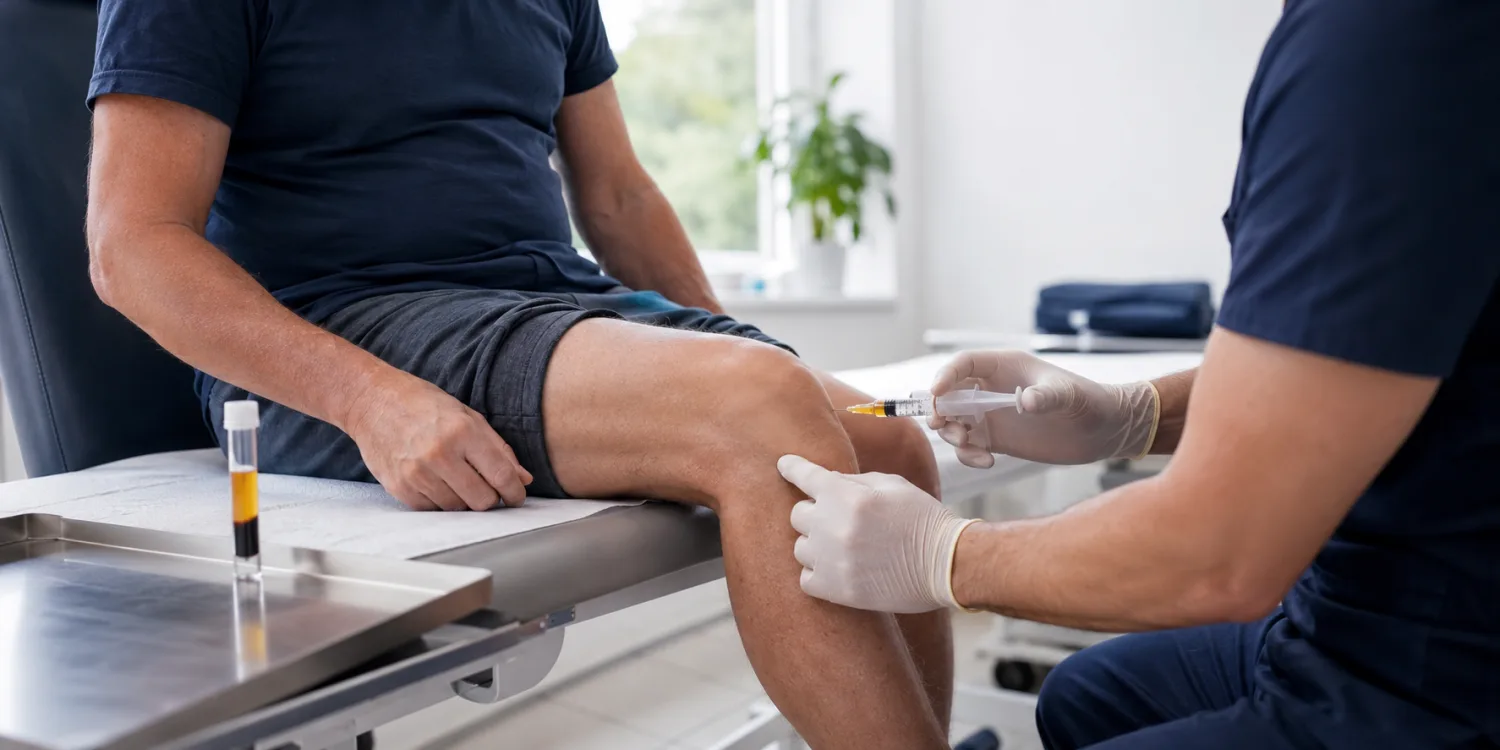
PRP stands for platelet-rich plasma. It is prepared from the patient’s own blood rather than manufactured as a conventional medicine.
During the procedure:
- A small quantity of blood is taken from a vein in your arm.
- The blood is placed in a centrifuge and spun to separate its components.
- A layer containing a higher concentration of platelets is collected.
- The prepared plasma is injected into the affected knee.
Platelets help blood clot, but they also release proteins and signalling molecules involved in inflammation and tissue repair. The theory behind PRP is that concentrating these platelets and injecting them into an affected joint may alter the local inflammatory response and improve symptoms.
PRP is not one standardised product. Preparations can differ in:
- the amount of blood collected;
- the concentration of platelets;
- whether white blood cells are retained or removed;
- whether red blood cells remain in the preparation;
- the centrifuge system and processing method;
- the final volume injected;
- whether another substance is used to activate the platelets;
- the number and timing of injections.
This variation is one reason why research findings—and the claims made by different clinics—can be difficult to compare.
How much do UK clinics charge?
Most standard private PRP knee injections cost approximately £350 to £800 per session. Prices between £450 and £600 are common for treatment at an independent musculoskeletal clinic, particularly when assessment and ultrasound guidance are included.
Published UK prices illustrate the range. One Midlands clinic advertises £450 for a single ultrasound-guided injection or £1,200 for three treatments. Another musculoskeletal clinic operating in Kent and London gives a general PRP price range of £400 to £900 per injection.
These are examples rather than national tariffs, and clinics can change their fees. Apparently similar treatments may also use different preparation systems and include different services.
The price may be affected by:
- the experience and professional background of the clinician;
- whether treatment takes place in an independent clinic or private hospital;
- the clinic’s location;
- whether ultrasound guidance is used;
- the PRP preparation system;
- the concentration and volume of the preparation;
- whether one or both knees are treated;
- whether consultation and follow-up are included;
- hospital or treatment-room charges.
A more expensive PRP product is not automatically more effective. Ask what makes the preparation different and whether comparative clinical evidence supports the additional cost.
What is included in the quoted price?
Some clinics offer an all-inclusive appointment, while others charge separately for each part of the pathway. Request a written breakdown before booking.
The advertised price may include:
- a clinical assessment;
- review of existing X-rays or MRI images;
- the blood draw;
- the PRP collection kit and preparation;
- ultrasound guidance;
- the injection itself;
- local anaesthetic where appropriate;
- aftercare instructions;
- a report sent to your GP;
- a scheduled follow-up.
Possible extra costs include:
- an initial consultant appointment;
- X-rays, ultrasound or MRI;
- hospital facility fees;
- a second injection into the same knee;
- treatment of the other knee;
- physiotherapy and rehabilitation;
- repeat assessment if the first injection does not help.
A £450 treatment may appear inexpensive until you discover that the clinic routinely recommends three injections, charges separately for consultation and requires additional imaging.
Why do some clinics recommend one injection and others three?
There is no universally accepted PRP protocol for knee osteoarthritis. Clinical studies have tested single injections, repeated injections and different intervals between treatments.
Some clinicians recommend one injection followed by a review. Others offer two or three injections approximately one to four weeks apart. Packages can reduce the price per injection, but they also require committing more money before knowing whether you will respond.
Before purchasing a course, ask:
- Why is this number of injections recommended for my diagnosis?
- Is the protocol supported by research using the same type of PRP?
- Could I pay for one treatment and assess the response first?
- How long should I wait before deciding whether it has worked?
- What happens if symptoms worsen after the first injection?
- Will unused sessions be refunded if I cannot continue?
Be cautious if every patient is offered the same expensive package regardless of diagnosis, osteoarthritis severity or response to the first treatment.
What does the evidence show?
The evidence for PRP in knee osteoarthritis is mixed. Many trials and pooled analyses report improvements in pain and knee function compared with saline, steroid or hyaluronic-acid injections. Other rigorous studies have found little or no meaningful difference from placebo.
A 2025 systematic review and meta-analysis of randomised trials reported clinically relevant functional improvement after PRP at several follow-up points, with pain improvement at some points. However, combining numerous trials does not resolve all the uncertainty because the studies used different products, protocols and comparison treatments.
One particularly important study was the RESTORE randomised clinical trial, published in JAMA. It compared three weekly injections of leukocyte-poor PRP with saline placebo in 288 adults with mild to moderate knee osteoarthritis.
At 12 months, PRP did not produce a statistically significant improvement in pain compared with placebo. It also did not reduce loss of medial tibial cartilage volume. Read the RESTORE trial.
Studies may produce conflicting findings because of differences in:
- the way PRP is prepared;
- platelet and white-cell concentrations;
- single versus repeated injections;
- the severity of osteoarthritis;
- the treatment used for comparison;
- whether participants and clinicians are adequately blinded;
- the outcomes measured;
- the length of follow-up;
- small study sizes and risk of bias.
It is reasonable to conclude that PRP may provide symptom relief for some people, but the likely size and duration of the benefit remain uncertain. Evidence is less convincing for claims that it repairs major cartilage loss or reverses established osteoarthritis.
What does NICE say about PRP?
NICE states that PRP injections for knee osteoarthritis raise no major safety concerns, but the evidence about how well they work is limited in quality.
Its interventional-procedures guidance recommends using PRP only with special arrangements for clinical governance, consent, audit or research. Patients should be clearly told about the uncertainty surrounding its effectiveness.
This does not mean that private clinics are prohibited from offering PRP. It means clinicians should document outcomes, obtain informed consent and avoid presenting the treatment as proven or guaranteed.
See the NICE guidance on platelet-rich plasma injections for knee osteoarthritis.
PRP is not a routine first-line treatment in standard NHS osteoarthritis care. NHS access is limited and may occasionally be available through research or a specialist service.
Who might consider PRP?
Private clinics most commonly offer PRP to people with mild or moderate knee osteoarthritis whose symptoms continue despite appropriate non-surgical treatment.
It may be considered when:
- exercise therapy and activity modification have not provided sufficient relief;
- pain is limiting walking, work, sleep or sport;
- anti-inflammatory medicines are unsuitable or insufficient;
- a steroid injection provided only short-lived relief;
- the patient wants to delay surgery;
- examination and imaging support osteoarthritis as the main cause;
- the patient understands that improvement is not guaranteed.
People with earlier-stage osteoarthritis may be more likely to respond than those with severe joint-space loss, major deformity or bone-on-bone disease. However, there is no reliable test that can predict an individual result.
PRP is also offered for certain tendon and sports injuries around the knee. Evidence for knee osteoarthritis cannot automatically be applied to patellar tendinopathy, ligament injury or another condition.
When might PRP be unsuitable?
Treatment may need to be avoided or delayed if you have:
- an infection in the knee or overlying skin;
- a current systemic infection or fever;
- very low platelets or another significant blood abnormality;
- a bleeding disorder;
- unexplained anaemia;
- active cancer or recent cancer treatment;
- severe uncontrolled illness;
- medication that significantly affects bleeding or platelet function.
Do not stop aspirin, warfarin, apixaban, rivaroxaban, clopidogrel or another prescribed medicine simply because a clinic recommends avoiding it. Any interruption must be approved by the clinician responsible for prescribing it.
What happens during and after the injection?
A PRP appointment commonly takes around 30 to 60 minutes. Most of this time is used for assessment, blood collection and preparation. The injection itself is relatively brief.
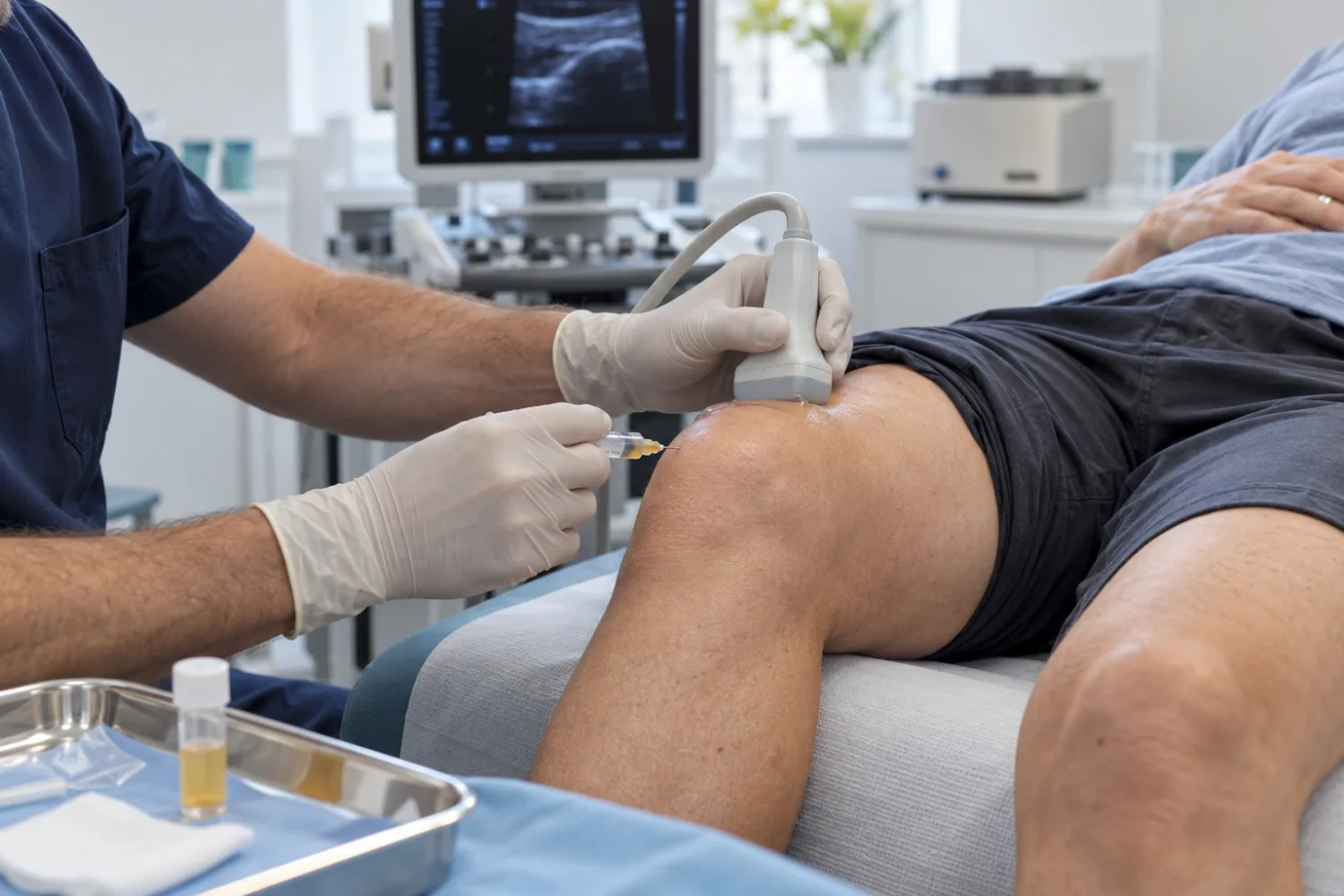
The clinician may use ultrasound to identify the joint space and guide the needle. Ultrasound can improve placement accuracy, but it does not make the PRP itself more effective or guarantee symptom relief.
You may feel pressure or discomfort during the injection. The knee can then become more painful, swollen or stiff for several days.
Aftercare may involve:
- relative rest for the first 24 to 72 hours;
- temporarily avoiding strenuous exercise;
- using paracetamol if it is suitable for you;
- avoiding anti-inflammatory medicines for a specified period;
- gradually restarting strengthening exercises;
- attending a review after several weeks.
Recommendations about ibuprofen, naproxen and other anti-inflammatory medicines differ between clinics. Follow the instructions from your treating clinician and do not stop medication prescribed for another condition without advice.
PRP does not usually provide immediate relief. If it helps, improvement may develop over several weeks. Clinics commonly advise waiting six to twelve weeks before judging the result.
What are the risks?
Because PRP is prepared from your own blood, an allergic reaction to the plasma itself is unlikely. The procedure is not risk-free, however.
Possible side effects and complications include:
- pain during the injection;
- a temporary flare in knee pain;
- swelling, warmth or stiffness;
- bruising where blood was taken;
- bleeding into or around the joint;
- infection;
- injury to a nerve, blood vessel or nearby tissue;
- fainting during blood collection;
- no improvement despite the cost and recovery time.
Seek urgent medical advice if the knee becomes increasingly hot, red and swollen, particularly if you also develop fever, chills or feel generally unwell. Joint infection is uncommon but requires prompt treatment.
How does PRP compare with other treatments?
PRP is only one possible part of osteoarthritis care. The best approach depends on the diagnosis, symptom severity, other health conditions and personal goals.
| Treatment | What to know | Typical private cost |
|---|---|---|
| Physiotherapy | Exercise and strengthening are central to osteoarthritis management. | £50–£120 per session |
| Steroid injection | May provide relatively quick but often short-term relief. | £150–£350 |
| Hyaluronic-acid injection | Evidence is mixed, and NICE does not routinely recommend it for osteoarthritis. | £250–£600 |
| PRP injection | Some trials show improvement, but products vary and benefit remains uncertain. | £350–£800+ |
| Private knee replacement | May be considered for severe symptoms and advanced joint damage. | Approximately £12,000–£20,000+ |
Core knee osteoarthritis treatment may include:
- individualised strengthening and aerobic exercise;
- weight management where relevant;
- activity pacing and modification;
- suitable footwear or a walking aid;
- topical anti-inflammatory medicine;
- oral pain treatment after considering personal risks;
- surgical assessment when symptoms are severe.
An injection should not replace an appropriate diagnosis and rehabilitation plan. A clinic offering PRP without discussing exercise, load management or alternative explanations for knee pain may not be providing a complete assessment.
Will insurance or the NHS pay for PRP?
PRP for knee osteoarthritis is usually self-funded. Many private medical insurers consider it experimental, unproven or outside standard policy benefits.
An insurer might cover the specialist consultation or diagnostic imaging without paying for the injection itself. Obtain written authorisation before treatment rather than assuming that the invoice will be reimbursed.
Ask the insurer:
- whether PRP is covered for your specific diagnosis;
- whether a GP referral is required;
- which clinician or facility must be used;
- whether ultrasound guidance is included;
- whether an excess or outpatient limit applies;
- whether rehabilitation after the injection is covered.
PRP is not routinely available through the NHS for knee osteoarthritis. Limited access may exist through a specialist service or clinical study, depending on local arrangements.
How can you choose a clinic?
Choose the clinician and assessment pathway rather than focusing only on the PRP brand or the number of platelets advertised.
Before booking, ask:
- Who will diagnose my knee problem and perform the injection?
- What professional registration and injection training do they hold?
- Why is PRP suitable for my diagnosis?
- How severe is my osteoarthritis?
- What evidence supports the preparation being offered?
- Is it leukocyte-poor or leukocyte-rich PRP?
- How many injections are recommended, and why?
- Is ultrasound guidance included?
- What is the total price, including consultation and follow-up?
- What outcome would count as successful?
- What happens if treatment does not work?
- What rehabilitation should accompany the injection?
Be cautious if a clinic claims that PRP:
- definitely regrows cartilage;
- works for almost everyone;
- permanently cures osteoarthritis;
- guarantees that surgery will never be needed;
- has no risks because it uses your own blood;
- must immediately be purchased as an expensive package.
Frequently asked questions
How much is one PRP knee injection in the UK?
A standard injection commonly costs approximately £350 to £800. Fees may be higher for consultant-led hospital treatment, specialist PRP systems or central London clinics.
How much does a course of three injections cost?
A three-injection course commonly costs around £900 to £1,800. Check whether consultation, imaging, ultrasound guidance and follow-up are included.
Is PRP available on the NHS?
It is not routinely offered for knee osteoarthritis. Limited access may occasionally be available through specialist services or research.
Does PRP regrow knee cartilage?
There is no convincing evidence that a routine PRP injection reliably regrows substantial lost cartilage or reverses established osteoarthritis. Symptom improvement is not the same as structural repair.
How successful are PRP knee injections?
There is no single reliable success rate because preparations, patient selection and definitions of success vary. Some trials report worthwhile improvement, while a major placebo-controlled trial found no significant benefit at 12 months.
How long does PRP take to work?
It does not normally provide immediate relief. Improvement may begin after several weeks, and the response is often reviewed between six and twelve weeks after treatment.
How long can the benefit last?
When PRP helps, the effect may last six to twelve months or sometimes longer. Some people improve for a shorter time, while others experience no meaningful benefit.
Is one injection enough?
It may be for some patients, but there is no universally accepted protocol. Some clinics use one treatment and others recommend two or three. The reason should be explained clearly.
Is PRP better than a steroid injection?
A steroid may act more quickly and can help an inflammatory flare. Some studies suggest PRP may offer longer-lasting improvement for selected patients, but neither option is universally better.
Does ultrasound guidance matter?
Ultrasound helps confirm needle placement inside the joint and avoid nearby structures. It improves procedural accuracy but cannot guarantee that PRP will relieve pain.
Can PRP make knee pain worse?
A temporary increase in pain, swelling and stiffness can occur. Contact the clinic if symptoms are severe, continue worsening or are accompanied by marked heat, redness or fever.
Can both knees be treated at the same appointment?
Some clinics treat both knees during one visit. Ask about the additional cost and whether temporary pain in both knees could make walking or driving difficult.
Can I drive afterwards?
Clinics often recommend arranging alternative transport because the knee may be painful or stiff and safe emergency braking could be affected. Follow your clinician’s instructions.
Do I need an MRI before PRP?
Not always. Clinical examination and recent weight-bearing X-rays may be sufficient for established osteoarthritis. MRI may help when the diagnosis is uncertain or another knee condition is suspected.
Is PRP worth paying for?
It may be reasonable for someone with a confirmed diagnosis, realistic expectations and continuing symptoms who accepts that the benefit is uncertain. It is less likely to offer good value when the diagnosis is unclear, established treatments have not been tried or the clinic promises guaranteed cartilage regrowth.