Private “stem cell” treatment for knee pain in the UK commonly costs around £3,000 to £7,000 for one knee, although some clinics charge considerably more.
That is a huge difference from a steroid injection costing a few hundred pounds or even many PRP treatments costing under £1,000.
So what exactly are you paying for?
The answer is more complicated than simply buying an injection containing stem cells.
Most private UK treatments marketed as stem-cell knee therapy involve taking tissue from your own body — often bone marrow or fat — processing it on the same day and injecting the resulting preparation into the knee.
The final product may contain a mixture of cells, platelets, growth factors and other biological material. It is therefore important to establish exactly what the clinic means when it uses the phrase “stem cell treatment”.
You are also paying for tissue harvesting, sterile processing, consultant time, imaging guidance, facilities and follow-up rather than simply the contents of the syringe.
This guide explains what private stem-cell knee treatment costs in the UK, what typically makes up the fee and how to decide whether the evidence justifies spending several thousand pounds.
How Much Does Stem Cell Knee Treatment Cost in the UK?
A realistic private self-pay range is roughly:
| Treatment | Indicative UK private cost |
|---|---|
| BMAC knee injection | About £3,000–£6,500 |
| Fat-derived or other autologous cell procedure | Often £4,000–£8,000+ |
| Combination regenerative treatment | About £5,000–£10,000+ |
| Complex surgical cell/cartilage procedure | Can exceed £10,000 |
There is no standard NHS or national private tariff.
Current published prices illustrate just how variable the market is.
London Cartilage Clinic currently lists BMAC injections from around £3,000. Another London provider advertises BMAC from £3,900 when added to another procedure and from £6,500 as a standalone inpatient procedure.
A separate regenerative clinic currently lists stem-cell therapy at around £5,000, including follow-up, physiotherapy and nutrition support.
Some highly specialised surgical pathways involving cartilage repair and cell-based treatment can cost £9,000, £10,000 or considerably more.
That means the phrase “stem-cell knee treatment” alone tells you almost nothing about price.
Our broader guide to regenerative medicine costs in the UK compares the wider range of regenerative procedures.
What Are You Actually Paying For?
The expensive part is not usually one injection.
A typical same-day autologous procedure involves several separate stages.
Specialist assessment
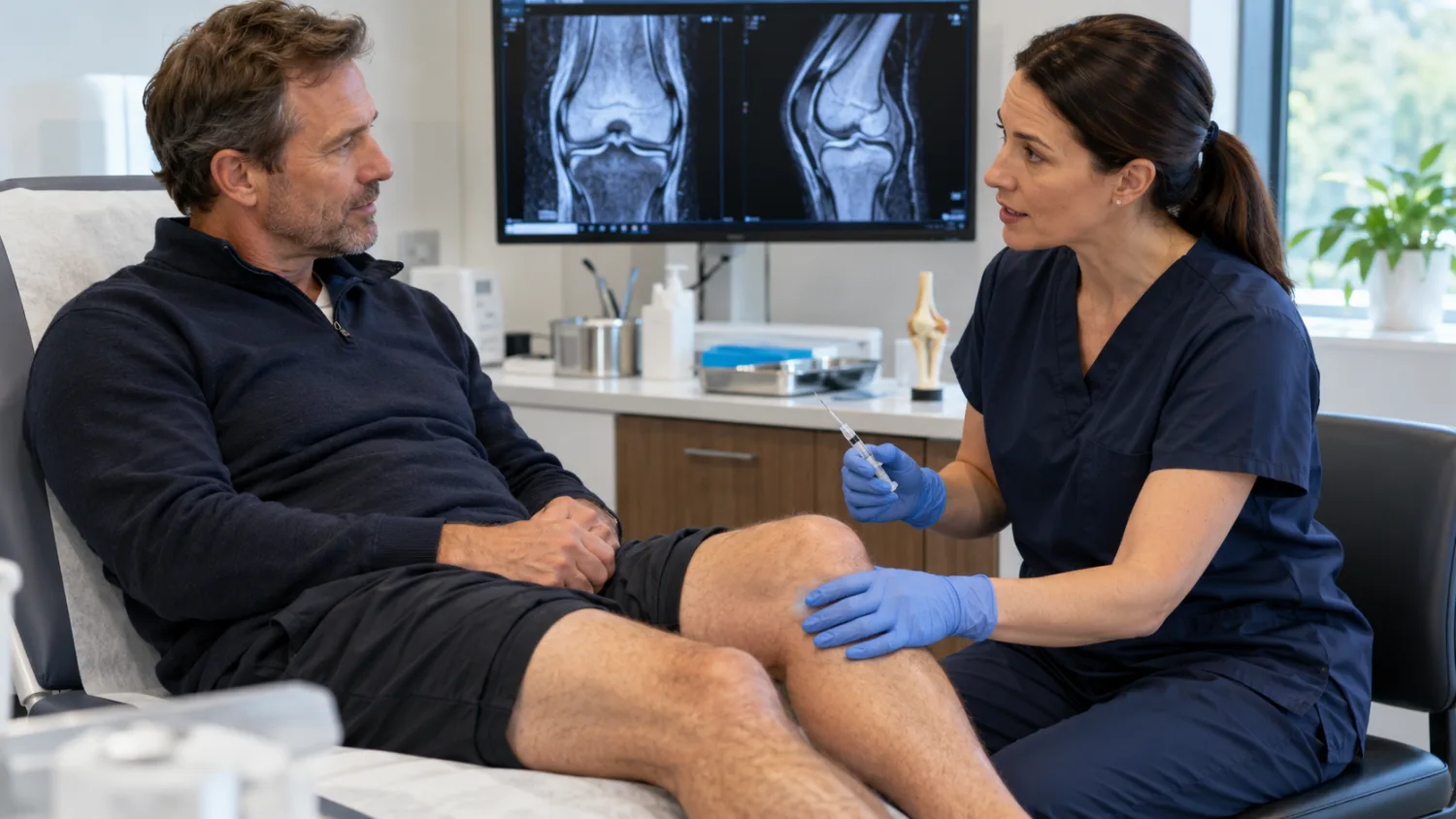
Before treatment, an orthopaedic specialist normally reviews your symptoms, examination findings and imaging.
This may cost around £200 to £400 if it is charged separately.
The purpose should be to decide whether you are actually a sensible candidate rather than simply confirming that you are willing to pay.
A good assessment may conclude that the treatment is unlikely to help.
Imaging
Existing X-rays or MRI scans may need to be reviewed.
If recent imaging is not available, new scans can add several hundred pounds.
Imaging helps determine whether pain is caused primarily by osteoarthritis, cartilage injury, meniscal damage or another problem.
Tissue harvesting
If bone marrow is being used, a clinician typically collects marrow from the pelvis.
This is a more involved procedure than taking blood for PRP.
It requires:
- sterile facilities;
- local anaesthetic or sedation in some cases;
- specialised aspiration equipment;
- clinical staff;
- monitoring.
Fat-derived procedures may involve harvesting adipose tissue through a small liposuction-style procedure.
Processing
The collected tissue is then processed to create the material that will be injected.
For bone marrow aspirate concentrate, or BMAC, the marrow is typically centrifuged to concentrate selected cellular and biological components.
This requires single-use processing kits, equipment and sterile handling.
Image-guided injection
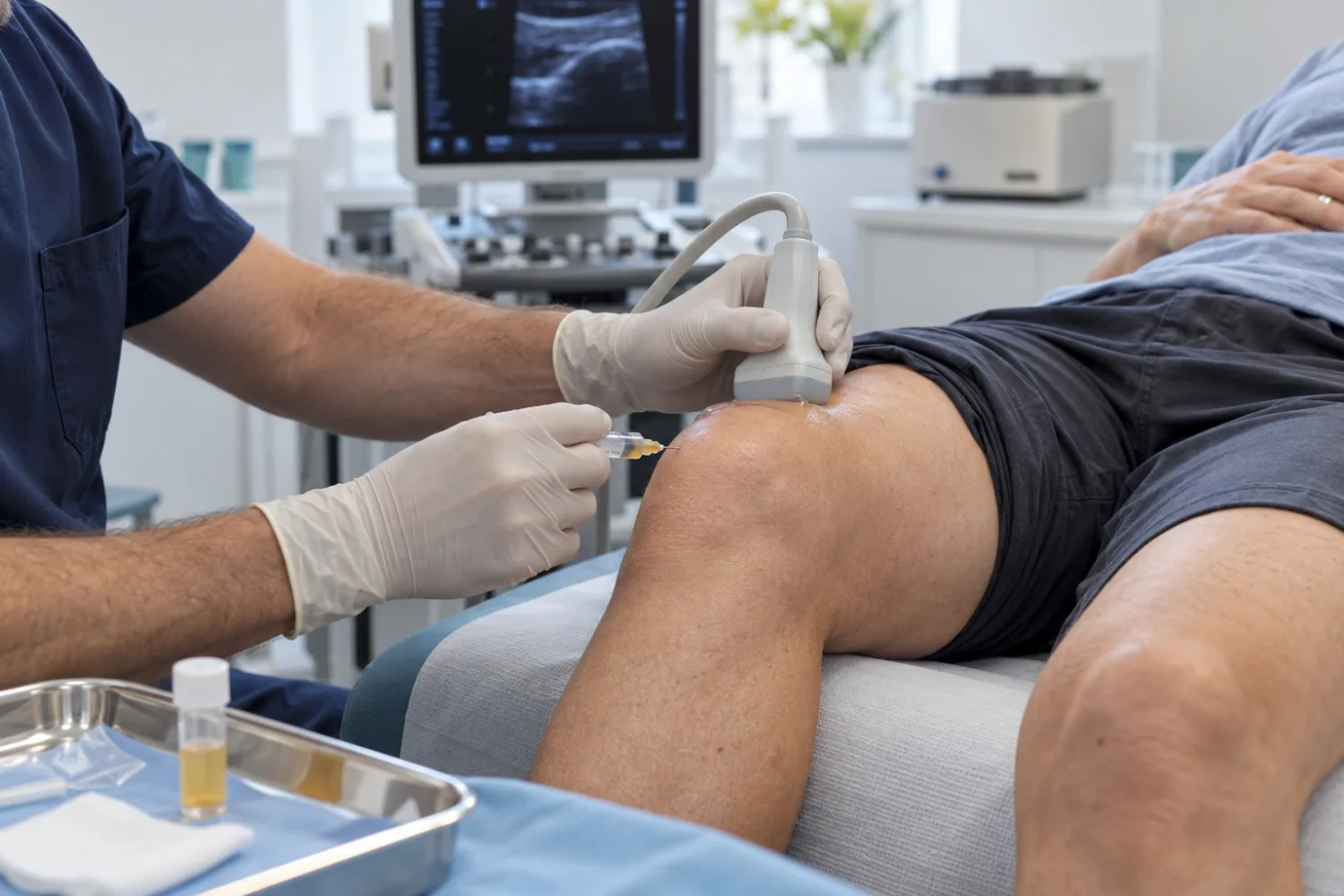
The final preparation is normally injected into the knee using ultrasound or fluoroscopic guidance.
Guidance helps ensure that the material is delivered accurately into the intended joint or tissue.
Follow-up
Some packages include one or more follow-up appointments, physiotherapy or rehabilitation advice.
Others charge these separately.
Always ask for an itemised quote.
What Is BMAC?
BMAC stands for bone marrow aspirate concentrate.
This is one of the most common procedures marketed as stem-cell treatment for knee osteoarthritis in the UK.
Bone marrow contains many components, including:
- blood-forming cells;
- platelets;
- growth factors;
- immune cells;
- a relatively small number of mesenchymal stromal cells.
The sample is collected and concentrated before being injected into the knee.
This distinction matters.
BMAC is not the same thing as a laboratory-grown preparation consisting of millions of purified stem cells.
The British Orthopaedic Association specifically warns that some orthobiologic procedures are described as “stem cell treatments” even though there may be relatively few true stem cells in the injected product.
Marketing can therefore make the treatment sound more sophisticated than the actual cell preparation.
You can read more about this wider issue in our guide to stem-cell therapy in the UK: approved uses versus private claims.
Is Fat-Derived Treatment Different?
Yes.
Some clinics use material taken from body fat rather than bone marrow.
A small amount of fat may be removed from an area such as the abdomen or thigh and then mechanically processed before being injected.
Again, the resulting product is not necessarily a purified stem-cell preparation.
It may contain a mixture of:
- fat tissue;
- stromal cells;
- blood vessels;
- signalling molecules;
- other cellular components.
The terminology used by clinics varies considerably.
You may see phrases such as:
- adipose-derived stem cells;
- microfragmented fat;
- stromal vascular fraction;
- medicinal signalling cells;
- regenerative cell therapy.
These terms do not necessarily describe identical products.
Ask the clinic exactly what material is being injected and how it is processed.
Does Stem Cell Treatment Regrow Knee Cartilage?
This is where marketing needs particular caution.
Some private clinics use phrases such as:
- “regenerates cartilage”;
- “repairs the joint naturally”;
- “reverses osteoarthritis”;
- “avoids knee replacement”.
These claims can go beyond what current clinical evidence can confidently establish.
NICE reviewed stem-cell injections for knee osteoarthritis and found only limited evidence from small studies.
Some studies suggested improvements in pain or function, but the evidence was not strong or consistent enough for NICE to recommend routine clinical use.
NICE therefore considers intra-articular stem-cell injection for osteoarthritis an experimental treatment that should be used in research.
That does not prove the treatment never helps anyone.
It means the evidence is not yet strong enough to say reliably:
- which patients benefit;
- how large the benefit is;
- how long it lasts;
- which cell preparation is best;
- whether cartilage is meaningfully restored;
- whether treatment actually delays knee replacement.
This uncertainty is important when deciding whether to spend £5,000 or more.
How Does It Compare With PRP?
PRP — platelet-rich plasma — is much simpler.
A sample of your blood is taken, processed to concentrate platelets and then injected into the knee.
There is no bone-marrow or fat-harvesting procedure.
For that reason, PRP is usually much cheaper.
A private PRP injection may cost roughly £250 to £600 per session, although courses of several injections cost more.
The evidence for PRP is also imperfect.
NICE says there are no major safety concerns but that the quality of evidence for effectiveness remains limited, so special arrangements for consent, governance and audit are recommended.
Our article on PRP for knee osteoarthritis looks at the research in more detail.
You can also see current pricing in our UK PRP knee injection cost guide.
Paying ten times more for a cell-based procedure does not automatically mean you are receiving ten times more benefit.
Who Might Consider Private Stem Cell Knee Treatment?
The typical private patient is not someone with a completely healthy knee.
Clinics usually market treatment towards people with:
- mild to moderate knee osteoarthritis;
- cartilage injury;
- persistent pain despite physiotherapy;
- sports-related joint damage;
- a desire to delay major surgery.
The most difficult situation is advanced “bone-on-bone” osteoarthritis.
If joint structure is already severely damaged, injecting a biological preparation cannot simply recreate an entirely normal knee joint.
Be particularly cautious if a clinic promises that severe arthritis can reliably be reversed without surgery.
Conversely, somebody with mild symptoms may improve with exercise, physiotherapy, weight management and ordinary pain treatment without needing a £5,000 procedure.
The value of treatment therefore depends heavily on patient selection.
What Are the Risks?
Using your own tissue avoids some issues associated with donor cells, but it does not make the procedure risk-free.
Possible complications include:
- pain after the procedure;
- swelling;
- bleeding or bruising at the harvest site;
- infection;
- injury to surrounding structures;
- anaesthetic or sedation complications;
- failure to improve symptoms.
Bone-marrow harvesting creates an additional procedure site, usually around the pelvis.
Fat harvesting has its own risks including bruising, discomfort and infection.
The British Orthopaedic Association has also highlighted infection as an important potential complication of orthobiologic procedures.
Because the treatment is expensive, financial harm is another legitimate consideration.
Spending several thousand pounds on a procedure that provides little or no benefit can itself have a significant impact.
What Should You Ask a Clinic Before Paying?
The first question should be:
What exactly are you injecting?
Do not settle for “your own stem cells”.
Ask:
- Are the cells taken from bone marrow or fat?
- What is the product called?
- How is it processed?
- Is it concentrated?
- Do you know approximately how many relevant cells are present?
- Is anything else added?
- Is PRP included?
- How many injections are planned?
- What published evidence supports this exact protocol?
Then ask about cost.
Does the quotation include:
- initial consultation;
- MRI or X-rays;
- hospital or theatre fee;
- anaesthetic;
- tissue harvesting;
- processing kit;
- image-guided injection;
- follow-up;
- physiotherapy;
- treatment if there is a complication?
A £3,000 headline price can become much higher if important parts of the pathway are billed separately.
How Can You Spot Exaggerated Claims?
Be cautious if the clinic promises:
- guaranteed cartilage regrowth;
- permanent cure of arthritis;
- a guaranteed alternative to knee replacement;
- near-100% success rates;
- no meaningful risk;
- the same stem-cell treatment for many unrelated diseases.
Testimonials and impressive MRI pictures are not substitutes for properly controlled clinical trials.
The British Orthopaedic Association specifically notes that orthobiologic marketing may overstate benefits and that the label “stem cell treatment” can itself be misleading.
Our guide to spotting exaggerated stem-cell clinic claims explains these warning signs in more detail.
A trustworthy clinic should be comfortable discussing:
- uncertainty;
- failure rates;
- alternative treatments;
- limitations of the research;
- which patients it refuses to treat.
Is It Better Than Knee Replacement?
They are not really equivalent treatments.
A knee replacement removes damaged joint surfaces and replaces them with artificial components.
A stem-cell or BMAC injection attempts to modify symptoms or the biological environment of the existing joint.
Knee replacement has a much larger evidence base for appropriately selected people with severe osteoarthritis.
It is also a major operation with a longer recovery and different risks.
Someone with early osteoarthritis would not normally choose between a £5,000 injection and immediate knee replacement as though they were interchangeable products.
The decision depends on:
- arthritis severity;
- pain;
- mobility;
- age;
- response to conservative treatment;
- imaging;
- personal priorities.
When severe arthritis is substantially affecting everyday life despite appropriate non-surgical treatment, joint replacement may eventually be the more evidence-based option.
So, Is Stem Cell Knee Treatment Worth Paying For?
There is no simple answer.
For someone who understands the uncertainty, has been assessed by an experienced orthopaedic specialist and is willing to spend several thousand pounds on a treatment that may or may not improve symptoms, it can be a personal choice.
But it should not be purchased on the assumption that £5,000 buys proven cartilage regeneration.
Current NICE guidance does not support routine stem-cell injections for knee osteoarthritis outside research because the evidence remains insufficient.
That makes the decision fundamentally different from paying privately for an established operation because the NHS waiting list is long.
You are paying for an experimental or emerging intervention whose effectiveness is still uncertain.
Before proceeding, it is reasonable to get an independent orthopaedic opinion from a clinician who does not sell the procedure.
That consultation may cost a few hundred pounds but could be the most useful part of a £5,000 treatment decision.
Frequently Asked Questions
How much does stem cell knee treatment cost in the UK?
Private procedures commonly cost around £3,000 to £7,000 for one knee, although some specialised treatments cost considerably more.
How much does BMAC treatment cost?
Current UK published examples range from around £3,000 to £6,500 depending on the clinic and whether it is performed as a standalone procedure or alongside another treatment.
What does BMAC stand for?
BMAC means bone marrow aspirate concentrate. Bone marrow is collected, processed to concentrate certain components and then injected into the affected joint.
Is BMAC really stem-cell therapy?
It contains a mixture of bone-marrow components, including a relatively small population of mesenchymal stromal cells. Calling it simply “stem-cell therapy” can make the preparation sound more concentrated or purified than it actually is.
Can stem cells regrow knee cartilage?
Research is ongoing, but current clinical evidence does not establish that private stem-cell injections reliably regenerate substantial lost cartilage or reverse established knee osteoarthritis.
Does NICE recommend stem-cell injections for knee arthritis?
No. NICE considers intra-articular stem-cell injections experimental and says they should not currently be used outside research for osteoarthritis.
Is stem-cell treatment available on the NHS?
Routine stem-cell injections for knee osteoarthritis are not an established NHS treatment. They are mainly available privately or within research settings.
Is stem-cell treatment better than PRP?
There is not enough high-quality evidence to say that expensive cell-based procedures consistently produce better outcomes than PRP. They are biologically different treatments and both have limitations in the evidence base.
How many injections are needed?
Many BMAC or fat-derived procedures are offered as a single treatment, although protocols vary. Some clinics combine them with PRP or recommend additional injections later.
How long does recovery take?
People can usually walk after many injection-based procedures, but soreness at both the knee and tissue-harvest site can last for days. Activity restrictions and rehabilitation depend on the procedure used.
Will private health insurance pay for it?
Often not. Many insurers regard orthobiologic or stem-cell treatment for osteoarthritis as experimental or non-standard treatment. Check with your insurer before assuming it is covered.
Can stem-cell treatment prevent knee replacement?
There is not currently strong evidence showing that these injections reliably prevent or substantially delay eventual knee replacement in people who would otherwise need surgery.
Is treatment using my own cells automatically safe?
No. Using your own tissue avoids donor rejection, but there are still risks from harvesting, processing, injection, infection and the possibility that the procedure simply does not work.
Why do clinics charge so much?
The cost reflects specialist assessment, bone-marrow or fat harvesting, sterile processing kits, facilities, image-guided injection, clinical staff and follow-up. The price does not necessarily reflect the amount of stem cells present or the strength of clinical evidence.
What is the most important question to ask before paying?
Ask exactly what is being injected and what good-quality evidence supports that specific preparation for people with your type and severity of knee problem.
This guide provides general information rather than a recommendation for or against a particular private treatment. Stem-cell and orthobiologic procedures for knee osteoarthritis remain an evolving area of medicine. Consider an independent orthopaedic opinion before paying for an expensive intervention.