STI testing in the UK is available free through NHS sexual health services, through private clinics and from postal testing providers. Each option can be appropriate, but they are not interchangeable.
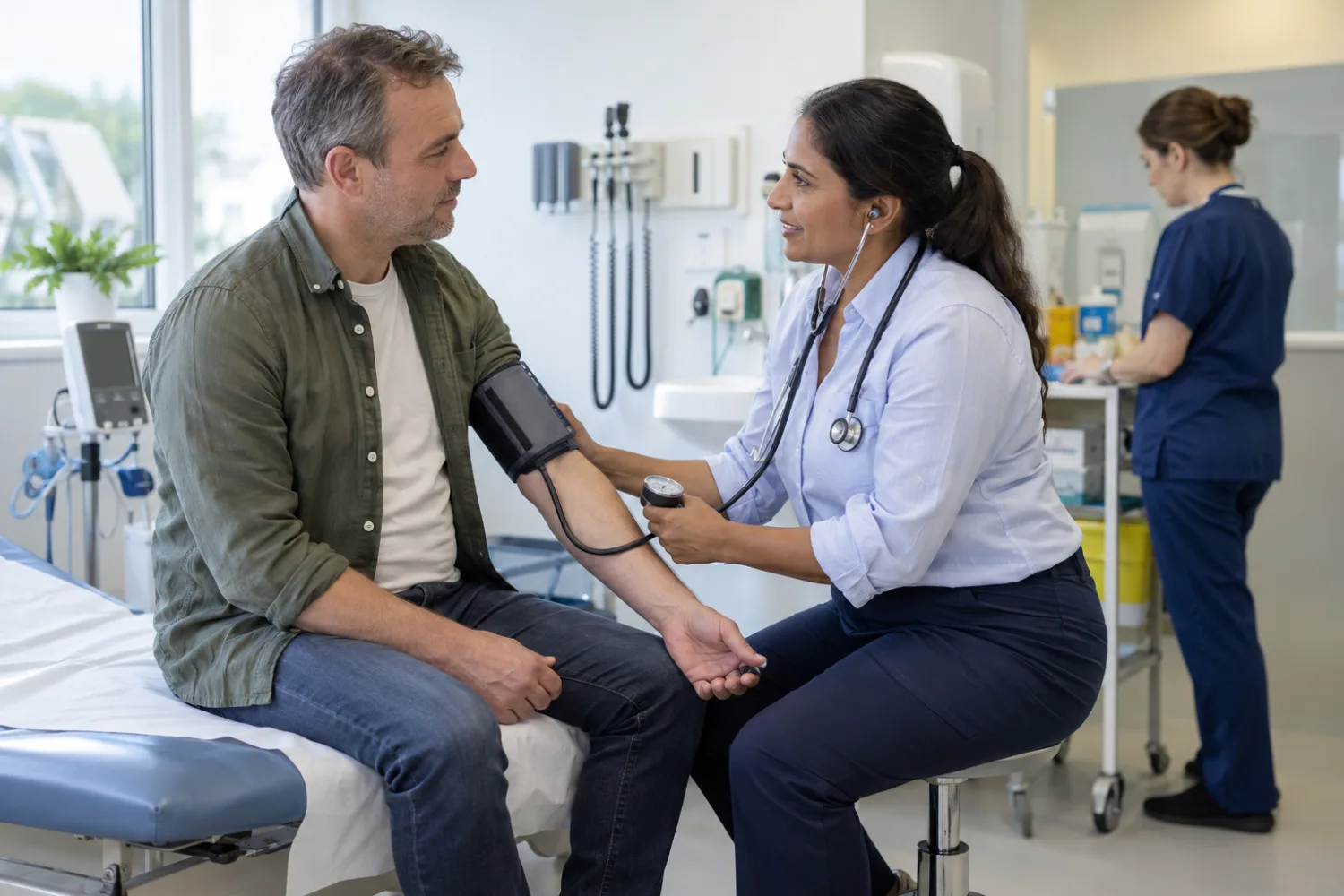
An NHS sexual health clinic is usually the strongest choice when you have symptoms, may need treatment, require an examination or are worried about a recent high-risk exposure. A postal kit can be a convenient option when you feel well and want routine screening. Private testing may be useful when you want a rapid appointment, a particular test or an option outside local NHS eligibility rules.
The most important question is not simply where to test. It is whether you are taking the correct tests, at the correct time and from every body site that may have been exposed.
A urine sample alone may miss an infection in the throat or rectum. A blood test taken too soon may not yet detect HIV or syphilis. A large commercial “full STI panel” may include tests that are not recommended for routine screening while omitting the clinical advice you actually need.
Many sexually transmitted infections cause no obvious symptoms. A person can feel completely well, and their partner can appear well, while an infection is still present. Testing is a normal part of looking after sexual health rather than evidence that anyone has behaved badly.
Seek urgent advice immediately after a possible HIV exposure. HIV post-exposure prophylaxis, or PEP, must be started as soon as possible and no later than 72 hours after the exposure. Contact a sexual health clinic, NHS 111 or an emergency department rather than waiting for an STI test.
Do not rely on a postal kit when you have severe symptoms. Seek prompt clinical assessment for significant pelvic or lower abdominal pain, severe testicular pain or swelling, fever, genital ulcers, pregnancy with pain or bleeding, a widespread rash, or feeling seriously unwell.
After sexual assault, you can contact a sexual assault referral centre for confidential medical care, forensic options and emotional support. You do not have to report the assault to the police to ask for healthcare.
Where can you get an STI test in the UK?
The main routes are NHS sexual health clinics, NHS postal services, GP practices, some pharmacies, private clinics and commercial home-testing companies.
The best route depends on whether you have symptoms, what exposure occurred, how recently it happened and whether you may need examination or treatment.
NHS sexual health clinics
Sexual health clinics—sometimes called GUM or genitourinary medicine clinics—offer specialist STI testing and treatment.
NHS sexual health services are generally:
- free;
- confidential;
- available without a GP referral;
- open to people regardless of age, gender, ethnicity or sexual orientation;
- able to provide treatment and partner-notification support.
You may need to book in advance because walk-in arrangements vary. Use the NHS sexual health clinic finder to check the nearest service and how it operates.
NHS postal STI kits
Many local authorities commission free postal testing for people living within their area.
Depending on postcode and eligibility, the kit may test for:
- chlamydia;
- gonorrhoea;
- HIV;
- syphilis.
Some local schemes offer only chlamydia and gonorrhoea, while others provide a broader screen. Age restrictions, symptom rules and availability differ by area.
Postal kits are commonly designed for people who do not have significant symptoms. Some services now accept selected mild symptoms or known contacts, but this should not be assumed.
GP practices
A GP can assess symptoms and arrange some STI tests, but the range of tests and sampling available may be more limited than at a specialist clinic.
A GP may be a suitable first step when sexual-health symptoms overlap with another medical problem. However, the GP may refer you to a sexual health service for specialist assessment, treatment or contact tracing.
Pharmacies
Some pharmacies provide or distribute chlamydia kits, particularly for younger adults, and can advise on local testing services, condoms and emergency contraception.
A pharmacy is not normally the best place for a complete assessment if you have pelvic pain, testicular pain, genital sores, significant discharge or another complex symptom.
Our guide to when to see a pharmacist instead of a GP explains which common health concerns can be managed safely in a pharmacy and when another service is more appropriate.
Private sexual health clinics
Private clinics may offer:
- same-day or next-day appointments;
- clinician consultation and examination;
- individual tests or screening packages;
- rapid-result tests;
- treatment where appropriate;
- telephone or online follow-up.
Unlike NHS sexual health care, private testing normally has a charge. Consultation, testing, treatment and follow-up may be priced separately.
Commercial postal kits
Private postal services allow you to order online, collect samples at home and send them to a laboratory.
They may be useful when local free kits are unavailable or when you want a particular testing package. Before paying, check what samples are required, which laboratory performs the tests and what medical support is available after a positive or unclear result.
NHS STI testing: what is free and confidential?
NHS sexual health clinic testing and treatment are free.
You do not normally need to live within the same local authority to attend a clinic, although postal-kit services commonly use postcode eligibility because they are commissioned locally.
Do you need a GP referral?
No. You can usually contact a sexual health clinic yourself.
Some services accept online bookings, some use telephone triage and others provide limited walk-in clinics.
Will the clinic tell your GP?
Sexual health clinic records are confidential and are generally kept separately from ordinary GP records.
The clinic will not normally tell your GP or anyone else that you attended without your permission.
There are limited exceptions where healthcare professionals may need to share information to protect a child, vulnerable person or someone at serious risk of harm. These safeguarding rules apply throughout healthcare, not only to sexual health services.
Can people under 16 use a sexual health clinic?
Yes. Young people can receive confidential sexual health advice, testing and treatment.
A clinician will assess whether the young person understands the care and is safe. Parents are not automatically informed simply because someone is under 16.
What can an NHS clinic provide?
Services vary, but a specialist clinic may offer:
- chlamydia and gonorrhoea testing;
- HIV and syphilis blood tests;
- hepatitis testing for people with relevant risks;
- examination of genital symptoms;
- testing for trichomoniasis or Mycoplasma genitalium where indicated;
- diagnosis of herpes or genital warts;
- STI treatment;
- partner notification;
- HIV PrEP and PEP assessment;
- contraception and emergency contraception;
- vaccination in eligible risk groups.
The NHS guide to visiting a sexual health clinic explains what usually happens at the appointment.
Will the clinic contact your partners?
If an STI is diagnosed, the service will discuss how recent partners can be informed and tested.
This is known as partner notification. You may choose to tell partners yourself, or the clinic may be able to contact them without naming you.
The purpose is to prevent reinfection and reduce onward transmission, not to assign blame.
Can you attend a clinic outside your area?
Usually, yes. Specialist sexual health clinics are generally open-access services.
However, local online and postal services commonly restrict eligibility to residents whose council funds that programme.
How private STI testing works and what it costs
Private testing can be convenient, but prices vary substantially.
A single test may cost tens of pounds, while a broad package with a clinician consultation and rapid laboratory processing may cost several hundred pounds.
| Private service | Indicative UK price |
|---|---|
| Single chlamydia or gonorrhoea test | Around £30–£70 |
| Combined chlamydia and gonorrhoea test | Around £50–£100 |
| HIV laboratory test | Around £40–£100 |
| HIV, syphilis, chlamydia and gonorrhoea screen | Around £100–£250 |
| Broad STI panel | Around £150–£350+ |
| Private clinician consultation | Around £50–£150, sometimes extra |
These are general planning figures rather than standard national prices. Always check whether the advertised amount includes sample collection, laboratory fees, consultation, results interpretation and treatment.
Clinic testing versus a private postal kit
A clinic can take a medical history, examine symptoms and select samples from the correct sites. It may also provide immediate treatment or arrange further assessment.
A postal service is usually cheaper and more convenient but relies on you selecting and collecting the correct samples.
What does “full STI screen” mean?
There is no single legally defined full STI panel.
One provider may use the phrase for:
- chlamydia;
- gonorrhoea;
- HIV;
- syphilis.
Another may add hepatitis B, hepatitis C, trichomoniasis, Mycoplasma genitalium, herpes antibodies or several other organisms.
Read the actual test list. Do not assume that “complete,” “comprehensive” or “platinum” has a standard medical meaning.
Are bigger panels better?
Not necessarily.
Broad panels can create confusing results, particularly when they include tests that are not recommended for routine screening in people without symptoms.
A focused screen based on sexual history is often more clinically useful than testing for every organism a laboratory can detect.
Will private health insurance cover STI testing?
Many private medical-insurance policies exclude routine screening and sexual-health tests carried out without symptoms.
A policy may cover investigation of specific symptoms, but authorisation rules and exclusions differ.
Check with the insurer before paying. Do not delay urgent assessment while waiting for insurance approval when PEP, emergency contraception or treatment may be time-sensitive.
Are private results added to NHS records?
Not automatically.
A private provider may ask permission to share results with your GP, particularly if follow-up is required. If treatment or further monitoring is needed, keep a copy of the laboratory report rather than relying on a screenshot showing only “positive” or “negative.”
How postal STI kits work
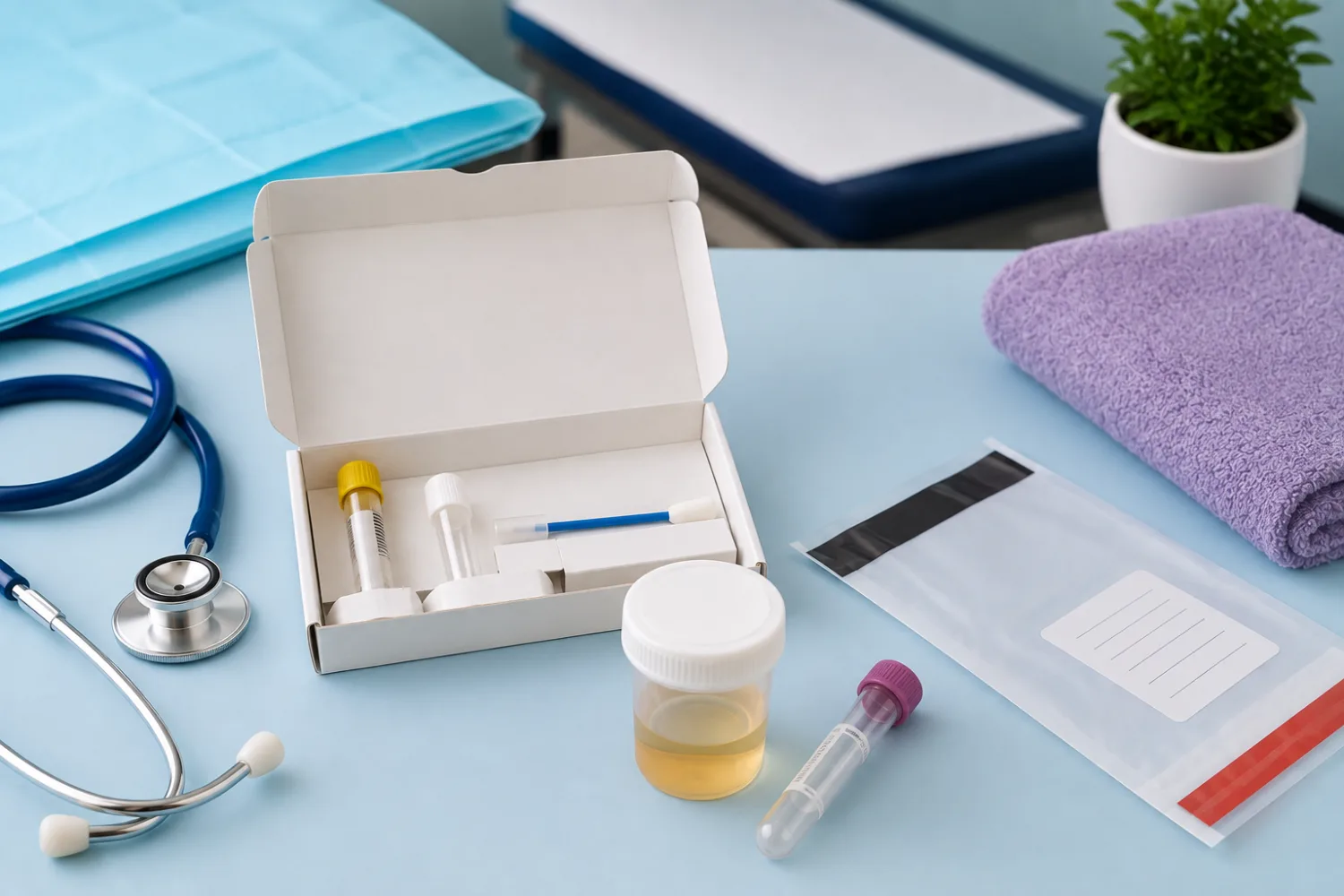
A postal STI kit is generally a self-sampling kit. You collect the specimen yourself, return it to a laboratory and receive the result later.
This is different from a rapid self-test that gives a result at home.
What samples might be included?
A kit may ask for:
- a vaginal or front-hole swab;
- a first-catch urine sample;
- a throat swab;
- a rectal swab;
- a finger-prick blood sample.
Not everyone needs every sample. The correct combination depends on anatomy and sexual contact rather than gender labels alone.
Vaginal swab or urine?
For people with a vagina or front hole, a self-taken vaginal swab is commonly used for chlamydia and gonorrhoea and may be more sensitive than urine.
For testing after penile exposure, a first-catch urine sample is commonly used. This means collecting the first part of the urine stream rather than a midstream specimen used for an ordinary UTI test.
If pain when urinating is your main symptom, see our guide to pain when urinating, including UTIs, kidney stones and STIs.
Finger-prick blood tests
Postal blood kits may test for HIV and syphilis and sometimes hepatitis B or C.
Collecting enough blood can be difficult. Follow the instructions carefully, warm the hands beforehand and allow drops to form naturally rather than repeatedly squeezing one spot very hard.
An insufficient or damaged sample may produce no result and require another kit or a clinic blood test.
How discreet is the packaging?
NHS and reputable private providers normally use plain packaging without sexual-health branding on the outside.
Check delivery and communication preferences if privacy at home is important. Results may be sent by text, portal, email or telephone.
How long do results take?
Results may be available within a few working days after the laboratory receives the samples.
Turnaround time does not start when you place the order. Delivery, sample collection, return postage and weekends can all extend the total wait.
What if the kit is positive?
A good service should explain:
- what the result means;
- whether confirmation is needed;
- where to receive treatment;
- whether partners need testing;
- how long to avoid sexual contact;
- whether repeat testing is recommended.
Some NHS postal services can arrange treatment directly. A private postal company may refer you to an NHS clinic, private doctor or pharmacy and may charge separately for the consultation and medicine.
When is a postal kit not enough?
Choose a clinic when you have:
- pelvic or lower abdominal pain;
- testicular pain or swelling;
- genital ulcers or blisters;
- a new genital rash;
- significant discharge;
- bleeding after sex;
- fever or feeling unwell;
- possible recent HIV exposure;
- a known contact with an STI requiring treatment;
- pregnancy with symptoms;
- concerns after sexual assault.
A clinician may need to examine you, take additional swabs or begin treatment without waiting for a postal result.
Which STIs are normally tested for?
A routine STI screen often focuses on chlamydia, gonorrhoea, HIV and syphilis.
Additional tests are selected according to symptoms, anatomy, vaccination history, sexual contact, travel and other risk factors.
Chlamydia
Chlamydia is tested using urine or swabs from relevant sites.
It often causes no symptoms. When symptoms occur, they may include:
- pain when urinating;
- unusual vaginal, penile or rectal discharge;
- bleeding after sex or between periods;
- pelvic pain;
- testicular pain.
Gonorrhoea
Gonorrhoea is also tested through urine and swabs.
A laboratory nucleic-acid test is commonly used for screening. If gonorrhoea is detected, the clinic may take a culture before treatment to assess antibiotic sensitivity because antimicrobial resistance is an important concern.
This is one reason treating suspected gonorrhoea using antibiotics bought online is unsafe.
HIV
HIV is generally tested using blood, although oral-fluid and rapid testing options exist.
Modern laboratory antigen-and-antibody tests can detect infection earlier than older antibody-only tests. The precise window period depends on the test used.
Anyone with a substantial exposure within the previous 72 hours should ask urgently about PEP rather than waiting for a test result.
Syphilis
Syphilis is generally tested through blood.
A clinic may also examine or swab a suspicious ulcer. People previously treated for syphilis require careful result interpretation because some antibodies can remain positive for many years.
A basic postal finger-prick test may therefore be unsuitable for someone with a previous syphilis diagnosis.
Hepatitis B and hepatitis C
These are not automatically included in every routine screen.
Testing may be recommended based on:
- type of sexual exposure;
- country of birth or residence;
- shared injecting equipment;
- sexual contact with someone living with hepatitis;
- men who have sex with men;
- sex work or other relevant exposures;
- abnormal liver tests;
- previous blood exposure.
Hepatitis B vaccination may be offered through sexual health services to eligible people.
Trichomoniasis
Trichomonas vaginalis can cause vaginal discharge, irritation and pain when urinating, although many infections are asymptomatic.
It is not always included in routine postal panels and is more commonly tested when symptoms or epidemiological risk make it relevant.
Mycoplasma genitalium
Mycoplasma genitalium, often shortened to Mgen, can cause urethritis, cervicitis and pelvic inflammatory disease.
Routine screening of everyone without symptoms is not generally recommended. Unnecessary testing and treatment can contribute to antibiotic resistance and difficult-to-interpret results.
Herpes
Genital herpes is best diagnosed by swabbing a fresh blister or ulcer.
Blood antibody tests cannot reliably show where the infection is located, when it was acquired or whether a current symptom is caused by herpes. They are therefore not a straightforward routine-screening test.
Genital warts and HPV
Genital warts are usually diagnosed by examination rather than through a standard STI panel.
Routine cervical HPV testing is part of cervical screening, not a general test for every HPV infection or a test of a partner’s overall sexual health.
For more detail, read our guide to cervical cancer, HPV and smear tests.
Thrush and bacterial vaginosis
Thrush and bacterial vaginosis are not normally classed as STIs, although sexual activity can influence symptoms and recurrence.
They require different testing and treatment from chlamydia or gonorrhoea. Our guide to vaginal discharge, thrush, BV and STIs explains common differences.
When should you test after sexual contact?
Testing immediately after sex may be too early.
A window period is the time between acquiring an infection and the point when the chosen test can detect it reliably.
The correct timing varies by infection, test technology and local service protocol.
| Infection | Common testing guidance after exposure |
|---|---|
| Chlamydia | Often around 2 weeks |
| Gonorrhoea | Often around 2 weeks |
| Laboratory HIV antigen-and-antibody test | Commonly around 6 weeks for reliable screening, depending on the test |
| Syphilis | May require testing at up to 12 weeks or 3 months |
| Hepatitis B or C | Timing varies and may require repeat testing |
These are general guideposts, not universal guarantees. Follow the timing given by the clinic or kit provider for the exact test being used.
Should you wait when you have symptoms?
No. Contact a sexual health clinic as soon as symptoms appear.
The clinician may test immediately, examine you and arrange repeat testing later if the first test falls within the window period.
What if a partner has tested positive?
Contact a clinic rather than simply waiting for the ideal screening date.
Depending on the infection and exposure, the service may recommend immediate testing, treatment, a later repeat test or all three.
Can an early test still be useful?
Yes, particularly when symptoms are present or an initial baseline result is clinically useful.
However, an early negative result may need repeating after the window period.
Does a negative test clear every recent exposure?
No. A result applies only to the infections, body sites and time period covered by that test.
A negative chlamydia urine result does not rule out throat gonorrhoea, syphilis, herpes or a very recent infection that has not yet become detectable.
When should regular screening take place?
There is no universal schedule for every sexually active adult.
Testing may be sensible:
- after changing partners;
- before stopping condom use with a new partner;
- after condomless sex with a new or casual partner;
- when a partner has other partners;
- after a known exposure;
- when symptoms occur;
- at regular intervals for people with continuing higher-risk exposure.
A sexual health service can recommend an appropriate schedule based on individual circumstances rather than judgement or assumptions.
Choosing the correct body-site samples
One of the biggest limitations of basic postal testing is that people may test only the genitals when exposure also involved the throat or rectum.
Chlamydia and gonorrhoea can infect each site independently.
Urine or genital swab
A genital sample may detect infection in the urethra, vagina or cervix, depending on the test and anatomy.
It does not automatically test the throat or rectum.
Throat swabs
A throat swab may be relevant after giving oral sex.
Throat gonorrhoea often causes no symptoms. A person can therefore have a negative urine test while still having an infection in the throat.
Rectal swabs
A rectal swab may be relevant after receptive anal sex or when there are rectal symptoms.
Rectal infection can occur without pain or discharge.
Do you need a swab after receiving oral sex?
The appropriate sample depends on which body site was exposed.
For example, receiving oral sex may expose the genitals to infection, while giving oral sex may expose the throat.
Complete the sexual-history questions accurately rather than choosing samples based only on your gender or usual identity.
Can self-taken swabs be accurate?
Yes. Properly collected self-taken vaginal, throat and rectal swabs can be highly effective for laboratory testing.
The swab must touch the correct area and be returned in the supplied tube. Follow the kit instructions rather than using ordinary cotton buds.
Should every person have samples from all three sites?
No. Samples should reflect actual exposure and symptoms.
Unnecessary testing increases cost and can complicate interpretation without adding meaningful clinical value.
Symptoms, urgent situations and when a clinic is better
Postal kits work best for routine screening when you feel well.
Symptoms deserve a clinical conversation because some require examination, immediate treatment or testing beyond a standard STI kit.
Common possible STI symptoms
Possible symptoms include:
- unusual discharge from the vagina, penis or anus;
- pain or burning when urinating;
- genital itching or irritation;
- sores, blisters, ulcers or growths;
- bleeding after sex;
- bleeding between periods;
- pelvic pain;
- testicular pain or swelling;
- rectal pain, discharge or bleeding;
- a new unexplained rash.
Many of these symptoms also have non-STI causes. Testing and examination help avoid repeatedly treating the wrong condition.
Pelvic inflammatory disease
Untreated chlamydia or gonorrhoea can sometimes contribute to pelvic inflammatory disease, or PID.
Possible symptoms include:
- lower abdominal or pelvic pain;
- pain during sex;
- bleeding after sex;
- unusual discharge;
- fever;
- feeling unwell.
PID needs clinical assessment and antibiotics. Do not wait several days for a postal result when symptoms suggest pelvic infection.
Testicular pain
STIs can cause epididymitis, producing testicular pain and swelling.
Sudden severe pain can also be caused by testicular torsion, which is an emergency requiring immediate hospital assessment.
Genital ulcers and blisters
Fresh sores may be swabbed for herpes or assessed for syphilis and other causes.
A blood-only postal panel may miss the opportunity to test the lesion directly.
HIV PEP
PEP is a course of HIV medicine taken after a substantial potential exposure.
It must be started within 72 hours and is more likely to work when begun as soon as possible, ideally within 24 hours.
Contact a sexual health clinic urgently. Outside clinic hours, contact NHS 111 or an emergency department.
Emergency contraception
If pregnancy is possible, emergency contraception is time-sensitive.
Depending on the method, an emergency contraceptive pill may be used within three or five days, while a copper intrauterine device can be fitted within the relevant clinical timeframe and is the most effective option.
Emergency contraception is available through NHS sexual health clinics and GP services, and pills are also available from many pharmacies.
Sexual assault support
A sexual assault referral centre can provide:
- medical care;
- STI testing and preventive treatment;
- emergency contraception;
- HIV PEP assessment;
- forensic examination when wanted;
- emotional and practical support.
Use the NHS sexual assault referral centre finder. Receiving care does not require you to make an immediate police report.
Understanding results, treatment and partner notification
Most laboratory reports describe the result as detected or not detected, reactive or non-reactive, positive or negative.
The exact wording depends on the infection and laboratory method.
What does a negative result mean?
It means the test did not detect the infection in the submitted sample.
It does not rule out:
- an infection acquired too recently;
- an infection at an untested body site;
- an STI not included in the panel;
- a problem caused by something other than an STI;
- a sample that was not collected properly.
What happens after a positive result?
The provider should explain the result and arrange or direct you to treatment.
Chlamydia, gonorrhoea, syphilis and trichomoniasis can be treated with appropriate prescription medicine. HIV can be managed effectively with lifelong treatment, allowing people receiving successful care to live long lives and preventing sexual transmission when the viral load remains undetectable.
Does every positive postal result need confirmation?
Not every bacterial result requires a repeat diagnostic test, but some results do need confirmation or further samples.
For example:
- a reactive HIV screening result requires confirmatory testing;
- gonorrhoea may require culture before treatment;
- syphilis results need interpretation using more than one antibody test;
- an unexpected result may need clinical review.
Can treatment be bought online?
Use a regulated clinical service that confirms the diagnosis, checks allergies and medicines, and follows current treatment guidance.
Avoid antibiotics from unregulated websites. Incorrect treatment can fail, cause side effects and contribute to antimicrobial resistance.
When can sex resume after treatment?
This depends on the infection and medicine.
You may need to avoid all sexual contact until:
- treatment is complete;
- the specified waiting period has passed;
- symptoms have settled;
- current partners have been treated;
- the clinic has advised that further testing is not required first.
Follow the instructions given for your diagnosis rather than applying one rule to every STI.
Will you need another test?
Repeat testing may be recommended:
- because the first test was too early;
- after treatment for gonorrhoea in selected circumstances;
- after syphilis treatment to monitor blood-test changes;
- after chlamydia because reinfection is common;
- when symptoms continue;
- after another exposure.
How are partners informed?
The clinic can help identify which recent partners need testing or treatment.
Anonymous notification may be available. A partner may receive a message advising them to contact a sexual health service without being told who named them.
How to choose a safe private or postal testing provider
A polished website and a long list of tests do not necessarily mean the service provides good clinical care.
Check how the test is processed, who interprets the result and what happens when something goes wrong.
Check the laboratory
Ask whether samples are processed by a UK laboratory accredited by the United Kingdom Accreditation Service, commonly known as UKAS.
UKAS accreditation should cover the relevant medical-testing scope rather than simply appearing as an unsupported logo.
Check the clinician
When a doctor or nurse provides consultation, diagnosis or treatment, check their professional registration where appropriate.
Doctors can be checked through the General Medical Council, nurses through the Nursing and Midwifery Council and pharmacies through the General Pharmaceutical Council.
Check which test technology is used
The provider should state:
- which infections are tested;
- which sample is required;
- whether the test is laboratory-based or rapid;
- the recommended window period;
- the expected turnaround time;
- whether positive results require confirmation.
Check whether all relevant sites are available
A postal service offering only urine may be inadequate after oral or anal exposure.
Look for throat and rectal swabs when your sexual history makes them relevant.
Check the medical support
Before purchasing, find out:
- who contacts you after a positive result;
- whether consultation is included;
- whether treatment is included or charged separately;
- whether partner notification is available;
- how urgent results are handled;
- whether support operates at weekends;
- where you are referred if the provider cannot treat you.
Check privacy and data handling
Read how the provider:
- packages the kit;
- communicates results;
- stores identification details;
- shares information with laboratories;
- handles requests to delete an account;
- uses health information for marketing.
STI testing is sensitive health data. A low price is not good value when privacy practices are vague.
Be cautious with unnecessary tests
Question providers that encourage everyone to purchase:
- herpes blood screening without symptoms;
- repeated Mycoplasma genitalium tests without an indication;
- large microbiome or “complete infection” packages with unclear clinical meaning;
- very early testing marketed as completely conclusive;
- antibiotics before an adequate diagnosis.
A reliable provider should explain a test’s limitations rather than promising certainty.
Frequently asked questions about STI testing in the UK
Is STI testing free in the UK?
Yes. NHS sexual health clinics provide free STI testing and treatment. Free postal testing may also be available depending on your postcode and local eligibility.
Do I need to see my GP first?
No. You can normally contact an NHS sexual health clinic directly.
Will my GP know that I visited a sexual health clinic?
Not normally. Sexual health clinic care is confidential and is not routinely shared with your GP without your permission.
Can someone under 16 get an STI test?
Yes. Sexual health services can provide confidential care when the young person understands the treatment and safeguarding concerns do not require additional action.
Can I order a free STI kit online?
Many areas offer free NHS-commissioned postal kits, but eligibility and the infections included vary by postcode.
How much is a private STI test?
A single test may cost around £30 to £100, while broader panels may cost £100 to £350 or more.
Is private testing more accurate than NHS testing?
Not inherently. Both can use high-quality accredited laboratories. Accuracy depends on the test, sample, collection, body site and timing.
Is a postal kit accurate?
Laboratory postal kits can be reliable when the correct samples are collected at the correct time and returned properly.
What is the difference between self-testing and self-sampling?
With self-sampling, you collect a specimen and send it to a laboratory. With self-testing, you perform the test and read the result yourself at home.
What is normally included in an STI screen?
A standard screen commonly tests for chlamydia, gonorrhoea, HIV and syphilis, but exact packages vary.
Does a full STI test check for everything?
No. “Full STI test” is a marketing phrase without one standard definition.
Is herpes included in a routine screen?
Usually not. Herpes is best tested by swabbing a fresh blister or ulcer.
Is HPV included?
Not normally. Cervical HPV testing is part of cervical screening, and genital warts are usually diagnosed through examination.
Does an STI test check for thrush?
Not usually. Thrush is a yeast infection and requires different assessment.
Does it check for bacterial vaginosis?
Not normally. BV is diagnosed through symptoms, examination and selected vaginal tests rather than a routine STI panel.
Can an STI cause no symptoms?
Yes. Chlamydia, gonorrhoea, HIV and other infections can be present without obvious symptoms.
How soon after sex should I test?
It depends on the infection. Chlamydia and gonorrhoea testing is often advised at around two weeks, HIV at around six weeks for many laboratory tests and syphilis at up to three months.
Can I test the next day?
You can seek advice immediately, particularly after a high-risk exposure, but a test the next day may be too early to detect a new infection.
Should I wait when I have symptoms?
No. Contact a sexual health clinic promptly. Testing can be repeated later if necessary.
Can I get PEP after an HIV exposure?
Possibly. It must be started no later than 72 hours after exposure and works best when started earlier.
Where can I get PEP?
Contact a sexual health clinic urgently. Outside its opening hours, contact NHS 111 or an emergency department.
Can I get emergency contraception from a sexual health clinic?
Yes. NHS sexual health clinics provide emergency contraception free.
Which sample checks for chlamydia?
A vaginal swab or first-catch urine sample is commonly used, depending on anatomy and exposure.
Can urine test the throat?
No. A separate throat swab is required.
Can urine test the rectum?
No. A separate rectal swab is required.
Do I need a throat swab after oral sex?
It may be relevant after giving oral sex. Discuss the exact exposure with the service.
Do I need a rectal swab?
It may be relevant after receptive anal sex or when rectal symptoms are present.
Can I take my own swabs?
Yes. Self-taken vaginal, throat and rectal swabs are widely used when collected correctly.
Do I need to stop urinating before a urine STI test?
Many services ask you not to urinate for a period before collecting first-catch urine. Follow the kit’s specific instructions.
Can I test during a period?
Often, yes, although heavy bleeding can affect some vaginal samples. Check the kit or clinic instructions.
Can antibiotics affect an STI result?
Yes. Recent antibiotics may suppress an infection and complicate testing. Tell the clinician or provider what you have taken.
Can I test while pregnant?
Yes. Inform the service because symptoms, treatment choices and urgency may differ during pregnancy.
How long do postal results take?
Often a few working days after the laboratory receives the sample, although postage and inadequate samples can cause delays.
What happens if my sample is insufficient?
You may need to submit another sample or attend a clinic.
Can I remain anonymous?
Services need enough information to identify samples and provide safe treatment. Care is confidential, but completely anonymous testing is not available through every service.
Will an STI show on a normal blood test?
No. A routine full blood count, liver test or general health screen does not automatically test for STIs.
Does cervical screening test for STIs?
No. Cervical screening tests for high-risk HPV and cervical cell changes, not chlamydia, gonorrhoea, HIV or syphilis.
Does a urine UTI test detect chlamydia?
No. An ordinary urine dipstick or culture is not the same as a laboratory chlamydia test.
Can an STI test be falsely negative?
Yes, particularly when testing is too early, the wrong site is sampled or the specimen is not collected properly.
Can an STI test be falsely positive?
It is possible, although good laboratory tests are highly specific. Some reactive results require confirmation.
What does reactive HIV mean?
It means the screening test needs confirmatory testing. It is not a final HIV diagnosis by itself.
Does a negative test mean my partner is negative?
No. Your result provides no information about a partner’s status.
Should both partners test before stopping condoms?
Testing can reduce uncertainty, but timing, exposures since testing and the range of infections tested still matter.
Can I have sex while waiting for results?
It is safest to avoid sex or use condoms until results are known, particularly when symptoms or a known exposure are present.
Will the clinic tell my partner?
Not by naming you without agreement. The clinic can often provide anonymous partner-notification support.
Do partners need treatment?
Often, yes, depending on the infection and timing of contact. The clinic will advise.
Can I buy STI antibiotics online?
Use only a regulated service following a confirmed diagnosis and medical assessment. Avoid unregulated antibiotic sellers.
Can chlamydia return after treatment?
Yes. Reinfection can occur if a partner is untreated or after a new exposure.
Will I need to retest after treatment?
It depends on the infection, pregnancy status, symptoms and risk of reinfection.
When should I choose a clinic instead of a postal kit?
Choose a clinic for symptoms, urgent exposure, pregnancy concerns, known STI contact, genital sores, pelvic or testicular pain, or when you may need treatment or examination.
How do I know whether a private provider is reliable?
Look for an appropriately accredited laboratory, clear test methods and window periods, regulated clinicians, transparent pricing and a defined pathway for positive results.
Is STI testing embarrassing?
It can feel awkward, but sexual health professionals handle these concerns every day. The appointment is usually straightforward, confidential and non-judgemental.