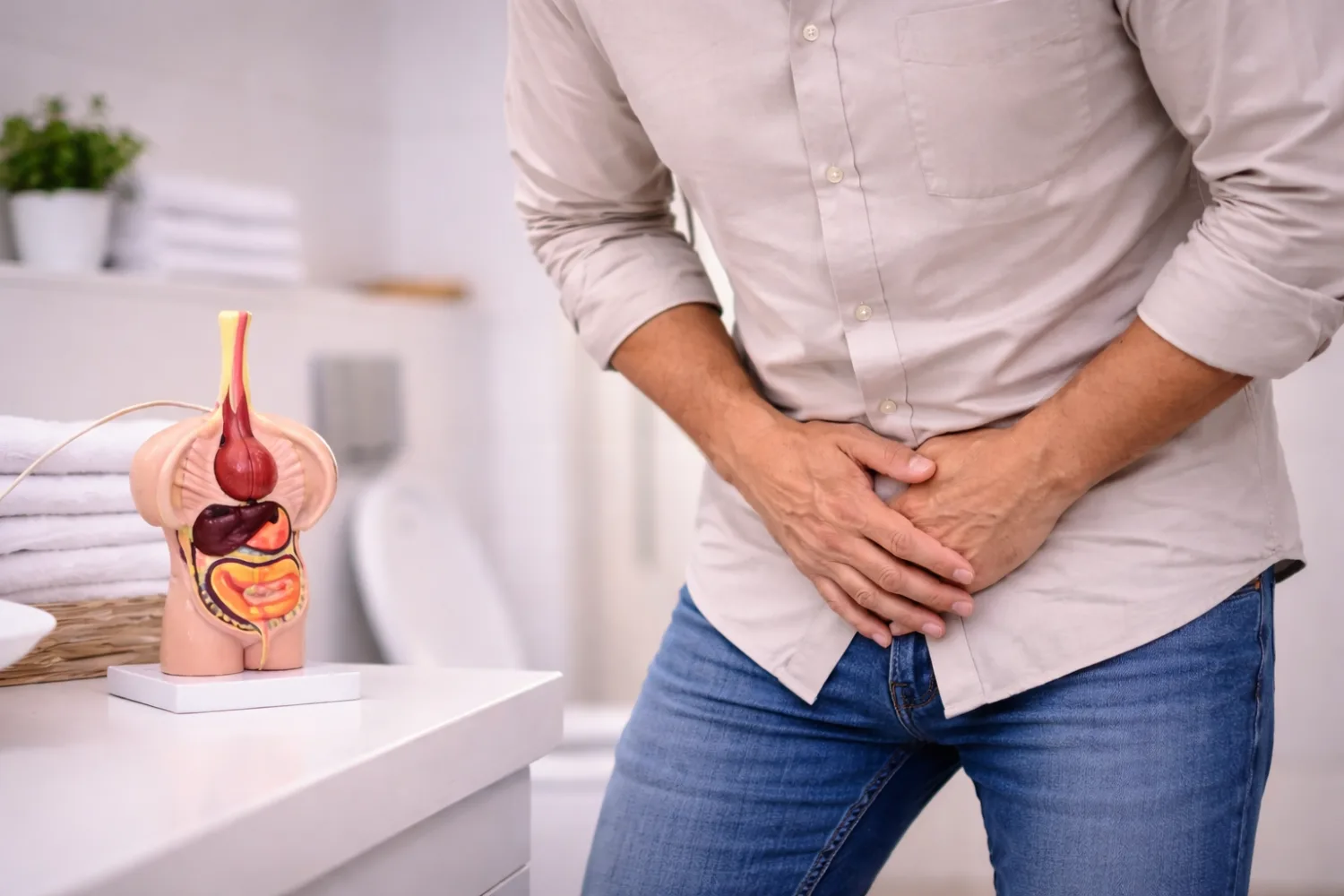
An enlarged prostate is one of the most common reasons older men start noticing changes in urination. It often begins gradually. A man who used to sleep through the night may start waking once or twice to pee. The stream may feel weaker than before. It may take longer to get started, or there may be a sense that the bladder has not emptied properly. These changes can be mild at first, but over time they can become frustrating, tiring and difficult to ignore. NHS guidance explains that the main symptoms of an enlarged prostate are problems with peeing, including difficulty starting, a weak flow, stopping and starting, dribbling and needing to pee more often or urgently, including at night.
The good news is that an enlarged prostate is very common and is usually not cancer. The medical term often used is benign prostate enlargement, or BPE. “Benign” means non-cancerous. That matters, because many men hear “prostate problem” and immediately worry about prostate cancer. In reality, urinary symptoms are much more often caused by benign enlargement than cancer, even though the symptoms can overlap and still need proper assessment. NICE says that in men, the most common cause of lower urinary tract symptoms is benign prostate enlargement, which can obstruct the bladder outlet, while NHS prostate cancer guidance notes that prostate cancer symptoms can look similar.
This guide explains what an enlarged prostate is, the symptoms it can cause, how it is usually assessed in the UK, which treatments may help, and when it is time to see a specialist. If urinary symptoms are happening alongside erection problems, you may also find our guide to erectile dysfunction (ED): causes, tests and treatment in the UK useful. For a broader overview, see our article on men’s health symptoms, common conditions and treatment options.
What is an enlarged prostate?
The prostate is a small gland found below the bladder. It surrounds part of the urethra, the tube that carries urine out of the body. As many men get older, the prostate gradually becomes bigger. If it enlarges enough, it can press against the urethra or affect how the bladder empties, leading to lower urinary tract symptoms. NHS describes enlarged prostate as a common condition in older men, and NICE patient information explains that a large prostate can press on the urethra and cause weak flow, hesitancy, straining and other urinary symptoms.
Not every man with a larger prostate has symptoms. That is important. Some men are told their prostate is enlarged but are not particularly bothered by it. Others have symptoms that significantly affect sleep, work, travel and confidence. Treatment decisions are usually based less on prostate size alone and more on how much the symptoms are affecting daily life, whether complications are developing, and what the man wants to do next. NHS England’s decision aid notes that a big prostate does not always need treatment straight away and that some men may choose no treatment initially, depending on symptoms.
The symptoms men usually notice first
Most men do not notice an enlarged prostate all at once. The pattern is usually gradual. At first, it may just feel as though peeing takes longer than it used to. Later, it may become obvious that something has changed.
Common symptoms include:
- difficulty starting to pee
- a weak urine stream
- “stop-start” flow
- taking longer to empty the bladder
- feeling that the bladder has not emptied fully
- dribbling after finishing
- needing to pee more often
- urgency
- getting up at night to pee
These are the symptoms most commonly listed by NHS guidance on enlarged prostate. NICE groups them under the wider term lower urinary tract symptoms, often shortened to LUTS, and explains that these symptoms can involve storage problems, voiding problems and post-micturition symptoms such as dribbling. The NICE guideline was reviewed in December 2024 and remains the main UK guideline covering assessment and management of LUTS in men.
A very common real-life example is the man who starts planning car journeys and evenings out around toilet access. Another is the man who feels increasingly tired because he is waking several times each night. Some men are more troubled by urgency and frequency; others by the weak stream and feeling of incomplete emptying. The symptom pattern can give clues, but it does not diagnose the cause on its own.
Does an enlarged prostate mean cancer?
No. An enlarged prostate and prostate cancer are not the same thing. Benign prostate enlargement is non-cancerous and extremely common with age. However, some urinary symptoms overlap, which is why persistent or worsening symptoms should still be assessed properly rather than assumed to be harmless. NHS guidance on prostate cancer symptoms lists difficulty starting to pee, weak flow, stop-start peeing, frequency and night-time urination among possible symptoms, which is why men should not try to distinguish the two entirely on their own.
The aim is not to panic every man with urinary symptoms. It is simply to remember that “probably benign” is not the same as “no need to get checked”.
What else can cause similar symptoms?
Another reason urinary symptoms should be assessed properly is that an enlarged prostate is not the only possible cause. Men can have similar symptoms because of prostatitis, urinary tract infection, overactive bladder, bladder muscle problems, medication effects or, less commonly, neurological conditions. NICE explains that LUTS can arise from abnormalities or abnormal function of the prostate, urethra, bladder or sphincters, not just prostate enlargement. NHS information on prostatitis also shows how pain, burning, difficulty peeing and frequency can overlap with other prostate and urinary problems.
That is why the best approach is not to guess which prostate condition you have, but to look at the full pattern of symptoms, age, pain, infections, urine flow, general health and any red flags.
When symptoms are mild, moderate or more serious
Men often ask whether their symptoms are “bad enough” to do anything about. There is no single universal threshold, but a simple way to think about it is this:
- Mild symptoms are noticeable but not causing major disruption.
- Moderate symptoms start affecting sleep, routine, travel, comfort or confidence.
- More serious symptoms may involve recurrent infections, urinary retention, visible blood, bladder stones, kidney concerns, or symptoms that are worsening despite treatment.
NHS England’s decision aid says symptoms are unlikely to get better on their own and may worsen as the prostate continues to grow, although treatment can be chosen later if needed. That means men with mild symptoms may choose monitoring and self-help at first, while men who are more bothered or have complications often move on to medication or specialist treatment.
How enlarged prostate is assessed in the UK
Many men are pleasantly surprised to find that the first assessment is usually quite straightforward. It often starts with a GP appointment and a conversation about the symptoms: what has changed, how long it has been happening, whether the problem is getting worse, and how much it is affecting life.
A typical assessment may include:
- questions about urinary symptoms and how often they happen
- review of medications, alcohol, caffeine and fluid habits
- urine testing
- blood pressure and general health review
- blood tests in selected cases
- sometimes a prostate examination
NICE recommends structured initial assessment for men with LUTS and also notes that some tests are not routinely needed at the first visit if symptoms are uncomplicated. For example, cystoscopy, upper urinary tract imaging and flow-rate measurement are not routinely offered at initial assessment for uncomplicated LUTS. That is useful for men who worry that seeking help automatically means invasive testing.
NICE also says kidney function testing should only be offered if renal impairment is suspected, such as when there is a palpable bladder, recurrent urinary infections, nocturnal enuresis or a history of renal stones. In other words, assessment should be targeted and sensible rather than excessive. This is set out in the NICE recommendations.
Treatment: what actually helps?
Treatment depends on how troublesome the symptoms are, whether complications have developed, and what the individual prefers. Not every man needs tablets immediately, and not every man with urinary symptoms is heading for surgery.
Self-help and watchful waiting
If symptoms are mild, doctors may suggest conservative management first. This can be a sensible option for men who are bothered but not severely affected.
Practical steps that may help include:
- reducing evening fluids if night-time urination is a major problem
- cutting down caffeine or alcohol if they worsen urgency or frequency
- double voiding, which means waiting a moment and trying again after finishing
- bladder training approaches in selected cases
NHS England’s easy-read decision aid specifically mentions trying to hold on a bit longer to train the bladder and trying to pass urine again after a few moments when you have finished. These are simple measures, but they can help some men.
Medication
Medication is often the next step when symptoms are more bothersome. The aim may be to relax the muscles around the prostate and bladder neck, reduce prostate size over time, or address related bladder overactivity depending on the symptom pattern. NHS medicines guidance explains that tamsulosin is used to treat symptoms of an enlarged prostate. Other NHS and NHS-linked sources also note the role of medicines that relax the prostate or help shrink it over time. NHS Devon information explains that alpha-blockers can relax the prostate and bladder outlet, while 5-alpha reductase inhibitors may be used to help reduce prostate size in selected men.
Medication may be considered if:
- symptoms are affecting sleep or daily life
- self-help measures have not helped enough
- the urinary flow is weak and bothersome
- there is persistent urgency or frequency
Medication can help many men, but it is not always enough on its own. Some men find the benefit is modest. Others improve significantly and delay or avoid procedures for years.
Procedures and surgery
If symptoms are severe, medication is not helping enough, or complications develop, a specialist may discuss procedures or surgery. That does not necessarily mean major open surgery. Modern treatment can include minimally invasive procedures as well as more established surgical approaches. Leeds Teaching Hospitals notes that surgery is usually considered if symptoms are severe, medical treatment has failed, or there are complications such as urinary retention, infection, stones or a large residual urine.
Specialist treatment may be discussed if there is:
- repeated urinary retention
- persistent troublesome symptoms despite medication
- recurrent infection
- bladder stones
- significant residual urine
- concern about kidney function or bladder damage
Oxford University Hospitals also notes that many men are managed by their GP at first, but if tablets do not work or are not tolerated, specialist procedures may be considered.
How enlarged prostate can affect everyday life
Urinary symptoms are sometimes dismissed as minor, but the impact can be bigger than it sounds on paper. Broken sleep from repeated night-time trips to the toilet can leave a man tired and irritable. Urgency can make travel stressful. Weak flow and hesitancy can create anxiety in public places. Some men stop going to events, sitting through long meetings, or drinking enough fluids because they are worried about being caught out.
That is why treatment decisions should not be based only on whether a symptom looks dramatic to someone else. If the problem is affecting daily life, it is worth discussing seriously.
When to see a specialist
Many men with enlarged prostate symptoms can start with their GP, but specialist input becomes more important in some situations.
You may need specialist assessment if:
- symptoms are getting worse
- medication is not helping enough
- you cannot pass urine properly
- you keep getting infections
- there is visible blood in the urine
- there is pain, fever or features suggesting another diagnosis
- there are concerns about the bladder or kidneys
NICE also advises that suspected prostate cancer in men with LUTS should be managed in line with suspected cancer guidance. That means some men need not just symptom treatment, but assessment for more serious causes.
What men should avoid
There are a few common mistakes that make enlarged prostate symptoms harder to manage.
- Assuming symptoms are “just age” and doing nothing for years. They may be common, but they are still worth assessing.
- Cutting fluids too aggressively. Some adjustment can help, but dehydration is not a good long-term solution.
- Trying to diagnose the cause yourself. Enlarged prostate is common, but it is not the only explanation for urinary symptoms.
- Ignoring blood in urine, pain, fever or inability to pee. These symptoms need prompt review.
Final thoughts
An enlarged prostate is one of the most common and most manageable prostate conditions in the UK. For some men, symptoms stay mild and can be handled with practical changes and monitoring. For others, medication makes a real difference. And for men whose symptoms are severe or complicated, specialist treatment can improve comfort, sleep and quality of life substantially. NHS and NICE both make clear that symptoms should be assessed properly and that treatment can be tailored to how much the condition is affecting the person.
The most helpful approach is not to ignore symptoms and not to jump to the worst conclusion. If urination has clearly changed, especially if the problem is persistent or worsening, get it checked. A proper assessment can tell you whether this is likely to be benign enlargement, whether something else may be going on, and what your options are next.
This article is for general information only and should not replace medical advice, diagnosis or treatment from a qualified healthcare professional.