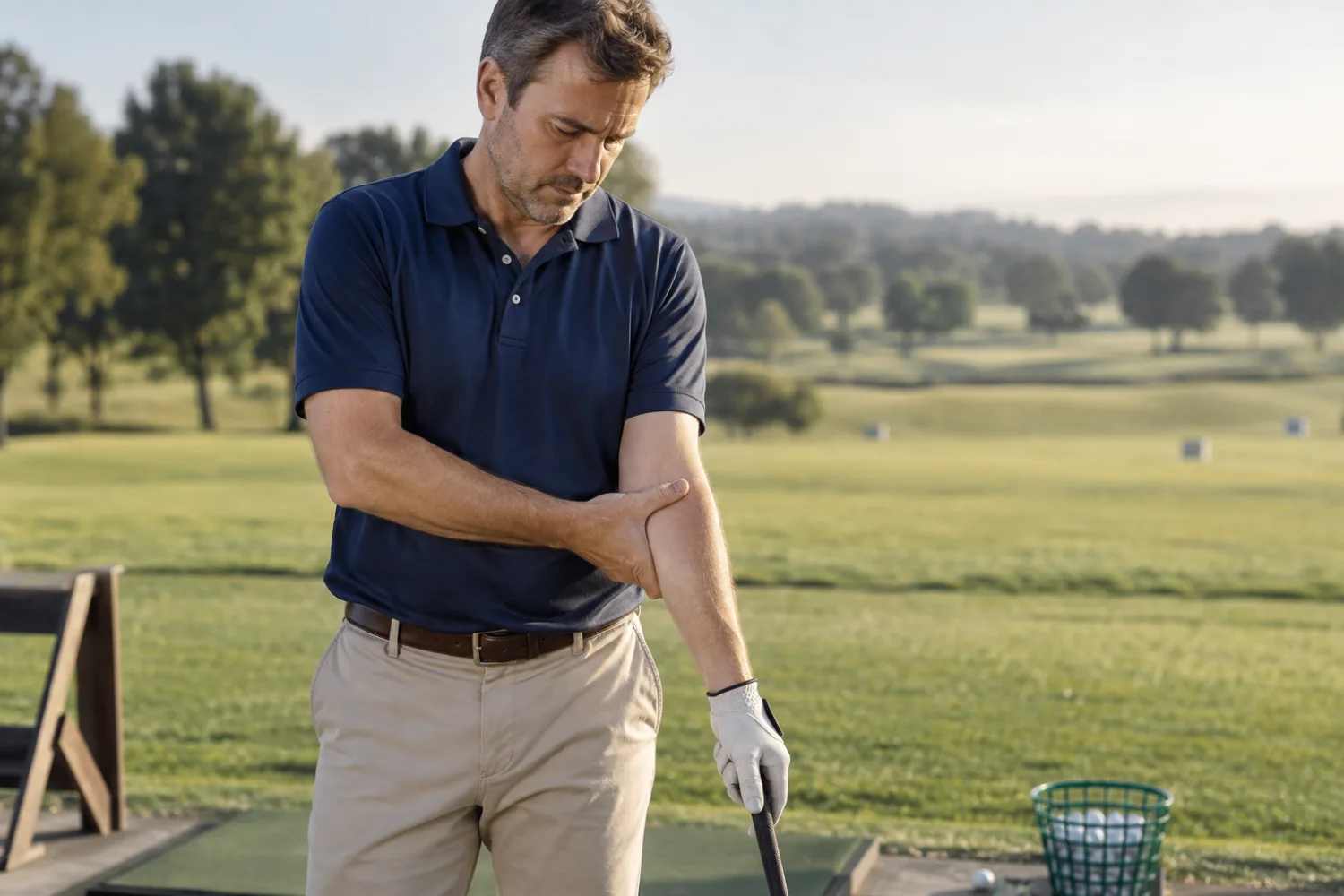
Golfer’s elbow is pain arising from the tendons that attach the forearm muscles to the bony prominence on the inside of the elbow. Its medical name is medial epicondylitis or medial epicondylalgia.
Despite the name, most people with golfer’s elbow do not need to play golf. Repeated gripping, lifting, pulling, throwing, tool use and wrist movement can all overload the same group of tendons.
Symptoms often improve without injections or surgery, but tendon recovery can be slow. Temporarily adjusting aggravating activity and following a progressive strengthening programme are usually more useful than complete, prolonged rest.
Arrange an assessment if the diagnosis is unclear, pain is severe, you have numbness in the ring or little finger, or symptoms are not improving. Sudden pain after an injury, major swelling, deformity or inability to use the arm may require urgent help.
What is golfer’s elbow?
Several muscles responsible for bending the wrist, gripping and turning the palm down begin in the forearm and join through a common tendon near the medial epicondyle—the bony point on the inside of the elbow.
Repeated or excessive loading can cause changes within this tendon. Although the condition is commonly described as tendinitis, persistent cases usually involve tendon degeneration and impaired adaptation rather than simple ongoing inflammation. The term tendinopathy is therefore often more accurate.
The muscles and tendons involved help with:
- bending the wrist towards the palm;
- gripping and squeezing;
- turning the palm down;
- stabilising the wrist while lifting;
- controlling a golf club, racket or throwing movement.
Golfer’s elbow usually develops gradually, but it can sometimes begin after one unusually heavy or forceful activity.
What does golfer’s elbow feel like?
The most characteristic symptom is pain or tenderness on the inner side of the elbow, centred around or just below the medial epicondyle.
Possible symptoms include:
- an ache or sharper pain on the inside of the elbow;
- pain spreading a short distance down the inner forearm;
- tenderness when pressing the tendon attachment;
- pain when gripping, squeezing or carrying;
- discomfort when bending the wrist against resistance;
- pain when turning a door handle or opening a jar;
- pain when shaking hands;
- reduced grip strength because gripping hurts;
- morning stiffness or discomfort after inactivity;
- pain during a golf swing, throw or gym exercise.
The pain may initially occur only during or after a demanding activity. If the tendon continues to be overloaded, it may begin earlier during activity and persist afterwards.
Some people also experience tingling or numbness in the ring and little fingers. This is not a typical tendon symptom and may indicate irritation of the nearby ulnar nerve.
How is it different from tennis elbow?
Golfer’s elbow affects the tendon attachment on the inside of the elbow. Tennis elbow affects the tendons on the outside.
| Feature | Golfer’s elbow | Tennis elbow |
|---|---|---|
| Medical name | Medial epicondylitis or medial epicondylalgia | Lateral epicondylitis or lateral epicondylalgia |
| Pain location | Inside of the elbow | Outside of the elbow |
| Common painful action | Wrist flexion, gripping and turning the palm down | Wrist extension, gripping and lifting palm-down |
| Tendon group | Wrist flexor and pronator tendons | Wrist extensor tendons |
Our guide to tennis elbow symptoms, exercises and recovery explains the condition affecting the outer side.
What causes golfer’s elbow?
The condition usually develops when tendon loading increases faster than the tendon can adapt. This can happen after starting a new activity, increasing frequency or intensity, changing equipment or repeatedly performing the same movement without enough recovery.
Activities associated with golfer’s elbow include:
- golf, particularly forceful gripping or repeatedly striking the ground;
- tennis and other racket sports;
- cricket, baseball and other throwing sports;
- weight training and repeated pulling exercises;
- climbing and rowing;
- gardening and digging;
- carpentry, plumbing and construction work;
- repeated use of screwdrivers or other hand tools;
- carrying heavy bags or cases;
- food preparation and repetitive cutting;
- manual factory or warehouse work;
- prolonged repetitive gripping at work.
In golf, contributing factors can include gripping the club too tightly, poor swing mechanics, unsuitable grip size, striking hard ground and abruptly increasing the number of rounds or practice sessions.
In the gym, symptoms may be aggravated by pull-ups, rows, curls, deadlifts and other movements requiring sustained forceful grip. The exercise itself is not necessarily harmful; the combination of load, volume, technique and insufficient recovery is usually more relevant.
Sometimes there is no obvious trigger. Tendon pain can develop gradually even when someone has performed the same work or activity for years.
Who is more likely to develop it?
Risk may be increased by:
- repetitive manual work;
- a sudden increase in training;
- poor sporting technique;
- using equipment that is too heavy or unsuitable;
- weakness or reduced endurance in the forearm and shoulder;
- returning too quickly after a previous injury;
- smoking;
- diabetes or another condition that can affect tendon health.
A risk factor does not prove the cause, and many people develop golfer’s elbow without any underlying illness.
What else can cause pain inside the elbow?
Not every pain over the inner elbow is golfer’s elbow. A proper assessment is particularly important when symptoms began suddenly, involve numbness or occur in a throwing athlete.
Other possible causes include:
- ulnar nerve irritation or cubital tunnel syndrome;
- injury to the ulnar collateral ligament;
- arthritis of the elbow;
- a tendon tear;
- a fracture or bone stress injury;
- pain referred from the neck;
- inflammatory arthritis;
- infection, although this is uncommon;
- pain arising from another forearm muscle or tendon.
Ulnar nerve symptoms
The ulnar nerve passes behind the medial epicondyle—the area commonly called the funny bone. Irritation can cause:
- tingling or numbness in the little finger and half of the ring finger;
- electric-shock sensations around the inner elbow;
- symptoms when the elbow remains bent;
- reduced hand coordination;
- weakness or wasting of small hand muscles in more advanced cases.
Golfer’s elbow and ulnar nerve irritation can occur together. Persistent numbness or hand weakness deserves clinical assessment rather than being treated solely with tendon exercises.
Ligament injury
The ulnar collateral ligament helps stabilise the inside of the elbow. Injury is particularly associated with repeated overhead throwing.
A ligament problem may be more likely if there was a sudden painful throw, a pop, loss of throwing speed or a feeling that the elbow is unstable. Competitive throwers should obtain sports-medicine or orthopaedic assessment.
How is golfer’s elbow diagnosed?
Diagnosis is usually based on the symptom pattern and physical examination. A GP, physiotherapist or other musculoskeletal clinician may ask about:
- where the pain is located;
- when it began;
- work, hobbies and sport;
- recent changes in training or workload;
- whether numbness or tingling is present;
- previous elbow, wrist, shoulder or neck problems;
- which movements reproduce symptoms.
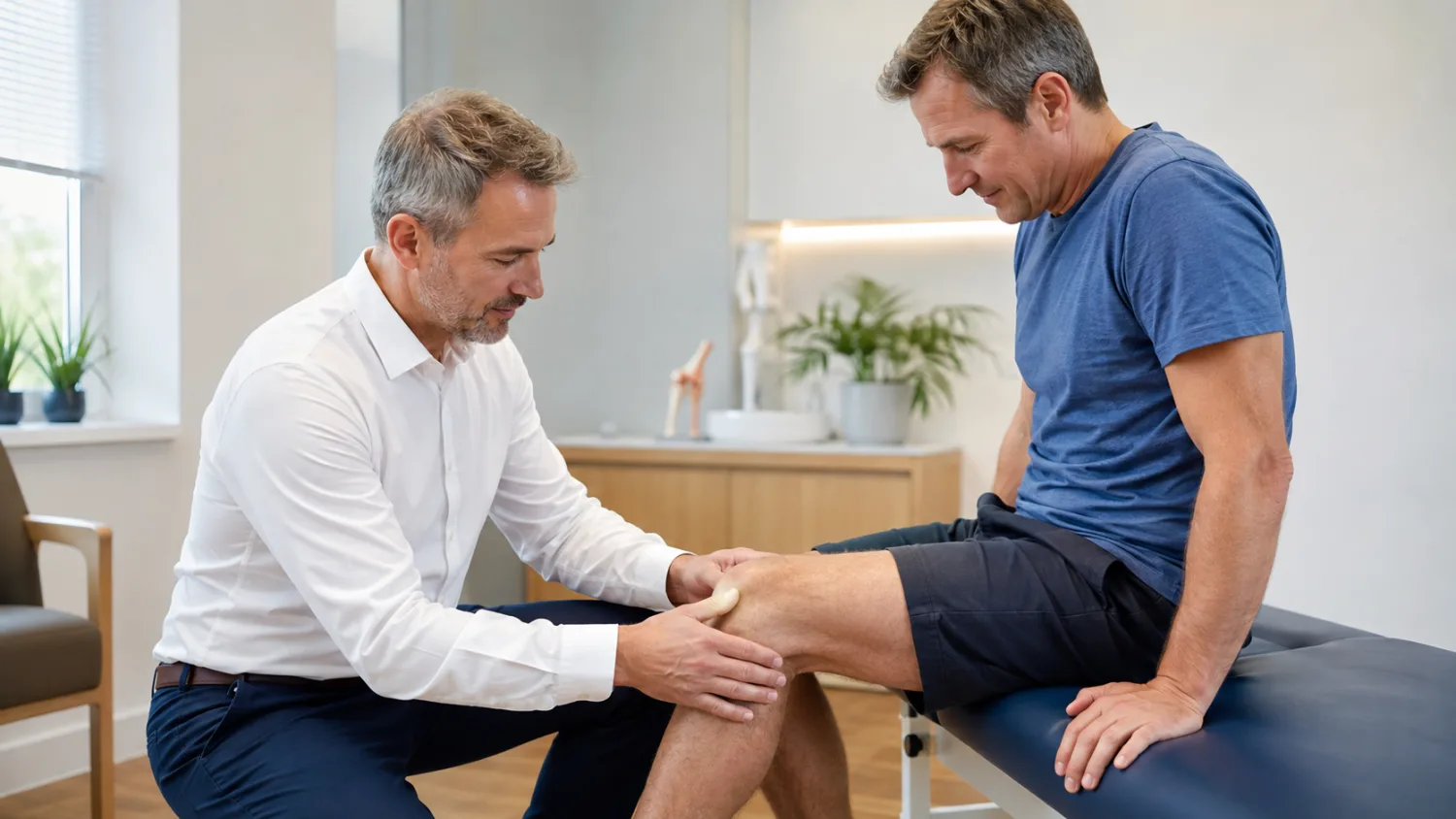
During the examination, the clinician may:
- press around the medial epicondyle;
- check elbow and wrist movement;
- test grip strength;
- ask you to bend the wrist against resistance;
- test turning the palm down against resistance;
- stretch the wrist and forearm muscles;
- assess the ulnar nerve;
- examine the neck and shoulder if needed;
- test elbow stability after an injury.
Pain reproduced by resisted wrist flexion or forearm pronation, together with tenderness at the inner tendon attachment, supports the diagnosis.
Are scans necessary?
Most straightforward cases do not require an X-ray, ultrasound or MRI scan.
Imaging may be considered when:
- the diagnosis is uncertain;
- there was a significant injury;
- the elbow is stiff or swollen;
- a tendon or ligament tear is suspected;
- symptoms continue despite appropriate rehabilitation;
- surgery is being considered;
- a clinician needs to exclude arthritis, fracture or another condition.
An X-ray shows bones and joint changes but not tendon health in detail. Ultrasound can assess tendon structure dynamically, while MRI can show tendons, ligaments, muscles, bone and other soft tissues.
Scan abnormalities do not always match pain. Tendon changes can appear in people without symptoms, so imaging should be interpreted alongside the history and examination.
What can you do at home?
Golfer’s elbow often improves with changes to painful activity and gradual rehabilitation. Complete rest is rarely necessary, but repeatedly provoking strong pain can delay recovery.
Adjust aggravating activity
Identify the movement, load or training volume that is causing symptoms. Temporary changes may include:
- reducing heavy or repetitive gripping;
- using two hands to carry objects;
- lifting with the palm facing upwards where practical;
- taking short breaks during repetitive work;
- temporarily reducing golf, throwing or racket-sport volume;
- using lifting straps selectively during gym training;
- reducing weight, repetitions or sets;
- changing tool handles or grip size;
- improving swing, throwing or lifting technique.
The aim is to reduce the most irritating load while retaining comfortable movement and gradually rebuilding capacity.
Cold or warmth
A wrapped cold pack may help after an aggravating activity, particularly when the area feels reactive. Apply it for approximately 10 to 15 minutes and protect the skin with a towel.
Some people prefer warmth before exercise because it reduces stiffness. Neither ice nor heat repairs the tendon, so use whichever provides short-term comfort.
Pain relief
Paracetamol or a topical anti-inflammatory gel may help some people. Oral anti-inflammatory medicines such as ibuprofen are not suitable for everyone, particularly people with stomach ulcers, kidney disease, certain heart conditions, asthma triggered by these medicines or those taking blood thinners.
Check with a pharmacist or clinician if you are uncertain. Pain relief should support sensible movement rather than allow repeated heavy loading through significant pain.
Elbow straps and wrist supports
A counterforce strap worn around the upper forearm can reduce discomfort during some activities. It should sit below the painful bony point rather than directly on it.
A wrist support may reduce tendon loading during short periods of aggravating work. Braces are optional symptom-management tools and do not replace progressive strengthening.
Stop using a strap if it increases pain, creates tingling or causes hand swelling.
Which exercises may help?
Exercise is a central part of treatment. The aim is to gradually increase the tendon’s ability to tolerate gripping, wrist movement and everyday load.
NHS musculoskeletal services advise that it can take six to eight weeks of regular specific exercise before a noticeable improvement occurs. Longer-standing symptoms may require several months of progressive rehabilitation.
The following examples are commonly used, but they may need adapting if the diagnosis is uncertain, pain is severe or nerve symptoms are present.
Wrist-flexor stretch
- Hold the affected arm in front of you with the elbow straight or slightly bent.
- Turn the palm upwards.
- Use the other hand to gently bend the wrist and fingers down.
- Stop when you feel a mild stretch along the inner forearm.
- Hold for approximately 20 to 30 seconds.
- Repeat two or three times.
The stretch should feel gentle rather than sharply painful. Stretching alone is unlikely to restore tendon capacity, so it is normally combined with strengthening.
Isometric wrist flexion
- Rest the forearm on a table with the palm facing upwards.
- Keep the wrist in a neutral position.
- Place the other hand against the palm.
- Try to bend the wrist upwards while the other hand prevents movement.
- Hold the contraction for 20 to 30 seconds.
- Repeat three to five times.
Isometric exercise may be useful when moving through a full range is initially uncomfortable.
Slow wrist-flexor strengthening
- Rest the forearm on a table with the hand extending beyond the edge and palm facing upwards.
- Hold a very light dumbbell or bottle.
- Use the other hand to help raise the affected wrist.
- Remove the assisting hand.
- Slowly lower the weight over three to five seconds.
- Begin with two or three sets of 8 to 15 repetitions.
As this becomes comfortable, raise and lower the weight using the affected arm alone. Progress gradually by adding weight, repetitions or another set—not all three at once.
Forearm rotation
- Sit with the elbow bent and forearm supported.
- Hold a light hammer, dumbbell or similar object vertically.
- Slowly rotate the forearm so the palm turns down and then back towards neutral.
- Keep the movement controlled.
- Perform two or three sets of 8 to 12 repetitions.
Hold the object closer to its centre to make the exercise easier and nearer the end to increase leverage.
Grip training
Gentle gripping with a soft ball, rolled towel or suitable hand exerciser may help rebuild capacity. Avoid maximum squeezing at first.
Grip exercises are most useful when they progress towards the demands of your job or sport. Someone returning to golf may need different later-stage exercises from someone returning to manual tool use.
How much exercise pain is acceptable?
A mild and manageable increase in discomfort during rehabilitation may be acceptable if it settles soon afterwards and is not clearly worse the following day.
Reduce the load if:
- pain is sharp or severe;
- technique changes because of pain;
- symptoms remain noticeably worse for more than 24 hours;
- tingling or numbness develops;
- grip strength is declining.
There is no benefit in repeatedly forcing the tendon through escalating pain. A physiotherapist can help establish an appropriate starting load and progression.
When should you see a physiotherapist or GP?
Arrange a routine assessment if:
- pain has not started improving after several weeks of sensible self-care;
- symptoms interfere with work, sleep or ordinary activities;
- you cannot identify which activity is aggravating the elbow;
- you are unsure whether the pain is golfer’s elbow;
- you need help returning to sport or manual work;
- the problem keeps returning;
- you have tingling or numbness in the hand;
- the elbow is becoming increasingly stiff;
- you have pain in several joints or symptoms of inflammatory illness.
A physiotherapist can assess strength, movement, technique and the demands placed on the arm. Treatment may include:
- a progressive loading programme;
- work or sport modification;
- advice about braces or supports;
- manual therapy for short-term symptom relief;
- shoulder and upper-limb strengthening;
- a graded return-to-activity plan.
Our guide to private physiotherapy costs in the UK explains typical assessment, follow-up and specialist-session fees.
When is urgent help needed?
Use NHS 111, an urgent treatment centre or another appropriate urgent service if:
- the elbow became very painful after a fall or forceful injury;
- you heard a snap or pop and immediately lost strength;
- there is marked swelling or bruising;
- the elbow looks deformed;
- you cannot bend or straighten the arm;
- the hand is numb, cold, pale or blue;
- the elbow is hot, red and swollen and you feel unwell;
- pain is severe and rapidly worsening.
Call 999 after a major injury if there is severe bleeding, obvious deformity with impaired circulation, or another life-threatening problem.
What professional treatments are available?
Physiotherapy and rehabilitation
Progressive exercise and load management are usually the main treatments. There is no single exercise programme that is best for everyone, and the plan should reflect symptom severity, work and sporting goals.
Passive treatments may provide temporary relief but should not normally replace rehabilitation.
Steroid injections
A corticosteroid injection may reduce pain in the short term, but its longer-term benefit for elbow tendinopathy is poor. Research on related tendon conditions has raised concern about symptom recurrence and worse longer-term outcomes after injection.
Repeated steroid injections can also weaken or damage tendon tissue. For these reasons, some current NHS services advise avoiding steroid injection for golfer’s elbow.
If one is offered, ask:
- what short- and long-term benefit is expected;
- what alternatives have been tried;
- how it will affect the rehabilitation plan;
- what tendon, skin, nerve and infection risks apply;
- whether ultrasound guidance is necessary.
PRP injections
Platelet-rich plasma, or PRP, is prepared from the patient’s blood and injected around the affected tendon. It is promoted as a way to encourage healing.
Evidence for PRP in elbow tendinopathy is inconsistent, and protocols vary considerably. It is usually available only privately and should not be presented as a guaranteed alternative to rehabilitation.
Our guide to regenerative medicine for sports and soft-tissue injuries examines PRP, stem-cell and exosome claims in more detail.
Shockwave therapy
Extracorporeal shockwave therapy delivers mechanical pulses through the skin. It may be considered for persistent tendon pain that has not improved with an appropriate exercise programme.
Evidence is mixed, and response varies. A course commonly involves several sessions. Ask whether the treatment is being used alongside progressive rehabilitation and what happens if it does not help.
Surgery
Surgery is rarely needed. It may be considered after several months of well-delivered non-surgical care when pain remains severe and the diagnosis has been confirmed.
An operation may remove damaged tendon tissue, repair the tendon attachment or address associated nerve or ligament problems. Recovery requires rehabilitation and does not guarantee complete relief.
If specialist assessment is being considered, our guide to private orthopaedic consultation costs explains likely appointment, imaging and follow-up fees.
How long does golfer’s elbow take to recover?
Recovery varies considerably. Mild symptoms may improve within several weeks after the aggravating load is reduced. Established tendinopathy commonly takes several months, and some cases persist for a year or longer.
Progress is rarely perfectly linear. The elbow may feel better for several days and then flare after an unusual task, heavy training session or sudden workload increase.
Signs of improvement include:
- less pain during everyday gripping;
- less tenderness over the inner elbow;
- better tolerance of exercise;
- increasing grip strength;
- faster recovery after activity;
- gradual return to work or sport.
A temporary flare does not necessarily mean that new damage has occurred. Review the load that triggered it, reduce the next session and rebuild progressively.
When can you return to golf or sport?
Return gradually when:
- daily activities are comfortable;
- you can grip without significant pain;
- wrist and forearm strength are close to the other side;
- sport-specific movements are tolerated;
- symptoms settle normally after exercise.
A golfer might begin with putting and short, easy practice before progressing to longer clubs, a small number of full swings and eventually a complete round.
Reviewing grip size, swing mechanics and practice volume can reduce the chance of recurrence. Similar gradual progression applies to racket sports, throwing, climbing and weight training.
Our broader guide to sports injuries and recovery explains load management and returning to activity after injury.
Frequently asked questions
Can you get golfer’s elbow without playing golf?
Yes. Repetitive gripping, lifting, throwing, gym training, tool use and manual work are common triggers. Some people cannot identify one specific cause.
Where is golfer’s elbow pain located?
It is normally centred on the bony prominence on the inside of the elbow and may spread a short distance down the inner forearm.
Is golfer’s elbow inflammation?
Early irritation may include inflammation, but persistent cases usually involve changes in tendon structure and load tolerance. This is why gradual strengthening is generally more useful than relying solely on anti-inflammatory treatment.
Should you rest golfer’s elbow completely?
Usually not. Temporarily reduce the activities that cause substantial pain while maintaining comfortable movement and beginning suitable strengthening. Prolonged complete rest can reduce the arm’s capacity without preparing it to return to activity.
Should you stretch golfer’s elbow?
Gentle stretching may reduce stiffness, but it should not be forceful or sharply painful. Strengthening and gradual load progression are usually more important for long-term recovery.
Does an elbow brace help?
A counterforce strap or wrist support can reduce discomfort during some tasks. It is an optional short-term aid rather than a cure and should not cause numbness, swelling or increased pain.
Is massage useful?
Massage may provide temporary relief, but it does not replace progressive exercise and activity modification. Aggressive pressure directly over a very sensitive tendon can aggravate symptoms.
Can golfer’s elbow cause hand numbness?
The tendon condition itself does not usually cause numbness. Tingling or numbness in the ring and little fingers may indicate irritation of the nearby ulnar nerve and should be assessed if persistent.
Can neck problems cause inner-elbow pain?
Yes. Nerve irritation in the neck can produce pain, tingling or weakness further down the arm. Neck pain, widespread symptoms or altered sensation make an alternative or additional diagnosis more likely.
Should you use ice or heat?
Either can be used for short-term comfort. Ice may feel helpful after an aggravating activity, while warmth may reduce stiffness before movement. Neither is essential for tendon healing.
Do steroid injections cure golfer’s elbow?
No. They may reduce pain temporarily but do not reliably produce better long-term recovery and may be followed by recurrence. Current NHS services increasingly advise against routine steroid injection for elbow tendinopathy.
Does PRP cure golfer’s elbow?
There is no guaranteed cure. Research findings are mixed, preparations differ and rehabilitation is still important. Discuss the uncertainty and full cost before paying for PRP.
Do you need an MRI scan?
Most people do not. MRI may be useful when the diagnosis is uncertain, a significant tear or ligament injury is suspected, symptoms persist despite treatment or surgery is being considered.
Can golfer’s elbow heal without surgery?
Yes. Most cases improve with time, activity modification and progressive exercise. Surgery is reserved for a small minority of persistent, carefully assessed cases.
Why does golfer’s elbow keep returning?
Recurrence can occur when activity increases faster than tendon capacity, rehabilitation stops too early, technique or equipment problems remain, or another condition has been mistaken for golfer’s elbow.