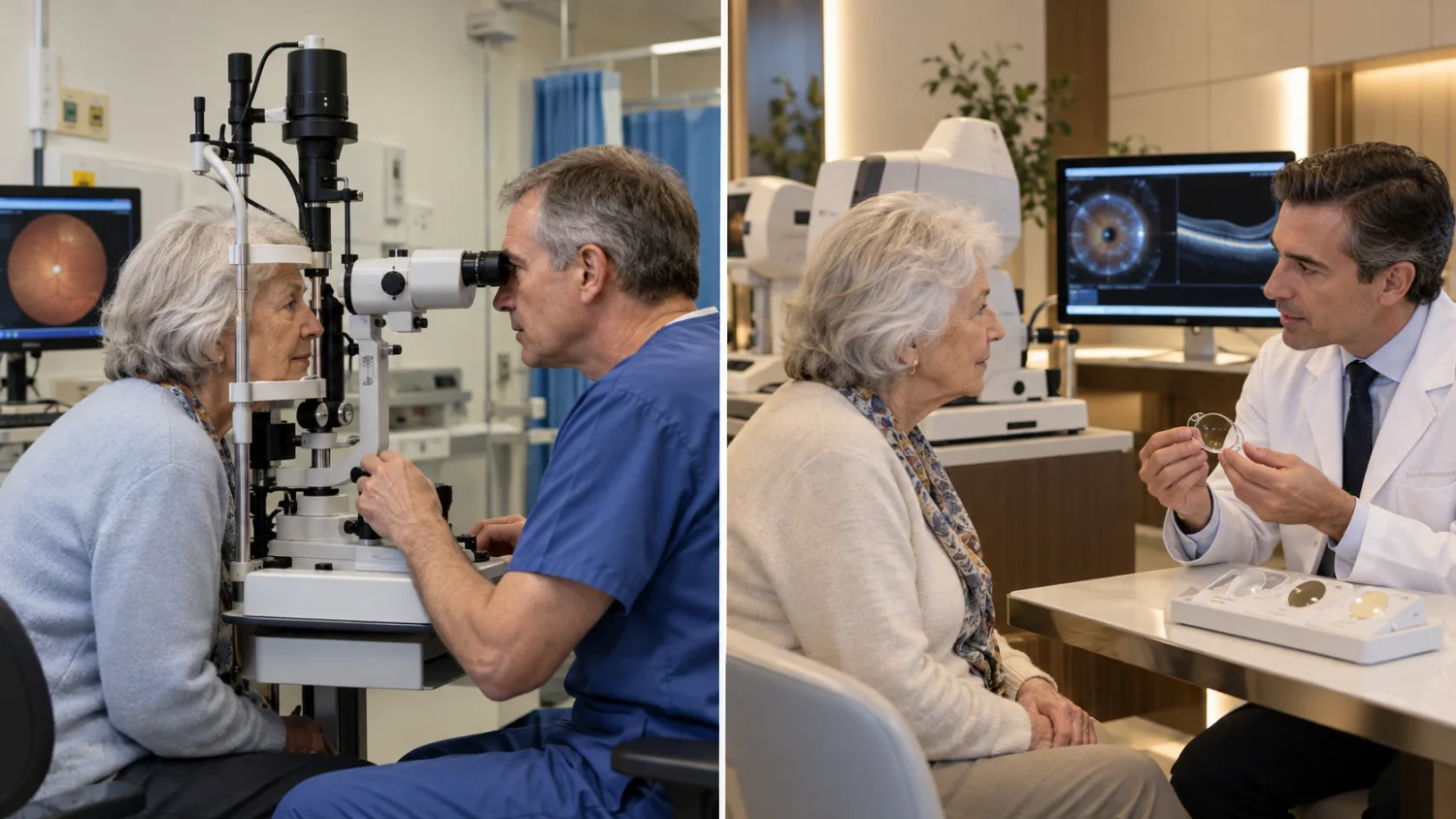
Cataract surgery is one of the most commonly performed operations in the UK, and the basic procedure is broadly similar whether you have it through the NHS or pay privately.
The cloudy natural lens inside the eye is removed and replaced with a clear artificial intraocular lens.
What differs is mainly:
- how quickly you can have surgery;
- which surgeon and hospital you use;
- how much choice you have over the replacement lens;
- how appointments are organised;
- how much you pay.
For many people, NHS cataract surgery is an excellent option and there is no clinical need to pay privately.
Private surgery becomes more attractive when waiting time matters, you want a particular consultant or you are interested in lenses designed to reduce dependence on glasses.
Private cataract surgery typically costs around £2,000 to £5,500 per eye, depending heavily on the lens used and the provider.
This guide compares NHS and private cataract surgery in the UK, including waiting times, monofocal, toric and multifocal lenses, total costs, recovery and how to decide whether paying privately is worthwhile.
NHS vs Private Cataract Surgery at a Glance
| Feature | NHS cataract surgery | Private cataract surgery |
|---|---|---|
| Cost | No charge for NHS treatment | Typically £2,000–£5,500+ per eye |
| Waiting time | Varies considerably by area and provider | Usually substantially faster |
| Standard lens | Monofocal | Monofocal available |
| Toric lens | Available in selected NHS patients/centres | Widely available |
| Multifocal/EDOF lens | Generally not routinely available | Available if suitable |
| Choice of surgeon | Usually limited | Usually yes |
| Hospital choice | Some choice may be available | Usually much wider choice |
| Follow-up | Included | Usually included in package |
Importantly, private surgery does not mean the basic cataract-removal technique is fundamentally superior.
The biggest differences are usually convenience and refractive choice.
How Long Is the NHS Wait for Cataract Surgery?
There is no single UK cataract waiting time.
Waiting times vary considerably according to:
- where you live;
- which NHS trust or independent NHS provider you use;
- how severe the cataract is;
- whether one or both eyes need treatment;
- local surgical capacity.
NHS England's wider elective waiting-list data show that waits remain highly variable across providers.
In January 2026, the median wait across all consultant-led elective pathways in England was around 13.6 weeks, although that figure covers many specialties rather than cataract surgery specifically.
Some ophthalmology services perform much better than the national elective average. Moorfields, for example, reported almost 85% of elective pathways waiting 18 weeks or less by July 2026.
NHS England has also acknowledged that many areas now have relatively short cataract waiting lists because cataract capacity has expanded substantially in recent years.
That means it is worth checking your actual local wait before assuming private treatment is necessary.
A person in one area might be offered NHS surgery reasonably quickly, while someone elsewhere could wait much longer.
If you are referred through the NHS, ask:
- which providers you can choose;
- their current waiting times;
- whether an independent-sector provider is performing NHS cataract surgery locally.
The fastest NHS option may not always be your nearest large hospital.
How Quickly Can Private Cataract Surgery Be Done?
Private treatment is generally much faster.
In many private eye hospitals, assessment can be arranged within days or a few weeks, with surgery soon afterwards if you are suitable.
The exact timeline depends on:
- consultant availability;
- pre-operative measurements;
- the lens selected;
- other eye conditions;
- whether additional investigations are needed.
For somebody whose cataract is making driving, work or everyday independence difficult, shortening the wait by several months can be a meaningful advantage.
However, cataracts usually develop gradually.
The NHS notes that adults do not always need surgery immediately; surgery is generally recommended when cataracts are significantly affecting vision and everyday life.
So paying privately purely to save a few weeks may make less sense than paying privately to avoid a very long local wait.
What Lens Do You Get on the NHS?
NHS cataract surgery normally uses a monofocal intraocular lens.
A monofocal lens is designed to focus clearly at one main distance.
Most patients choose distance vision.
After surgery they may therefore see well across the room or outdoors but still need reading glasses.
Moorfields explains that NHS cataract surgery uses a lens with one focal power. If the eye is targeted for good distance vision, reading glasses will generally still be needed.
You can sometimes choose to remain mildly short-sighted instead.
That may allow better near vision without glasses but means distance glasses are needed.
Can you have monovision?
In selected patients, one eye can be focused more towards distance and the other slightly nearer.
This is called monovision.
It may reduce dependence on glasses, but it does not suit everyone.
If you have previously used monovision contact lenses successfully, it may be particularly worth discussing with the cataract team.
Can You Get a Toric Lens on the NHS?
Sometimes.
Toric lenses are designed to correct astigmatism as well as replacing the cloudy natural lens.
Availability varies between NHS trusts.
Moorfields offers toric lenses to some NHS patients with moderate or high astigmatism, and Imperial College Healthcare also states that toric lenses are available in selected cases where local criteria are met.
Other trusts do not routinely provide them.
A toric lens does not automatically eliminate glasses.
It mainly aims to reduce astigmatism and improve unaided distance vision.
You may still need reading glasses and sometimes distance glasses too.
Toric lenses also need to remain correctly aligned inside the eye. Occasionally they rotate and require another procedure to reposition them.
What Extra Lens Choices Do You Get Privately?
This is where the biggest difference appears.
Private cataract providers commonly offer:
- standard monofocal lenses;
- enhanced monofocal lenses;
- toric lenses;
- extended-depth-of-focus lenses;
- multifocal or trifocal lenses;
- toric versions of premium lenses.
Enhanced monofocal lenses
These aim to provide slightly more intermediate vision than a traditional monofocal lens while retaining relatively good visual quality.
They may reduce dependence on glasses for tasks such as computer work, although reading glasses may still be needed.
Extended depth of focus lenses
EDOF lenses are designed to broaden the range of clear vision, particularly distance and intermediate vision.
They may suit someone who wants less dependence on glasses but wants to avoid some of the visual effects associated with multifocal lenses.
Multifocal or trifocal lenses
These divide light into several focal zones to provide useful vision at near, intermediate and distance ranges.
The potential advantage is obvious:
less dependence on glasses.
But there are trade-offs.
Some people experience:
- halos around lights;
- glare;
- reduced contrast sensitivity;
- difficulty with night driving;
- a period of adaptation.
Multifocal lenses are therefore not simply “better cataract lenses”.
Moorfields notes that they are not suitable for everyone and may create visual-quality problems.
People with other eye disease such as macular degeneration, significant glaucoma or certain retinal conditions may be less suitable.
Premium lenses should therefore be selected based on eye health and lifestyle rather than the assumption that the most expensive lens is automatically best.
How Much Does Private Cataract Surgery Cost?
A realistic UK range is around:
| Private cataract option | Typical price per eye |
|---|---|
| Standard monofocal | About £2,000–£3,500 |
| Enhanced monofocal | About £2,250–£4,000 |
| Toric | About £2,600–£4,500 |
| EDOF | About £3,000–£5,000 |
| Multifocal/trifocal | About £3,000–£5,500+ |
Current published examples demonstrate the difference.
Practice Plus Group currently lists:
- standard monofocal cataract surgery at £2,099 per eye;
- enhanced monofocal at £2,249;
- enhanced toric at £2,649;
- multifocal at £2,949;
- EDOF at £3,099;
- toric EDOF at £3,249.
Optegra currently lists standard private cataract surgery with a monofocal lens from £2,995 per eye and includes a year of aftercare, including YAG treatment if required within that period.
Premium London clinics can be substantially more expensive.
For a fuller breakdown, see our guide to private cataract surgery costs, lens options and fees.
What Does the Private Price Usually Include?
A good fixed-price package may include:
- pre-operative consultation;
- biometry and lens measurements;
- surgeon's fee;
- operating theatre fees;
- local anaesthetic;
- lens implant;
- post-operative eye drops;
- follow-up appointments;
- management of routine post-operative issues.
But packages differ.
Ask specifically whether the price includes:
- consultation;
- OCT scanning;
- premium-lens measurements;
- all surgeon fees;
- follow-up;
- treatment if posterior capsule opacification develops;
- additional surgery if the lens needs repositioning.
YAG laser capsulotomy deserves particular attention.
Months or years after cataract surgery, the capsule behind the artificial lens can become cloudy. This is called posterior capsule opacification.
It can usually be treated quickly with YAG laser.
Some private packages include YAG treatment for a period after surgery; others charge separately.
Is Private Cataract Surgery Better Than NHS Surgery?
Not automatically.
The basic operation is the same:
the cloudy lens is removed and an artificial lens is implanted.
NHS cataract surgery uses modern intraocular lenses and established surgical techniques.
The main private advantages are:
- shorter waits;
- choice of consultant;
- greater control over surgery dates;
- premium lens options;
- potentially more continuity of care.
If you are happy to wear reading glasses and your NHS wait is reasonable, the clinical argument for spending £3,000 or £4,000 per eye may be limited.
Private treatment becomes more attractive if:
- your local NHS wait is long;
- poor vision is preventing you from driving or working;
- you specifically want a premium lens;
- you want one named surgeon;
- you place high value on reducing dependence on glasses.
If you want a specialist private assessment first, our guide to private ophthalmologist consultation and scan costs explains the likely fees.
What Are the Risks of Cataract Surgery?
Cataract surgery is highly successful, but no operation is risk-free.
Possible complications include:
- infection;
- inflammation;
- raised eye pressure;
- retinal swelling;
- unexpected refractive outcome;
- lens movement;
- retinal detachment;
- posterior capsule opacification.
Imperial College Healthcare notes that serious sight-threatening complications are rare, although further treatment or surgery is occasionally required.
One important warning after cataract surgery is the sudden appearance of:
- many new floaters;
- flashes of light;
- a dark shadow or curtain;
- sudden deterioration in vision.
These can indicate a retinal tear or detachment and need urgent assessment.
See our guides to eye floaters and flashes and retinal detachment warning signs.
Posterior vitreous detachment also becomes more common after eye surgery and can cause new flashes and floaters. Our guide to posterior vitreous detachment explains how this differs from retinal detachment.
How to Decide Between NHS and Private Cataract Surgery
Start by finding out what the NHS is actually offering you.
Ask:
- What is the expected waiting time?
- Can I choose a different NHS provider?
- What lens will be offered?
- Do I have enough astigmatism to qualify for a toric lens locally?
- What visual target is planned?
Then compare that with the private alternative.
If paying privately, ask:
- Which lens are you recommending and why?
- How much less dependent on glasses can I realistically expect to be?
- What visual side effects are possible?
- Would a cheaper monofocal lens actually suit my eyes better?
- Is my surgeon performing the operation personally?
- What is included in the quoted price?
- How long is aftercare included?
For many patients, the most sensible decision is surprisingly simple.
If NHS surgery is available within an acceptable time and you are happy with a monofocal lens, NHS treatment is difficult to beat financially.
If you strongly value reduced dependence on glasses or need surgery much sooner than the NHS can provide locally, paying privately may be worthwhile.
Frequently Asked Questions
Is NHS cataract surgery free?
Yes. Clinically appropriate cataract surgery provided through the NHS does not require you to pay for the operation.
How long is the NHS wait for cataract surgery?
There is no single national cataract wait. It varies substantially between providers and regions, so ask for the current waiting time at the specific services available to you.
How quickly can I get private cataract surgery?
Private assessment can often be arranged quickly, with surgery following within days or weeks if appropriate. Exact timing depends on the clinic and surgeon.
What lens does the NHS use?
The standard NHS lens is usually monofocal, designed to provide clear focus at one main distance.
Can I choose my NHS cataract lens?
You can normally discuss whether the eye should be targeted towards distance or near vision. The range of lens technologies available is more limited than privately.
Can you get toric cataract lenses on the NHS?
Sometimes. Some NHS centres offer toric lenses to selected patients with significant astigmatism, but eligibility and availability vary.
Can you get multifocal cataract lenses on the NHS?
They are generally not routinely available on the NHS. Patients wanting multifocal or other premium refractive lenses usually need private surgery.
Can I pay extra for a premium lens during NHS surgery?
Generally no. NHS centres such as Moorfields state that multifocal lenses cannot simply be purchased privately and inserted as part of an NHS cataract operation.
How much does private cataract surgery cost?
Standard monofocal private surgery commonly costs around £2,000–£3,500 per eye, while premium lens packages may cost around £3,000–£5,500 or more per eye.
Is a multifocal lens worth the extra money?
It can be for someone who strongly values reducing dependence on glasses and is a good clinical candidate. However, multifocal lenses can cause halos, glare and reduced contrast and are not suitable for everyone.
Will I still need glasses after cataract surgery?
Possibly. With a standard distance-focused monofocal lens, reading glasses are usually needed. Even premium lenses cannot guarantee complete freedom from glasses.
Can both eyes be operated on at once?
NHS guidance commonly describes the eyes being treated on separate days. Some private providers offer immediate sequential bilateral cataract surgery in selected patients, but this requires individual assessment.
How long does cataract surgery take?
The operation itself is usually relatively quick. Moorfields states that surgery typically takes around 15–20 minutes, although the total hospital visit is longer.
Is cataract surgery painful?
The eye is numbed with anaesthetic drops, injections or both. Most people feel pressure or awareness rather than significant pain.
How long does recovery take?
Vision often begins improving within days, although complete settling can take several weeks. Eye drops are normally used during recovery.
Can cataracts come back?
The removed cataract itself cannot return. However, the capsule behind the artificial lens can later become cloudy, producing posterior capsule opacification. This can usually be treated with YAG laser.
Which is better: NHS or private cataract surgery?
Neither is automatically better clinically. NHS surgery offers effective cataract treatment without private fees. Private treatment mainly offers faster access, more surgeon choice and a wider range of lenses.
When is private cataract surgery most worth considering?
It may be worth considering when local NHS waiting times are significantly affecting your life, or when you specifically want a premium lens to reduce dependence on glasses.