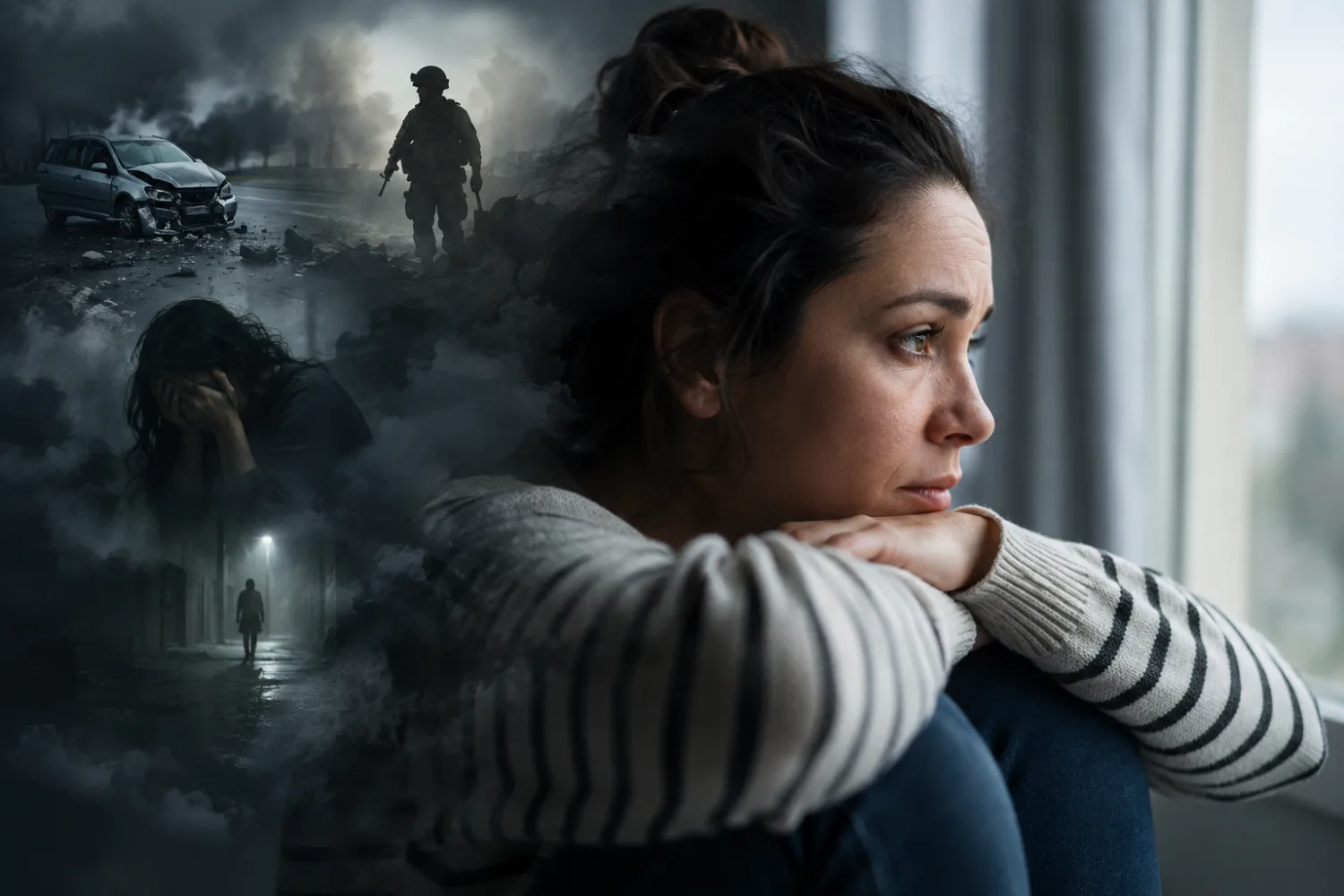
Post-traumatic stress disorder, or PTSD, can develop after experiencing or witnessing something extremely frightening, dangerous or distressing. It can involve flashbacks, nightmares, avoiding reminders of what happened, feeling constantly on guard and changes in mood, sleep and concentration.
Having a strong emotional reaction after trauma does not automatically mean you have PTSD. In the days and weeks afterwards, people may feel frightened, angry, numb, tearful, restless or unable to sleep. For many, these reactions gradually become less intense. PTSD is more likely when symptoms persist and continue to interfere with everyday life.
Trauma can come from many different experiences. It may follow a serious accident, violence, sexual assault, abuse, military combat, a difficult childbirth, a medical emergency, a sudden death, witnessing violence or another event in which someone felt they or another person were at serious risk.
PTSD is not a sign that someone was “not strong enough” to cope. Two people can live through the same event and respond very differently. Previous experiences, what happened afterwards, whether there was continuing danger and the support available can all shape recovery.
Symptoms may begin soon after the traumatic event, but they can also emerge months or occasionally years later.
Treatment can help substantially. The main evidence-based treatments in the UK are trauma-focused psychological therapies, particularly trauma-focused cognitive behavioural therapy and eye movement desensitisation and reprocessing, usually shortened to EMDR. Medication is sometimes used as well.
Seek urgent help if you are at immediate risk of harming yourself or someone else, cannot keep yourself safe, or are experiencing severe distress or psychosis. Call 999 or go to A&E if there is immediate danger.
If you need urgent mental-health support but it is not an immediate emergency, contact NHS 111 and use the mental-health option where available, your local urgent mental-health service or your existing mental-health team.
If the traumatic event involved recent physical or sexual assault, you can also seek medical care even if you are not sure whether you want to report what happened to the police.
What is PTSD?
PTSD develops when the brain and body continue responding as though danger is still present even after the traumatic event has ended.
This can affect memory, attention, emotions and the body's threat response.
Someone may intellectually know that they are safe while their nervous system reacts very differently.
A slammed door, smell, place, voice, date or physical sensation can suddenly bring back intense fear or a vivid memory.
The NHS groups PTSD symptoms broadly around re-experiencing, avoidance and emotional numbing, hyperarousal, and other changes such as sleep difficulty, anxiety, depression and physical symptoms.
PTSD is more than remembering something upsetting
Most people remember frightening events.
With PTSD, memories may feel unusually intrusive or immediate.
The person may feel as though the event is happening again rather than simply remembering something from the past.
PTSD can follow one event or repeated trauma
Some people develop PTSD after one clearly identifiable event.
Others experience repeated or prolonged trauma, such as:
- childhood abuse;
- domestic violence;
- repeated sexual violence;
- war or torture;
- human trafficking;
- repeated exposure to traumatic events through certain occupations.
Long-lasting or repeated trauma can sometimes be associated with complex PTSD, which includes the core features of PTSD plus additional difficulties with emotional regulation, relationships and self-image.
What are the main symptoms of PTSD?
PTSD does not look exactly the same in everyone.
One person may be troubled mainly by nightmares and flashbacks. Another may rarely talk about the event but organise their entire life around avoiding reminders of it.
Symptoms often fall into several overlapping groups.
Re-experiencing the trauma
This can include:
- intrusive memories;
- flashbacks;
- nightmares;
- distressing images or sensations;
- intense emotional reactions to reminders;
- physical reactions such as sweating, shaking or a racing heart.
A memory may be triggered deliberately, but often it appears without warning.
Avoidance
A person may try hard not to think or talk about what happened.
They may avoid:
- particular places;
- people;
- news stories;
- driving;
- medical settings;
- certain smells or sounds;
- relationships or intimacy.
Avoidance can provide relief in the short term but gradually make life smaller.
Someone who was involved in a road collision may stop driving, then avoid being a passenger, then avoid travelling altogether.
Feeling numb or disconnected
Some people describe feeling emotionally flat rather than constantly frightened.
They may feel detached from family, lose interest in things that previously mattered or struggle to feel positive emotions.
Hyperarousal
Hyperarousal means the body's alarm system remains unusually active.
Possible signs include:
- being easily startled;
- constantly scanning for danger;
- irritability;
- difficulty concentrating;
- poor sleep;
- feeling tense or unable to relax.
This constant alertness can be exhausting.
What do flashbacks and trauma triggers feel like?
The word flashback is sometimes used casually to mean remembering something embarrassing or unpleasant.
In PTSD, a flashback can be much more intense.
The person may temporarily feel that part of the traumatic event is happening again.
A flashback is not always a visual movie
Some people see vivid images.
Others experience:
- a smell;
- a physical sensation;
- a sudden surge of terror;
- a sound;
- a feeling of being trapped;
- fragmented images rather than a complete memory.
This can make flashbacks difficult to recognise at first.
What is a trigger?
A trigger is something associated with the trauma that activates a strong reaction.
It may be obvious, such as returning to the place where an assault occurred.
Or it may seem completely unrelated until the connection is understood.
Examples include:
- a particular perfume;
- sirens;
- a person's tone of voice;
- being touched unexpectedly;
- hospital equipment;
- anniversaries;
- news footage;
- a type of weather.
What helps during a flashback?
Grounding techniques can help reconnect someone with the present.
That may include noticing:
- where you are now;
- today's date;
- five things you can see;
- the feeling of your feet on the floor;
- sounds in the room;
- slow, steady breathing.
The aim is not to force the memory away. It is to remind the brain that the memory belongs to the past and that the current environment is different.
PTSD, anxiety, depression and other conditions
PTSD often overlaps with other mental-health difficulties.
This can make it difficult to work out what is happening, particularly when the traumatic event occurred years earlier.
PTSD and anxiety
Both can involve:
- fear;
- racing heart;
- poor sleep;
- avoiding situations;
- difficulty concentrating.
With PTSD, these symptoms are connected to traumatic experiences and often include intrusive memories, flashbacks or trauma-related avoidance.
Our guide to anxiety disorder symptoms and treatment explains how broader anxiety disorders can present.
PTSD and depression
Depression is common alongside PTSD.
A person may feel:
- hopeless;
- exhausted;
- guilty;
- emotionally numb;
- withdrawn;
- unable to enjoy anything.
Read our guide to depression symptoms and treatment in the UK if low mood has become a major part of the picture.
PTSD and OCD
PTSD can involve repetitive unwanted thoughts, but these usually relate to trauma and threat.
OCD involves obsessions and compulsions that may have a very different structure.
For more detail, see our guide to OCD symptoms, diagnosis and treatment.
PTSD and bipolar disorder
Sleep disturbance, irritability and emotional intensity can occur in both conditions, but bipolar disorder is characterised by distinct episodes of mania or hypomania and depression.
PTSD symptoms are organised more around trauma memories, avoidance and ongoing threat.
Our guide to bipolar disorder symptoms, diagnosis and treatment explains mania, hypomania and bipolar depression in more detail.
Alcohol and drugs
Some people use alcohol, sedatives, cannabis or other drugs to sleep, suppress nightmares or feel less anxious.
This can appear helpful initially but may make sleep, mood, memory and anxiety more difficult over time.
Treatment should address both the trauma and substance use rather than treating either one as a character flaw.
What is complex PTSD?
Complex PTSD, often shortened to CPTSD, can develop following severe, repeated or prolonged trauma, particularly where escape was difficult.
It includes the central PTSD symptoms but also causes broader difficulties with emotions, self-perception and relationships.
Emotional regulation
A person may experience:
- very intense emotional reactions;
- difficulty calming down;
- emotional shutdown;
- persistent anger;
- feeling disconnected from emotions.
Negative beliefs about yourself
Repeated trauma can leave someone with deeply rooted beliefs such as:
“I am broken.”
“It was my fault.”
“I cannot trust anyone.”
“I don't deserve good things.”
These beliefs can persist even when the person intellectually knows they are unfair.
Relationships
Someone may struggle to:
- trust;
- feel safe with intimacy;
- set boundaries;
- ask for help;
- recognise healthy relationships.
Other people may become extremely important very quickly because connection feels desperately needed, or the person may keep everyone at a distance.
Is complex PTSD the same as borderline personality disorder?
No.
There can be overlap in emotional difficulties, relationships and self-image, but they are distinct diagnoses.
A careful assessment should consider the person's developmental history, trauma exposure, relationship patterns and wider symptoms rather than assigning a diagnosis based on one characteristic.
How is PTSD diagnosed in the UK?
There is no blood test, scan or single online questionnaire that confirms PTSD.
Diagnosis is based on symptoms, trauma history, how long symptoms have been present and how much they affect daily life.
NICE recommends assessment that considers trauma symptoms as well as other difficulties such as depression, anxiety, substance misuse, physical health and safety.
Do you need to tell your GP every detail?
No.
You may need to explain broadly what happened and how it is affecting you, but you do not need to describe every traumatic detail at the first GP appointment.
You can say something such as:
“Something traumatic happened to me and I am having nightmares, intrusive memories and panic whenever I am reminded of it.”
That is enough to begin the conversation.
What will the clinician ask?
They may ask about:
- what kind of event occurred;
- flashbacks or intrusive memories;
- nightmares;
- avoidance;
- sleep;
- feeling constantly alert;
- mood;
- relationships;
- work or education;
- alcohol or drug use;
- self-harm or suicidal thoughts.
Can PTSD be diagnosed years later?
Yes.
Some people live with symptoms for years before recognising them as trauma-related.
Delayed presentation does not make the symptoms less real.
What about symptoms in the first month?
Strong reactions during the first weeks after trauma are common.
NICE recommends active monitoring in some situations, while people with severe symptoms may be offered trauma-focused treatment earlier.
You do not need to wait until exactly one month has passed before asking for help.
How do I access assessment?
A GP is a common starting point.
Depending on where you live and the nature of the symptoms, you may also be able to access NHS talking therapies or another mental-health service.
Our guide to how to access mental-health services in the UK explains NHS referral and self-referral routes.
How is PTSD treated?
PTSD treatment aims to help the traumatic memory become something that happened in the past rather than something the brain repeatedly experiences as a current threat.
For adults, NICE recommends trauma-focused psychological treatments as the central treatment approach.
Trauma-focused CBT
Trauma-focused cognitive behavioural therapy is specifically adapted for PTSD.
It may involve:
- learning about trauma responses;
- working with trauma memories;
- understanding avoidance;
- examining meanings attached to the event;
- reducing guilt and shame;
- gradually rebuilding activities that have been avoided.
This is not simply ordinary CBT with a little discussion of trauma added.
NICE recommends individual trauma-focused CBT for adults with PTSD or clinically important PTSD symptoms more than one month after the traumatic event.
EMDR
Eye movement desensitisation and reprocessing is another established trauma treatment.
During EMDR, the person recalls aspects of the traumatic experience while engaging in bilateral stimulation, often guided side-to-side eye movements.
The aim is to help the brain process traumatic memories so they become less vivid and emotionally overwhelming.
The NHS lists EMDR alongside trauma-focused CBT as a main treatment for PTSD.
Does treatment mean reliving everything in detail?
Good trauma therapy is structured and paced.
It does involve working with the traumatic memory rather than avoiding it completely, but the therapist should explain what will happen and help you stay within a level of distress that can be managed.
You should not feel pushed into disclosing traumatic details before there is enough safety and trust to work effectively.
How long does therapy take?
There is no single length appropriate for everyone.
NICE often describes trauma-focused CBT and EMDR in courses of multiple sessions, with the number depending on factors such as whether there was one traumatic event, multiple traumas or complex needs.
Someone with one recent trauma may require a different course from someone recovering from years of childhood abuse.
What about private therapy?
Private treatment can offer faster access, but check that the therapist has genuine trauma-treatment training rather than simply listing “trauma” among dozens of conditions they treat.
Our guide to private therapy costs in the UK explains typical fees and how to compare therapists.
Can medication help PTSD?
Medication can help some people, although psychological treatment is usually the main treatment approach.
The NHS says antidepressants may be used for PTSD, particularly depending on symptoms and circumstances.
Antidepressants
SSRIs and related antidepressants can sometimes reduce:
- anxiety;
- low mood;
- intrusive symptoms;
- hyperarousal.
NICE specifically discusses medications such as sertraline and venlafaxine when an adult with PTSD has a preference for drug treatment.
If sertraline is being considered, our guide to sertraline and what to expect in the first weeks explains common early effects and side effects.
Medication does not erase traumatic memories
The aim is to reduce symptoms enough to make everyday life more manageable.
Some people take medication alongside trauma-focused therapy.
Sleeping tablets
Sleep problems are common in PTSD, but long-term reliance on sedating medicines is generally not the preferred solution.
Sleep often improves as the underlying trauma symptoms are treated.
Antipsychotic medication
NICE allows for specialist consideration of antipsychotic medication such as risperidone in selected adults with severe disabling symptoms that have not responded to other treatments, particularly where there are psychotic symptoms or severe hyperarousal.
This is not routine first-line treatment for most people with PTSD.
What about cannabis or psychedelics?
There is growing research interest in several substances for trauma-related disorders, but experimental or privately marketed treatments should not be confused with established UK first-line care.
The evidence base and regulatory status continue to evolve, while NICE's current standard treatment recommendations remain centred on established trauma-focused psychological therapies.
Recovering from trauma and managing symptoms day to day
Professional treatment matters, but recovery also happens in ordinary life.
The aim is not to organise every day perfectly. It is to gradually help the brain and body relearn that danger is not everywhere.
Sleep
Nightmares and hypervigilance can make sleep extremely difficult.
Helpful basics include:
- a reasonably regular waking time;
- reducing alcohol used as a sleep aid;
- avoiding large amounts of caffeine late in the day;
- creating a calmer pre-bed routine;
- talking to a clinician when nightmares or insomnia remain severe.
Exercise and movement
Walking, swimming, strength training or another form of movement can help reduce general stress and reconnect attention with the body.
The activity does not have to be intense.
Grounding
When intrusive memories appear, try deliberately noticing what is different about the present.
For example:
“I am in my kitchen. It is Tuesday morning. I can hear the washing machine. My feet are on the floor. The event is not happening now.”
This may feel simplistic when distress is intense, but repeated grounding can help build a clearer distinction between memory and present danger.
Avoidance needs patience
It can be tempting to force yourself to confront every fear immediately.
That is not necessarily helpful.
Trauma-focused therapy generally approaches avoided memories and situations in a structured way.
The opposite extreme—avoiding every reminder indefinitely—can also keep PTSD going.
Relationships
Partners and family members may not understand why someone:
- does not want to be touched unexpectedly;
- becomes distressed in apparently ordinary situations;
- avoids places they once enjoyed;
- needs to sit facing the door;
- seems emotionally distant.
Explaining that these responses relate to a threat system rather than lack of affection can sometimes reduce conflict.
Be careful with self-blame
Trauma often produces repeated thoughts about what someone “should have” done differently.
Those judgements are made with information available now, not with the fear, confusion and limited choices available during the event.
Working through guilt and shame is often an important part of trauma-focused therapy.
PTSD in children and young people
Children can develop PTSD too.
Their symptoms do not always look like an adult verbally describing flashbacks.
NICE specifically covers PTSD assessment and treatment in children and young people, with trauma-focused CBT forming the main psychological treatment approach. Drug treatment should not routinely be offered to people under 18 for the prevention or treatment of PTSD.
Possible signs in children
A child might:
- have nightmares;
- become unusually clingy;
- avoid reminders;
- become more irritable;
- have difficulty concentrating at school;
- reenact parts of the event through play;
- develop physical complaints;
- seem unusually watchful or frightened;
- regress in behaviour.
Children may not have the language to explain it
A young child may not say:
“I'm having intrusive trauma memories.”
They may simply refuse to go somewhere, wake screaming, repeatedly draw the same frightening scene or become distressed whenever a particular sound occurs.
Should parents make children talk about trauma?
Children should know that they can talk and that adults believe them.
But repeatedly forcing them to recount traumatic details is not the same as therapeutic treatment.
Where significant symptoms continue, specialist trauma-focused support is more appropriate.
What treatment is recommended?
NICE recommends trauma-focused CBT for children and young people with clinically important PTSD symptoms, with timing and the number of sessions adjusted for age and clinical circumstances.
When should you seek help?
You do not need to wait until life has completely fallen apart.
Talk to a GP or mental-health professional if trauma symptoms are continuing, worsening or interfering with relationships, sleep, work or ordinary daily life.
Seek help particularly if you are
- having repeated flashbacks or nightmares;
- avoiding large parts of normal life;
- feeling constantly unsafe;
- using alcohol or drugs to cope;
- unable to sleep;
- experiencing persistent guilt or shame;
- becoming increasingly isolated;
- having thoughts of self-harm or suicide.
What if the trauma happened years ago?
You can still seek treatment.
There is no rule that trauma therapy only works when PTSD is diagnosed shortly after the event.
What if previous therapy did not help?
“Therapy” covers many different approaches.
General supportive counselling is not the same as structured trauma-focused CBT or EMDR.
If previous treatment did not address the traumatic memories directly, it may be worth discussing whether an evidence-based trauma treatment is appropriate.
Private psychiatric assessment
Some people seek a private psychiatrist when the diagnosis is uncertain, symptoms are complex or medication needs specialist review.
Our guide to private psychiatrist costs in the UK explains typical consultation and follow-up fees.
Frequently asked questions about PTSD
What does PTSD stand for?
Post-traumatic stress disorder.
What causes PTSD?
It can develop after experiencing or witnessing an event involving serious danger, violence, injury, abuse, death or another severely traumatic experience.
Does everyone who experiences trauma develop PTSD?
No. Many people experience significant distress after trauma without developing long-term PTSD.
How soon can PTSD start?
Symptoms may start soon after trauma, but they can also appear months or occasionally years later.
Can you have delayed PTSD?
Yes. Some people do not develop or recognise substantial symptoms until long after the traumatic event.
What are the main PTSD symptoms?
Common features include intrusive memories or flashbacks, nightmares, avoidance, emotional numbing and persistent hyperarousal.
What does hypervigilance mean?
It means remaining unusually alert for possible danger even in situations that are currently safe.
Can PTSD cause panic attacks?
Yes. Trauma reminders can trigger intense fear and physical panic symptoms.
Can PTSD cause nightmares?
Yes. Repeated distressing dreams are a common symptom.
Do nightmares have to replay the exact event?
No. They may recreate the event directly or contain different frightening themes and sensations.
What is a flashback?
It is an intrusive re-experiencing of part of the trauma that can feel unusually immediate or as though the event is happening again.
Can you have a flashback without seeing pictures?
Yes. Flashbacks can involve emotions, bodily sensations, sounds or smells rather than clear visual images.
What is a PTSD trigger?
It is a reminder associated with the traumatic event that activates an intense emotional or physical response.
Can smells trigger PTSD?
Yes.
Can anniversaries trigger PTSD?
Yes. Symptoms may become stronger around dates associated with the trauma.
Can PTSD cause memory problems?
Yes. Stress, poor sleep, intrusive memories and dissociation can all affect concentration and memory.
Can PTSD cause anger?
Yes. Irritability and anger can be part of persistent hyperarousal.
Can PTSD cause physical symptoms?
Yes. People may experience sweating, shaking, nausea, headaches, palpitations, muscle tension and other stress-related physical symptoms.
Can PTSD cause dissociation?
Yes. Some people feel detached from themselves, their body or their surroundings.
What is complex PTSD?
Complex PTSD includes core PTSD symptoms together with persistent difficulties involving emotions, relationships and self-image.
Is CPTSD caused by childhood abuse?
It can be, but prolonged trauma in adulthood can also contribute.
Is PTSD an anxiety disorder?
PTSD has strong anxiety and fear components but is classified specifically as a trauma-related disorder in modern diagnostic systems.
Is PTSD the same as anxiety?
No. Anxiety disorders can occur without a traumatic event or trauma-related re-experiencing.
Is PTSD the same as depression?
No, although depression commonly occurs alongside PTSD.
Can PTSD and bipolar disorder occur together?
Yes.
Can PTSD and OCD occur together?
Yes.
Can PTSD cause psychosis?
Severe trauma-related conditions can sometimes involve unusual perceptual experiences or beliefs, but possible psychosis needs careful clinical assessment.
Can you have PTSD without flashbacks?
Yes. Symptoms vary, and some people experience intrusive memories or nightmares rather than classic flashbacks.
Can you have PTSD without nightmares?
Yes.
Can someone have PTSD and still work?
Yes. Severity varies considerably, and many people continue working while receiving treatment.
Can PTSD affect relationships?
Yes. Avoidance, emotional numbness, hypervigilance and difficulty trusting can affect intimacy and communication.
Can PTSD go away by itself?
Some post-traumatic symptoms improve naturally. Persistent or severe PTSD is more likely to benefit from structured treatment.
How is PTSD diagnosed?
A clinician assesses symptoms, trauma history, duration, functional impact and other possible mental-health conditions.
Is there a blood test for PTSD?
No.
Can a brain scan diagnose PTSD?
No routine brain scan can diagnose PTSD.
Can an online PTSD quiz diagnose me?
No. Screening questionnaires can indicate whether further assessment may be useful but cannot confirm a diagnosis.
Do I need a psychiatrist?
Not always. PTSD can be assessed and treated by appropriately trained mental-health professionals, with psychiatry involved when diagnosis, medication or risk is more complex.
Can my GP help?
Yes. A GP can assess symptoms, discuss treatment and refer or direct you to appropriate NHS mental-health services.
Can I self-refer for PTSD therapy?
In parts of England, NHS talking-therapy services allow self-referral, although local pathways and eligibility vary.
What is the best treatment for PTSD?
Trauma-focused psychological therapies such as trauma-focused CBT and EMDR are among the main evidence-based treatments recommended in UK guidance.
What is trauma-focused CBT?
It is a form of CBT designed specifically to work with traumatic memories, avoidance, beliefs and ongoing threat responses.
What is EMDR?
EMDR is a trauma therapy that combines recalling traumatic material with bilateral stimulation such as guided eye movements.
Does EMDR work?
It is recommended within UK guidance as an evidence-based treatment for PTSD in appropriate adults.
Does trauma therapy make things worse before they improve?
Working with traumatic memories can temporarily increase distress, but treatment should be structured and paced to keep this manageable.
Do I have to tell the therapist every detail?
Therapy generally involves working with important aspects of the trauma, but a competent therapist should explain the process and build enough safety before intensive memory work.
Can counselling treat PTSD?
Supportive counselling can help some people, but NICE specifically recommends trauma-focused treatments for PTSD rather than relying only on general supportive therapy.
Can medication treat PTSD?
Medication can reduce symptoms for some adults, particularly where psychological treatment is not preferred, not available or where other conditions coexist.
Which antidepressants are used?
NICE specifically mentions sertraline and venlafaxine as options for adults who prefer drug treatment.
Can medication cure PTSD?
Medication can help control symptoms but does not simply erase traumatic memories.
Can sleeping tablets treat PTSD?
They are not a core PTSD treatment, although sleep difficulties may sometimes require additional management.
Should I use alcohol to help sleep?
No. Alcohol may make it easier to fall asleep initially but can worsen sleep quality, mood and trauma symptoms.
Can cannabis help PTSD?
Some people report short-term relief, but cannabis can also worsen anxiety, memory or mental-health symptoms. It is not a standard NICE-recommended PTSD treatment.
Can children develop PTSD?
Yes.
How does PTSD look in children?
Children may have nightmares, avoidance, clinginess, irritability, concentration difficulties, repetitive trauma-related play or regression.
What treatment do children receive?
Trauma-focused CBT is a main recommended treatment for children and young people with significant PTSD symptoms.
Are medicines used for childhood PTSD?
NICE advises against drug treatment for preventing or treating PTSD in people under 18.
Can childbirth cause PTSD?
Yes. A frightening or traumatic birth experience can lead to post-traumatic stress symptoms.
Can a medical emergency cause PTSD?
Yes. ICU treatment, emergency surgery, severe illness and other frightening medical experiences can be traumatic.
Can bereavement cause PTSD?
A sudden, violent or traumatic death can sometimes contribute to PTSD as well as grief.
Can witnessing an accident cause PTSD?
Yes. Directly witnessing serious injury or death can be traumatic even when you were not physically injured.
Can police, military personnel or healthcare workers develop PTSD?
Yes. Repeated occupational exposure to traumatic events can contribute to PTSD.
Can PTSD return after treatment?
Symptoms can recur during periods of stress or after new trauma, but previous treatment skills can help and further therapy may be useful.
Can PTSD be treated years after the trauma?
Yes. It is not too late to seek help.
When should I seek urgent help?
Seek urgent help if you cannot keep yourself safe, have serious suicidal thoughts or plans, are experiencing severe psychosis or another person is at immediate risk.