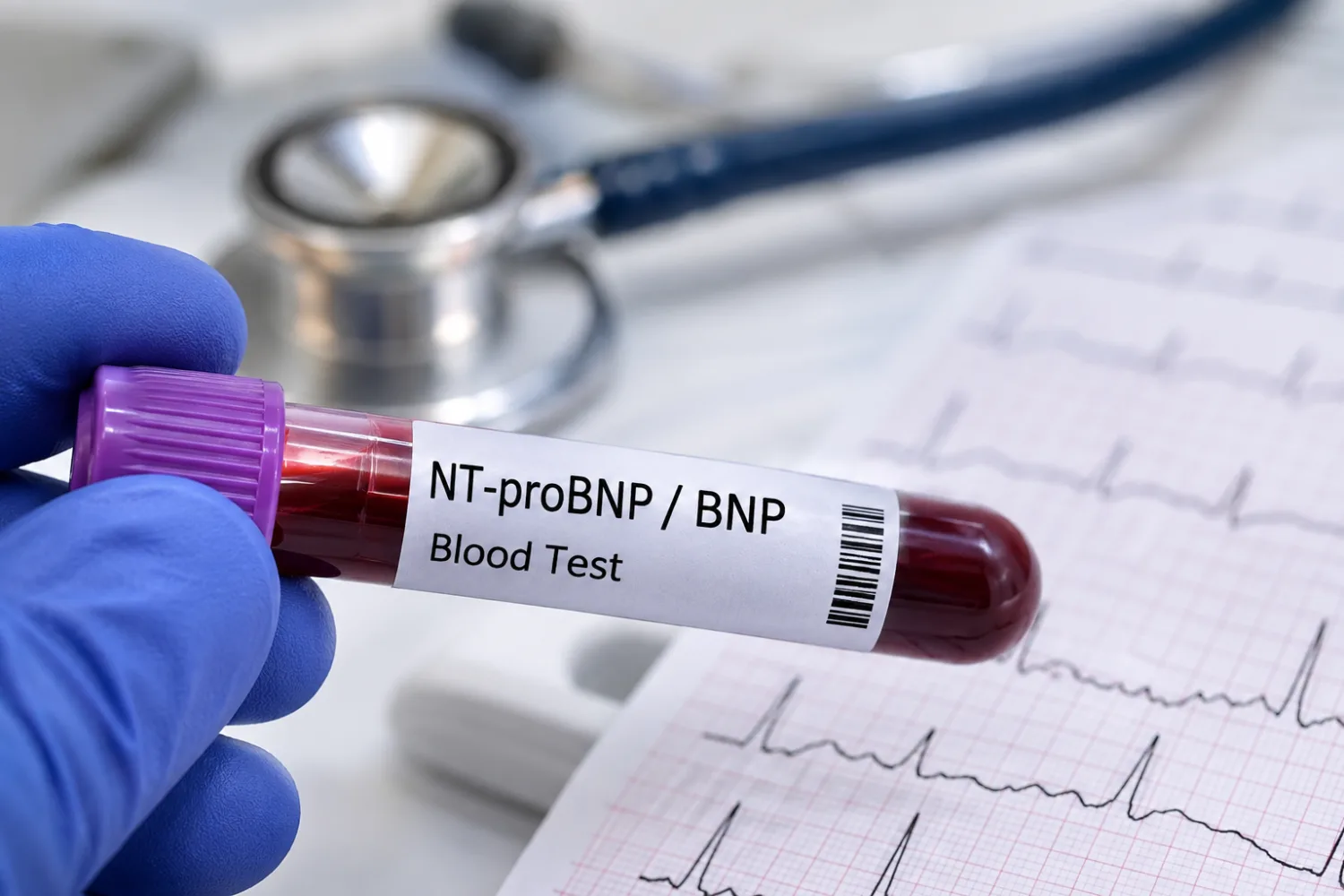
BNP and NT-proBNP are blood tests used mainly when doctors are investigating possible heart failure.
If you have been told that your BNP or NT-proBNP is raised, it is understandable to assume that this means you have heart failure. The result is not quite that straightforward.
These blood tests measure substances released when the heart is under increased pressure or stretch. Heart failure is one important reason for this to happen, but it is not the only one. Age, kidney function, heart rhythm problems, lung disease and severe illness can all affect the result.
Conversely, a relatively low result can make heart failure much less likely, although even that has to be interpreted alongside your symptoms and medical history.
In England, NICE currently uses NT-proBNP rather than BNP in the standard pathway for investigating suspected chronic heart failure. An untreated person with an NT-proBNP below 400 ng/L is less likely to have heart failure, while higher results usually lead to specialist assessment and an echocardiogram.
This guide explains what BNP and NT-proBNP actually measure, what common results mean and why the number should never be interpreted in isolation.
What Are BNP and NT-proBNP?
BNP stands for B-type natriuretic peptide. You may sometimes see it described by the older name “brain natriuretic peptide”, although most of it is produced by the heart.
When heart muscle is stretched because pressure or fluid volume has increased, it releases a precursor molecule called proBNP.
This is then split into two parts: active BNP and an inactive fragment called NT-proBNP.
BNP has biological effects. Among other things, it encourages the kidneys to remove sodium and water and helps blood vessels relax. These actions help reduce pressure on the heart.
NT-proBNP does not have the same active hormonal role, but it stays in the bloodstream longer and is particularly useful as a laboratory marker.
Both tests therefore provide indirect information about how much strain the heart may be experiencing.
They are related tests, but they are not numerically interchangeable. A BNP of 400 and an NT-proBNP of 400 do not mean the same thing and should not be interpreted using the same cut-offs.
Why Is NT-proBNP Tested?
A GP may request NT-proBNP when symptoms raise the possibility of heart failure.
One of the most common reasons is unexplained breathlessness. Other clues may include swollen ankles, reduced exercise tolerance, unusual tiredness or difficulty breathing when lying flat.
These symptoms are not specific to heart failure. Breathlessness can also come from lung disease, anaemia, obesity, infection or poor fitness, while ankle swelling has many possible causes.
That is where NT-proBNP becomes useful.
A low result makes heart failure less likely and can help the doctor look more confidently for another explanation. A raised result signals that the heart deserves closer investigation, usually with an echocardiogram.
The blood test itself does not show how well the heart pumps, which valve may be abnormal or whether the problem is heart failure with reduced or preserved ejection fraction. Those questions require imaging and clinical assessment.
If you are referred for one, our guide to what an echocardiogram shows explains how the scan is performed and what doctors look for.
What Do NT-proBNP Results Mean in the UK?
For adults with suspected chronic heart failure, NICE currently uses three important NT-proBNP bands.
| NT-proBNP result | What NICE recommends |
|---|---|
| Below 400 ng/L | Heart failure is less likely in an untreated person |
| 400–2,000 ng/L | Specialist assessment and echocardiogram within 6 weeks |
| Above 2,000 ng/L | Urgent specialist assessment and echocardiogram within 2 weeks |
These are referral thresholds rather than a simple “normal versus abnormal” laboratory range.
An NT-proBNP of 500 does not mean that someone definitely has heart failure. It means the result is high enough, in someone with appropriate symptoms, that heart failure should be investigated.
Similarly, an NT-proBNP above 2,000 is taken seriously because very high levels are associated with a greater likelihood of heart failure and a poorer prognosis. It still does not identify the exact type or cause by itself.
There can also be differences between laboratories in how results are displayed. NT-proBNP is commonly reported as ng/L or pg/mL. Numerically these units are equivalent: 400 ng/L is the same concentration as 400 pg/mL.
Why Can NT-proBNP Be High Without Heart Failure?
This is one of the most important things to understand about the test.
NT-proBNP reflects cardiac stress, but heart failure is not the only situation that can create that stress or increase the amount of NT-proBNP circulating in the blood.
Levels naturally tend to rise with age. Someone in their 80s can therefore have a higher baseline NT-proBNP than a healthy person in their 30s.
Kidney function also matters. NT-proBNP is partly cleared through the kidneys, so chronic kidney disease can push the level upwards even when heart failure is not the sole explanation.
Atrial fibrillation is another common cause of elevated natriuretic peptide levels. The abnormal rhythm places additional strain on the atria and ventricles and can produce substantially higher results.
Other recognised causes include pulmonary embolism, pulmonary hypertension, heart valve disease, heart muscle disease, myocardial ischaemia, rapid heart rhythms, severe infection and sepsis, COPD and liver cirrhosis.
That is why a raised NT-proBNP should be interpreted as a signal to investigate rather than as a stand-alone diagnosis.
If kidney blood tests are also abnormal, our guide to eGFR and creatinine results explains what reduced kidney function can mean.
Can NT-proBNP Be Low Even If Someone Has Heart Failure?
Yes.
A low value makes heart failure substantially less likely, but no blood test is perfect.
One particularly important factor is obesity. People living with obesity often have lower concentrations of BNP and NT-proBNP than expected for the degree of cardiac dysfunction.
Certain heart-failure treatments can also lower natriuretic peptide concentrations. NICE specifically notes that diuretics, ACE inhibitors, ARBs, ARNIs, beta-blockers and mineralocorticoid receptor antagonists can reduce levels.
This matters because the NICE threshold of 400 ng/L is most useful in an untreated person being assessed for suspected chronic heart failure.
If symptoms remain strongly suggestive despite an NT-proBNP below 400, the result should not simply end the investigation. NICE advises considering other causes and discussing the case with a heart-failure specialist if concern remains.
Is BNP Interpreted Differently?
Yes.
BNP and NT-proBNP come from the same biological process, but their concentrations and diagnostic thresholds are different.
In UK primary care, NT-proBNP is the test used in the NICE chronic-heart-failure pathway. BNP may still be used in hospitals and some other clinical settings.
For someone presenting with new suspected acute heart failure, NICE says a BNP below 100 ng/L or an NT-proBNP below 300 ng/L can help rule acute heart failure out.
Notice how different these thresholds are from the 400 and 2,000 NT-proBNP figures used in the chronic outpatient pathway.
This is why searching online for a single “normal BNP level” can be confusing. Interpretation depends on which peptide was measured and whether the person is being assessed for sudden acute illness or longer-term symptoms.
Does a Very High NT-proBNP Mean Severe Heart Failure?
Generally, higher natriuretic peptide concentrations are associated with greater cardiac stress and poorer outcomes in people who genuinely have heart failure.
That is why NICE treats results above 2,000 ng/L as particularly important.
But the number does not map neatly onto a specific stage of disease.
A person with kidney impairment and atrial fibrillation may have a very high NT-proBNP for several overlapping reasons. Another person with genuine heart failure may have a much lower value, particularly if they are obese or already receiving treatment.
NT-proBNP also cannot tell you whether the heart's ejection fraction is reduced, mildly reduced or preserved. NICE specifically warns against using the peptide level to make that distinction.
The echocardiogram and specialist assessment provide that information.
What Usually Happens After a Raised Result?
If your GP requested NT-proBNP because of possible chronic heart failure, the next step usually depends on the number and your overall clinical picture.
A result between 400 and 2,000 ng/L normally leads to specialist assessment and echocardiography within six weeks under NICE guidance. A result above 2,000 should lead to assessment within two weeks.
The specialist may review your symptoms, examine you and look at an ECG alongside the echocardiogram.
Other blood tests commonly help identify alternative explanations or conditions that can worsen heart failure. These may include a full blood count, kidney function, electrolytes, liver tests, thyroid tests and blood glucose.
An ECG looks at the electrical activity and rhythm of the heart, while an echocardiogram shows its physical structure and pumping function. The two tests answer very different questions.
Depending on the findings, further investigations may occasionally be needed.
BNP Is Not the Same as Troponin
BNP, NT-proBNP and troponin are all described as “heart blood tests”, which can cause understandable confusion.
They measure different things.
BNP and NT-proBNP mainly reflect pressure and stretch on the heart. Troponin is released when heart muscle cells are injured.
Troponin is therefore central to assessing possible heart attacks, although it can also rise for other reasons.
A person can have a raised NT-proBNP with normal troponin, raised troponin with a relatively modest NT-proBNP, or both tests raised at the same time.
Neither test should be substituted for the other.
Our guide to troponin blood-test results explains normal, raised and repeat troponin measurements in more detail.
When Should You Seek Urgent Medical Help?
An abnormal BNP or NT-proBNP result on its own is not normally a reason to call an ambulance.
Your symptoms matter much more than the laboratory number.
Call 999 if you develop severe difficulty breathing, sudden severe chest pain, collapse, blue or grey lips or skin, or another rapidly worsening medical emergency.
New severe breathlessness, particularly when it starts suddenly, should not wait for a routine heart-failure referral simply because blood tests are already being arranged.
If symptoms are concerning but not immediately life-threatening, NHS 111 can help direct you to the appropriate service.
Frequently Asked Questions
What is a normal NT-proBNP result?
There is no single universal “normal” value for every situation. In the NICE pathway for suspected chronic heart failure, a result below 400 ng/L in an untreated person makes heart failure less likely.
Is NT-proBNP over 400 high?
For someone being investigated for suspected chronic heart failure in England, 400 ng/L or above reaches the NICE threshold for specialist assessment and echocardiography.
What does an NT-proBNP of 1,000 mean?
It falls within the NICE 400–2,000 ng/L referral range. Heart failure is possible, but the result does not confirm it. Other factors such as age, kidney function and heart rhythm need to be considered.
What does an NT-proBNP above 2,000 mean?
NICE considers this a very high result in suspected chronic heart failure and recommends specialist assessment and echocardiography within two weeks.
Does a high BNP definitely mean heart failure?
No. BNP and NT-proBNP can rise because of kidney disease, atrial fibrillation, pulmonary embolism, lung disease, heart valve problems, sepsis and several other conditions.
Can kidney disease raise NT-proBNP?
Yes. Reduced kidney function is a well-recognised cause of higher NT-proBNP concentrations and needs to be considered when interpreting the result.
Does age raise NT-proBNP?
Yes. Natriuretic peptide concentrations tend to increase with age, which is one reason the result must be interpreted alongside the patient's overall clinical picture.
Can atrial fibrillation raise NT-proBNP?
Yes. Atrial fibrillation can substantially increase natriuretic peptide levels even when it is not the only heart problem present.
Can obesity lower NT-proBNP?
Yes. Obesity is associated with lower BNP and NT-proBNP concentrations, meaning a relatively low result can occasionally be less reassuring in someone with strong symptoms.
Is NT-proBNP the same as BNP?
No. They are produced from the same precursor molecule but are different substances with different blood concentrations and diagnostic cut-offs.
Is BNP the same as troponin?
No. BNP and NT-proBNP mainly reflect cardiac stretch and pressure, whereas troponin is a marker of heart-muscle injury.
Does a raised NT-proBNP mean I need an echocardiogram?
Usually, if it was requested because chronic heart failure is suspected. NICE recommends echocardiography and specialist assessment for NT-proBNP results of 400 ng/L or above.
Can NT-proBNP tell what type of heart failure I have?
No. The result cannot distinguish heart failure with reduced, mildly reduced or preserved ejection fraction. An echocardiogram and specialist assessment are needed.
Should NT-proBNP results be compared over time?
Levels can change as heart strain, fluid status and treatment change, and falling values are often associated with improvement. However, treatment should not be adjusted by patients themselves simply to reach a particular NT-proBNP number.