A private Holter monitor in the UK typically costs approximately £240 to £500 for 24-hour monitoring and £300 to £750 for 48-hour monitoring. Monitoring for three to seven days may cost £350 to £1,000, while a specialist wireless patch worn for up to 14 days can cost £600 to £1,500 or more.
The advertised price does not always include a cardiologist consultation, fitting appointment, analysis, written report and follow-up. If these are charged separately, the complete private pathway may cost approximately £500 to £1,300 for a conventional Holter test and considerably more when longer monitoring or additional heart tests are needed.
A longer test is not automatically better. The most useful duration depends largely on how often your symptoms occur. Daily palpitations may be captured within 24 hours, while symptoms occurring only once a week may require a seven-day patch or another type of event monitor.
Do not arrange routine private monitoring instead of seeking urgent help for ongoing chest pressure, severe breathlessness, collapse, signs of a stroke or a very fast or slow heartbeat accompanied by severe symptoms. Call 999 when someone may be having a life-threatening emergency.
Prices in this guide are indicative self-pay figures. Ask the provider for a written quotation confirming the monitoring duration and everything included.
How much does a private Holter monitor cost in the UK?
Private prices vary according to the type of recorder, monitoring duration, clinic location and level of clinical interpretation.
| Service | Typical or possible self-pay cost |
|---|---|
| Resting 12-lead ECG | Approximately £80–£180 |
| 24-hour Holter monitor | Approximately £240–£500 |
| 48-hour Holter monitor | Approximately £300–£750 |
| 72-hour monitoring | Approximately £350–£850 |
| Five-to-seven-day monitoring | Approximately £350–£1,000 |
| Up to 14-day wireless patch | Approximately £600–£1,500+ |
| Initial cardiologist consultation | Approximately £180–£350 |
| Follow-up consultation | Approximately £120–£250 |
Published prices demonstrate the variation. Heartsure lists self-funded monitoring at £300 for 24 hours, £350 for 48 hours and £450 for 72 hours or longer. London Cardiology Clinics advertises a 24-hour monitor for £240.
At the higher end, Guy’s and St Thomas’ Specialist Care publishes prices starting at £360 for a wired 24-hour monitor, £753 for 48 hours and £997 for seven days. Its 14-day wireless patch is listed at £1,440. These examples should be treated as comparisons rather than national tariffs.
Clinic prices can change, so confirm the current charge at the time of booking. A lower price may represent the monitor and technical report only, while a higher package may include specialist review.
What is a Holter monitor?
A Holter monitor is a small wearable device that continuously records the electrical activity of your heart while you carry out normal daily activities. It is also called an ambulatory ECG, ambulatory electrocardiogram or ECG tape.
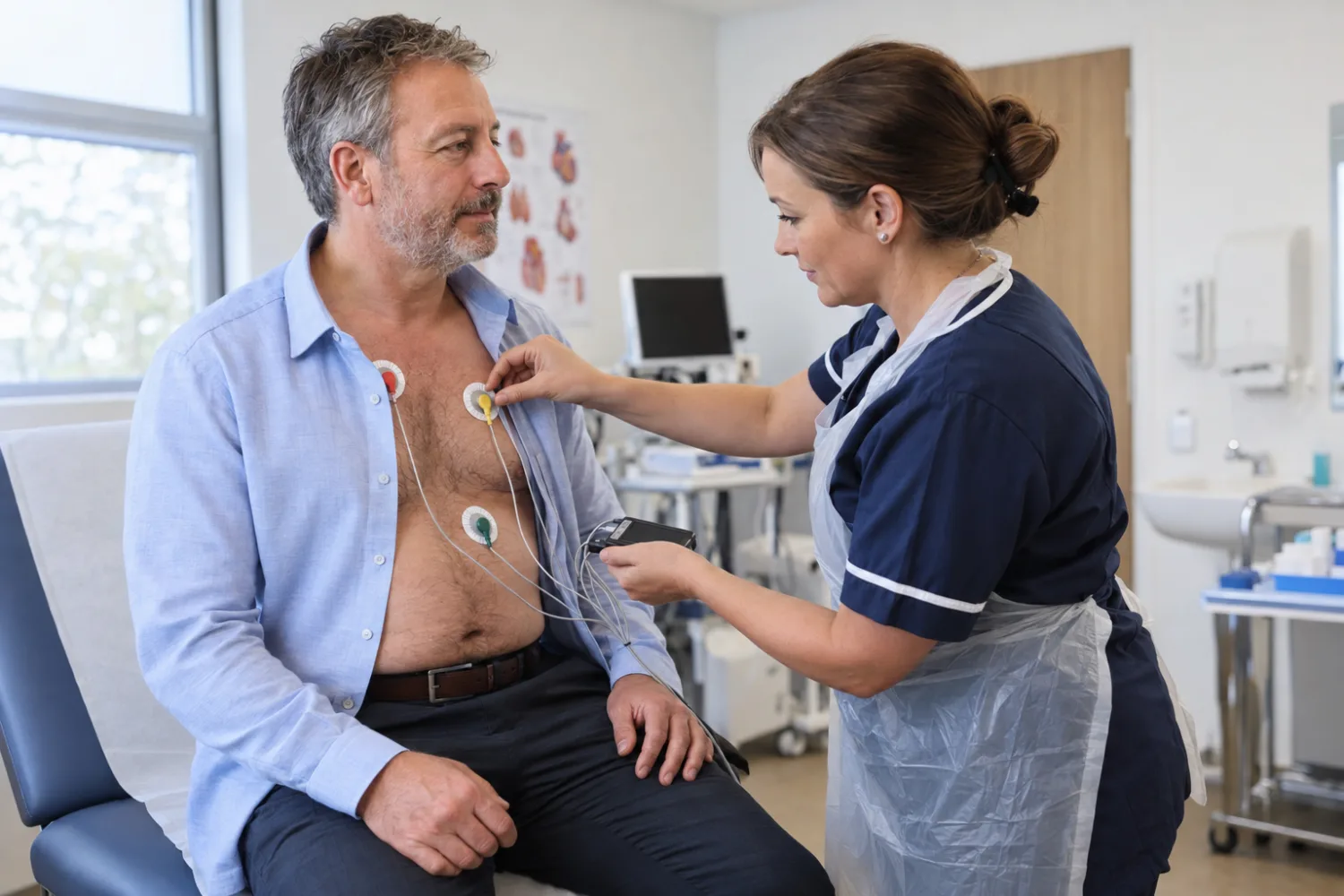
Several adhesive electrodes are attached to the chest and connected to a portable recorder. Some modern systems use a small wireless patch with fewer or no visible wires.
The monitor records every heartbeat during the selected period. Software and a trained cardiac professional then examine the recording for:
- unusually fast or slow rhythms;
- extra or premature heartbeats;
- atrial fibrillation or atrial flutter;
- pauses in the heartbeat;
- episodes of supraventricular tachycardia;
- some ventricular rhythm disturbances;
- changes occurring at the time of reported symptoms.
A standard resting ECG records only a short snapshot, usually lasting seconds. A Holter monitor records for much longer, which increases the chance of detecting an intermittent rhythm problem.
For help understanding the terminology commonly found on a report, see our guide to ECG results and measurements.
When might ambulatory ECG monitoring be recommended?
A clinician may recommend monitoring when symptoms could be caused by an abnormal heart rhythm but a resting ECG has not provided an answer.
Common reasons include:
- recurrent heart palpitations;
- an unexplained racing, pounding or fluttering heartbeat;
- dizziness or light-headedness;
- unexplained fainting or near-fainting;
- episodes of unusual weakness;
- intermittent breathlessness;
- suspected atrial fibrillation;
- checking the effect of heart-rhythm medication;
- assessing the function of a pacemaker in selected situations;
- investigating symptoms occurring during sleep or exercise.
Palpitations are common and do not always represent heart disease. They can be associated with stress, caffeine, alcohol, lack of sleep, anaemia, thyroid problems, fever and certain medicines. Monitoring helps establish whether the sensation corresponds to an abnormal rhythm.
Our guide to heart palpitations and when to see a doctor explains common triggers and warning signs.
A Holter monitor does not directly show the heart’s valves, pumping strength or coronary arteries. An echocardiogram, blood tests, exercise ECG or another investigation may be recommended depending on the symptoms.
Should you choose 24-hour, 48-hour or longer monitoring?
The aim is to monitor long enough to capture a representative symptom without paying for unnecessary recording time. The frequency of symptoms is usually more important than their severity when choosing the duration.
| How often symptoms occur | Monitoring that may be considered |
|---|---|
| Several times every day | 24-hour Holter monitoring may be sufficient |
| Most days but not predictably | 48-to-72-hour monitoring may improve the chance of capture |
| Once or twice a week | Five-to-seven-day continuous monitoring may be more useful |
| Less often than weekly | A 14-day patch or longer event monitor may be considered |
| Rare unexplained collapses | A longer external or implantable recorder may be needed |
Twenty-four-hour monitoring
A 24-hour monitor is usually the least expensive option and may work well when symptoms occur every day. It can also assess the overall number of extra beats or the heart rate across daytime activity and sleep.
Its main limitation is straightforward: if the symptom does not occur during that particular day, the recording may not answer the question.
Forty-eight or 72-hour monitoring
Monitoring for two or three days gives additional opportunities to capture symptoms that do not happen daily. The device and fitting process are generally similar, although skin irritation and inconvenience may increase with time.
Five-to-seven-day monitoring
A longer monitor may be appropriate for symptoms occurring approximately once a week. Lightweight patches can be easier to manage than conventional wires, although device capabilities and water resistance differ.
Fourteen-day patches and event recorders
A wireless patch can continuously record for up to 14 days, depending on the model. Some event monitors record automatically, while others allow the wearer to press a button when symptoms occur.
If symptoms happen only once every few weeks or months, even a 14-day recording may miss them. A cardiologist may discuss a longer event recorder or an implantable loop recorder rather than repeatedly arranging short Holter tests.
What should the quoted price include?
A comprehensive Holter-monitor fee may include:
- reviewing the referral and deciding which monitor is suitable;
- the fitting appointment;
- electrodes, adhesive patches and the recording device;
- instructions and a symptom diary;
- removal or return of the device;
- downloading the complete recording;
- technical analysis of the heart rhythm;
- review by a cardiac physiologist or cardiologist;
- a written clinical report;
- sending the report to the referring clinician.
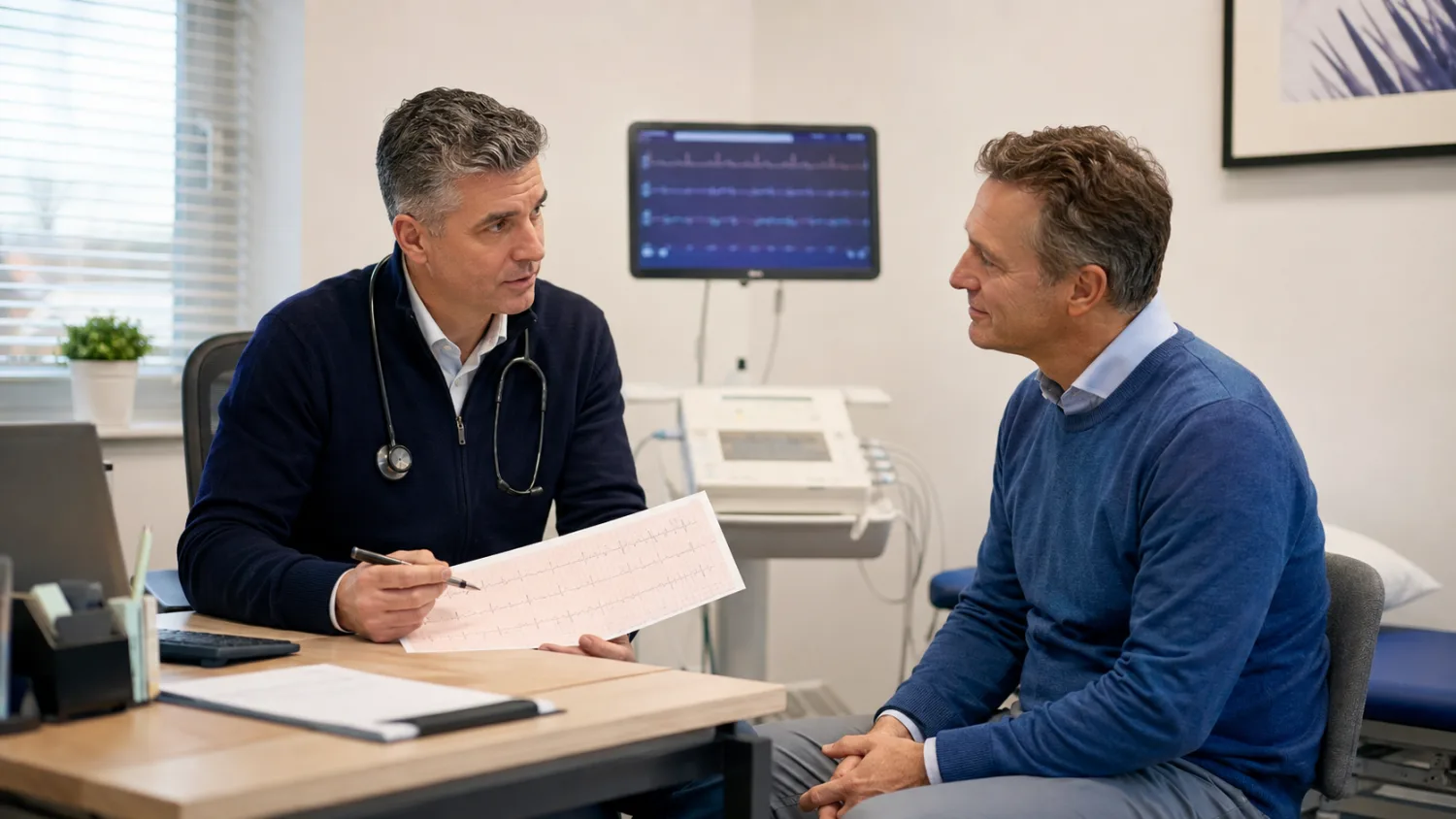
Do not assume that “analysis included” means a cardiologist will discuss the results with you. Some providers supply a technical report that must then be interpreted by your GP or consultant.
Ask who will sign the report and whether they will compare the electrical recording with the times entered in your symptom diary.
Which additional costs might be charged?
The Holter fee may be only one part of a wider cardiology assessment.
| Possible additional service | Approximate cost |
|---|---|
| Private GP appointment or referral | £70–£200+ |
| Initial cardiologist consultation | £180–£350+ |
| Resting ECG | £80–£180 |
| Echocardiogram | £250–£500+ |
| Blood tests | £50–£300+ |
| Exercise ECG | £300–£600+ |
| Follow-up cardiologist appointment | £120–£250+ |
| Replacement or late-return charge | Depends on provider terms |
A patient starting with palpitations might therefore pay £250 for a consultant appointment, £350 for a 48-hour monitor and £180 for a follow-up, producing a total near £780. Adding an echocardiogram and blood tests could take the overall cost above £1,100.
Ask for a written quotation separating:
- consultant fees;
- hospital or clinic charges;
- the device and fitting fee;
- analysis and reporting;
- follow-up care.
Our guide to private cardiologist costs in the UK explains the wider cost of consultations and cardiac investigations. If a heart ultrasound is proposed, see our guide to private echocardiogram prices.
What happens during a Holter-monitor test?
The fitting appointment commonly takes around 15 to 30 minutes. You may be asked to remove clothing from the upper body so that the electrodes can be positioned correctly.
The appointment usually involves:
- confirming your symptoms, medicines and monitoring duration;
- cleaning small areas of skin on the chest;
- removing a small amount of chest hair if necessary for adhesion;
- attaching several electrodes or a self-contained patch;
- connecting and activating the recorder;
- checking that a clear signal is being received;
- explaining how to record symptoms and return the equipment.
You normally continue with everyday activities, including walking, working and sleeping. Maintaining a fairly normal routine may help reproduce the circumstances in which symptoms occur.
Record the exact time and nature of any symptom, such as:
- fluttering or pounding;
- chest discomfort;
- breathlessness;
- dizziness;
- feeling faint;
- unusual fatigue.
Also note relevant activities such as climbing stairs, exercising, drinking caffeine, going to bed or waking from sleep. This helps the reviewer match symptoms to the heart rhythm at that moment.
Can you shower, sleep and exercise while wearing it?
Whether you can shower depends on the particular monitor. Traditional wired recorders usually need to remain completely dry, meaning you cannot shower, bathe or swim while wearing them. Some modern adhesive patches are water-resistant, but water-resistant does not necessarily mean suitable for swimming or submersion.
Follow the clinic’s instructions rather than assuming the device is waterproof.
You can normally sleep while wearing a Holter monitor. The clinic may show you how to position the recorder and secure the wires to reduce pulling during the night.
Normal light-to-moderate exercise may be encouraged if it usually triggers symptoms and the referring clinician considers it safe. Avoid:
- swimming or water sports;
- contact sports;
- activities likely to dislodge electrodes;
- exercise that your clinician has told you to avoid;
- deliberately provoking severe symptoms.
Do not stop prescribed medication, consume excessive caffeine or perform unusually strenuous exercise merely to try to create an abnormal recording.
What can a Holter monitor detect—and what can it miss?
A Holter monitor may identify an abnormal rhythm and show whether it occurred at the same time as your symptoms. It can also provide useful information about the lowest, highest and average heart rates during the recording.
Possible findings include:
- normal sinus rhythm during reported symptoms;
- premature atrial or ventricular beats;
- episodes of atrial fibrillation;
- supraventricular tachycardia;
- marked slowing of the heartbeat;
- pauses or conduction abnormalities;
- selected ventricular arrhythmias.
A normal result does not prove that symptoms are imaginary or that every heart condition has been excluded. Important limitations include:
- the relevant episode may not occur during the test;
- loose electrodes can create gaps or artefacts;
- movement can produce electrical interference;
- some single-lead patches provide less detail than a 12-lead ECG;
- a Holter monitor does not show heart structure;
- it cannot directly detect a blocked coronary artery.
The report must be interpreted alongside your symptoms, medical history, examination and other tests. A rhythm that looks significant in one clinical context may be less concerning in another.
How quickly will you receive the results?
Results may be available within a few working days, but some clinics take one to two weeks. Longer recordings contain more data and may take more time to analyse.
The report may include:
- the duration and quality of the recording;
- minimum, maximum and average heart rates;
- the underlying rhythm;
- the number and type of extra beats;
- any episodes of fast or slow rhythm;
- pauses or conduction changes;
- the rhythm during symptoms recorded in the diary;
- a clinical conclusion and recommended next step.
Ask in advance:
- when the report should be ready;
- who will receive it;
- whether you will receive a copy;
- who will explain the findings;
- whether a follow-up fee applies;
- what happens if an important abnormality is discovered.
If the monitor records a potentially dangerous rhythm, a well-organised service should have a process for urgent clinical review rather than waiting for a routine appointment.
Is a private Holter monitor covered by health insurance?
Private medical insurance may cover ambulatory ECG monitoring when it is medically necessary, referred appropriately and performed by a recognised provider. Cover is not automatic.
Before booking, check:
- whether you need a GP referral;
- whether the cardiologist and facility are recognised;
- whether pre-authorisation is required;
- which monitoring duration has been approved;
- whether the consultation and follow-up are covered;
- your outpatient benefit limit;
- your excess or co-payment;
- whether a wireless patch attracts an additional charge.
An insurer might approve a conventional 24-hour test but not a more expensive seven or 14-day monitor without further clinical justification. Obtain an authorisation number and confirm which parts of the pathway will be billed separately.
Our guide to private cardiology tests and insurance cover provides a broader explanation. It is also useful to understand how an outpatient benefit limit can affect diagnostic-test claims.
When should symptoms be treated as urgent?
A Holter monitor is used to investigate intermittent symptoms in a patient who is currently stable. It is not an emergency response system and is not normally watched continuously by a clinical team.
Call 999 if palpitations or an abnormal heartbeat occur with:
- persistent chest pressure, tightness or severe pain;
- severe difficulty breathing;
- collapse or loss of consciousness;
- new facial weakness, arm weakness or speech difficulty;
- confusion or inability to wake normally;
- grey, blue or very pale skin;
- another sign that someone is seriously ill.
Seek prompt medical advice for a first unexplained faint, recurrent near-fainting, palpitations lasting a long time or symptoms that are becoming more frequent. NHS 111 can help identify the appropriate urgent service when the situation does not appear immediately life-threatening.
Do not wait for the monitor fitting appointment if your condition changes. Wearing a monitor also does not mean you should ignore serious symptoms because “the device is recording them”. Many devices store information for later review and do not alert an emergency team in real time.
Frequently asked questions
How much is a private 24-hour ECG monitor?
A private 24-hour Holter monitor commonly costs approximately £240 to £500. Check whether fitting, analysis, a written report and specialist interpretation are included.
How much is a private 48-hour Holter monitor?
Prices are commonly around £300 to £750. The fee varies according to the device, clinic and whether consultant review is included.
How much does a seven-day ECG monitor cost?
A five-to-seven-day monitor may cost approximately £350 to £1,000. Some providers offer lower direct-access prices, while hospital-based specialist services can charge considerably more.
Can I book a Holter monitor without seeing a cardiologist?
Some clinics accept direct bookings or a GP referral. Others require assessment by their cardiologist first. Even when direct access is available, an appropriate clinician must interpret the result in the context of your symptoms.
Is a Holter monitor available through the NHS?
Yes. A GP or hospital clinician can refer eligible patients for NHS ambulatory ECG monitoring when clinically indicated. There is no self-pay charge for NHS treatment, although waiting times vary.
Is a 48-hour monitor better than a 24-hour monitor?
It provides a longer opportunity to capture intermittent symptoms, but it is not automatically necessary when symptoms occur several times every day. The appropriate duration depends mainly on symptom frequency and the clinical question.
What if I have no symptoms during the recording?
The monitor may still identify an unsuspected rhythm abnormality, but it may not explain your usual symptoms. A clinician may recommend longer monitoring or another type of recorder.
Does the monitor record sound or location?
A conventional Holter monitor records the heart’s electrical activity. It does not normally record conversations or track your location. Connected devices may use a smartphone or mobile data, so check the provider’s privacy information.
Can a Holter monitor detect anxiety?
It cannot diagnose anxiety. It can show the heart rhythm during an episode that feels like palpitations, which may help determine whether the sensation corresponds to an arrhythmia or a normal rhythm.
Can a Holter monitor detect a blocked artery?
No. It records electrical activity and rhythm rather than directly imaging the coronary arteries. Further assessment may be needed when symptoms suggest coronary heart disease.
Can I work while wearing a Holter monitor?
Most people can continue working unless their job involves water, strong electromagnetic equipment, strenuous physical activity or another situation that could damage the device. Ask the clinic about your specific work environment.
Can I drive while wearing one?
The device itself does not usually prevent driving. However, you should not drive if you have experienced unexplained loss of consciousness, severe dizziness or another condition affecting driving safety. Ask your clinician about DVLA requirements relevant to your symptoms or diagnosis.
Can I remove the monitor myself?
Some patches are designed for removal and return at home, while traditional equipment may need to be removed at the clinic. Follow the provider’s instructions so that data are not lost and the equipment is returned safely.
Is private monitoring worth paying for?
It may be worthwhile when symptoms need timely investigation and the private package includes appropriate clinical interpretation and follow-up. It offers less value when the wrong monitoring duration is chosen or the advertised price excludes essential reporting and specialist review.