You can have a healthy diet, exercise regularly, avoid smoking and still have a cardiovascular risk factor you know nothing about.
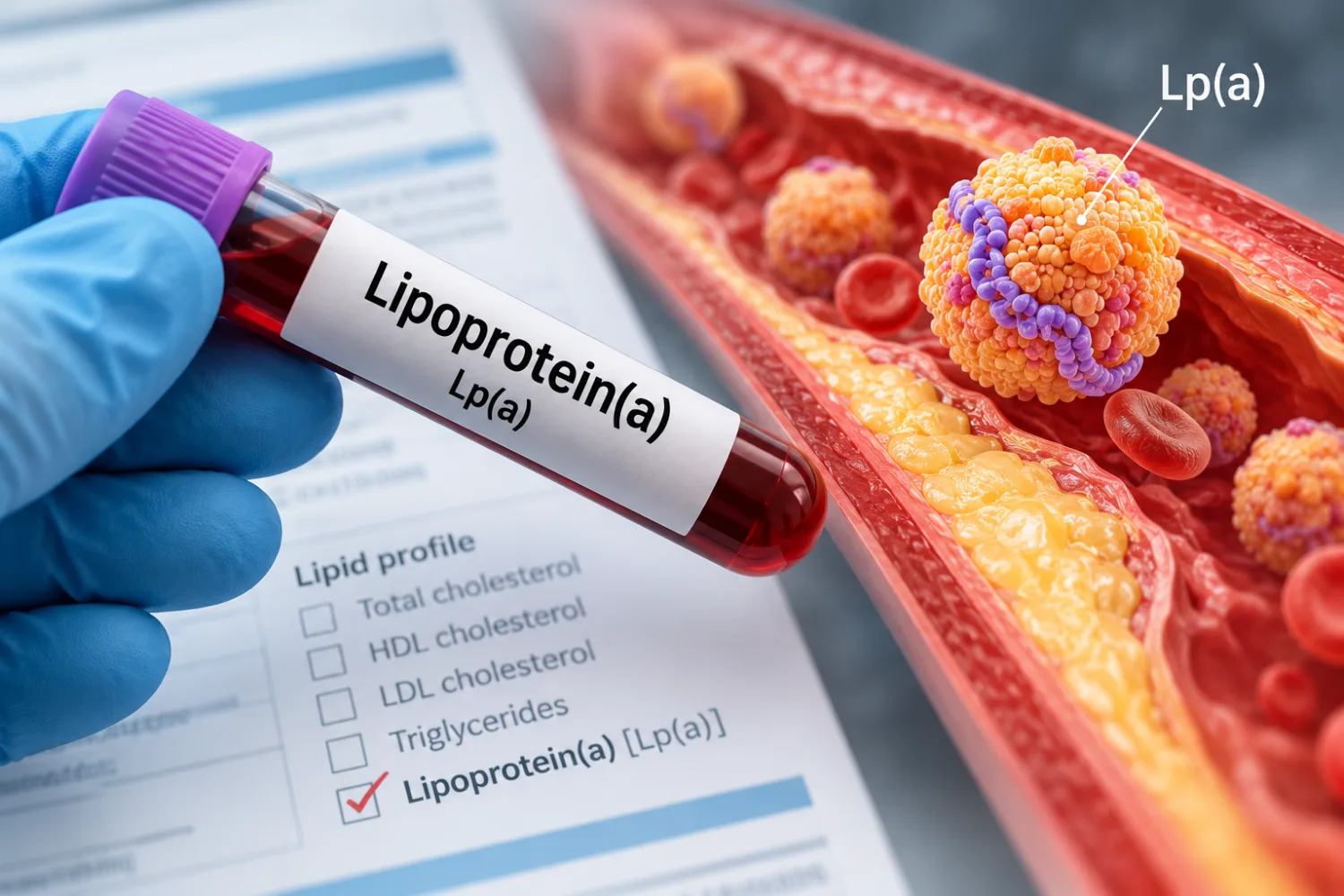
Lipoprotein(a), usually shortened to Lp(a), is a cholesterol-carrying particle in the blood. High levels are associated with an increased risk of heart attack, stroke and calcific aortic valve disease.
Unlike ordinary LDL cholesterol, Lp(a) is determined largely by genetics. This means somebody can have a high level despite living a very healthy lifestyle.
It also means Lp(a) usually does not need checking every year. For most people, one measurement can provide useful information for the rest of their life.
The test is not currently part of an ordinary NHS cholesterol profile in most UK GP practices, so many people have never had it measured.
This guide explains what Lp(a) is, who should consider testing, how results are reported and what can be done if your level is high.
What Is Lipoprotein(a)?
Lipoproteins are particles that carry cholesterol and other fats through the bloodstream.
LDL is probably the best-known example. LDL particles transport cholesterol around the body and, when present in excessive numbers, can contribute to cholesterol building up inside artery walls.
Lipoprotein(a) is structurally similar to LDL but has an additional protein attached to it called apolipoprotein(a), or Apo(a).
It also contains apolipoprotein B, or ApoB.
This combination makes Lp(a) an atherogenic particle — meaning it can contribute to the development of fatty plaques inside arteries.
Higher Lp(a) is associated with increased risk of:
- coronary heart disease;
- heart attack;
- ischaemic stroke;
- peripheral arterial disease;
- calcific aortic valve stenosis.
The British Heart Foundation describes Lp(a) as an inherited cardiovascular risk factor and notes that raised levels are also associated with calcific aortic valve stenosis.
If you are already familiar with ApoB testing, our guide to ApoB vs LDL cholesterol explains why counting atherogenic particles can add information beyond an ordinary cholesterol number.
How Is Lp(a) Different From LDL Cholesterol?
LDL and Lp(a) are related, but they are not interchangeable.
An ordinary cholesterol test typically reports measurements such as:
- total cholesterol;
- HDL cholesterol;
- non-HDL cholesterol;
- LDL cholesterol;
- triglycerides.
Lp(a) usually has to be ordered separately.
This means you can have what appears to be a reasonably reassuring standard cholesterol profile while still having a high Lp(a) concentration.
The reverse can also occur: somebody may have high LDL cholesterol but a relatively low Lp(a).
Your total cardiovascular risk depends on the combination of these factors rather than one measurement in isolation.
Our guide to cholesterol test results explains the standard lipid profile in more detail.
Why Is Lp(a) Mostly Genetic?
Your Lp(a) level is largely controlled by variations in the LPA gene.
This is different from LDL cholesterol, which can be influenced substantially by diet, body weight, metabolic health and medicines.
Because Lp(a) is so strongly inherited, high levels often run in families.
If one person is found to have a very high Lp(a), testing parents, siblings or children may therefore identify relatives who also have increased cardiovascular risk.
HEART UK recommends considering family testing when a first-degree relative has an Lp(a) level above 200 nmol/L.
Levels also differ between populations. Average Lp(a) concentrations tend to be higher in people of African ancestry, although cardiovascular risk can occur at elevated levels in people of any ethnic background.
Because the genetic contribution is so strong, your Lp(a) level usually remains reasonably stable over your lifetime.
Who Should Consider an Lp(a) Blood Test?
There is growing support for broader Lp(a) testing.
The 2025 ESC/EAS dyslipidaemia update says that Lp(a) measurement should be considered at least once in every adult's lifetime to improve cardiovascular risk assessment.
UK practice is still somewhat more selective.
HEART UK currently recommends measurement particularly in people with:
- a personal history of premature cardiovascular disease;
- a family history of premature cardiovascular disease;
- a first-degree relative with very high Lp(a);
- familial hypercholesterolaemia or another inherited lipid disorder;
- calcific aortic valve disease or a family history of it;
- borderline cardiovascular risk where an additional risk factor could affect treatment decisions.
HEART UK defines premature cardiovascular disease in this context as occurring before age 60.
A strong family history of early heart disease
This is one of the most useful reasons to test.
Imagine your father had a heart attack at 49, your uncle had coronary bypass surgery at 52 and your standard cholesterol result looks only moderately raised.
An Lp(a) test may reveal an inherited risk factor that helps explain the family pattern.
Heart disease despite apparently reasonable cholesterol
Lp(a) can also be useful when somebody develops coronary disease, stroke or peripheral arterial disease earlier than expected despite not having dramatically elevated conventional cholesterol measurements.
It does not necessarily explain everything, but it can contribute to the overall risk picture.
Familial hypercholesterolaemia
People with familial hypercholesterolaemia already have increased lifetime exposure to LDL cholesterol. A high Lp(a) can add another inherited cardiovascular risk factor.
This combination may affect how intensively other modifiable risk factors are managed.
Aortic valve stenosis
Raised Lp(a) has also been linked with calcification of the aortic valve.
Testing may therefore be considered when someone has calcific aortic valve stenosis, particularly when it occurs relatively early or there is a family history.
What Do Lp(a) Results Mean?
Lp(a) interpretation is more complicated than many ordinary blood tests because laboratories can report it in different units.
You may see:
- nmol/L — the number of Lp(a) particles;
- mg/dL — the mass concentration.
These units are not directly interchangeable with one universal conversion formula because Lp(a) particles vary in size.
Do not therefore take a result in mg/dL and multiply it by a fixed number you found online unless the laboratory or clinician specifically recommends that conversion.
HEART UK recommends reporting Lp(a) in nmol/L and currently describes results approximately as:
| Lp(a) | HEART UK risk category |
|---|---|
| Below 32 nmol/L | No additional Lp(a)-related risk |
| 32–90 nmol/L | Minor additional risk |
| 90–200 nmol/L | Moderate additional risk |
| 200–400 nmol/L | High additional risk |
| Above 400 nmol/L | Very high additional risk |
These bands should not be treated as sharp boundaries where risk suddenly changes. Cardiovascular risk generally rises progressively as Lp(a) increases.
The 2025 ESC/EAS update identifies Lp(a) above 50 mg/dL, approximately 105 nmol/L, as a cardiovascular risk-enhancing factor, while recognising that higher concentrations carry progressively greater risk.
Do You Need to Test Lp(a) More Than Once?
Usually not.
This is one of the biggest differences between Lp(a) and LDL cholesterol.
LDL may change substantially after weight loss, dietary changes, statin treatment or another cholesterol-lowering medication.
Lp(a), by contrast, is largely genetically determined and tends to remain relatively stable.
The British Heart Foundation says that most people only need their Lp(a) measured once.
There are exceptions.
Some medical conditions can affect Lp(a), including kidney disease and hypothyroidism, and levels can change in some physiological circumstances.
Repeat testing may also become relevant if targeted Lp(a)-lowering medicines become part of routine treatment in future.
But for ordinary cardiovascular risk assessment, repeated annual Lp(a) testing generally adds little information.
Can Diet and Exercise Lower Lp(a)?
Not by very much.
This can be frustrating to hear because people are accustomed to being told that cholesterol is something they can lower through diet and exercise.
Lp(a) is different.
Healthy eating, weight loss and exercise generally have little effect on the underlying genetically determined Lp(a) concentration.
But this absolutely does not mean lifestyle is pointless.
If you cannot easily change one cardiovascular risk factor, it becomes even more valuable to optimise the ones you can change.
That means paying attention to:
- LDL and non-HDL cholesterol;
- blood pressure;
- smoking;
- diabetes;
- physical activity;
- body weight where appropriate;
- diet.
HEART UK emphasises that although lifestyle has little direct effect on Lp(a), managing these other risk factors remains an important way to reduce total cardiovascular risk.
Our guide to cardiovascular risk and heart attack and stroke prevention explains how these factors fit together.
What Happens If Your Lp(a) Is High?
A high result does not mean that you are destined to have a heart attack.
It means one element of your cardiovascular risk is higher than it would otherwise be.
The response usually involves looking more closely at your overall risk profile.
Your clinician may review:
- LDL cholesterol;
- non-HDL cholesterol;
- ApoB;
- blood pressure;
- smoking history;
- diabetes;
- kidney function;
- family history;
- existing cardiovascular disease.
For somebody with high Lp(a), doctors may decide there is more reason to lower LDL cholesterol aggressively because this reduces the amount of modifiable atherogenic cholesterol circulating alongside the genetically determined Lp(a).
What about statins?
Statins do not specifically lower Lp(a).
That sometimes leads to confusion online, with people asking why they should take a statin if their problem is high Lp(a).
The purpose is to reduce LDL-related risk.
If Lp(a) represents a risk factor you cannot currently modify easily, lowering LDL can still reduce your overall chance of cardiovascular disease.
The 2025 ESC/EAS update specifically states that raised Lp(a) should not be used as a reason to avoid statins when statin treatment is otherwise indicated.
You can read more in our guide to statins, benefits and side effects.
Are there medicines specifically for Lp(a)?
As of 2026, there is still no routinely approved medication whose primary indication is specifically to lower Lp(a) and prevent cardiovascular events.
Several targeted medicines are being studied in major clinical trials, including treatments designed to reduce production of apolipoprotein(a).
This is an active area of cardiovascular research.
The important remaining question is not simply whether these drugs can lower the laboratory number — several can — but whether doing so reduces heart attacks, strokes and other important clinical events.
Current European guidance states that whether targeted Lp(a) reduction reduces cardiovascular events and progression of aortic valve stenosis still needs to be established.
Should You Pay Privately for an Lp(a) Test?
Lp(a) is not routinely included when a GP requests a standard cholesterol test in the UK.
HEART UK notes that NHS testing may be available through specialist lipid services for appropriate patients.
Private laboratories also increasingly offer Lp(a), sometimes alone and sometimes as part of more detailed cardiovascular blood-test panels.
If you are paying privately, check that you are actually ordering lipoprotein(a) rather than ApoA1, ApoB or an ordinary lipid profile. These are different tests.
One-off testing may be particularly reasonable if you:
- have a strong family history of early heart attack or stroke;
- have familial hypercholesterolaemia;
- have premature cardiovascular disease yourself;
- have calcific aortic valve disease;
- want a more complete assessment of inherited cardiovascular risk.
If you are otherwise young and healthy with no obvious risk factors, the newer European recommendation to consider once-in-a-lifetime testing means asking about Lp(a) is still reasonable, although it is not yet a routine part of UK NHS cardiovascular screening.
Frequently Asked Questions
Is lipoprotein(a) the same as cholesterol?
No. Lp(a) is a lipoprotein particle that carries cholesterol and contains ApoB plus an additional protein called apolipoprotein(a). It contributes to cardiovascular risk but is not the same measurement as LDL cholesterol or total cholesterol.
Is Lp(a) included in a normal cholesterol blood test?
Usually not. A standard lipid profile commonly measures total cholesterol, HDL, LDL or non-HDL cholesterol and triglycerides. Lp(a) generally needs to be specifically requested.
What causes high Lp(a)?
Genetics is the main cause. Your Lp(a) concentration is largely determined by variants inherited through the LPA gene, which is why high levels often cluster within families.
What is considered a high Lp(a)?
The answer partly depends on the units used. HEART UK classifies 200–400 nmol/L as high and above 400 nmol/L as very high. Current European guidance considers levels above approximately 105 nmol/L, or 50 mg/dL, a cardiovascular risk-enhancing factor. Risk rises progressively rather than suddenly at one cutoff.
Is an Lp(a) result of 100 nmol/L high?
HEART UK places 90–200 nmol/L within its moderate-risk category. The result should be interpreted alongside LDL cholesterol, blood pressure, smoking, diabetes, family history and other cardiovascular risk factors.
Can Lp(a) be lowered naturally?
Diet, exercise and weight loss generally have little effect on the underlying Lp(a) concentration because it is mainly genetically determined. These measures remain important because they reduce other cardiovascular risk factors.
Do statins reduce lipoprotein(a)?
No significant direct Lp(a) reduction should be expected from statins. Their value is in lowering LDL cholesterol and reducing overall cardiovascular risk when treatment is indicated.
Does high Lp(a) mean I will have a heart attack?
No. It increases risk but does not determine your future. Someone with high Lp(a) and otherwise well-controlled cardiovascular risk factors may have a very different overall risk from someone who also smokes, has severe hypertension, diabetes and high LDL cholesterol.
Should my children be tested if my Lp(a) is high?
Because high Lp(a) is inherited, testing first-degree relatives can be useful when somebody has a markedly elevated result. The appropriate age and timing should be discussed with a GP or lipid specialist, particularly where there is also a family history of premature cardiovascular disease.
Does Lp(a) increase stroke risk?
Higher Lp(a) is associated with increased risk of atherosclerotic cardiovascular disease, including ischaemic stroke. It should be considered as one component of overall vascular risk rather than as a standalone prediction of stroke.
Does high Lp(a) cause aortic stenosis?
High Lp(a) is associated with increased risk of calcific aortic valve disease and aortic stenosis. Research is continuing into whether directly lowering Lp(a) can slow progression of valve disease.
Do I need Lp(a) tested every year?
Usually not. Because the level is predominantly genetically determined and tends to remain relatively stable, one measurement is generally enough for cardiovascular risk assessment.
Should everyone have Lp(a) tested?
European guidance now says once-in-a-lifetime measurement should be considered in every adult. UK recommendations have historically focused more strongly on people with premature cardiovascular disease, relevant family history, inherited lipid disorders or calcific aortic valve disease. UK practice may therefore vary.
This guide provides general information rather than interpretation of an individual cardiovascular risk profile. Lp(a) should be considered alongside cholesterol, blood pressure, smoking, diabetes, family history and other risk factors. Discuss a significantly elevated result with a GP, cardiologist or lipid specialist.