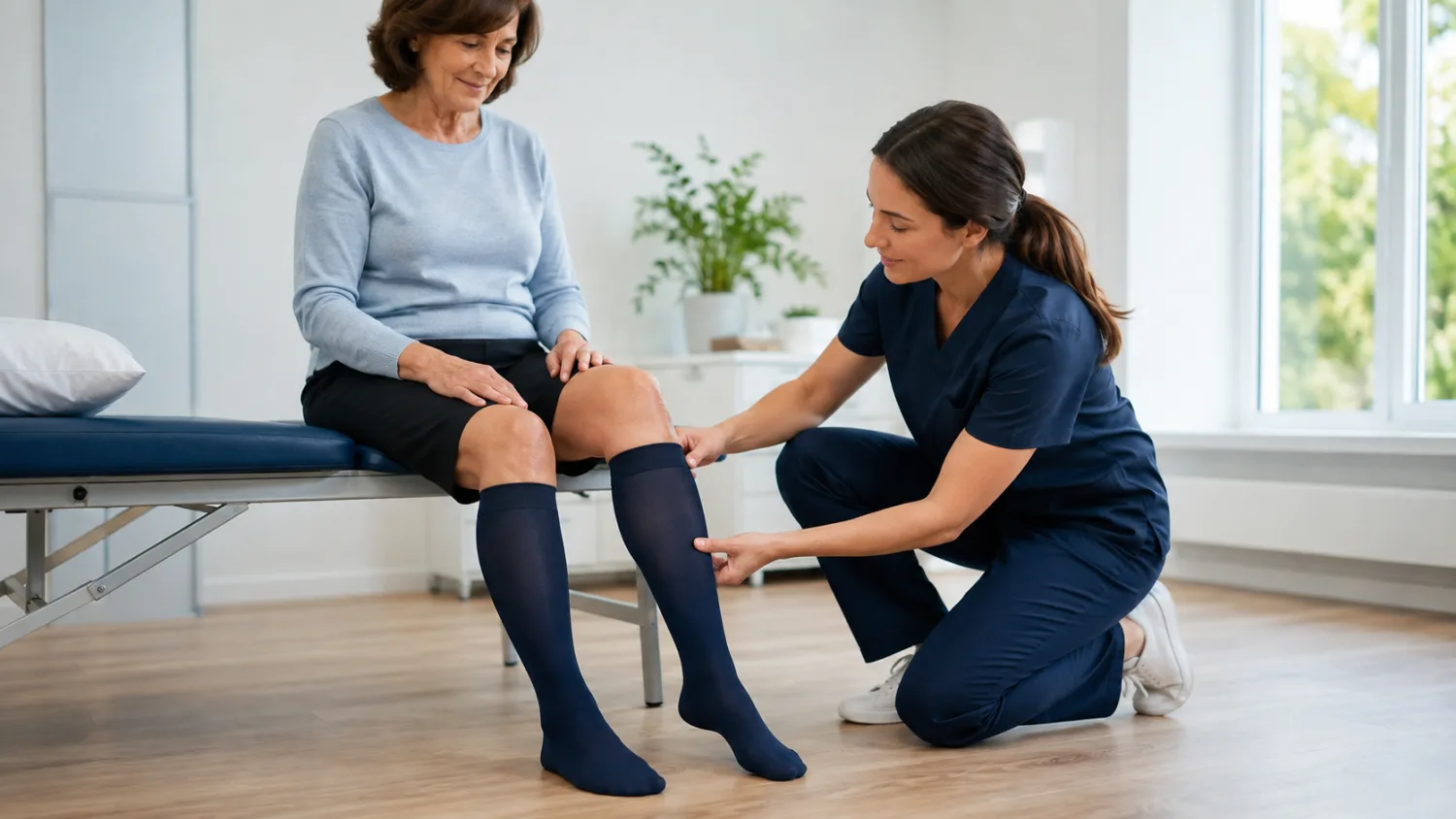
Compression socks are close-fitting garments that apply graduated pressure to the legs. They are tightest around the ankle and usually become less firm higher up the leg, helping blood and fluid move away from the lower limbs.
They may help people with varicose veins, persistent leg swelling, lymphoedema or certain circulation problems. Hospitals also use specialist anti-embolism stockings for selected patients who are less mobile after illness or surgery.
Compression socks are not suitable for everyone. They can be unsafe when blood flow through the leg arteries is significantly reduced. People with diabetes, loss of sensation, heart failure, damaged skin or unexplained swelling should obtain professional advice before choosing strong compression.
Do not use compression socks to self-treat possible deep vein thrombosis. Seek urgent medical advice for new pain and swelling in one leg. Call 999 if this occurs with chest pain, breathlessness, coughing blood, collapse or a very fast heartbeat.
This article provides general information. The correct garment and pressure depend on the cause of the symptoms, arterial circulation, leg measurements and relevant medical conditions.
What are compression socks?
Compression socks, stockings and tights are elasticated garments designed to apply controlled pressure to a limb. Most leg garments use graduated compression, meaning the pressure is strongest at the ankle and gradually reduces towards the knee or thigh.
This pressure can:
- reduce the diameter of superficial veins;
- support the valves inside the veins;
- help blood return towards the heart;
- limit the accumulation of fluid in the tissues;
- support the calf-muscle pump during walking;
- reduce aching, heaviness and swelling in selected conditions.
Compression does not cure damaged vein valves or every cause of swelling. Its purpose is generally to control symptoms, support healing or reduce a particular risk.
Products range from light-support travel socks sold without a prescription to firm medical compression garments fitted by a trained professional. Appearance alone does not show how much pressure a garment provides.
Who may benefit from compression socks?
Compression may be recommended for people with:
- varicose veins causing aching, heaviness or swelling;
- chronic venous insufficiency;
- ankle swelling caused by poor venous return;
- venous eczema or skin changes;
- a healed or active venous leg ulcer as part of specialist care;
- lymphoedema;
- swelling after certain operations;
- post-thrombotic symptoms after a previous blood clot;
- an increased risk of blood clots during hospital admission;
- pregnancy-related varicose veins or swelling;
- jobs involving prolonged standing, when symptoms have been assessed.
The NHS explains that compression stockings can improve blood flow and help with swelling and pain associated with varicose veins. However, they are not suitable when there are problems with arterial blood flow. Read the NHS overview of varicose veins and compression treatment.
Someone with mild ankle swelling after standing all day may need a different product from a person with lymphoedema or a venous ulcer. The diagnosis should guide the strength, length and construction of the garment.
What are the different types of compression garment?
“Compression socks” is a broad term covering several products that are not interchangeable.
| Type | Main use |
|---|---|
| Non-medical support or travel socks | Light support for comfort during prolonged sitting or standing |
| Graduated medical compression hosiery | Venous disease, swelling and other diagnosed conditions |
| Anti-embolism stockings | Reducing clot risk in selected people with limited mobility in hospital |
| Flat-knit garments | Often used for lymphoedema or limbs with substantial shape changes |
| Compression wraps | Adjustable compression for people who cannot manage ordinary hosiery |
| Compression bandaging | Specialist management of ulcers or significant swelling |
Anti-embolism stockings are not ordinary travel socks. They are intended mainly for people lying down or moving very little and should be selected according to a clinical clot-risk assessment.
Medical compression garments may be knee-high, thigh-high or full tights. Knee-high socks are adequate for many lower-leg conditions and can be easier to apply, but the prescriber may recommend a longer garment when swelling or vein problems extend above the knee.
What do compression classes and mmHg mean?
Compression strength is commonly expressed in millimetres of mercury, written as mmHg. A higher number indicates greater pressure.
You may see products described as:
- light support;
- Class 1;
- Class 2;
- Class 3;
- mild, moderate or firm compression;
- a specific pressure range in mmHg.
These descriptions can be confusing because British, European and international classification systems do not always use identical pressure ranges. A “Class 2” stocking under one standard may not be equivalent to a Class 2 product under another.
Check:
- the actual pressure range;
- where that pressure is measured;
- which classification standard is being used;
- whether the product is medical hosiery or general support wear;
- whether the stated pressure is suitable for your condition.
Stronger is not automatically better. Excessive pressure, an incorrect size or a rolled stocking can damage skin and restrict blood flow.
Who should avoid compression socks or seek advice first?
Do not begin strong compression without clinical assessment if you have or might have significantly reduced arterial circulation. Compressing a limb that already receives insufficient blood can worsen tissue damage.
Seek professional advice before using compression if you have:
- peripheral arterial disease;
- pain in the calves when walking that improves with rest;
- pain in the feet while resting, particularly at night;
- cold, pale, blue or unusually dark toes;
- foot wounds that are slow to heal;
- diabetes, especially with foot problems or reduced sensation;
- peripheral neuropathy or difficulty feeling pressure and pain;
- severe or unstable heart failure;
- sudden unexplained swelling;
- active cellulitis or another skin infection;
- very fragile, damaged or weeping skin;
- an unusual leg shape that prevents safe fitting;
- an allergy to a garment material;
- recent arterial surgery or a vascular procedure.
Some of these conditions do not prohibit every form of compression. They may require reduced pressure, additional monitoring or treatment supervised by a vascular, lymphoedema or wound-care team.
The NHS notes that compression garments used for lymphoedema may not be suitable for people with arterial problems. Its guide to lymphoedema treatment also explains how compression works alongside exercise and skin care.
Why does arterial circulation need to be checked?
Arteries carry oxygen-rich blood from the heart into the legs and feet. Veins return blood towards the heart. Compression can assist venous return, but it must not excessively obstruct an already limited arterial supply.
A clinician may assess circulation by:
- asking about walking pain, rest pain and wounds;
- examining skin colour and temperature;
- feeling pulses in the feet;
- checking capillary refill;
- performing an ankle–brachial pressure index, or ABPI;
- using toe-pressure or Doppler tests when appropriate.
An ABPI compares blood pressure at the ankle with blood pressure in the arm. It can help determine whether standard compression is safe, whether modified compression is needed or whether vascular assessment should come first.
ABPI results can be harder to interpret in people whose arteries are unusually stiff or calcified, including some people with diabetes or kidney disease. Toe-pressure testing or specialist vascular assessment may then be more informative.
Do not rely on warm feet or the absence of obvious symptoms to exclude arterial disease when firm medical compression is being considered.
Can compression socks prevent DVT during travel?
Graduated travel socks may reduce symptomless leg swelling and can be recommended for some travellers at increased risk of deep vein thrombosis. They do not eliminate the risk and are not necessary for every passenger.
DVT risk can rise during journeys lasting more than four hours, particularly when other factors are present, such as:
- a previous DVT or pulmonary embolism;
- recent surgery or hospital admission;
- active cancer;
- pregnancy or the period shortly after birth;
- limited mobility;
- oestrogen-containing contraception or HRT;
- a known clotting disorder;
- several risk factors occurring together.
General travel precautions include:
- walking when possible;
- moving the ankles and calves regularly;
- avoiding prolonged immobility;
- wearing comfortable, non-restrictive clothing;
- drinking sufficient non-alcoholic fluids.
People at substantial risk should ask a clinician whether they need properly fitted compression socks, anticoagulant medicine or another plan. Do not take aspirin solely to prevent travel-related DVT unless a clinician has recommended it for another reason.
The NHS guide to deep vein thrombosis explains current warning signs and travel precautions.
Can you wear compression socks during pregnancy?
Compression stockings are commonly used during pregnancy to help manage varicose veins, aching and lower-leg swelling. Pregnancy also increases the risk of blood clots, particularly when other risk factors are present.
Ask a midwife, GP or pharmacist which strength and size are suitable, especially if:
- swelling appeared suddenly;
- one leg is more swollen than the other;
- the leg is painful, red or hot;
- you have high blood pressure or pre-eclampsia concerns;
- you have diabetes or circulation problems;
- you have previously had a blood clot;
- you are preparing for a caesarean birth or hospital admission.
Sudden one-sided pain and swelling should be assessed urgently for DVT rather than treated with a newly purchased sock.
General swelling in both ankles can be common later in pregnancy. Sudden swelling of the face, hands or feet with a severe headache, visual disturbance, pain below the ribs or feeling very unwell requires urgent maternity advice because it may be associated with pre-eclampsia.
How should compression socks be measured and fitted?
A compression garment works properly only when its size and shape match the limb. A sock that is too loose may provide little useful pressure, while one that is too tight or creased can create concentrated bands of pressure.
Measurements commonly include:
- the narrowest part of the ankle;
- the widest part of the calf;
- the distance from the floor or heel to below the knee;
- the thigh circumference for thigh-high stockings;
- the full leg length when required.
Measurements are often best taken in the morning before swelling has accumulated. People with lymphoedema, ulcers, substantial swelling or an unusual limb shape may need specialist fitting or a made-to-measure garment.
When choosing a product, confirm:
- the prescribed compression strength;
- the correct leg length;
- whether open-toe or closed-toe hosiery is preferable;
- whether the fabric suits the skin and level of swelling;
- whether you can put it on and remove it safely;
- how often it should be replaced.
Pharmacists, nurses, vascular services, lymphoedema practitioners and trained hosiery fitters may all help with measurement, depending on the condition.
How do you put compression socks on correctly?
Compression socks are easiest to apply first thing in the morning, when the legs are usually least swollen.
- Make sure the skin is dry and check it for wounds or redness.
- Turn the garment partly inside out as far as the heel.
- Place the foot into the toe and position the heel correctly.
- Gradually ease the material over the ankle and up the leg.
- Smooth the fabric so there are no wrinkles or twisted areas.
- Keep the top band flat and in the intended position.
Do not:
- roll the top into a tight band;
- fold a knee-high stocking down;
- pull forcefully from the top edge;
- leave deep wrinkles around the ankle;
- wear two garments together unless prescribed;
- cut or alter the garment.
Rubber gloves can improve grip and protect the fabric from fingernails. A stocking applicator or donning aid may help people with arthritis, reduced strength or difficulty bending.
If another person applies the socks, they should check the toes, heel, ankle and top band afterwards. A garment can look correct from the front while being folded or bunched behind the leg.
How long should you wear compression socks?
For many venous conditions, compression socks are put on in the morning, worn during the day and removed before bed. The NHS gives this general advice for compression stockings used to manage varicose-vein symptoms.
However, the correct schedule depends on why they were prescribed:
- travel socks are worn during the journey;
- post-operative instructions may specify a particular number of hours or weeks;
- anti-embolism stockings in hospital may be worn for longer periods with regular skin checks;
- lymphoedema garments may be part of a daily long-term plan;
- venous-ulcer compression follows specialist wound-care instructions.
Do not sleep in compression socks unless your healthcare team has specifically told you to do so. Pressure requirements change when lying down, and the garment may wrinkle or roll unnoticed overnight.
Medical compression gradually loses elasticity. Replacement may be needed approximately every three to six months with regular use, although this depends on the product, washing, wear and prescribing arrangements.
Follow the manufacturer’s washing instructions. Harsh heat, fabric conditioner and tumble drying can damage elastic fibres in some garments.
What side effects or warning signs should you watch for?
A correctly fitted garment should feel firm and supportive, but it should not cause severe pain, numbness or colour changes.
Remove the sock and seek advice if you develop:
- new or worsening pain;
- numbness, tingling or loss of sensation;
- cold toes or feet;
- toes becoming pale, blue, purple or unusually dark;
- new weakness in the foot;
- persistent deep marks or blistering;
- broken, bleeding or weeping skin;
- a rash or suspected allergic reaction;
- swelling collecting above or below the garment;
- the stocking repeatedly rolling into a tight band.
A mild temporary imprint from the fabric is not necessarily harmful, but painful grooves, broken skin or colour changes suggest excessive or uneven pressure.
Check the skin every day, including around the ankle, heel and toes. This is especially important for people with diabetes, neuropathy, fragile skin or limited ability to inspect their feet.
Our guide to diabetes and its complications explains why reduced sensation and circulation need careful management.
When does leg swelling need medical assessment?
Compression may ease swelling, but it does not explain why the swelling developed. New, unexplained or changing swelling should be assessed before it is managed with stronger hosiery.
Arrange a GP or pharmacist review when:
- both ankles remain swollen for several days;
- swelling is recurring or gradually worsening;
- the skin has become itchy, discoloured or hardened;
- there is a wound that is slow to heal;
- swelling began after starting a medicine;
- you have heart, kidney or liver disease;
- the cause has never been established.
Seek urgent help through a GP or NHS 111 if one leg suddenly becomes swollen, painful, warm or discoloured. These can be symptoms of DVT, although other conditions can produce a similar appearance.
Call 999 if leg pain or swelling occurs with:
- sudden breathlessness;
- chest pain, particularly when breathing in;
- coughing blood;
- fainting or collapse;
- a very fast heartbeat;
- severe difficulty breathing.
These symptoms could indicate a pulmonary embolism. Do not drive yourself to hospital.
Read our guide to swollen legs and ankles for other possible causes and warning signs.
Frequently asked questions
What do compression socks actually do?
They apply controlled pressure to the legs, supporting venous blood return and limiting fluid accumulation. Their effect depends on the pressure, fit and underlying condition.
Can anyone wear compression socks?
No. They may be unsuitable for people with poor arterial circulation and require caution with neuropathy, diabetes, significant heart failure, damaged skin or unexplained swelling.
How do I know which compression level I need?
The appropriate level depends on the diagnosis and circulation assessment. Ask a doctor, nurse or pharmacist rather than assuming that firm compression is more effective.
Are travel socks the same as medical compression stockings?
No. Travel socks usually provide light graduated compression. Medical hosiery and anti-embolism stockings have specific clinical purposes and may use different pressure standards.
Can compression socks cause blood clots?
Correctly fitted compression is used in some circumstances to reduce clot risk. An incorrectly fitted or rolled garment can impair circulation and damage skin, so sizing and safe use matter.
Should I wear compression socks if I think I have a DVT?
Do not attempt to diagnose or manage a possible DVT yourself. Seek urgent medical assessment for new one-sided pain and swelling. Compression may be recommended after diagnosis as part of an individual plan.
Can compression socks help swollen ankles?
They can help swelling caused by venous or lymphatic problems. Swelling can also arise from medicines, heart disease, kidney disease, injury or a clot, so the cause should be established.
Do compression socks help varicose veins?
They may reduce aching, heaviness and swelling, but they do not remove the underlying varicose veins. Other procedures may be more appropriate for some people.
Can you wear compression socks every day?
Many people with chronic venous disease or lymphoedema wear them daily. The garment should fit correctly, the skin should be checked and the hosiery should be replaced as advised.
Can you sleep in compression socks?
Usually not unless a healthcare professional has specifically advised it. Most medical compression socks for mobile people are worn during the day and removed at bedtime.
Why do my compression socks hurt?
They may be the wrong size or strength, wrinkled, rolled or unsuitable for your circulation. Remove them and seek advice if pain is significant or accompanied by numbness, coldness or colour change.
Should compression socks leave marks?
A mild temporary fabric impression can occur. Deep painful grooves, blisters, broken skin or a tight ring where the stocking ends are not acceptable.
Are knee-high compression socks effective?
Knee-high garments are effective for many lower-leg venous conditions and are easier to manage than thigh-high stockings. The correct length depends on where swelling and disease are present.
Can people with diabetes wear compression socks?
Some can, but diabetes may be associated with reduced sensation or arterial circulation. A foot and circulation assessment is advisable before using firm compression.
Can compression socks reduce blood pressure?
They are not a treatment for high blood pressure. They affect circulation within the legs and may be used for particular venous, lymphatic or clot-prevention purposes.
How often should compression socks be replaced?
Frequently worn medical hosiery may need replacement every three to six months, depending on the product and care instructions. Replace it earlier if it loses elasticity, becomes damaged or no longer stays in position.