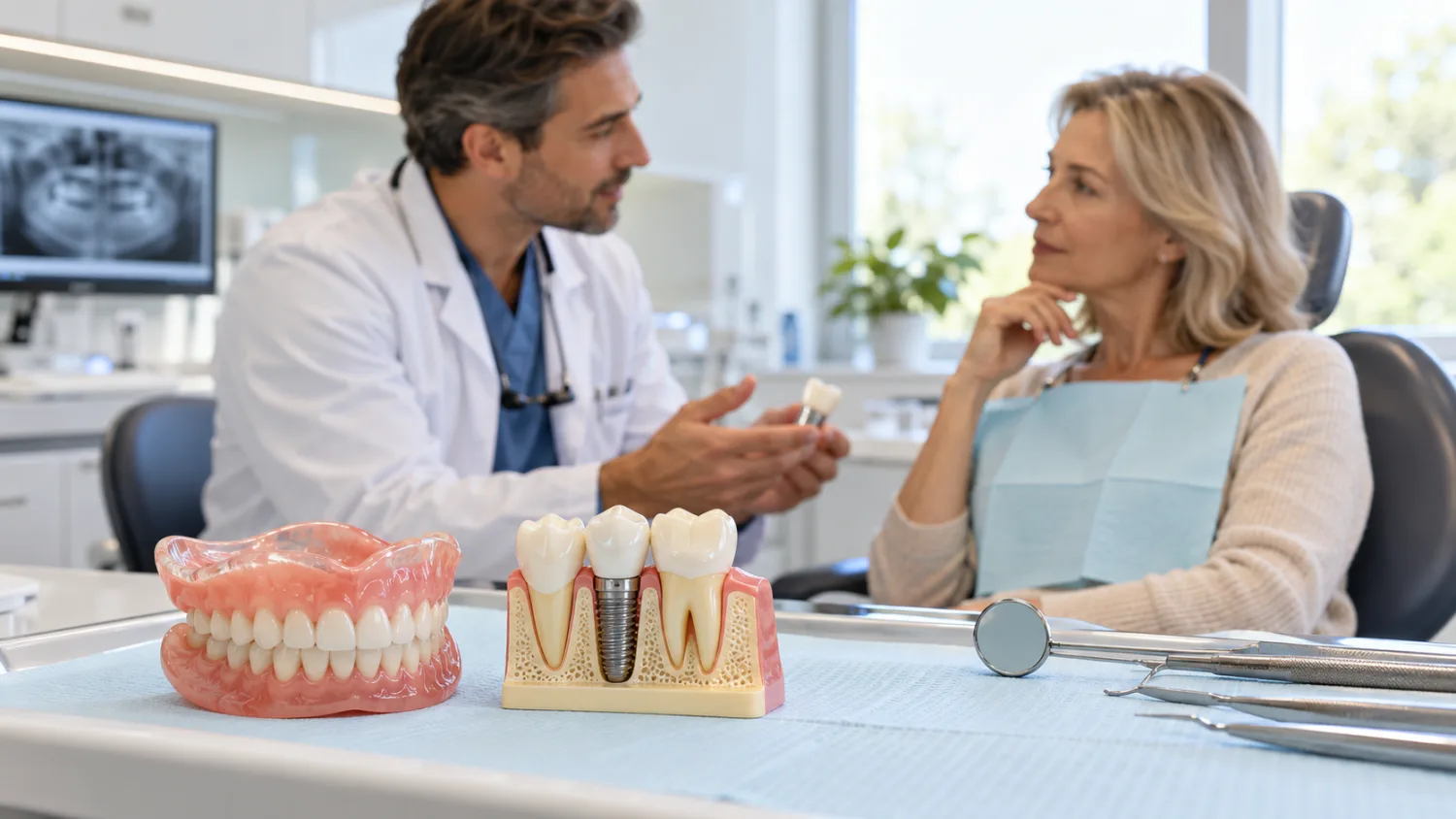
Losing a tooth — or several teeth — does not automatically mean there is one obvious way to replace them. For some people, a dental implant provides the closest thing to having a fixed tooth again. For others, a denture is simpler, quicker, less invasive and much more realistic financially.
The decision is not simply a question of whether implants are "better" than dentures. Your remaining teeth, gums, jawbone, general health, budget and willingness to undergo surgery all matter. So does the number of teeth you need to replace.
There is also a middle ground. Dental implants can sometimes be used to stabilise a removable denture, giving patients some of the advantages of both approaches.
This guide looks at dental implants vs dentures, the patients who may be better suited to each option, and the questions worth discussing with your dentist before deciding.
What Is the Main Difference Between a Dental Implant and a Denture?
A dental implant is placed into the jawbone and acts as an artificial tooth root. It can then support a crown, bridge or, in some cases, a denture.
The implant itself is usually made from titanium and is surgically inserted into the jaw. After it has had time to integrate with the surrounding bone, the replacement tooth or teeth can be attached.
A denture works differently. It is a removable appliance that replaces missing teeth and sits over the gums. A partial denture replaces some missing teeth while using the remaining teeth for support or retention. A complete denture replaces all the teeth in the upper or lower jaw.
Our guide to dentures in the UK looks at the different denture types, fitting process and costs in more detail.
The simplest distinction is therefore that conventional dentures are removable, while an implant is fixed into the jawbone. However, what sits on top of implants can itself be either fixed or removable.
When Might a Dental Implant Be the Better Option?
Dental implants tend to appeal to people who want a replacement that feels as stable as possible and who are comfortable having a surgical procedure.
Imagine, for example, that you have lost one front tooth but the teeth on either side are healthy. A single implant may allow the missing tooth to be replaced without relying on those neighbouring teeth for support.
This is one of the important advantages of implant treatment. A conventional bridge may require neighbouring teeth to support the replacement, although the amount of preparation depends on the type of bridge being used. If you are comparing those options as well, see our guide to dental bridges.
Implants can also be particularly useful when:
- one or several teeth are missing;
- you dislike the idea of taking a denture in and out;
- a conventional denture is unstable or difficult to tolerate;
- there is sufficient healthy jawbone to support implants, or bone grafting is possible;
- your gums and remaining teeth are healthy enough for implant treatment;
- you are prepared for a longer treatment process and ongoing maintenance.
Dental implants are not an instant solution. Implant treatment normally involves assessment, scans, surgery and a healing period before the final restoration is completed. Cambridge University Hospitals notes that healing in the bone commonly takes around three to six months, and can take longer when bone grafting is required.
That makes implants very different from simply having a replacement tooth fitted at one appointment.
When Might Dentures Suit a Patient Better?
Dentures sometimes get treated as the "second-best" option in discussions about tooth replacement. That is too simplistic.
A well-designed denture can be a very sensible treatment, particularly when several or all teeth are missing. It avoids implant surgery, can usually be provided much more quickly and normally has a considerably lower upfront cost.
For someone who has lost many teeth, replacing every gap with individual implants may be unnecessary, unaffordable or clinically inappropriate. A partial or complete denture may restore appearance and make eating and speaking easier without requiring extensive treatment.
Dentures may be especially worth considering if you:
- want to avoid dental surgery;
- need to replace many teeth;
- do not have enough bone for straightforward implant placement;
- would require extensive grafting before implants;
- want a less expensive initial treatment;
- have health or dental factors that make implant treatment less suitable;
- want teeth replaced relatively quickly.
Age alone does not automatically mean someone should have dentures rather than implants. A healthy older adult may still be considered for implant treatment. Equally, a younger patient may decide that a denture is the most practical option for their circumstances.
What If You Are Replacing Just One Tooth?
When only one tooth is missing, a full or large denture clearly makes little sense. The more realistic comparison is usually between a single-tooth implant, a small partial denture and a dental bridge.
A single implant can be attractive because the replacement is fixed and does not normally depend on the neighbouring teeth. Once treatment is complete, there is nothing to remove at night.
A small removable denture is generally less invasive and cheaper, but some people find having a removable appliance for a single missing tooth inconvenient.
A bridge provides another fixed option and avoids implant surgery, but its suitability depends partly on the condition and position of the surrounding teeth.
There is another important question before any of these decisions: does the tooth really need to be removed?
If a damaged or infected natural tooth can predictably be saved, keeping it may be preferable to extracting it simply to place an implant. For a badly infected tooth, for example, the discussion may initially be about root canal treatment vs extraction, rather than implant vs denture.
What If Most or All of Your Teeth Are Missing?
This is where the choices become more interesting.
If all teeth in one jaw are missing, a conventional complete denture is one option. It rests on the gums and is removed for cleaning and usually at night.
Some people manage extremely well with complete dentures. Others struggle, particularly with a lower denture that moves during eating or speaking.
Implants can sometimes help without requiring every missing tooth to have its own implant.
Implant-retained dentures
An implant-retained denture remains removable, but implants provide attachment points that help hold it in position. It can therefore feel considerably more secure than a conventional denture while still being removable for cleaning.
This can be an important compromise for somebody who does not necessarily need or want a completely fixed set of teeth but is frustrated by a loose denture.
Fixed full-arch implant teeth
Another possibility is a fixed bridge supported by several implants. Treatments commonly marketed as All-on-4 use a small number of implants to support a full arch of replacement teeth rather than placing one implant for every missing tooth.
Our separate guide explains All-on-4 dental implants and UK costs, including what may or may not be included in quoted treatment prices.
Full-arch implant treatment is much more involved than making a conventional denture. Careful assessment is essential, particularly when teeth are being removed as part of a large treatment plan.
Which Feels More Like Natural Teeth?
For many patients, fixed implant-supported teeth feel more similar to natural teeth than conventional removable dentures do.
Because implants are anchored into the jaw, the restoration does not rely on simply resting against the gums. There is also no denture to remove each evening when the restoration is fixed.
That does not mean implants literally feel identical to natural teeth. An implant does not have the same ligament and nerve structures as a natural tooth, and implant crowns and bridges still require careful cleaning.
Dentures can take some getting used to. The NHS advises that it may take a few weeks to become comfortable wearing new dentures. Eating softer foods initially and gradually returning to a normal diet can help.
Fit matters enormously. A comfortable, stable denture can work very well. A poorly fitting denture can move, rub the gums, affect speech and make eating frustrating.
Dentures can also become looser with time because the gums and underlying jawbone can change shape. This does not necessarily mean anything has gone wrong with the denture — it may simply need adjustment, relining or replacement.
Are Dental Implants Suitable for Everyone?
No. Having missing teeth does not automatically make someone a good implant candidate.
Your dentist needs to assess the health of your mouth and the amount and quality of available bone. X-rays and sometimes 3D imaging are used when planning treatment.
Good oral hygiene is particularly important. Implants cannot develop tooth decay, but the tissues around them can still become inflamed or infected. Poor plaque control can contribute to peri-implant disease and bone loss around an implant.
Smoking is another important consideration because it can affect healing and increase the risk of implant complications. Certain medical conditions and medicines can also influence treatment planning, so your dentist needs an accurate medical history before recommending surgery.
Bone is another issue. When a tooth has been missing for some time, the jawbone in that area may have reduced in volume. Some patients can still have implants, but bone grafting or another additional procedure may be required.
That adds cost, treatment time and complexity.
Cambridge University Hospitals provides useful patient information about dental implants, including suitability, treatment stages and long-term maintenance.
Dental Implant vs Denture Cost in the UK
Cost can make the decision much more straightforward for some patients.
Conventional dentures are generally considerably less expensive than implant treatment, especially when several teeth need replacing. Dentures may also be available as NHS treatment when clinically appropriate.
Dental implants, on the other hand, are usually provided privately. NHS implant treatment exists, but availability is limited and patients generally need to meet specific clinical criteria.
The NHS explains that implants are usually only available privately, although NHS-funded implants may occasionally be considered in particular circumstances.
Private implant costs can vary significantly. The advertised price for an implant may not always represent the final treatment cost. Depending on the case, fees may include consultations, scans, extractions, bone grafting, the implant itself, an abutment, temporary teeth and the final crown or bridge.
The same principle applies to dentures. Price varies according to the materials used, whether the denture is full or partial, and whether treatment is being provided privately or through the NHS.
For broader comparisons, see our guide to private dentist prices in the UK.
Some patients also look overseas when faced with the cost of extensive implant work. Lower advertised prices can be attractive, but travel, repeat visits, aftercare and dealing with complications should form part of the calculation. We explore those issues separately in Dental Implants Abroad vs UK: True Cost Comparison.
What Are the Downsides of Each Option?
Neither treatment is maintenance-free.
Possible disadvantages of implants
Implants require surgery and treatment can take months rather than weeks. They are expensive, and additional procedures such as bone grafting can increase both cost and treatment time.
Implants can also fail. Problems can occur during healing or years later. Inflammation and bone loss around implants — known as peri-implant disease — can threaten an implant if oral hygiene and maintenance are poor.
The crown, bridge or denture attached to an implant is not necessarily permanent either. Components can wear, loosen, chip or need replacing over time.
Possible disadvantages of dentures
Dentures are removable and can feel bulky when you first start wearing them. Some people notice changes to speech or need time to learn how to eat comfortably with them.
They can also become loose as the mouth changes shape. This is particularly relevant after teeth have recently been extracted because the gums and bone can change substantially during healing.
The NHS recommends removing dentures at night unless your dentist has specifically advised otherwise. They also need daily cleaning, while any remaining natural teeth and gums still require normal oral hygiene.
You can read the NHS advice on wearing and caring for dentures for more information.
How Do You Choose Between an Implant and a Denture?
Rather than starting with "Which treatment is best?", it is often more useful to ask, "Which treatment makes the most sense for my mouth and my priorities?"
Someone with one missing tooth, excellent oral health and enough bone may reach a very different decision from someone who has lost most of their teeth and has significant bone loss.
Think about what matters most to you. Is avoiding a removable appliance your main priority? Are you comfortable with surgery? How important is keeping the initial cost down? Would you accept several months of treatment for a fixed result? Are you able and willing to maintain implants carefully for the long term?
You should also ask what happens if you choose the simpler option now. For example, having a denture today does not always rule out implants later, although continuing bone changes may affect what is possible in future.
Likewise, implants do not necessarily mean you need fixed teeth. An implant-retained removable denture may provide exactly the balance of stability, cost and maintainability that you are looking for.
A dentist should explain the reasonable alternatives, expected benefits, limitations, costs and maintenance involved before treatment begins. If you are considering extensive implant treatment involving several extractions or a full arch, getting a second opinion can also be worthwhile.
Frequently Asked Questions
Are dental implants better than dentures?
Not for every patient. Implants generally provide greater stability and can support fixed replacement teeth, but they require surgery, sufficient healthy bone and a considerably larger financial commitment. Dentures are removable but can provide an effective, less invasive and more affordable way of replacing several or all missing teeth.
Can I have implants if I already wear dentures?
Possibly. Implants can sometimes be placed to stabilise an existing type of removable denture or to support a new implant-retained denture. Your jawbone, gum health, medical history and current denture all need to be assessed first.
Can I replace a denture with implants later?
Often, but it is not guaranteed. Jawbone tends to change after teeth are lost, and some patients may need bone grafting before implants can be placed. If you think you may want implants eventually, it is worth discussing that possibility with your dentist early.
Do implants last forever?
No dental treatment can be guaranteed for life. Implants can function for many years, but their long-term success depends on factors including oral hygiene, gum health, smoking, bite forces and regular dental maintenance. The crown, bridge or denture attached to the implants may also require repair or replacement even when the implants themselves remain healthy.
Are dentures uncomfortable?
They should not remain painful. New dentures often feel unfamiliar and can take several weeks to get used to, but persistent rubbing, ulcers, pain or movement should be checked by a dentist. Adjustments can often improve the fit.
Can you eat normally with dentures?
Many people eat a varied diet with dentures, although there is usually an adjustment period. Starting with softer foods, taking smaller bites and chewing carefully can help while you get used to them. Very hard or sticky foods may remain more difficult, particularly with a complete lower denture.
Do dental implants hurt?
Implant placement is normally carried out using local anaesthetic, so you should not feel the surgical procedure itself. Some soreness, swelling and discomfort afterwards is expected. The amount varies depending on how many implants are placed and whether procedures such as extractions or bone grafting are carried out at the same time.
Can older people have dental implants?
Yes. There is not a simple upper age limit that automatically rules out implants. General health, oral health, bone, medicines, ability to undergo surgery and ability to maintain the implants are more important considerations than age alone.
What is an implant-retained denture?
It is a removable denture that attaches to dental implants for additional stability. You can still take the denture out for cleaning, but the implants help reduce movement while it is being worn. For some people with loose conventional dentures, this provides a useful middle ground between ordinary dentures and a completely fixed implant bridge.
Can I get dental implants on the NHS?
NHS-funded implants are possible in some circumstances, but they are not routinely available simply because a tooth is missing. NHS guidance states that implants are usually provided privately, with NHS treatment generally limited to particular clinical situations. Eligibility and arrangements can also differ across the UK.
Should I have a tooth extracted and replaced with an implant?
Not automatically. If a natural tooth can be predictably restored, saving it may be an appropriate option. Before agreeing to extraction, ask your dentist about the prognosis of the tooth, whether treatments such as root canal therapy or a crown could save it, and what the advantages and disadvantages would be compared with extraction and replacement.
Which option is easiest to look after?
Both require ongoing care. Dentures need to be removed and cleaned regularly, while the gums and remaining teeth also need cleaning. Implants stay in the mouth but need meticulous cleaning around the implant and restoration to keep the surrounding tissues healthy. Fixed implant bridges can sometimes require interdental brushes, floss designed for bridges or other cleaning aids.
This article provides general information and is not a substitute for an individual dental assessment. The right way to replace missing teeth depends on your oral health, medical history, anatomy and personal priorities.