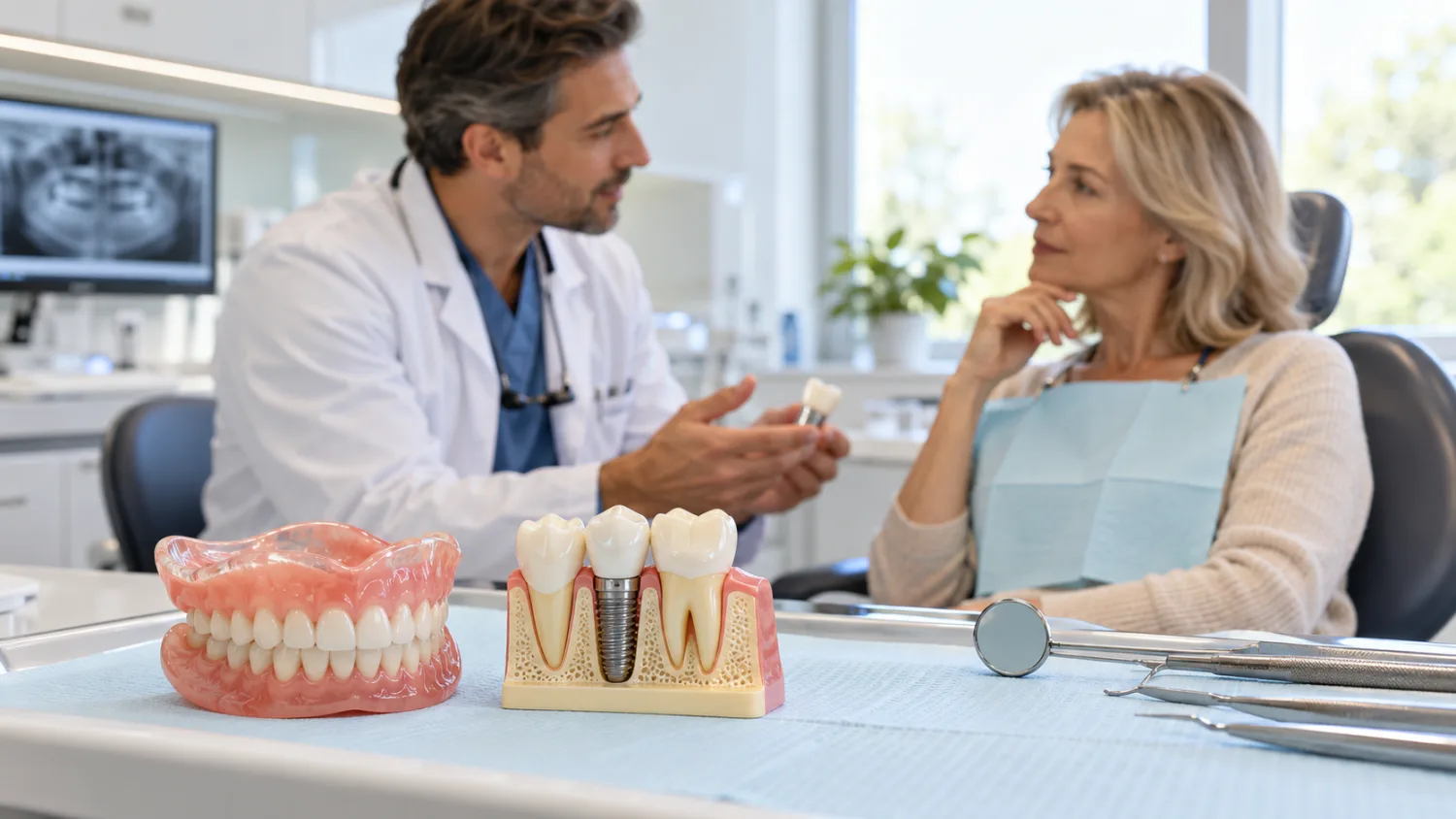
Dental implants are one of the most popular ways to replace missing teeth in the UK, especially for people who want a fixed alternative to dentures or bridges. They can look natural, feel stable and help restore confidence when eating, smiling and speaking. But they are also a significant investment, and they are not the right option for everyone.
This guide explains what dental implants are, how the procedure works, how much dental implants cost in the UK, whether you can get them on the NHS, what risks to consider, and which alternatives may be worth discussing with your dentist.
If you are still comparing NHS and private treatment, you may also find our guide to NHS dentist vs private dentist helpful. If you are dealing with pain, swelling or infection rather than a planned tooth replacement, read our guides to toothache, dental abscesses and dental emergencies.
Quick summary
- Dental implants replace missing tooth roots with a small screw-like fixture, usually made from titanium or zirconia.
- A single dental implant in the UK commonly costs around £2,000 to £3,500, but complex cases can cost more.
- Dental implants are usually private treatment. NHS implants are only available in limited clinical situations.
- The full process often takes several months, especially if bone grafting, healing time or staged treatment is needed.
- Alternatives include dentures, dental bridges, adhesive bridges and, in some cases, doing nothing with monitoring.
- Good oral hygiene, healthy gums and long-term maintenance are essential for implant success.
What is a dental implant?
A dental implant is an artificial tooth root that is placed into the jawbone to support a replacement tooth, bridge or denture. Most implants are small screw-shaped fixtures made from titanium, a material widely used in medical and dental surgery because it can integrate with bone. Some systems use zirconia, a ceramic material, although titanium remains the most common.
A complete dental implant restoration usually has three main parts:
- The implant: the screw-like fixture placed into the jawbone.
- The abutment: the connector that joins the implant to the replacement tooth.
- The crown, bridge or denture: the visible tooth or teeth attached to the implant.
In simple terms, the implant replaces the missing root, and the crown or bridge replaces the visible tooth. The aim is to create a stable, functional and natural-looking replacement.
NHS hospital information describes a dental implant as a screw placed into the jaw to replace the root portion of a missing tooth. You can read more from Leeds Teaching Hospitals NHS Trust.
Who might consider dental implants?
Dental implants may be considered if you have one or more missing teeth and want a fixed replacement. They are often discussed when someone has lost teeth because of decay, gum disease, trauma, failed root canal treatment, failed crowns or long-term denture problems.
Common reasons people consider implants include:
- Replacing a single missing tooth without drilling the neighbouring teeth for a bridge.
- Replacing several missing teeth with an implant-supported bridge.
- Stabilising loose dentures.
- Replacing a full arch of missing teeth with fixed or removable implant-supported teeth.
- Improving chewing comfort compared with conventional dentures.
- Improving confidence when smiling or speaking.
However, implants are not automatically the best answer. The right treatment depends on your mouth, your medical history, your budget, your expectations and how much maintenance you are willing to do.
Are dental implants available on the NHS?
In most cases, dental implants are not available as routine NHS dental treatment. They are usually provided privately. The NHS generally focuses on treatment needed to keep the mouth, teeth and gums healthy, and missing teeth can often be replaced with dentures or bridges where clinically appropriate.
NHS-funded dental implants may be considered in specific clinical circumstances, usually through specialist hospital services. Examples can include patients who have lost teeth because of major trauma, head and neck cancer treatment, inherited conditions causing missing teeth, or severe situations where conventional dentures have repeatedly failed. The criteria are strict, and referral does not guarantee treatment.
Guy’s and St Thomas’ NHS Foundation Trust, for example, explains that NHS dental implant treatment may be funded for selected patients including those who have had surgery for head and neck cancer, inherited conditions leading to missing teeth, severe trauma, or complete tooth loss where repeated non-implant denture treatment has been unsuccessful. You can read more on the Guy’s and St Thomas’ dental implants service page.
If you are unsure whether you may qualify for NHS treatment, speak to your dentist first. They can advise whether referral is appropriate or whether private treatment is the realistic route.
How much do dental implants cost in the UK?
The cost of dental implants in the UK varies widely. As a rough guide, a single dental implant with an abutment and crown commonly costs around £2,000 to £3,500. Some clinics may advertise prices from slightly lower or higher than this, and complex cases can cost considerably more.
Bupa Dental Care, for example, states a single implant price point from £2,400 including the implant, abutment and screw-retained porcelain crown, while noting that prices and options may vary by location and suitability. You can see their information here: Bupa dental implant costs.
Typical UK private price ranges may look like this:
| Treatment type | Typical UK private cost range | Notes |
|---|---|---|
| Single dental implant with crown | Approximately £2,000 to £3,500 | May include implant, abutment and crown, but always check what is included. |
| Implant consultation | Often £50 to £200+ | Some clinics offer free consultations, but scans or detailed planning may cost extra. |
| CBCT 3D scan | Often £100 to £250+ | Used to assess bone, nerves, sinuses and implant position. |
| Bone grafting | Often £400 to £2,000+ | Cost depends on size, material and complexity. |
| Sinus lift | Often £800 to £2,500+ | Sometimes needed for upper back teeth where sinus space is close to the jawbone. |
| Implant-supported bridge | Often £4,000 to £12,000+ | Depends on number of implants and replacement teeth. |
| Implant-retained denture | Often £4,000 to £10,000+ per arch | May use two or more implants to stabilise a denture. |
| Full arch fixed implants | Often £12,000 to £25,000+ per arch | Sometimes marketed as “all-on-4” or “same-day teeth”; suitability varies. |
These ranges are only a guide. The final cost depends on your diagnosis, treatment plan, the clinic, the clinician’s experience, the implant system used, laboratory fees, scans, grafting, temporary teeth and follow-up care.
What should be included in an implant quote?
Dental implant quotes can be confusing because some clinics show a complete package price while others separate each stage. Before comparing quotes, ask exactly what is included.
A clear implant quote should explain:
- Consultation fees.
- X-rays and 3D scan costs.
- The implant fixture.
- The abutment.
- The final crown, bridge or denture.
- Temporary tooth replacement during healing, if needed.
- Tooth extraction, if needed.
- Bone grafting or sinus lift costs, if needed.
- Sedation fees, if offered.
- Review appointments.
- Repair or maintenance arrangements.
- What happens if the implant fails during healing.
A cheaper quote is not always worse, and a more expensive quote is not always better. What matters is whether the plan is clinically appropriate, clearly explained, fully costed and realistic for your mouth.
Why do dental implant prices vary so much?
Dental implant costs vary because no two mouths are the same. A straightforward single implant in healthy bone is very different from a complex case involving infection, gum disease, bone loss, multiple missing teeth, failing crowns or a full-mouth reconstruction.
Prices may vary because of:
- Location: clinics in London and major cities may charge more than clinics in smaller towns.
- Complexity: bone grafting, sinus lifts and multiple implants increase the cost.
- Implant system: some brands and components cost more than others.
- Clinician experience: dentists with advanced training or specialist referral experience may charge more.
- Laboratory quality: crowns and bridges vary in material, design and technical quality.
- Technology: 3D scanning, guided surgery and digital planning can add cost but may improve planning accuracy.
- Aftercare: good long-term review and maintenance may be built into the price.
The dental implant procedure: step by step
Dental implant treatment is usually planned in stages. Some people imagine it as a single appointment, but in many cases the full process takes several months.
1. Consultation and assessment
The dentist will examine your mouth, discuss your goals, review your medical history and check whether implants are suitable. They will look at your gums, bite, missing teeth, remaining teeth and oral hygiene.
You should tell the dentist about:
- Medical conditions, including diabetes, osteoporosis, heart conditions and immune problems.
- All medicines, including blood thinners and bisphosphonates.
- Smoking or vaping.
- Previous gum disease.
- Previous radiotherapy to the head or neck.
- Dental anxiety or difficulty tolerating dental treatment.
2. X-rays and 3D scanning
Implant planning usually involves X-rays and often a CBCT scan. A CBCT scan gives a three-dimensional view of the jawbone, nerves, sinuses and surrounding structures. This helps the dentist assess whether there is enough bone and where the implant should be placed.
3. Treatment planning
The dentist should explain the recommended plan, alternatives, risks, benefits, costs and expected timescale. You should have time to ask questions and consider your options before agreeing to treatment.
Important questions include:
- How many implants do I need?
- Do I need bone grafting?
- Will I need a temporary tooth?
- How long will treatment take?
- What are the risks in my specific case?
- What happens if the implant does not integrate?
- How often will I need maintenance appointments?
4. Tooth extraction, if needed
If a damaged or infected tooth is still present, it may need to be removed before implant placement. Sometimes an implant can be placed at the same appointment as the extraction. In other cases, the dentist may recommend waiting for healing first.
If your tooth may be saved, ask whether other treatment such as root canal treatment is possible. You can read more in our guide: Root Canal Treatment Explained.
5. Bone grafting or sinus lift, if needed
Implants need enough healthy bone for support. If bone has shrunk after tooth loss, infection or gum disease, grafting may be needed. Bone grafting adds volume to the jawbone and may be done before or during implant placement.
For upper back teeth, a sinus lift may be needed if the sinus is close to the jawbone. This procedure creates more bone height so an implant can be placed safely.
6. Implant placement surgery
Implant placement is usually done under local anaesthetic. The dentist makes an opening in the gum, prepares a space in the bone and places the implant. The gum is then closed, or a healing cap may be attached depending on the technique used.
Many patients are surprised that implant placement can be less uncomfortable than they expected. However, it is still surgery, and you should expect some soreness, swelling or bruising afterwards.
7. Healing and osseointegration
After placement, the implant needs time to integrate with the jawbone. This process is called osseointegration. It often takes around 8 to 16 weeks, but timing varies depending on bone quality, grafting, implant position and the dentist’s plan.
During this time, you may have a temporary denture, temporary bridge or temporary crown depending on the location and treatment plan.
8. Abutment and impressions or digital scans
Once the implant has healed, the dentist attaches an abutment and takes impressions or digital scans. These are used to make the final crown, bridge or denture.
9. Fitting the final tooth or teeth
The final crown, bridge or denture is fitted and adjusted. The dentist will check your bite, comfort, appearance and cleaning access.
10. Maintenance and long-term reviews
Implant treatment does not end when the crown is fitted. You need regular check-ups and good home care. Implants cannot get tooth decay, but the gum and bone around them can become inflamed or infected. This is one of the most important things patients need to understand.
How long does dental implant treatment take?
A simple single implant may take around three to six months from consultation to final crown. More complex treatment can take longer, especially if you need extractions, bone grafting, sinus lift surgery or treatment for gum disease first.
Some clinics advertise “same-day teeth”. This can be suitable for selected patients, especially full-arch cases, but it does not mean the treatment is simple or risk-free. Often the teeth fitted on the day are temporary, with final teeth fitted later after healing.
Is dental implant surgery painful?
Implant placement is usually carried out with local anaesthetic, so you should not feel sharp pain during the procedure. You may feel pressure, vibration or movement. After surgery, soreness, swelling and bruising are common for a few days.
Your dentist should give you aftercare advice, including how to manage pain, what to eat, how to clean the area and when to seek help.
Contact your dentist urgently if you have severe worsening pain, spreading swelling, fever, uncontrolled bleeding, pus, difficulty swallowing or difficulty breathing. For severe symptoms affecting breathing or swallowing, call 999.
Who is suitable for dental implants?
Suitability depends on your oral health, general health and expectations. Many adults can have implants, but some people need additional treatment first, and some may be better suited to alternatives.
Good candidates often have:
- Healthy gums or controlled gum disease.
- Enough jawbone, or willingness to consider grafting.
- Good oral hygiene.
- Realistic expectations.
- Commitment to maintenance appointments.
- Medical conditions that are stable or well controlled.
Implant treatment may be more complicated if you:
- Smoke heavily.
- Have uncontrolled diabetes.
- Have active gum disease.
- Have severe bone loss.
- Take medicines that affect bone healing.
- Have had radiotherapy to the jaw area.
- Grind or clench your teeth heavily.
- Struggle to clean your teeth and gums effectively.
These factors do not always rule out implants, but they must be considered carefully. The British Society of Periodontology has useful patient information about implants and gum health on its dental implants FAQ page.
Risks and possible complications of dental implants
Dental implants have a good success rate when properly planned, placed and maintained. However, no surgery is risk-free. You should understand the possible complications before agreeing to treatment.
Short-term risks
- Pain and swelling: some discomfort is expected after surgery.
- Bleeding: mild bleeding can happen after placement.
- Infection: infection can occur around the surgical site.
- Bruising: bruising of the face or gum can occur.
- Nerve injury: rare but important, especially in the lower jaw. It can cause numbness, tingling or altered sensation.
- Sinus problems: upper implants near the sinus require careful planning.
- Failure to integrate: the implant may not bond with the bone during healing.
Long-term risks
- Peri-implant mucositis: inflammation of the gum around an implant.
- Peri-implantitis: inflammation and bone loss around an implant, similar in some ways to gum disease.
- Loose screws or components: implant parts can sometimes loosen and need adjustment.
- Chipped crown or bridge: the visible restoration can wear, chip or break.
- Gum recession: the gum around an implant can recede, affecting appearance.
- Bite problems: too much pressure on an implant can cause complications.
- Need for replacement: crowns, bridges or dentures attached to implants may need replacing over time.
The Faculty of Dental Surgery and related UK professional guidance emphasises that implant patients need careful long-term maintenance. Implants are not “fit and forget” treatment.
How long do dental implants last?
Dental implants can last many years, and some last decades. However, the crown, bridge or denture attached to the implant may need repair or replacement sooner. Longevity depends on planning, surgical placement, oral hygiene, bite forces, smoking, gum health and ongoing maintenance.
A realistic way to think about implants is this: the implant is a long-term foundation, but the visible tooth on top is a dental restoration that may need maintenance, repair or replacement over time.
How to care for dental implants
Dental implants need excellent daily cleaning. Although the implant itself cannot decay, the tissues around it can become inflamed and infected.
Good implant care usually includes:
- Brushing twice daily with fluoride toothpaste.
- Cleaning carefully around the implant with interdental brushes, floss or specialist tools recommended by your dentist or hygienist.
- Regular dental check-ups.
- Regular hygienist appointments if advised.
- Stopping smoking or reducing smoking as much as possible.
- Wearing a night guard if you grind your teeth and your dentist recommends one.
- Reporting bleeding, soreness, looseness or bad taste around the implant promptly.
If you already have bleeding gums or gum disease, read our guide: Bleeding Gums and Gum Disease: Causes and Treatment.
Dental implants vs bridges vs dentures
Implants are not the only way to replace missing teeth. The main alternatives are bridges and dentures. Each option has advantages and disadvantages.
| Option | Best suited for | Main advantages | Main disadvantages |
|---|---|---|---|
| Dental implant | One or more missing teeth where there is enough bone and good oral health | Fixed, natural-feeling, does not usually require drilling neighbouring teeth | Higher cost, surgery required, takes time, not suitable for everyone |
| Dental bridge | Replacing one or more missing teeth when neighbouring teeth can support a bridge | Fixed, often quicker than implants, may be available on NHS if clinically needed | May require drilling healthy teeth, harder to clean, may need replacement |
| Adhesive bridge | Often used for front teeth in selected cases | Less drilling than conventional bridge, usually quicker | Can debond, not suitable for every bite or every missing tooth |
| Partial denture | Replacing several missing teeth at lower cost | Usually cheaper, non-surgical, often repairable | Removable, can feel bulky, may move during eating |
| Full denture | Replacing all teeth in one jaw | Non-surgical, usually lower cost than full-arch implants | Can feel loose, may affect chewing, requires adaptation |
| No replacement | Selected cases where the gap does not affect function or appearance | No surgery, no prosthetic cost | Teeth may drift, bite may change, chewing may be affected |
Alternative 1: Dental bridges
A dental bridge replaces a missing tooth by attaching a false tooth to neighbouring teeth. Conventional bridges usually involve preparing the neighbouring teeth for crowns. Adhesive bridges use a wing bonded to the back of a tooth and may involve less drilling.
Bridges can be a good option if you want a fixed tooth replacement but do not want surgery or are not suitable for implants. They may also be quicker and cheaper than implants.
However, conventional bridges can require drilling teeth that might otherwise be healthy. They also need careful cleaning underneath. If the supporting tooth develops decay, gum disease or root problems, the bridge can fail.
Alternative 2: Dentures
Dentures are removable appliances that replace missing teeth. They can replace a few teeth or a full arch. Modern dentures can look natural and are often much more affordable than implants.
Dentures may be a good option if you want to avoid surgery, need a lower-cost solution, or have several missing teeth. They can also be used temporarily while waiting for implants.
The main drawbacks are that dentures can move, feel bulky, affect taste or speech at first, and need regular adjustment as the mouth changes. Some people adapt very well; others find dentures difficult.
Alternative 3: Implant-retained dentures
Implant-retained dentures sit between conventional dentures and fixed implant bridges. A small number of implants are placed to help hold a denture more securely. The denture can usually still be removed for cleaning.
This can be especially helpful for people who struggle with loose lower dentures. It is usually less expensive than a full arch of fixed implant teeth but more expensive than a conventional denture.
Alternative 4: Root canal treatment and saving the tooth
If a tooth is damaged or infected, extraction and implant replacement may not be the only option. In some cases, root canal treatment can save the tooth. This is usually worth discussing before removing a tooth, especially if the tooth has a reasonable long-term outlook.
Read more here: Root Canal Treatment Explained.
Alternative 5: Orthodontic space closure
In selected cases, especially where teeth are crowded or a tooth has been missing for a long time, orthodontic treatment may be used to close or redistribute spaces. This is not suitable for every case, but it can sometimes avoid the need for an implant.
Should you travel abroad for dental implants?
Some UK patients consider travelling abroad for cheaper dental implants. Dental tourism can reduce upfront costs, but it also introduces risks and practical issues.
Before travelling abroad for implants, consider:
- Who will provide aftercare when you return to the UK?
- What happens if the implant, crown or bridge fails?
- Will your UK dentist be willing and able to maintain another clinic’s implant system?
- Are all stages included in the quote?
- Is there enough time for proper healing and review?
- What legal protection do you have if something goes wrong?
- Are you being rushed into extractions, crowns or full-mouth treatment?
The biggest issue is often continuity of care. Implants require planning, surgery, restoration and long-term maintenance. A lower price may become less attractive if complications require multiple trips, extra costs or urgent care in the UK.
Questions to ask before agreeing to dental implants
A good implant consultation should leave you feeling informed, not pressured. Before agreeing to treatment, ask:
- Am I definitely suitable for implants?
- Do I have gum disease or bone loss that needs treating first?
- What are my non-implant alternatives?
- How many implants do I need?
- What brand or implant system will be used?
- Will I need bone grafting or a sinus lift?
- Will I have a temporary tooth during treatment?
- What is included in the quote?
- What costs might be extra?
- What is the expected treatment timescale?
- What are the main risks in my case?
- What happens if the implant fails?
- How often will I need maintenance?
- Who will I contact if I have a problem out of hours?
Red flags to watch out for
Be cautious if a clinic:
- Pressures you to decide quickly.
- Offers a price without proper examination or scans.
- Does not discuss alternatives such as bridges or dentures.
- Does not explain risks clearly.
- Cannot explain what is included in the quote.
- Promises “guaranteed” results without explaining limitations.
- Suggests removing many teeth without a clear clinical reason.
- Does not discuss maintenance or long-term care.
- Uses dramatic before-and-after images without realistic context.
Dental professionals in the UK must follow standards set by the General Dental Council. The GDC also provides guidance on dental advertising, including the need for advertising to be accurate and not misleading. You can read more from the General Dental Council.
How to find a dental implant dentist in the UK
Dental implants can be provided by general dentists with additional implant training, dentists with special interests, oral surgeons, periodontists, prosthodontists and specialist referral clinics. The right provider depends on the complexity of your case.
When comparing clinics, look for:
- Clear information about the dentist’s implant training and experience.
- Transparent pricing.
- Use of appropriate scans and planning.
- Evidence of careful consent and discussion of alternatives.
- Good maintenance and follow-up arrangements.
- Clear complaints and emergency contact procedures.
- CQC registration for dental providers in England.
You can browse local dental providers through All Health and Care, including our Top 10 Dentists in the UK and local pages such as Top 10 Dentists in London.
Dental implants and gum disease
Gum disease is one of the most important issues to address before implant treatment. If gum disease is active around natural teeth, the same bacteria and inflammation can increase the risk of problems around implants.
Before implant placement, your dentist may recommend periodontal treatment, hygienist visits, improved home cleaning and smoking cessation. In some cases, implant treatment should be delayed until gum health is stable.
If your gums bleed when brushing, do not ignore it. Bleeding gums can be an early sign of gum inflammation. Read more in our guide to bleeding gums and gum disease.
Dental implants after tooth decay or infection
Tooth decay is one of the common reasons teeth are lost. If a tooth is badly decayed, fractured or infected, your dentist may discuss extraction and replacement options. However, the infection usually needs to be controlled before or during treatment planning.
If you are unsure why a tooth cannot be saved, ask your dentist to explain the diagnosis, X-ray findings and alternatives. Sometimes a tooth can be restored with a filling, crown or root canal treatment. In other cases, extraction may be the most predictable option.
For background, read: Tooth Decay Explained.
Dental implants and smoking
Smoking can affect healing and increase the risk of implant complications. It can reduce blood flow, slow tissue repair and increase the risk of gum and bone problems around implants.
If you smoke, your dentist may strongly advise stopping before implant treatment and during healing. Some clinicians may decline to place implants until smoking is reduced or stopped, especially in complex cases.
Dental implants and diabetes
People with diabetes may still be suitable for dental implants, especially if their diabetes is well controlled. Poorly controlled diabetes can increase the risk of infection and delayed healing.
If you have diabetes, tell your implant dentist and make sure your general health is being properly managed. Your dentist may liaise with your GP or specialist in more complex situations.
Dental implants and teeth grinding
Heavy grinding or clenching can place extra force on implants, crowns and bridges. This does not always rule out treatment, but it needs to be planned for. Your dentist may recommend a night guard or design changes to reduce risk.
What happens if a dental implant fails?
Implant failure can happen early during healing or later after the implant has been in function. Early failure usually means the implant has not integrated with the bone. Late failure may be linked to infection, overload, bone loss, smoking, poor cleaning or other factors.
If an implant fails, the dentist may remove it, allow healing, treat infection or bone loss, and consider whether another implant can be placed later. Sometimes an alternative such as a bridge or denture may be more appropriate.
Before treatment starts, ask the clinic what their policy is if the implant fails during healing. Some clinics include replacement under certain conditions; others charge additional fees.
Are dental implants worth it?
Dental implants can be worth it for many people, especially when they restore comfort, function and confidence. They can be particularly valuable when they avoid drilling neighbouring healthy teeth or stabilise dentures that otherwise move.
However, implants are not always the best choice. They are expensive, require surgery, need maintenance and can fail. For some patients, a bridge, denture or tooth-saving treatment may be more sensible.
The best decision is not “implants are best” or “implants are too expensive”. The best decision is the one that fits your mouth, health, budget and long-term priorities.
Final thoughts
Dental implants are one of the most advanced options for replacing missing teeth, but they should be carefully planned. A good implant journey starts with a proper diagnosis, clear explanation of alternatives, transparent costs and realistic expectations.
If you are considering dental implants in the UK, do not rush. Ask questions, compare treatment plans, check what is included in the quote and make sure you understand the maintenance commitment. A well-planned implant can be life-changing, but a rushed or poorly explained treatment plan can become expensive and stressful.
For broader dental guidance, explore our Dental Health & Dentistry resource section.
Frequently asked questions about dental implants in the UK
How much does one dental implant cost in the UK?
A single dental implant with an abutment and crown commonly costs around £2,000 to £3,500 in the UK. Some cases may be cheaper or more expensive depending on the clinic, location, implant system, scans, grafting and complexity. Always ask what is included in the quote.
Can I get dental implants on the NHS?
Usually, no. Dental implants are normally private treatment. NHS-funded implants may be available in limited clinical situations, such as severe trauma, head and neck cancer treatment, inherited conditions causing missing teeth, or repeated failure of conventional dentures in specific cases. Your dentist can advise whether referral is appropriate.
Are dental implants better than dentures?
Dental implants are more stable than conventional dentures and can feel more like natural teeth. However, dentures are cheaper, non-surgical and may be more suitable for some people. Implant-retained dentures can be a middle option for patients who struggle with loose dentures.
Are dental implants better than bridges?
Implants can replace a missing tooth without drilling neighbouring teeth, which is a major advantage. Bridges can be quicker, cheaper and non-surgical, but they may involve preparing the teeth next to the gap. The best option depends on your teeth, gums, bite and budget.
How long do dental implants last?
Dental implants can last many years and sometimes decades, but this depends on oral hygiene, gum health, smoking, bite forces, planning and maintenance. The crown, bridge or denture attached to the implant may need repair or replacement over time.
Is dental implant surgery painful?
Implant surgery is usually done under local anaesthetic, so you should not feel sharp pain during the procedure. Some soreness, swelling and bruising are common afterwards. Your dentist should provide pain relief and aftercare advice.
How long does the dental implant process take?
A straightforward single implant often takes around three to six months from consultation to final crown. More complex cases involving extraction, infection, bone grafting or full-arch treatment can take longer.
What is bone grafting for dental implants?
Bone grafting is a procedure used to add or rebuild bone where there is not enough jawbone to support an implant. It may be done before implant placement or at the same time, depending on the case.
What is a sinus lift?
A sinus lift is a bone grafting procedure sometimes needed for upper back teeth. It creates more bone height between the mouth and the sinus so an implant can be placed safely.
Can smokers have dental implants?
Some smokers can have dental implants, but smoking increases the risk of healing problems and implant complications. Many dentists strongly advise stopping smoking before and after implant surgery.
Can people with diabetes have dental implants?
People with well-controlled diabetes may be suitable for implants. Poorly controlled diabetes can increase the risk of infection and delayed healing, so your dentist will consider this carefully during assessment.
Can dental implants get infected?
Yes. The implant itself cannot decay, but the gum and bone around it can become inflamed or infected. This is why daily cleaning, regular check-ups and hygienist care are important.
What are the signs of a dental implant problem?
Warning signs include bleeding, swelling, pus, bad taste, pain, gum recession, looseness, difficulty biting or a change in how the implant feels. Contact your dentist promptly if you notice these symptoms.
Can a failed implant be replaced?
Sometimes, yes. If an implant fails, the dentist may remove it, treat the area, allow healing and consider another implant later. In some cases, a bridge or denture may be a better alternative.
Are cheap dental implants safe?
A low price does not automatically mean unsafe, but you should check what is included, who is providing treatment, what implant system is used, what scans are taken, and what aftercare is available. Be cautious with prices that seem unrealistically low or vague.
Should I go abroad for dental implants?
Some people travel abroad for lower-cost implants, but you need to think carefully about aftercare, complications, legal protection and the cost of returning for review or repairs. Implant treatment requires long-term maintenance, which can be harder when the clinic is overseas.
Do dental implants look natural?
Well-planned dental implants can look very natural, especially when there is enough gum and bone to support the final crown. Results depend on implant position, gum shape, crown design, laboratory work and the condition of nearby teeth.
Can I have a dental implant straight after tooth extraction?
Sometimes. Immediate implant placement can be suitable in selected cases, but it depends on infection, bone condition, gum shape and the tooth position. In other cases, it is safer to allow the area to heal first.
Do I need a dentist or a specialist for implants?
Many general dentists provide implant treatment after additional training. More complex cases may be referred to a specialist or a dentist with advanced implant, surgical, periodontal or restorative experience. Ask about the clinician’s training and experience with cases like yours.
What is the best alternative to dental implants?
The best alternative depends on your situation. A bridge may be best if you want a fixed option without surgery. A denture may be best if you want a lower-cost or non-surgical option. Root canal treatment may be best if the tooth can still be saved.
Do dental implants need special cleaning?
Yes. You need to clean carefully around implants every day using the tools recommended by your dentist or hygienist. This may include interdental brushes, floss or special implant-cleaning aids.
Are dental implants covered by dental insurance?
Many standard dental insurance policies do not fully cover implants, or they only cover them in limited circumstances. Some plans may contribute towards consultations, extractions or crowns. Always check policy wording before starting treatment.
Can I spread the cost of dental implants?
Many private dental clinics offer payment plans or finance options. Check the total cost, interest rate, repayment period and what happens if extra treatment is needed.
What happens if I do not replace a missing tooth?
Sometimes doing nothing is reasonable, especially if the gap does not affect function or appearance. However, nearby teeth can drift, the bite can change and chewing may be affected. Ask your dentist what is likely in your specific case.
How do I choose a dental implant clinic?
Look for clear diagnosis, proper scans, transparent pricing, discussion of alternatives, realistic expectations, good consent, maintenance planning and clear aftercare. Avoid clinics that pressure you or promise perfect results without explaining risks.