Dental implants are designed as a long-term replacement for missing teeth, and many remain in place for decades.
But “how long do implants last?” is more complicated than giving one number.
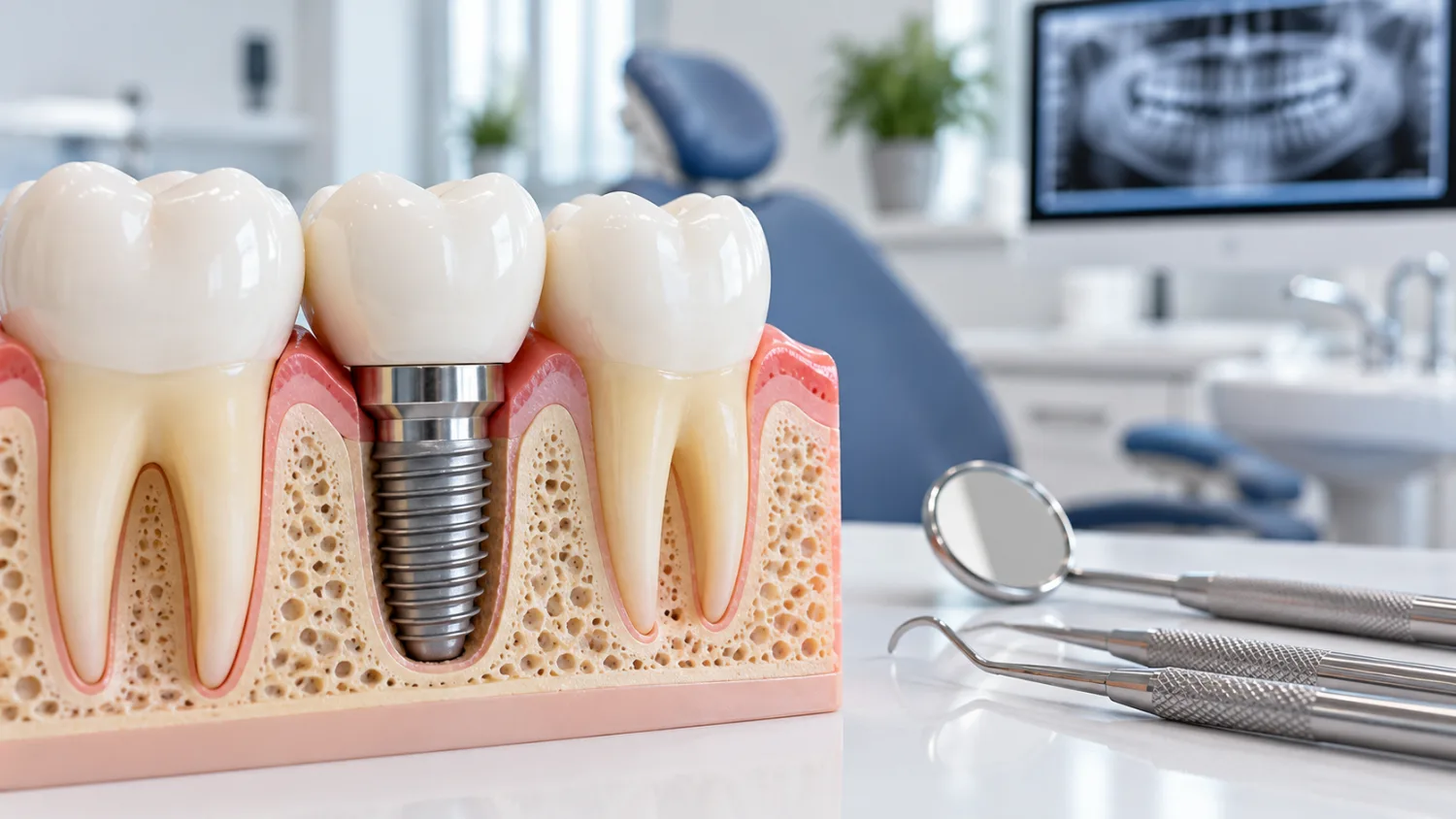
A dental implant restoration usually has several separate parts:
- the implant fixture fixed into the jawbone;
- the abutment connecting the implant to the replacement tooth;
- the crown, bridge or denture attached above it.
These parts do not necessarily have the same lifespan.
The titanium implant itself may remain securely integrated with the bone for 20 years or longer, while the crown attached to it may chip, wear or need replacing much sooner.
A major 2026 systematic review involving more than 20,000 implants found roughly 95% implant survival after 10 to 25 years.
Another review of prospective studies estimated survival at around 93% after at least 20 years.
Those figures are reassuring, but survival does not mean an implant is maintenance-free.
Implants can develop gum inflammation, bone loss and mechanical problems even while they remain physically present in the mouth.
This guide explains how long dental implants can last, what causes early and late failure, which warning signs to watch for and what you can do to improve the chances of keeping an implant for decades.
How Long Do Dental Implants Usually Last?
There is no guaranteed lifespan.
A well-placed and properly maintained implant can potentially remain functional for decades.
Current long-term research is encouraging.
A 2026 systematic review of 34 studies involving 7,522 patients and 20,445 implants found survival rates of approximately 95% after 10 to 25 years. ([pubmed.ncbi.nlm.nih.gov](https://pubmed.ncbi.nlm.nih.gov/42867085/))
A separate systematic review focusing on implants followed for at least 20 years estimated a survival rate of approximately 93%. ([pubmed.ncbi.nlm.nih.gov](https://pubmed.ncbi.nlm.nih.gov/42173763/))
NHS patient information from Leeds Teaching Hospitals also notes that around 90% of implants placed ten years earlier remain present and functioning. ([leedsth.nhs.uk](https://www.leedsth.nhs.uk/patients/resources/dental-implants/))
This means implant treatment is generally very durable.
But it is better to think in probabilities than promises.
No dentist can honestly guarantee that an implant will last for life.
The Implant and the Crown Have Different Lifespans
This distinction is important.
When someone says their “implant failed”, the titanium implant itself may be perfectly healthy.
The problem may instead involve the restoration attached to it.
The implant fixture
This is the titanium or titanium-alloy screw placed in the jawbone.
If it integrates successfully and the surrounding bone remains healthy, it may last for several decades.
The abutment
This connects the implant to the visible tooth.
Abutments can occasionally loosen, fracture or require replacement.
The crown
The crown is exposed to everyday chewing forces.
It can:
- wear;
- chip;
- fracture;
- become loose;
- lose some of its appearance over time.
A crown may therefore need replacement while the implant underneath remains completely usable.
The same applies to implant-supported bridges and full-arch restorations.
Recent reviews of implant-supported full-arch prostheses report high implant survival but still find technical problems such as screw loosening and ceramic chipping over time. ([pubmed.ncbi.nlm.nih.gov](https://pubmed.ncbi.nlm.nih.gov/41927400/))
If you are deciding between implants and removable teeth, see our guide to dental implants vs dentures.
What Causes an Implant to Fail Early?
Early failure usually happens before the implant has properly integrated with the jawbone.
This process is called osseointegration.
Normally, bone grows closely around the implant surface and anchors it firmly.
If that does not happen successfully, the implant may remain mobile or become painful.
Possible reasons include:
- poor bone quality or quantity;
- excessive movement during healing;
- infection;
- heavy smoking;
- poor healing;
- excessive loading too soon;
- surgical or anatomical complications.
Early failure does not always mean implants are no longer possible.
The failed implant can often be removed, the area allowed to heal and treatment reconsidered later.
Additional bone grafting may sometimes be needed.
Leeds Teaching Hospitals describes failure to integrate with bone as an uncommon early complication and notes that alternative replacement options can be discussed if it occurs. ([leedsth.nhs.uk](https://www.leedsth.nhs.uk/patients/resources/dental-implants/))
What Causes an Implant to Fail Years Later?
The most important biological cause is loss of supporting tissue around the implant.
This often starts with inflammation caused by bacterial plaque.
Peri-implant mucositis
This is inflammation of the gum around an implant.
It is somewhat comparable to gingivitis around a natural tooth.
Signs may include:
- bleeding when brushing;
- redness;
- swelling;
- tenderness.
At this stage there may not yet be significant bone loss.
Early treatment and improved cleaning can often bring the inflammation under control.
Peri-implantitis
If inflammation progresses and supporting bone begins to disappear, the condition is called peri-implantitis.
This is much more serious.
As bone is lost, the implant becomes progressively less supported.
Eventually it may become loose and need to be removed.
The European Federation of Periodontology identifies poor oral hygiene, previous periodontitis and smoking as major implant-failure risks. It also warns that peri-implant disease may progress more quickly and be more difficult to treat than gum disease around natural teeth. ([efp.org](https://www.efp.org/for-patients/dental-implants/peri-implant-diseases))
Our guide to bleeding gums and gum disease explains the related problems around natural teeth.
Which Factors Make Implant Failure More Likely?
Implant failure is rarely caused by one thing alone.
Several risks can combine.
Smoking
Smoking is one of the clearest avoidable risk factors.
It affects blood supply, healing and the health of the gums and supporting tissues.
The European Federation of Periodontology recommends avoiding smoking as one of the key measures for preventing peri-implant disease. ([efp.org](https://www.efp.org/for-patients/dental-implants/peri-implant-disease-prevention/))
Previous gum disease
A history of periodontitis does not automatically mean implants cannot be used.
But it increases the risk of future peri-implant problems.
Gum disease should ideally be controlled before implant placement, with ongoing maintenance afterwards.
Poor oral hygiene
Implants cannot develop tooth decay, but the gum and bone around them can become diseased.
Plaque must therefore be removed carefully around implants every day.
Poorly controlled diabetes
Diabetes does not necessarily rule out implant treatment.
However, poorly controlled diabetes can interfere with healing and increase infection risk.
Grinding and heavy bite forces
Bruxism — clenching or grinding — can put significant mechanical stress on implant crowns, screws and bridges.
It may contribute to:
- crown fractures;
- ceramic chipping;
- screw loosening;
- mechanical overload.
A night guard may be advised in selected patients.
Insufficient bone
The implant requires adequate bone around it.
Patients who have lost significant bone may need:
- bone grafting;
- sinus augmentation;
- a different implant design;
- a different treatment plan.
This is why CBCT imaging is often used before complex implant surgery.
Our guide to dental X-rays and CBCT scans explains the imaging options.
What Are the Warning Signs of Implant Problems?
A healthy implant should not routinely hurt, bleed or feel loose.
Arrange a dental assessment if you notice:
- bleeding around the implant;
- red or swollen gums;
- bad taste;
- persistent bad breath;
- pus or discharge;
- pain when chewing;
- the crown or bridge moving;
- the implant itself feeling loose;
- gum recession exposing more implant surface.
The European Federation of Periodontology identifies increasing bleeding, swelling, bad breath or taste and loosening of the implant or restoration as warning signs of peri-implant disease. ([efp.org](https://www.efp.org/for-patients/dental-implants/peri-implant-diseases))
Do not wait for the implant to become painful.
Peri-implantitis can cause significant bone loss before severe symptoms develop.
How Can You Make Dental Implants Last Longer?
Long-term implant survival depends partly on treatment quality and partly on what happens after the dentist finishes the restoration.
Clean around the implant every day
Brushing alone may not remove plaque from all implant surfaces.
Depending on the restoration, you may need:
- interdental brushes;
- floss designed for implants;
- superfloss;
- water irrigation devices.
Your hygienist can show you which tools fit around your particular implant.
Attend maintenance appointments
Professional maintenance helps identify inflammation before extensive bone loss occurs.
Regular dental examinations may include:
- checking gum health;
- measuring around the implant;
- assessing mobility;
- checking the bite;
- taking X-rays when appropriate.
The European Federation of Periodontology recommends regular professional maintenance and radiographic monitoring where appropriate. ([efp.org](https://www.efp.org/for-patients/dental-implants/peri-implant-disease-prevention/))
Our guide to dental hygienist appointments explains what routine gum maintenance involves.
Stop smoking
This is one of the most useful modifiable steps for reducing implant risk.
Control gum disease
If you still have natural teeth, keeping those teeth and gums healthy matters too.
Active periodontal disease elsewhere in the mouth increases the bacterial and inflammatory burden around implants.
Deal with grinding
If you clench or grind heavily, ask whether a protective night guard is appropriate.
Do not disappear after treatment
An implant is not something that should be placed and then ignored for 15 years.
The long-term reviews showing excellent survival generally involve patients who continued receiving dental care.
Can a Failing Implant Be Saved?
Sometimes.
The answer depends on what is actually failing.
Loose crown or screw
This may be a relatively straightforward mechanical repair.
The dentist may be able to tighten or replace the screw while leaving the implant itself untouched.
Broken crown
The implant may be completely healthy.
A new crown can often be made.
Peri-implant mucositis
Early inflammation without significant bone loss can often improve with professional cleaning and better daily plaque control.
Peri-implantitis
Treatment is more difficult.
Depending on severity, management may involve:
- professional cleaning;
- specialised decontamination;
- surgery;
- regenerative procedures in selected cases.
If too much supporting bone has already been lost, removing the implant may be the most predictable option.
A replacement implant may sometimes be possible later, although bone grafting may be needed first.
What About All-on-4 and Full-Arch Implants?
The same basic principles apply, but full-arch treatment introduces additional mechanical components.
With All-on-4 or another full-arch system, several implants support a complete bridge.
The implants themselves can remain healthy for many years while the bridge requires maintenance.
Possible long-term issues include:
- wear of replacement teeth;
- chipping;
- screw loosening;
- framework problems;
- difficulty cleaning under the bridge.
A 2026 umbrella review found implant survival of approximately 95–99% for full-arch implant prostheses over follow-up periods of five to 15 years, while technical complications such as screw loosening and ceramic chipping remained relatively common. ([pubmed.ncbi.nlm.nih.gov](https://pubmed.ncbi.nlm.nih.gov/41927400/))
This is why full-arch treatment should be thought of as a long-term maintenance commitment rather than a one-off purchase.
See our guide to All-on-4 dental implant costs and long-term maintenance.
Does Having Implants Abroad Affect Their Lifespan?
The country itself does not determine whether an implant succeeds.
A well-planned implant placed by an experienced clinician abroad can perform just as well as one placed in the UK.
The practical issue is long-term follow-up.
If a screw loosens, gum inflammation develops or a crown fractures, returning to the original clinic may involve:
- flights;
- hotels;
- time off work;
- additional treatment fees.
Another UK dentist may be willing to help, but they may not routinely use the same implant system or have access to the correct components.
This matters because implant brands use different screws, connections and prosthetic parts.
If you have implants placed abroad, obtain written records containing:
- implant manufacturer;
- implant model;
- diameter and length;
- abutment details;
- restoration information.
Our guide to dental implants abroad vs the UK explains the potential cost and aftercare implications.
Frequently Asked Questions
How long do dental implants last?
Many implants last 20 years or longer. Recent long-term evidence suggests approximately 95% remain in place after 10 to 25 years, although individual outcomes vary.
Can a dental implant last for life?
It can, but this cannot be guaranteed. Long-term survival depends on bone and gum health, oral hygiene, smoking, bite forces, medical health and ongoing maintenance.
How long does an implant crown last?
The crown may need repair or replacement before the implant fixture itself fails because it is exposed to daily chewing, wear and grinding forces.
What is the most common reason dental implants fail?
Long-term biological failure is commonly associated with peri-implant disease. Poor oral hygiene, previous periodontitis and smoking are important risk factors.
What is peri-implantitis?
It is inflammation around a dental implant accompanied by loss of supporting bone. If it progresses far enough, the implant can become loose and may need removal.
Can peri-implantitis be treated?
Sometimes, particularly when detected early. More advanced cases are difficult to treat and may require surgery or implant removal.
Can dental implants get infected?
The implant itself cannot develop tooth decay, but bacteria can cause inflammation and infection in the surrounding gum and bone.
Can gum disease make implants fail?
Yes. A history of periodontitis increases the risk of peri-implant complications, so gum disease should be treated and controlled before and after implant placement.
Does smoking make implants fail?
Smoking increases the risk of poor healing and peri-implant disease and is one of the major avoidable risks for implant failure.
Can diabetes cause implant failure?
Well-controlled diabetes does not automatically prevent implant treatment. Poorly controlled diabetes can increase healing and infection problems and may increase failure risk.
Can teeth grinding damage implants?
Heavy clenching and grinding can damage crowns, screws and bridges and place additional forces on implants. A night guard may sometimes be recommended.
How do I know if my implant is failing?
Warning signs include bleeding, swelling, bad taste, pain, gum recession or movement of the crown, bridge or implant.
Is a loose implant always a failure?
No. Sometimes only the crown or abutment screw is loose. A dentist needs to determine whether the implant fixture itself is moving.
Can an implant be replaced if it fails?
Often, yes. The implant may be removed and another implant considered after healing. Bone grafting may be necessary if significant bone has been lost.
How often should implants be checked?
The schedule depends on your individual risk. Regular dental and hygienist appointments are important, and people with previous gum disease may need closer monitoring.
Do implants need professional cleaning?
Yes. Professional maintenance helps control plaque and allows early inflammation to be detected before extensive bone loss develops.
Can implants develop cavities?
No. Titanium implants and artificial crowns cannot develop tooth decay. However, the surrounding gum and bone can develop peri-implant disease.
Are dental implants more durable than bridges?
Implants can be highly durable and do not require neighbouring teeth to support the restoration. However, neither treatment lasts forever and both require maintenance. Our guide to dental bridges explains the alternative.
Is an implant better than a denture?
Not for everyone. Implants generally provide greater stability but require surgery, adequate bone and a higher upfront cost. Dentures may be more suitable for some patients depending on health, anatomy and budget.
How much does replacing a failed implant cost?
The cost depends on whether the crown alone needs replacing or whether the implant must be removed and replaced. Bone grafting can make retreatment substantially more expensive. See our single-tooth implant cost guide for typical UK fees.