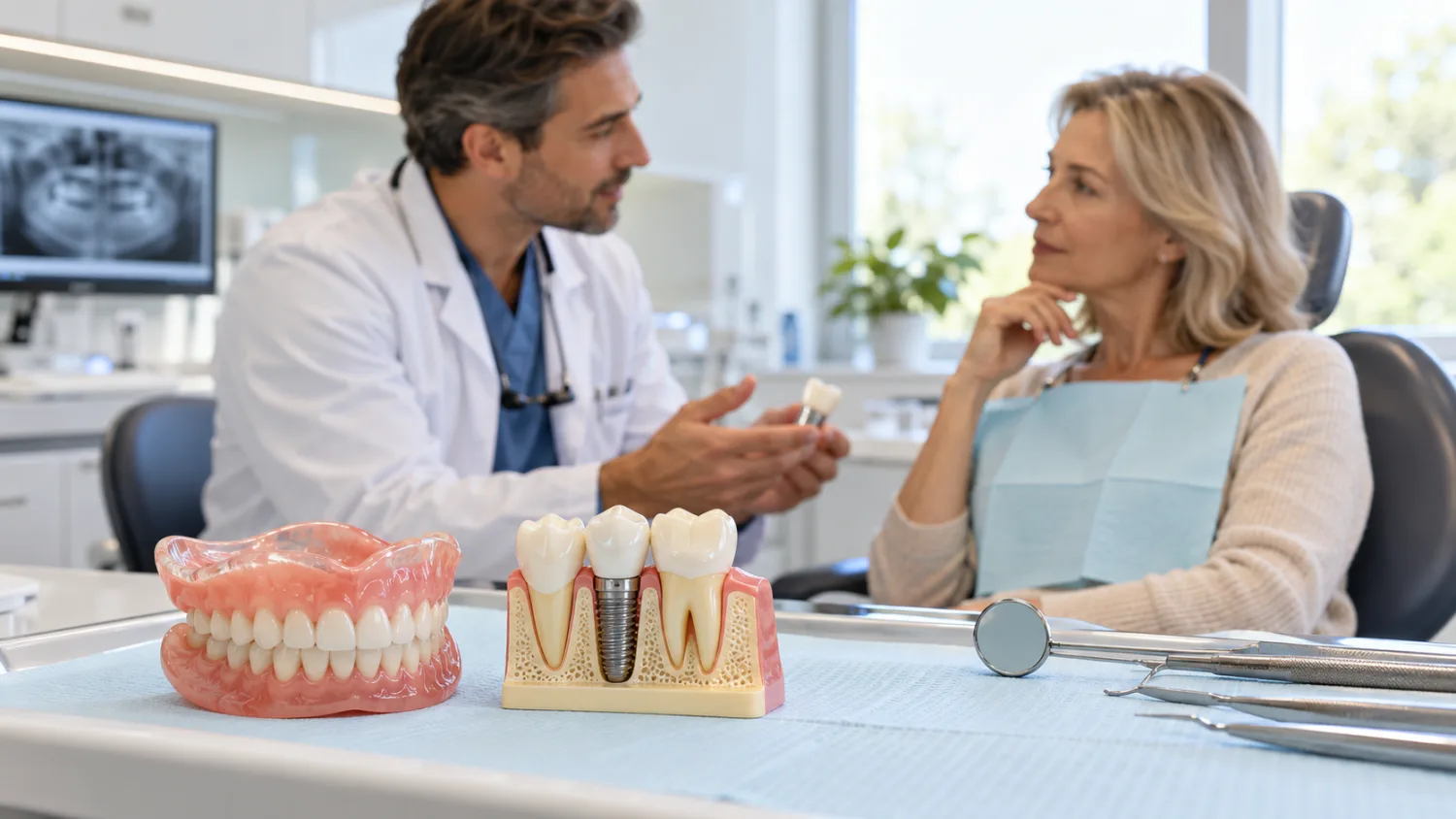
Dental X-rays are one of the most useful tools in dentistry. They help dentists see what cannot be seen properly during a normal examination, including decay between teeth, infection around roots, bone loss, impacted wisdom teeth, hidden cracks, old filling problems and the position of teeth before treatment.
For many patients, the word “X-ray” can sound worrying. You may wonder whether dental X-rays are safe, whether you really need one, how often they should be taken, and whether you will have to pay extra. The simple answer is that dental X-rays are commonly used, usually quick, and involve low levels of radiation. But they should still be taken only when there is a clear reason.
This guide explains the main types of dental X-rays, what they show, how safe they are, what they may cost on the NHS and privately, and what questions to ask before agreeing to one.
What are dental X-rays?
A dental X-ray is an image that helps your dentist see the teeth, roots, jawbone and surrounding structures in more detail. Some X-rays show a small area of the mouth, such as one or two teeth. Others show the full mouth, jaws, wisdom teeth or facial bones.
During a dental check, the dentist can see the visible surfaces of your teeth and gums. But many dental problems begin in areas that are hard to see. Decay can start between teeth. Infection can develop at the tip of a root. Bone loss from gum disease can progress below the gumline. A wisdom tooth may be trapped under the gum. An old crown or filling may hide problems underneath.
X-rays do not replace a dental examination. They support it. A good dentist uses your symptoms, dental history, clinical examination and X-ray findings together before making a diagnosis or recommending treatment.
If you are having a routine appointment, you may also find our guide to dental check-ups useful, as it explains what usually happens before and after an X-ray decision is made.
Why might a dentist recommend an X-ray?
A dentist should recommend an X-ray because it is likely to help answer a clinical question. It should not feel like an automatic add-on that happens at every visit without explanation.
Dental X-rays may be used to check for decay between teeth, especially if you have tight contacts, previous fillings or symptoms that do not match what can be seen in the mouth. They can also help identify infection, abscesses, cysts, impacted teeth, bone loss, root shape, tooth position, jaw problems and the condition of existing dental work.
For example, if you have toothache, an X-ray may help show whether decay has reached the nerve, whether there is infection around the root, or whether a previous filling or crown is failing. If you have swelling, an X-ray may help identify a dental abscess. If you are planning implants, braces, clear aligners, wisdom tooth removal or root canal treatment, imaging may be essential for safe planning.
Sometimes X-rays are used even when you do not have pain. This can be sensible if you are at higher risk of dental problems. Early decay and early bone loss may not hurt. Finding them sooner can help prevent more complex treatment later.
However, X-rays should still be justified. You can always ask your dentist: “What are you checking for?” and “How will this X-ray affect the treatment plan?”
Types of dental X-rays
Different dental X-rays are used for different reasons. The best type depends on what the dentist needs to see.
Bitewing X-rays
Bitewing X-rays are commonly used in routine dentistry. They show the upper and lower back teeth together, including the areas between teeth where decay often starts. They can also show the level of bone between teeth, which is useful when checking gum health.
A dentist may recommend bitewing X-rays if you have a history of cavities, fillings, early decay, food trapping, sensitivity or gum concerns. They are especially useful because decay between teeth can be difficult to spot with the eye alone.
If decay is found, our guide to tooth decay explains how cavities develop and when a filling may be needed.
Periapical X-rays
A periapical X-ray shows the whole tooth, from the crown to the root tip and surrounding bone. It is often used when a dentist needs to investigate a specific tooth.
You may need a periapical X-ray if you have toothache, pain when biting, a suspected abscess, trauma, a deep filling, a cracked tooth, or a tooth that may need root canal treatment. It can help show infection around the root, root shape, bone changes and whether previous root canal treatment is healing properly.
Periapical X-rays are often important in diagnosing dental infections. If you have swelling, severe pain or signs of infection, see our guides to dental abscess and dental emergencies.
Panoramic X-rays
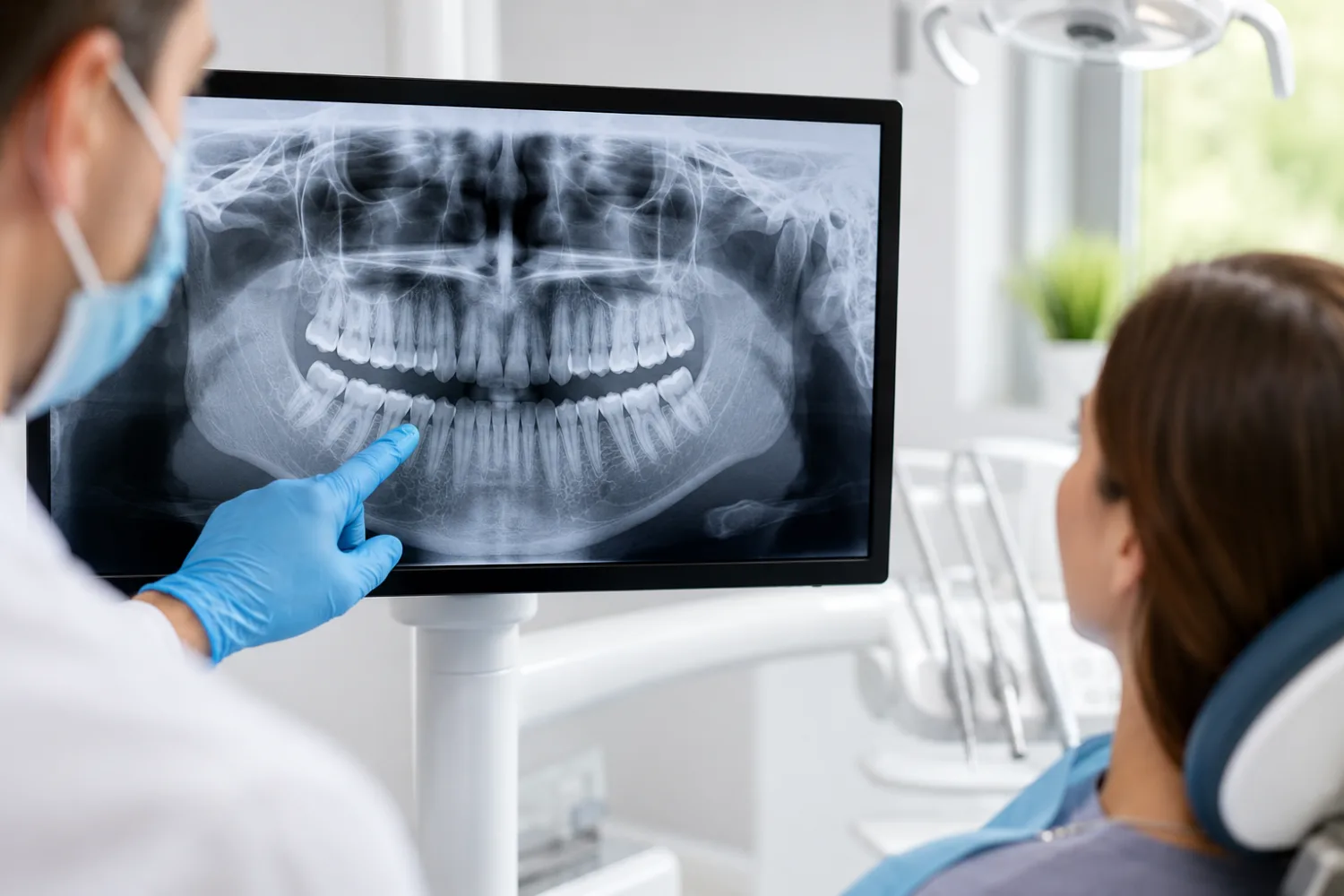
A panoramic X-ray, sometimes called an OPG, shows a wide view of the teeth, upper and lower jaws, jaw joints and surrounding structures. You usually stand or sit while the machine moves around your head.
Panoramic X-rays are useful when a dentist needs a broad overview. They are commonly used for wisdom teeth, orthodontic assessment, missing teeth, jaw problems, dental implants, dentures, multiple extractions or before referral to a specialist.
For example, if wisdom teeth are causing pain, a panoramic X-ray can help show whether they are impacted, close to important nerves, or likely to cause problems. Our guide to wisdom tooth pain and removal explains this in more detail.
Occlusal X-rays
Occlusal X-rays are less common in routine adult dentistry, but they can be useful in certain situations. They show a larger area of the upper or lower jaw and may be used to assess tooth position, extra teeth, trauma, jaw swelling or development in children.
Cone beam CT scans
A cone beam CT scan, often called CBCT, creates a three-dimensional image of the teeth and jaws. It gives much more detail than a standard 2D dental X-ray, but it also involves a higher radiation dose than many routine dental X-rays, so it should be used only when the extra information is needed.
CBCT scans may be used for dental implants, complex root canal cases, impacted teeth, surgical planning, jaw assessment, trauma or complex infection. They are not usually needed for a simple routine check-up.
If you are considering implants, see our guide to dental implants in the UK, which explains why careful assessment and planning matter.
What can dental X-rays show?
Dental X-rays can show a wide range of problems, but they are not magic pictures. They are one part of the diagnostic process.
They can help detect cavities between teeth, decay under old fillings, infection around roots, bone loss from gum disease, impacted wisdom teeth, missing or extra teeth, root shape, jaw cysts, dental trauma, problems around crowns or bridges, and healing after treatment.
They can also help dentists plan treatment more safely. Before root canal treatment, the dentist needs to understand the tooth roots. Before removing a wisdom tooth, they may need to see its position in the jaw. Before placing a dental implant, the dentist needs to assess bone volume and important structures nearby. Before orthodontic treatment, X-rays may help assess tooth and jaw position.
However, not every dental issue is visible on an X-ray. Some cracks, early gum problems, soft tissue changes, bite problems and pain conditions may need other types of examination. This is why your symptoms and clinical examination still matter.
Are dental X-rays safe?
Dental X-rays use radiation, so it is reasonable to ask about safety. The key point is balance: the radiation dose from routine dental X-rays is generally low, but X-rays should still only be taken when they are expected to provide useful diagnostic information.
Modern dental practices use equipment, training and safety procedures to keep exposure as low as reasonably practicable. Digital imaging, careful positioning, small image fields and proper maintenance all help reduce unnecessary radiation.
In the UK, dental radiography is regulated and dental teams must follow radiation safety rules. Guidance for dental professionals covers justification, optimisation and safe use of X-ray equipment. In simple terms, this means the X-ray should be needed, the image should be taken in the safest practical way, and the benefit should outweigh the small radiation risk.
For patients, the practical message is this: dental X-rays are considered safe when properly used, but they should not be taken casually. A dentist should be able to explain why the image is needed.
You can read more about general X-ray use on the NHS X-ray information page. For dental-specific radiation guidance, GOV.UK also publishes information on dental radiographic X-ray imaging and patient dose.
Dental X-rays during pregnancy
If you are pregnant, tell your dentist before having an X-ray. This does not automatically mean you cannot have dental imaging. It means the dentist should consider whether the X-ray is needed now, whether it can safely wait, and whether it will affect your diagnosis or treatment.
Dental X-rays are not aimed at the abdomen. When an X-ray is needed to diagnose or treat a dental problem, NHS hospital guidance explains that dental X-rays can be taken during pregnancy.
In practice, many routine X-rays may be postponed if there is no urgent reason. But if you have severe pain, swelling, trauma or suspected infection, delaying diagnosis may be more harmful than taking a clinically justified dental X-ray.
Pregnancy can also affect oral health. Some people experience bleeding gums, gum swelling or changes in dental symptoms. If you are pregnant and have dental pain, swelling, bleeding gums or infection symptoms, contact a dentist rather than waiting.
How often should you have dental X-rays?
There is no single correct answer for everyone. Some people need dental X-rays more often, while others may go years without needing them. The timing should be based on your age, symptoms, dental history, decay risk, gum health, previous treatment and what the dentist can see clinically.
A person with frequent cavities, many fillings, dry mouth, high sugar intake, orthodontic appliances or active gum disease may need X-rays more often than someone with stable teeth and gums. Children and teenagers may need imaging when checking tooth development or orthodontic concerns, but X-rays should still be justified.
You should not assume that “every six months” or “every year” is automatically correct. A better approach is risk-based. Ask your dentist why an X-ray is needed at that visit and whether your previous X-rays are still recent enough to be useful.
If you have changed dentist, it may be worth asking your previous practice whether recent X-rays can be transferred. This may avoid repeating images unnecessarily, although new X-rays may still be needed if your symptoms or treatment plan have changed.
How much do dental X-rays cost in the UK?
Dental X-ray costs depend on whether you are treated on the NHS or privately, the type of X-ray, and whether it is part of a wider course of treatment.
In England, NHS dental X-rays are included in Band 1 if they are clinically needed as part of examination and diagnosis. From April 2026, the NHS Band 1 charge in England is £27.90. This can include examination, diagnosis, advice, X-rays if needed, and some preventive care such as fluoride or clinically necessary scaling.
If the X-ray leads to further NHS treatment, such as a filling, extraction or root canal treatment, the total cost may move into Band 2. Crowns, dentures and bridges usually fall under Band 3. You should normally pay one charge for a course of NHS treatment, rather than paying separately for every item within that course.
Private dental X-ray costs vary. A small intraoral X-ray may be included in a consultation fee or charged separately. A panoramic X-ray may cost more. A CBCT scan is usually more expensive because it is a more advanced 3D scan. Prices vary significantly between practices, so ask before booking.
As a rough guide, private dental X-rays may range from a small additional fee for a simple image to significantly more for panoramic imaging or CBCT scans. If you are having a private consultation, ask whether X-rays are included in the appointment fee and whether you will receive a written treatment plan afterwards.
For more detail on treatment fees, see our guide to private dentist prices in the UK and the official NHS page on NHS dental treatment costs.
What to expect during a dental X-ray
Most dental X-rays are quick. For small intraoral X-rays, the dental team places a small sensor or film inside your mouth and asks you to bite gently or hold still. The X-ray machine is positioned beside your face, and the image is taken in a moment.
For a panoramic X-ray, you usually stand or sit in the machine, bite gently on a small guide, and keep still while the machine rotates around your head. It does not hurt, although you may need to hold your position for a short time.
A CBCT scan is similar in that the machine moves around your head, but it captures 3D information. You will be asked to remain still so the image is clear.
If you have a strong gag reflex, small mouth, jaw pain or dental anxiety, tell the dental team before the X-ray. They may be able to use a smaller sensor, adjust positioning, give you a moment to breathe, or choose a different imaging method if appropriate.
After the image is taken, the dentist should explain what it shows in plain language. You should not be left confused by technical terms. Ask to see the image if you want to understand the problem. Many patients find it helpful when the dentist points out decay, bone levels, infection or tooth position on the screen.
When dental X-rays are especially useful
Dental X-rays are particularly valuable when symptoms are unclear. A tooth may hurt even when it looks normal. A filling may look intact but have decay underneath. A gum problem may involve bone loss that cannot be seen by looking at the gum alone.
X-rays are also useful before treatment that depends on tooth or bone anatomy. Root canal treatment, extractions, wisdom tooth surgery, implants, orthodontics, crowns and bridges may all require imaging at some stage.
If you are planning cosmetic treatment, X-rays may sometimes reveal health problems that should be treated first. For example, veneers, whitening, bonding or aligners should not be used to cover up active decay, gum disease or infection. Cosmetic dentistry is safest when the underlying teeth and gums are healthy.
This is one reason a proper dental check-up matters before treatment. If you are considering cosmetic options, you may find our guides to cosmetic dentistry, veneers, composite bonding and clear aligners useful.
Questions to ask before having a dental X-ray
You do not need to challenge every X-ray, but you are entitled to understand why it is being taken. Good dental care should feel clear, not rushed or mysterious.
Useful questions include:
- What are you looking for with this X-ray?
- Is this X-ray essential today, or can it wait?
- When was my last X-ray of this area?
- Will this X-ray change the treatment plan?
- Is the cost included in my NHS band or private consultation fee?
- Can you show me what the X-ray means afterwards?
- Are there any alternatives if I am pregnant, anxious or have difficulty tolerating X-rays?
A clear answer is a good sign. It shows the dentist is using imaging thoughtfully, not routinely without reason.
FAQ
Do I need dental X-rays at every check-up?
No. Dental X-rays are not always needed at every check-up. Your dentist should recommend them based on your symptoms, decay risk, gum health, dental history and whether they need information that cannot be seen during the examination.
Are dental X-rays dangerous?
Dental X-rays involve radiation, but the dose from routine dental imaging is generally low. They are considered safe when used properly and only when clinically justified. The benefit of diagnosing hidden decay, infection or bone loss often outweighs the small radiation risk.
Can I refuse a dental X-ray?
Yes, you can refuse. However, your dentist should explain why the X-ray is recommended and what could be missed without it. In some cases, refusing an X-ray may limit the dentist’s ability to diagnose a problem or provide certain treatment safely.
Are dental X-rays safe during pregnancy?
Dental X-rays can be taken during pregnancy when they are needed for diagnosis or treatment. Routine X-rays may sometimes be postponed, but urgent dental pain, swelling, trauma or suspected infection may need imaging. Always tell your dentist if you are pregnant or think you might be.
What is the most common type of dental X-ray?
Bitewing X-rays are among the most common in routine dentistry. They are often used to check for decay between the back teeth and to assess bone levels around the teeth.
What is the difference between a normal dental X-ray and a panoramic X-ray?
A small dental X-ray shows a limited area, such as a few teeth. A panoramic X-ray shows a wider view of the teeth, jaws, wisdom teeth and jaw joints. Panoramic X-rays are useful for planning, wisdom tooth assessment, orthodontics and broader dental checks.
What is a CBCT scan?
A CBCT scan is a 3D dental scan. It gives more detailed information than a standard X-ray and may be used for implants, complex root canal treatment, impacted teeth or surgical planning. It is not usually needed for simple routine dental checks.
Are dental X-rays included in NHS dental charges?
In England, clinically needed X-rays are included in NHS Band 1 as part of examination and diagnosis. If further treatment is needed, the total course of treatment may fall into Band 2 or Band 3 depending on what is required.
How much do private dental X-rays cost?
Private costs vary. Some practices include small X-rays in the consultation fee, while others charge separately. Panoramic X-rays and CBCT scans usually cost more than small intraoral X-rays. Ask for a clear price before the image is taken.
Can dental X-rays show gum disease?
Dental X-rays can help show bone loss around teeth, which may be linked to gum disease. They do not replace gum measurements and a clinical gum examination, but they are useful for assessing how advanced gum problems may be.
Can dental X-rays show an abscess?
They can often show signs of infection around the root of a tooth, especially if the abscess has affected the surrounding bone. However, early infection may not always be obvious on an X-ray, so symptoms and examination findings are also important.
Can children have dental X-rays?
Yes, children can have dental X-rays when clinically needed. Dentists may use them to check decay, tooth development, missing teeth, extra teeth or orthodontic concerns. As with adults, they should only be taken when the benefit justifies the exposure.
Should I ask for copies of my dental X-rays?
You can ask your dental practice about access to your records or whether X-rays can be transferred to another dentist. Sharing recent X-rays may help avoid repeat imaging, although new X-rays may still be needed if your symptoms or treatment plan has changed.