Dental veneers are one of the best-known cosmetic dentistry treatments in the UK. They can change the colour, shape, length and overall appearance of teeth, and they are often promoted as a way to create a straighter, whiter and more even smile.
But veneers are also one of the most misunderstood dental treatments. They are not simply “stick-on teeth”. Some types are more conservative than others, some involve permanent changes to natural teeth, and all veneers need maintenance. Poorly planned veneers can lead to sensitivity, gum problems, unnatural-looking results, repeated repairs and expensive replacement work.
This guide explains what veneers are, the difference between composite veneers and porcelain veneers, how much veneers cost in the UK, how long they last, whether they are available on the NHS, the risks to consider, and what alternatives may be better depending on your teeth.
If you are still comparing cosmetic options, you may also find our guides to composite bonding in the UK, teeth whitening in the UK, NHS dentist vs private dentist and dental implants in the UK useful.
Quick summary
- Dental veneers are thin layers of material placed over the front of teeth to improve their appearance.
- Composite veneers are made from tooth-coloured resin and are usually cheaper, quicker and more repairable.
- Porcelain veneers are made in a dental laboratory and are usually stronger, more stain-resistant and longer-lasting.
- Cosmetic veneers are usually private treatment in the UK, not NHS treatment.
- Composite veneers often cost around £250 to £600+ per tooth privately.
- Porcelain veneers often cost around £600 to £1,200+ per tooth privately.
- Veneers can chip, stain, debond, cause sensitivity or need replacement.
- Some veneers require enamel removal, which makes the treatment irreversible.
- Alternatives include whitening, composite bonding, orthodontics, crowns, bridges or doing nothing.
What are dental veneers?
Dental veneers are thin coverings placed over the visible front surface of teeth. They are used to improve the appearance of teeth that are discoloured, chipped, worn, uneven, slightly gappy or not the desired shape.
Veneers are most often used on the upper front teeth, although they can sometimes be placed on lower teeth too. They may be used on one tooth, several teeth or a full visible smile line.
Veneers can change:
- Tooth colour.
- Tooth shape.
- Tooth length.
- Tooth width.
- Minor gaps.
- Small chips.
- Surface texture.
- Smile symmetry.
The two main types are composite veneers and porcelain veneers. They can both improve a smile, but they differ in cost, preparation, lifespan, repairability and maintenance.
Composite veneers vs porcelain veneers: the basic difference
Composite veneers are made from tooth-coloured resin. The material is usually applied directly to the teeth by the dentist, shaped by hand, hardened with a curing light and polished. They are closely related to composite bonding, but usually cover more of the front tooth surface.
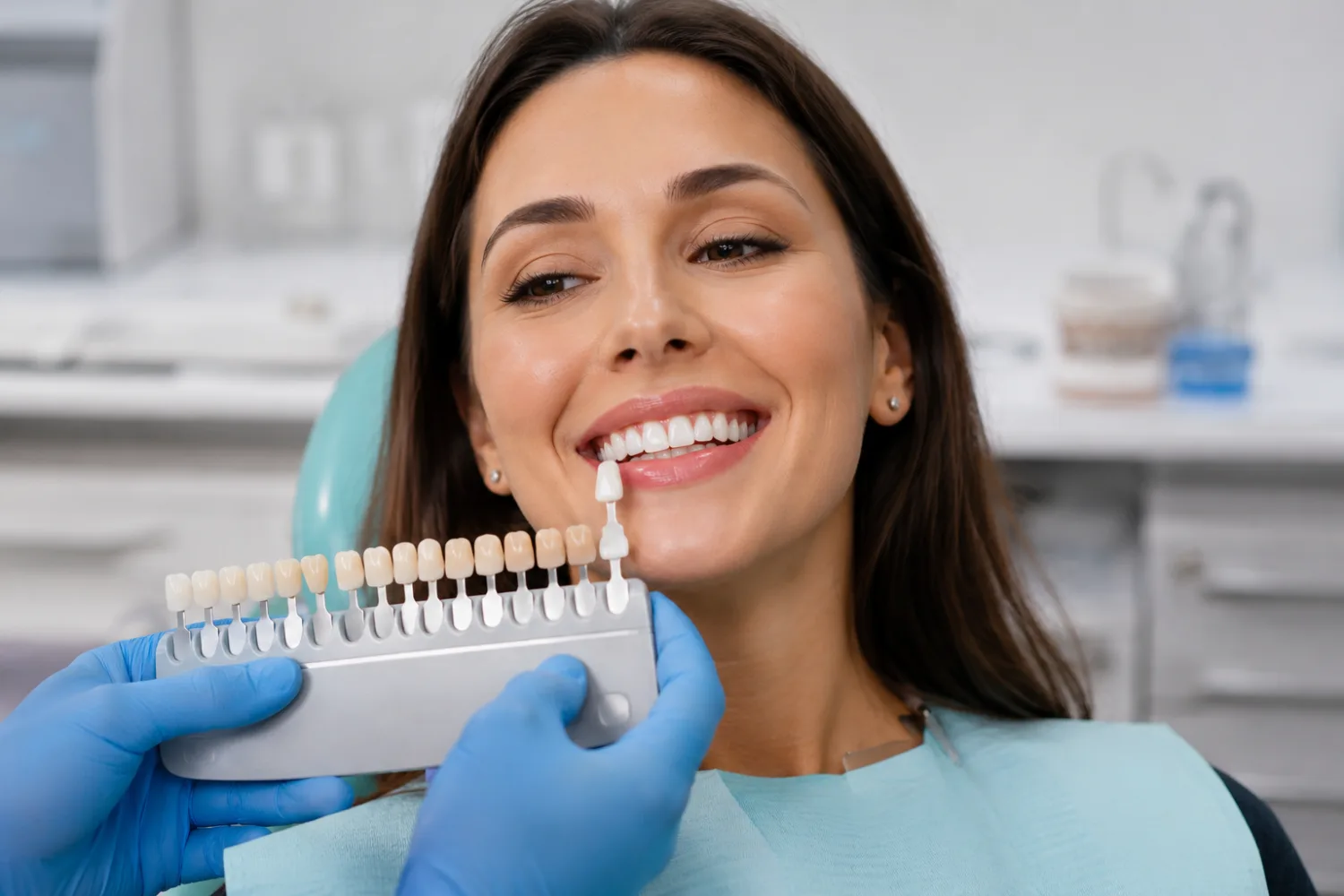
Porcelain veneers are thin ceramic shells made outside the mouth, usually in a dental laboratory. The dentist prepares the tooth, takes a scan or impression, and the porcelain veneer is then made to fit. It is bonded to the tooth at a later appointment.
In simple terms:
- Composite veneers are usually quicker, cheaper and easier to repair.
- Porcelain veneers are usually stronger, more stain-resistant and longer-lasting.
- Composite veneers are often more conservative, but may need more maintenance.
- Porcelain veneers often look highly natural, but may require more enamel removal and cost more.
Are veneers available on the NHS?
Cosmetic veneers are usually not available on the NHS. If healthy teeth are being treated mainly to make them look whiter, straighter, longer or more symmetrical, the treatment is normally private.
The NHS explains that, with the exception of teeth whitening, implants and veneers, the dental treatments listed on its dental treatment information page are usually available on the NHS. You can read more on the NHS dental treatments page.
That does not mean front teeth are never restored on the NHS. If a tooth is damaged, decayed or clinically needs treatment, your dentist may discuss options such as fillings, crowns or other clinically necessary care. But elective cosmetic veneers are generally private.
If you are not sure whether your treatment is cosmetic or clinically necessary, ask your dentist:
- What dental problem is being treated?
- Is the treatment available on the NHS?
- Is there a clinically necessary alternative?
- What would I pay privately?
- What are the risks and benefits of each option?
How much do veneers cost in the UK?
Veneer prices in the UK vary widely depending on the material, clinic, location, dentist experience, planning process and number of teeth treated.
As a broad guide:
- Composite veneers often cost around £250 to £600+ per tooth.
- Porcelain veneers often cost around £600 to £1,200+ per tooth.
- Premium cosmetic clinics, specialist cases or complex smile makeovers can cost more.
A single veneer for one damaged or discoloured tooth is very different from a full smile makeover involving 8, 10 or 12 teeth. Always ask for a written treatment plan rather than relying on a headline “per tooth” price.
Typical UK veneer cost guide
| Treatment type | Typical private cost range | Notes |
|---|---|---|
| Composite veneer | Approximately £250 to £600+ per tooth | Usually placed directly by the dentist; cheaper but more likely to stain or chip. |
| Porcelain veneer | Approximately £600 to £1,200+ per tooth | Made in a laboratory; stronger, more stain-resistant and usually longer-lasting. |
| Single veneer | Approximately £250 to £1,200+ | Cost depends heavily on composite vs porcelain and the difficulty of matching one tooth. |
| 6 composite veneers | Approximately £1,500 to £3,600+ | Often used for a visible upper smile improvement. |
| 6 porcelain veneers | Approximately £3,600 to £7,200+ | Costs can be higher in premium or complex cosmetic cases. |
| 8 to 10 composite veneers | Approximately £2,000 to £6,000+ | Usually needs careful planning to avoid bulky or artificial results. |
| 8 to 10 porcelain veneers | Approximately £4,800 to £12,000+ | Laboratory work, trial smiles and temporary veneers may affect cost. |
| Veneer repair or replacement | Varies widely | Composite may often be repaired; porcelain usually needs replacement if fractured. |
These figures are guide ranges only. Prices vary by clinic and by your mouth. A proper quote should come after an examination, discussion of goals and assessment of oral health.
Why do veneer prices vary so much?
Veneers are not a standard product. The cost depends on diagnosis, planning, materials, laboratory quality, dentist skill and how much preparatory work is needed.
Prices may vary because of:
- Material: porcelain usually costs more than composite.
- Number of teeth: treating 8 to 10 teeth costs much more than treating one tooth.
- Complexity: dark teeth, rotated teeth, old fillings, worn teeth and uneven gum levels make treatment harder.
- Clinic location: fees are often higher in London and major cities.
- Dentist experience: advanced cosmetic dentistry planning and execution can cost more.
- Laboratory fees: high-quality porcelain veneers depend on skilled dental technicians.
- Planning tools: digital smile design, mock-ups, scans and temporary veneers can add cost.
- Pre-treatment: whitening, hygiene treatment, gum treatment or orthodontics may be recommended first.
- Aftercare: review appointments, night guards and maintenance may or may not be included.
What should be included in a veneer quote?
Before agreeing to veneers, ask exactly what is included in the price. A clear quote should explain:
- Consultation fee.
- X-rays or scans, if needed.
- Clinical photographs.
- Smile design or mock-up, if included.
- Tooth preparation.
- Temporary veneers, if needed.
- Laboratory fees for porcelain veneers.
- Final fitting appointment.
- Review appointment.
- Night guard, if recommended.
- Repair or replacement policy.
- Future maintenance costs.
Also ask whether whitening, hygiene appointments, gum treatment, replacement of old fillings or orthodontics are separate costs.
Who might consider veneers?
Veneers may be considered by people who want to improve the appearance of visible teeth and have healthy enough teeth and gums for treatment.
They may be used for:
- Discoloured teeth that do not respond well to whitening.
- Chipped front teeth.
- Worn tooth edges.
- Small gaps.
- Uneven tooth shapes.
- Small or peg-shaped teeth.
- Mildly rotated teeth where orthodontics is not chosen.
- Old composite bonding that needs replacing.
- A smile makeover where shape and colour both need changing.
Veneers can be very effective in selected cases, but they should not be used to hide untreated dental disease.
Who may not be suitable for veneers?
Veneers may not be suitable if you have:
- Active tooth decay.
- Untreated gum disease.
- Very weak or heavily filled teeth.
- Severe tooth grinding or clenching.
- Severe crowding or bite problems.
- Very little enamel for bonding.
- Poor oral hygiene.
- Unrealistic expectations.
- A desire for a “permanent” treatment that will never need replacement.
If you have tooth decay, gum problems or dental pain, deal with those first. You may find these guides useful: Tooth Decay Explained, Bleeding Gums and Gum Disease and Toothache: Causes, Relief and When to See a Dentist.
Composite veneers explained
Composite veneers are made from tooth-coloured resin material. The dentist usually builds the veneer directly onto the tooth in the surgery. The material is shaped, hardened and polished during the appointment.
Composite veneers are often chosen because they are cheaper than porcelain veneers and may require little or no tooth drilling. They can be a good option for small to moderate cosmetic changes.
Advantages of composite veneers
- Usually cheaper than porcelain veneers.
- Often completed in one appointment.
- Often needs little or no enamel removal.
- Repairable if chipped.
- Good for small shape changes and edge improvements.
- Can be a conservative alternative to porcelain in selected cases.
Disadvantages of composite veneers
- Stain more easily than porcelain.
- Chip more easily than porcelain.
- Usually do not last as long.
- Need regular polishing to maintain shine.
- May look bulky if used to correct too much crowding or misalignment.
- The final appearance depends heavily on the dentist’s hand skills.
If you want a more detailed explanation of this material and how it compares with smaller bonding repairs, read our full guide to Composite Bonding in the UK.
Porcelain veneers explained
Porcelain veneers are thin ceramic shells made to fit the front of teeth. They are usually created in a dental laboratory after the dentist prepares the teeth and takes a digital scan or impression.
Porcelain veneers are often chosen for more significant cosmetic changes because they can create excellent colour, translucency and shape. They are also more resistant to staining than composite.
Advantages of porcelain veneers
- More stain-resistant than composite.
- Usually longer-lasting than composite veneers.
- Can look very natural when well planned.
- Good for bigger colour and shape changes.
- High-quality ceramic can mimic natural enamel beautifully.
- May retain polish and shine better over time.
Disadvantages of porcelain veneers
- More expensive than composite.
- Usually needs at least two appointments.
- May require enamel removal.
- Often irreversible if enamel is removed.
- Harder to repair if chipped or cracked.
- If one veneer breaks, replacement may be needed.
- Future replacement costs should be expected.
Composite vs porcelain veneers: comparison table
| Feature | Composite veneers | Porcelain veneers |
|---|---|---|
| Material | Tooth-coloured resin | Laboratory-made ceramic |
| Typical cost | Lower | Higher |
| Typical UK price | Often £250 to £600+ per tooth | Often £600 to £1,200+ per tooth |
| Appointments | Often one appointment | Usually two or more appointments |
| Tooth preparation | Often minimal | May require enamel removal |
| Stain resistance | Moderate | High |
| Chip resistance | Lower | Higher, but still not unbreakable |
| Repairability | Often repairable | Usually harder to repair |
| Typical lifespan | Often around 3 to 7 years | Often around 10 to 15 years or longer in suitable cases |
| Best for | Smaller or medium cosmetic changes | Bigger, longer-lasting aesthetic changes |
How long do veneers last?
Veneer lifespan varies depending on material, oral health, bite, dentist skill, maintenance and habits.
As a broad guide:
- Composite veneers often last around 3 to 7 years.
- Porcelain veneers often last around 10 to 15 years, and sometimes longer.
These are not guarantees. Veneers can fail earlier if they are poorly planned, placed on unhealthy teeth, exposed to heavy grinding, not cleaned properly or used to bite hard objects.
Even when porcelain veneers last well, they should be viewed as long-term restorations that may eventually need replacement. If you get veneers in your 20s or 30s, you should expect future replacement costs during your lifetime.
The veneer procedure: step by step
The exact process depends on whether you choose composite or porcelain veneers, but a good veneer journey should include proper assessment and planning.
1. Consultation and smile assessment
Your dentist examines your teeth, gums, bite and smile. They should ask what you want to change and explain whether veneers are suitable.
A proper assessment should look for:
- Tooth decay.
- Gum disease.
- Old fillings.
- Tooth wear.
- Grinding or clenching.
- Bite problems.
- Tooth colour and shade.
- Gum levels.
- Smile symmetry.
2. Discussion of alternatives
Your dentist should explain the alternatives. These may include whitening, composite bonding, orthodontics, crowns, replacement fillings, gum treatment or no treatment.
Veneers should not be presented as the only solution unless they genuinely are the most appropriate option.
3. Photographs, scans and mock-up
Many cosmetic cases involve photographs, digital scans and sometimes a mock-up or trial smile. This helps you preview shape and proportions before committing.
4. Whitening, if planned
If you want a brighter smile, whitening is often done before veneers. This is because veneers are matched to the chosen shade, and natural teeth around them may still be visible.
Read more in our guide: Teeth Whitening in the UK: Options, Safety and Costs.
5. Tooth preparation
Composite veneers may need little or no drilling. Porcelain veneers often require a thin layer of enamel to be removed so the veneer can fit naturally without looking bulky.
The amount of preparation varies. Some cases are described as “no-prep” or “minimal-prep”, but this is not suitable for everyone. If enamel is removed, the treatment is usually irreversible.
6. Temporary veneers
If porcelain veneers are being made in a laboratory, temporary veneers may be placed while you wait for the final veneers. These protect the prepared teeth and give you a temporary version of the planned appearance.
7. Final fitting
Porcelain veneers are tried in, checked for fit, colour and shape, then bonded to the teeth using dental adhesive. Composite veneers are shaped directly on the teeth and polished during the appointment.
8. Bite check and adjustments
The dentist checks how your teeth meet. This matters because veneers can chip, crack or debond if the bite is not balanced.
9. Review and maintenance
Your dentist may arrange a review appointment to check comfort, gums, bite and cleaning. Veneers need ongoing care just like natural teeth.
Do veneers hurt?
Veneer treatment should not be painful, but some people experience sensitivity during or after treatment, especially if enamel is removed. Local anaesthetic may be used during tooth preparation.
Temporary sensitivity to cold is common after preparation or bonding. Persistent pain, severe sensitivity or discomfort when biting should be checked by your dentist.
Are veneers permanent?
Veneers are not permanent in the sense that they last forever. They may need repair or replacement over time.
However, porcelain veneers that require enamel removal are often permanent in another sense: once enamel has been removed, the tooth will usually always need some form of covering. That may be another veneer, a crown or a different restoration in the future.
This is why veneers should not be rushed. A cosmetic decision made today may affect your dental care for decades.
Do veneers damage your teeth?
Veneers do not automatically damage teeth when they are carefully planned and placed by a qualified dentist. But they can involve irreversible tooth preparation, and poor planning can cause problems.
Potential issues include:
- Loss of enamel.
- Sensitivity.
- Gum irritation.
- Poor fit or rough margins.
- Decay around veneer edges if cleaning is poor.
- Bite problems.
- Chipping or debonding.
- Need for repeated replacement.
The safest veneer is usually the one that removes the least healthy tooth structure while still achieving a good, cleanable and stable result.
Risks and complications of veneers
Veneers are common, but they are still dental treatment. Before agreeing to them, you should understand the risks.
1. Sensitivity
Teeth may become sensitive after preparation or bonding. Sensitivity may settle, but sometimes it persists.
2. Chipping or cracking
Composite can chip, and porcelain can crack or fracture. Veneers are not designed for biting hard objects, chewing pens or opening packets.
3. Debonding
A veneer can come loose or fall off. This is more likely if there is limited enamel, heavy bite pressure or bonding problems.
4. Gum irritation
Bulky veneers, poor margins or poor cleaning can irritate the gums. Gums may become inflamed, red or prone to bleeding.
5. Decay
Veneers do not stop decay. Natural tooth remains underneath and around the edges. Poor cleaning, sugar intake and rough margins can increase decay risk.
6. Unnatural appearance
Veneers can look too white, too square, too thick or too identical if poorly designed. Natural smiles usually have subtle variation.
7. Bite problems
If veneers change how teeth meet, you may feel discomfort, jaw strain or uneven pressure.
8. Replacement cycle
Veneers may need replacing in the future. Each replacement can involve cost and, sometimes, further tooth preparation.
9. Root canal risk
In some cases, heavily prepared teeth can become inflamed or painful and may later need root canal treatment. This risk is higher when teeth are aggressively drilled.
If you want to understand root canal treatment, read: Root Canal Treatment Explained.
Veneers, crowns and “Turkey teeth”: know the difference
One of the biggest sources of confusion is the difference between veneers and crowns.
A veneer usually covers mainly the front surface of the tooth. A crown covers most or all of the tooth. Crowns generally require much more tooth reduction than veneers.
Some treatments advertised online as “veneers” may actually involve crowns or very aggressive tooth preparation. This is sometimes linked with the phrase “Turkey teeth”, where people travel abroad for a dramatic smile makeover and later discover that healthy teeth were heavily drilled.
Crowns are valuable when teeth are badly broken, heavily filled or structurally weak. But using crowns mainly for cosmetic reasons on healthy teeth can be much more destructive than conservative bonding or veneers.
Before treatment, ask:
- Are you proposing veneers or crowns?
- How much tooth will be removed?
- Is the treatment reversible?
- Why is this better than whitening, bonding or orthodontics?
- What will happen when the restorations need replacing?
Can veneers fix crooked teeth?
Veneers can sometimes disguise very minor unevenness, but they do not move teeth. If teeth are significantly crowded, twisted or protruding, orthodontic treatment may be a better and healthier option.
Using veneers to hide crowded teeth can require more drilling and may create bulky or unnatural results. In many cases, the best sequence is:
- Orthodontics to move the teeth into a better position.
- Whitening if a brighter shade is wanted.
- Minimal bonding or veneers only where needed.
Can veneers close gaps?
Veneers can close small gaps by making teeth slightly wider. This can work well when the proportions still look natural.
Larger gaps may be better treated with orthodontics. If too much width is added with veneers, teeth can look broad, square or unnatural.
Can veneers whiten teeth?
Veneers can make teeth appear whiter because the visible surface is changed. This can be useful for teeth that do not respond well to whitening, such as some internal stains.
However, if your natural teeth are healthy and your main concern is colour, professional whitening is usually less invasive and cheaper than veneers.
What are the alternatives to veneers?
Veneers are only one option. Depending on your teeth, a less invasive or more appropriate alternative may be better.
Teeth whitening
Whitening is often the first choice if the main concern is tooth colour. It does not change tooth shape, but it preserves natural tooth structure.
Composite bonding
Composite bonding can repair chips, close small gaps and improve edges with less cost and often less tooth preparation than porcelain veneers.
Orthodontics
Braces or clear aligners can move teeth rather than covering them. This may be better for crowding, gaps or bite issues.
Crowns
Crowns may be better for heavily damaged, root-filled or structurally weak teeth. They are usually more invasive than veneers.
Replacing old fillings
Sometimes replacing stained or poorly shaped old fillings can improve appearance without full veneers.
Gum treatment or gum contouring
Sometimes the issue is not the tooth but the gumline. Gum health should always be checked before cosmetic treatment.
No treatment
If teeth are healthy and the concern is mild, doing nothing may be a reasonable option. Cosmetic treatment should be a choice, not something you feel pressured into.
Veneers vs composite bonding
Composite bonding and composite veneers overlap, but bonding is often used for smaller repairs and refinements. Veneers usually cover more of the tooth surface and create a bigger cosmetic change.
Bonding may be better if you have:
- A small chip.
- Slightly worn edges.
- A minor gap.
- One or two teeth needing subtle reshaping.
- A limited budget.
- A desire to avoid enamel removal where possible.
Veneers may be better if you need:
- A bigger change in tooth colour.
- A bigger change in tooth shape.
- More uniformity across several teeth.
- A longer-lasting ceramic result.
- Replacement of older cosmetic work.
How to look after veneers
Veneers need daily care. They may cover the front surface of teeth, but the natural tooth, gum and edges still need cleaning.
To help veneers last:
- Brush twice daily with fluoride toothpaste.
- Clean between your teeth every day.
- Attend regular dental check-ups.
- See a hygienist if advised.
- Avoid biting nails, pens or hard objects.
- Do not use your teeth to open packets.
- Wear a night guard if you grind or clench and your dentist recommends one.
- Limit staining habits, especially with composite veneers.
- Report chips, looseness, sensitivity or gum bleeding early.
Can veneers stain?
Porcelain veneers are highly stain-resistant, although the natural teeth around them and the margins can still change over time.
Composite veneers stain more easily. Coffee, tea, red wine, smoking, vaping residue and strongly coloured foods can dull the surface. Regular polishing may help maintain appearance.
Can veneers fall off?
Yes, veneers can debond. This can happen because of bite forces, poor bonding, limited enamel, trauma, decay, grinding or simply age.
If a veneer comes off, keep it safe and contact your dentist. Do not try to glue it back yourself with household glue.
Can veneers be replaced?
Yes, veneers can be replaced. Replacement may be needed because of staining, chips, fractures, gum recession, decay, poor fit or changes in appearance.
Replacement is easier when the tooth underneath is healthy and enough enamel remains. Repeated replacement over many years can become more complex and expensive.
Questions to ask before getting veneers
Before agreeing to veneers, ask your dentist:
- Are my teeth and gums healthy enough for veneers?
- Do I need whitening, hygiene treatment or orthodontics first?
- Would composite bonding be a better option?
- Would porcelain veneers be better than composite in my case?
- How much enamel will be removed?
- Is the treatment reversible?
- How many teeth actually need veneers?
- Can I see a mock-up before treatment?
- What shade and shape will look natural?
- How long should the veneers last?
- What happens if one chips or falls off?
- What maintenance will I need?
- Will I need a night guard?
- What will replacement cost in the future?
Red flags to watch out for
Be careful if a clinic or provider:
- Promises perfect or permanent results.
- Does not examine your teeth and gums properly.
- Does not discuss your bite.
- Recommends treating many healthy teeth without explaining why.
- Does not explain alternatives.
- Uses heavy discounts or pressure tactics.
- Cannot explain whether you are getting veneers or crowns.
- Does not tell you how much enamel will be removed.
- Shows only heavily edited before-and-after photos.
- Does not explain maintenance or replacement costs.
Dental professionals in the UK must follow standards set by the General Dental Council. The GDC warns that misleading claims can make it harder for patients to choose dental services and can create expectations that cannot be fulfilled. You can read more in the GDC guidance on advertising.
How to choose a veneer dentist in the UK
Veneer treatment is highly visible and can affect your teeth for many years, so choose carefully.
Look for:
- A full dental examination before cosmetic planning.
- Clear explanation of composite vs porcelain options.
- Discussion of whitening, bonding and orthodontic alternatives.
- Natural-looking before-and-after examples.
- Transparent pricing.
- A written treatment plan.
- No pressure to decide immediately.
- Clear aftercare and repair policy.
- CQC registration for dental providers in England.
- Good communication about risks and limitations.
You can browse local dental providers through All Health and Care, including our Top 10 Dentists in the UK and local pages such as Top 10 Dentists in London.
Are veneers worth it?
Veneers can be worth it for people who want a significant cosmetic improvement and understand the cost, risks and maintenance. They can transform the appearance of teeth when carefully planned and placed.
However, veneers may not be worth it if your teeth are healthy and your concerns could be solved with less invasive treatment such as whitening, bonding or orthodontics. They may also be a poor choice if you expect them to last forever or if you are not prepared for future replacement costs.
The best veneer treatment is not simply the whitest or most dramatic result. It is the treatment that improves your smile while preserving as much healthy tooth structure as possible.
Final thoughts
Veneers can be a powerful cosmetic dentistry option, but they should be approached carefully. Composite veneers are usually cheaper, quicker and more repairable, while porcelain veneers are usually more durable, more stain-resistant and more expensive.
Before choosing veneers, make sure your teeth and gums are healthy, ask about less invasive alternatives, understand whether enamel will be removed, and think about long-term maintenance. A beautiful smile should not come at the cost of rushed decisions or unnecessary damage to healthy teeth.
For more patient-friendly dental guides, visit our Dental Health & Dentistry resource section.
Frequently asked questions about veneers in the UK
How much do veneers cost in the UK?
Composite veneers often cost around £250 to £600+ per tooth privately. Porcelain veneers often cost around £600 to £1,200+ per tooth. Complex cases, premium clinics and larger smile makeovers can cost more.
Can you get veneers on the NHS?
Cosmetic veneers are usually not available on the NHS. If treatment is mainly to improve the appearance of healthy teeth, it is normally private. Clinically necessary treatment for damaged teeth may involve other NHS options depending on the diagnosis.
What is the difference between composite and porcelain veneers?
Composite veneers are made from tooth-coloured resin, usually applied directly by the dentist. Porcelain veneers are ceramic shells made in a dental laboratory. Composite is usually cheaper and easier to repair; porcelain is usually stronger, more stain-resistant and longer-lasting.
How long do composite veneers last?
Composite veneers often last around 3 to 7 years. They may need polishing, repair or replacement sooner if they stain, chip or wear.
How long do porcelain veneers last?
Porcelain veneers often last around 10 to 15 years and sometimes longer in suitable cases. They still need care and may eventually need replacing.
Do veneers ruin your teeth?
Veneers do not automatically ruin teeth, but some types require enamel removal, which is irreversible. Poorly planned veneers can cause sensitivity, gum problems, decay risk and future replacement issues.
Are veneers painful?
Veneer treatment should not be painful, but sensitivity can happen, especially if enamel is removed. Local anaesthetic may be used during preparation.
Do veneers look natural?
Well-planned veneers can look very natural. The result depends on shape, shade, translucency, gum levels, tooth proportions and the skill of the dentist and technician.
Can veneers stain?
Porcelain veneers are highly stain-resistant. Composite veneers stain more easily and may need regular polishing.
Can veneers chip?
Yes. Composite can chip, and porcelain can crack or fracture. Avoid biting hard objects, chewing pens, opening packets with teeth or ignoring grinding habits.
Can veneers fall off?
Yes, veneers can debond. If a veneer comes off, keep it safe and contact your dentist. Do not use household glue.
Can veneers be repaired?
Composite veneers can often be repaired. Porcelain veneers are harder to repair and may need replacing if they fracture.
Are veneers better than composite bonding?
Veneers may be better for bigger colour and shape changes. Composite bonding may be better for smaller chips, edge repairs and minor gaps. Bonding is usually cheaper and often less invasive.
Are veneers better than teeth whitening?
If your main concern is tooth colour, whitening is usually less invasive and cheaper. Veneers may be considered when whitening will not achieve the desired result or when shape changes are also needed.
Can veneers fix gaps?
Veneers can close small gaps by changing tooth width. Larger gaps may be better treated with orthodontics to avoid teeth looking too wide.
Can veneers fix crooked teeth?
Veneers can disguise very minor unevenness, but they do not move teeth. Significant crowding or bite problems are often better treated with orthodontics.
Are no-prep veneers really no drilling?
Some cases need little or no drilling, but no-prep veneers are not suitable for everyone. If teeth are crowded, dark or already bulky, preparation may still be needed.
What happens when veneers need replacing?
The old veneers are removed and new restorations are made. Replacement can be simple or complex depending on tooth health, remaining enamel, gum position and bite.
Can I whiten veneers?
No. Whitening gel does not whiten composite or porcelain veneers. If surrounding natural teeth whiten, old veneers may no longer match.
Should I whiten my teeth before veneers?
Often, yes, especially if only some teeth are being veneered. Whitening first can help the dentist match veneers to a brighter natural shade.
How many veneers do I need?
Some people need one veneer for a single tooth. Others may have 4, 6, 8 or 10 veneers for a broader smile change. More veneers are not always better.
Are veneers the same as crowns?
No. Veneers usually cover the front surface of a tooth. Crowns cover most or all of the tooth and usually require more tooth reduction.
Can I eat normally with veneers?
Usually yes, but you should avoid using veneered teeth to bite very hard objects. Your dentist may recommend a night guard if you grind or clench.
Do veneers need special cleaning?
Veneers need normal but thorough cleaning: brushing twice daily, cleaning between teeth and regular dental check-ups. The tooth and gum around the veneer still need care.
Is it cheaper to get veneers abroad?
It may be cheaper upfront, but you need to consider aftercare, repairs, legal protection, travel costs and what happens if something goes wrong. Veneers often need long-term maintenance.
How do I choose a veneer dentist?
Choose a dentist who checks your oral health first, explains composite and porcelain options, discusses alternatives, shows natural-looking examples, gives transparent pricing and does not pressure you.