Repeated painful lumps in the armpits, groin or underneath the breasts are often dismissed as boils, ingrown hairs or shaving irritation.
But when these lumps keep returning in the same areas, leak pus, leave scars or seem to form tunnels underneath the skin, another condition should be considered: hidradenitis suppurativa.
Hidradenitis suppurativa, usually shortened to HS, is a long-term inflammatory skin condition affecting hair follicles. It commonly causes painful nodules and abscess-like lumps in areas where skin rubs together.
HS is not caused by poor hygiene and it is not contagious.
It can range from occasional isolated lumps to widespread inflammation, scarring and draining tunnels under the skin. Because early HS can look like ordinary boils, diagnosis is often delayed.
Recognising the pattern matters because treatment can reduce flare-ups and may help limit further scarring and tunnel formation.
This guide explains the symptoms of hidradenitis suppurativa, where it develops, how it is diagnosed and the treatments available in the UK.
What Is Hidradenitis Suppurativa?
Hidradenitis suppurativa is a chronic inflammatory skin disease.
The inflammation begins around hair follicles. Follicles can become blocked and inflamed, leading to deep painful lumps underneath the skin.
These lesions can:
- settle down;
- rupture and drain;
- return in the same place;
- appear nearby;
- eventually leave permanent scars.
In more established HS, repeated inflammation can create channels underneath the skin. These are sometimes called sinus tracts or tunnels.
They can connect different areas of inflammation and may repeatedly leak fluid or pus.
The NHS estimates that HS affects roughly 1 in 100 people, although severity varies greatly.
The condition often begins after puberty and is more common in women.
What Does Hidradenitis Suppurativa Look and Feel Like?
Early HS may look surprisingly ordinary.
You may initially notice one tender lump that resembles a spot or boil.
Over time, however, a pattern often develops.
Typical features include:
- deep painful lumps under the skin;
- boil-like abscesses;
- blackheads, sometimes occurring in pairs;
- spots or lumps that repeatedly return in the same areas;
- lesions that rupture and leak pus;
- persistent drainage;
- thickened or rope-like scars;
- tunnels forming under the skin.
The pain can be significant even when the lump does not look particularly large.
Some people experience several days of tenderness or burning before a visible lump appears.
More severe disease can make walking, sitting, exercising or moving an arm painful.
Drainage can also stain clothing and may have an unpleasant smell, which can be particularly difficult socially and emotionally.
Where Does HS Usually Develop?
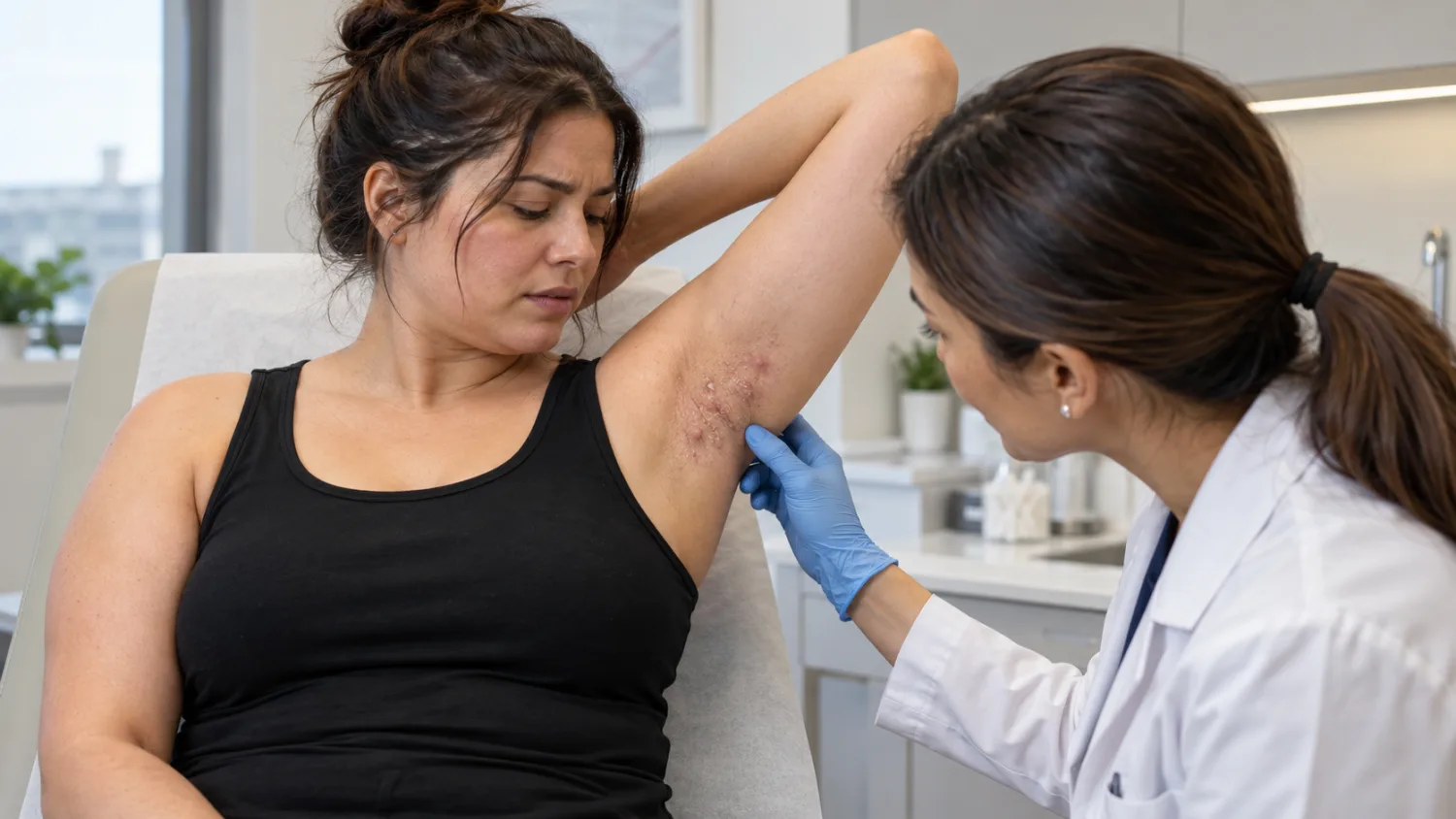
HS tends to affect areas where skin touches skin and where there are many hair follicles and apocrine sweat glands.
The most common areas are:
- armpits;
- groin;
- inner thighs;
- underneath the breasts;
- between or underneath the buttocks;
- around the genitals;
- around the anus.
It can sometimes appear around the waistband, abdomen or back of the neck.
Having a single boil in one of these areas does not mean you have HS.
The clue is usually the recurring pattern.
A lump disappears, another develops nearby, and eventually the same area may show scars from previous episodes.
HS vs Boils, Acne and Ingrown Hairs
HS is frequently mistaken for more common skin problems.
HS vs an ordinary boil
A boil is usually a bacterial infection involving a hair follicle.
It can become painful and filled with pus, but after treatment or drainage it often resolves without repeatedly returning in exactly the same pattern.
HS, by contrast, tends to recur in characteristic areas and can eventually produce tunnels and scarring.
Bacteria can infect an HS lesion secondarily, but HS itself is not simply a recurring skin infection.
HS vs acne
HS and acne are related inflammatory follicular conditions, and some people have both.
Acne primarily affects areas such as the face, chest and upper back, whereas HS commonly affects the armpits, groin, buttocks and skin folds.
If ordinary acne is your main concern, see our guide to acne treatment in the UK.
HS vs ingrown hairs
An ingrown hair can create a small inflamed bump after shaving or hair removal.
Repeated deep lumps, drainage and scarring in several typical HS locations are less consistent with simple ingrown hairs.
British Association of Dermatologists guidance notes that HS is often initially mistaken for boils, infection or folliculitis, which can delay appropriate treatment.
What Causes Hidradenitis Suppurativa?
The exact cause is not fully understood.
What is clear is that HS involves blockage and inflammation around hair follicles rather than simply excessive sweating or poor cleanliness.
Several factors appear to influence susceptibility.
Genetics
HS can run in families.
The NHS estimates that around one-third of people with HS have another affected family member.
Hormones
The condition commonly begins after puberty, and some people notice that symptoms change with their menstrual cycle.
This suggests hormones may influence the disease in some patients.
Smoking
Smoking is strongly associated with HS and may make symptoms more difficult to control.
Stopping smoking can therefore form part of HS management, although smoking is not the sole cause of the disease.
If you want support with quitting, see our guide to stopping smoking and NHS treatment options.
Body weight
HS is also more common and can be more severe in people living with obesity.
Skin friction, inflammation and metabolic factors may all contribute.
This does not mean that someone's HS is simply caused by their weight. Thin people can develop HS too.
Where excess weight is relevant, gradual weight loss may reduce friction and disease severity in some people.
How Is Hidradenitis Suppurativa Diagnosed?
There is no single blood test, scan or biopsy that routinely confirms HS.
Diagnosis is usually based on:
- what the lesions look like;
- where they occur;
- whether they repeatedly return;
- whether scarring or tunnels have developed.
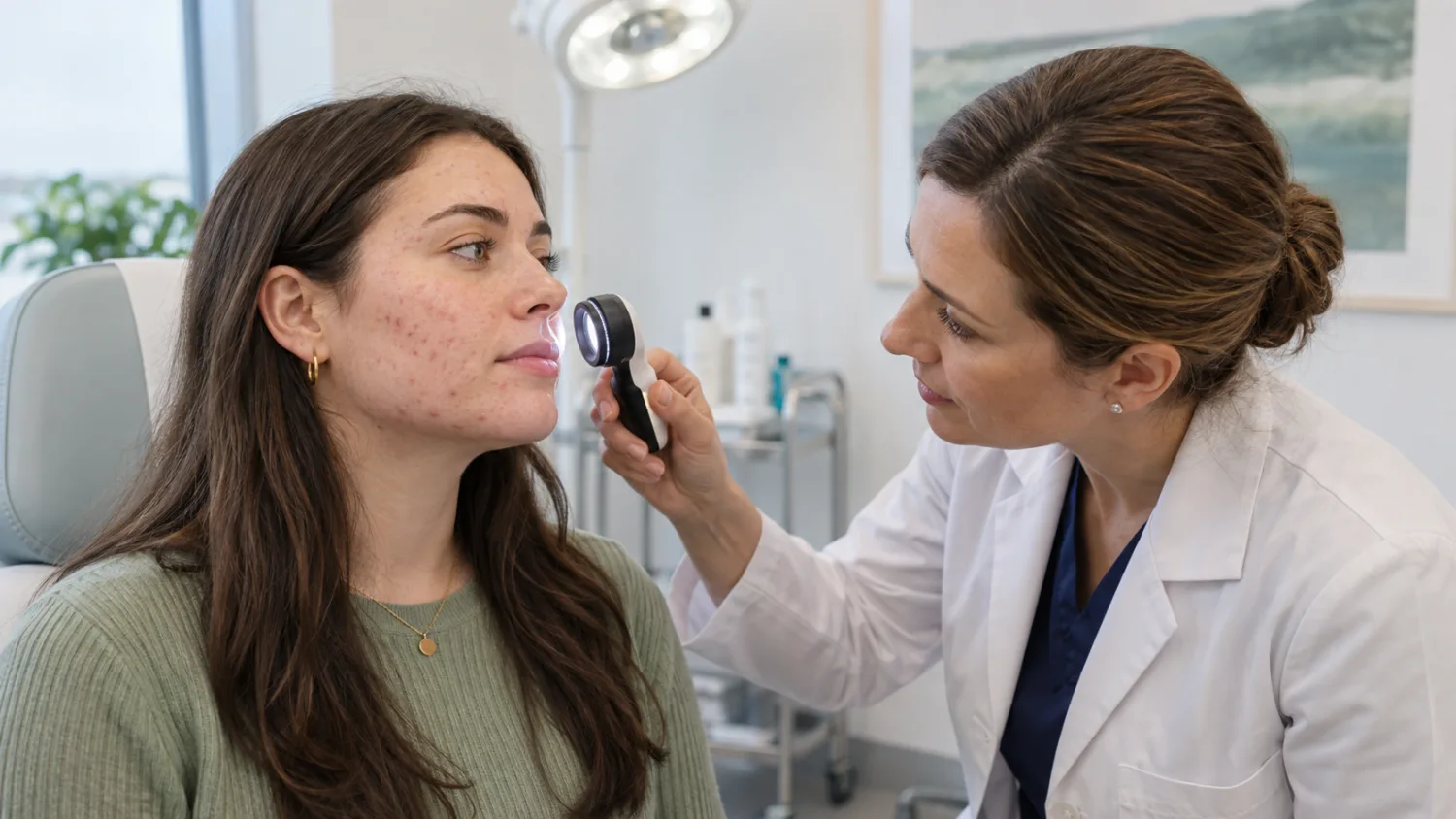
A GP may be able to diagnose typical HS, particularly when there is a clear history of recurring lumps in characteristic locations.
If the diagnosis is uncertain, symptoms are more severe or first-line treatment is not controlling the condition, you may be referred to a dermatologist.
A swab may occasionally be taken when a lesion is draining, particularly if secondary bacterial infection is suspected.
However, finding no bacteria does not rule out HS because the underlying disease is inflammatory rather than simply infectious.
Doctors may also ask about other conditions that sometimes occur alongside HS, including acne, pilonidal sinus and inflammatory bowel disease.
HS affecting the skin around the anus or groin can sometimes overlap with symptoms seen in Crohn's disease. You can read more about that condition in our guide to Crohn's disease symptoms and diagnosis.
How Severe Can HS Become?
Doctors sometimes describe HS using the Hurley staging system.
Hurley stage I
There are isolated abscesses or inflammatory lumps without permanent tunnels or extensive scarring.
Hurley stage II
Lumps recur and there may be some scarring and tunnel formation, but affected areas are still separated by relatively normal skin.
Hurley stage III
There is widespread involvement with multiple interconnected tunnels, recurring abscesses and significant scarring across an affected region.
The stage is only part of assessing severity.
Doctors also consider how often you flare, the number of painful lesions, how much drainage occurs and the impact on everyday life.
How Is Hidradenitis Suppurativa Treated?
There is no single treatment that works for everyone.
Treatment depends on how frequently the disease flares, how many areas are involved and whether permanent tunnels or scarring have developed.
Early disease may be manageable with topical treatment and medicines.
More persistent or severe disease may require prolonged medication, biologic treatment or surgery.
Antiseptic washes
Antiseptic washes such as chlorhexidine may be recommended to reduce bacterial colonisation of the affected skin.
They are usually used alongside other treatment rather than as a cure.
Topical treatment
Topical antibiotics such as clindamycin may sometimes be used for relatively mild disease.
Oral antibiotics
Antibiotics are frequently used in HS.
Sometimes they are prescribed for a short period because a lesion has developed a secondary bacterial infection.
But antibiotics can also be used over several months for their anti-inflammatory effect even when there is no obvious bacterial infection.
Tetracycline-type antibiotics such as doxycycline or lymecycline are commonly used.
More difficult disease may sometimes be treated with a combination such as clindamycin and rifampicin under medical supervision.
Hormonal treatment
When HS appears linked to hormonal patterns, treatment such as certain combined oral contraceptives may be considered for some women.
The choice depends on medical history and individual risk factors.
Retinoids
Dermatologists may sometimes use medicines such as acitretin.
These drugs require careful supervision and have important pregnancy restrictions.
When Are Biologic Medicines Used?
Biologic medicines target specific components of the immune system involved in inflammation.
They are generally reserved for moderate to severe HS that has not responded adequately to conventional systemic treatment.
In the NHS, established options include adalimumab.
Adalimumab blocks tumour necrosis factor, or TNF, an inflammatory signalling protein.
NICE recommends it for adults with active moderate to severe HS when conventional systemic treatment has not worked well enough.
Another option is secukinumab.
Secukinumab targets a different inflammatory pathway, interleukin-17A.
NICE recommends secukinumab for eligible adults with moderate to severe active HS when conventional systemic treatment has failed and adalimumab is unsuitable, has not worked or has stopped working.
These medicines are normally initiated and monitored by specialist dermatology services.
Before starting biologic treatment, patients usually need screening for infections and other potential contraindications.
When Is Surgery Used for HS?
Surgery can become important when permanent tunnels and recurrent disease have developed.
Simply treating each new abscess may not address the abnormal tissue underneath the skin.
Procedures vary from relatively limited treatment of individual tunnels to removal of a wider area of repeatedly affected skin.
Options may include:
- opening or removing individual tunnels;
- limited excision;
- wide surgical excision of severely affected skin;
- laser-based procedures in selected patients.
Incision and drainage can relieve pressure from a very painful acute abscess, but it does not necessarily prevent that HS lesion from recurring.
More definitive surgery aims to remove persistently diseased tissue.
Some patients continue medical treatment even after surgery because HS may remain active elsewhere.
What Can You Do During Everyday Life?
HS is not caused by poor hygiene, so aggressive scrubbing will not cure it and may irritate painful skin.
Practical measures may nevertheless reduce irritation.
The NHS and British Association of Dermatologists suggest measures such as:
- wearing loose-fitting clothing;
- reducing friction over affected areas;
- avoiding shaving directly over active HS where possible;
- using an antiseptic wash if recommended;
- stopping smoking if you smoke;
- working towards a healthier weight if excess weight is relevant.
A warm compress may help comfort an acutely painful lump and encourage spontaneous drainage.
Do not squeeze or repeatedly pierce HS lesions yourself. This can increase trauma, inflammation and the risk of secondary infection.
Absorbent dressings can help with persistent drainage.
If HS is part of a wider pattern of skin problems, our guide to common skin conditions and treatment options provides additional background.
When Should You See a GP or Dermatologist?
Consider seeing a GP if you repeatedly develop painful lumps, boils or abscesses in your:
- armpits;
- groin;
- inner thighs;
- under-breast area;
- buttocks;
- genital or anal area.
It is particularly worth asking whether HS could be the cause if the lesions:
- keep returning;
- appear in several characteristic areas;
- leave scars;
- form tunnels;
- regularly leak fluid;
- have been repeatedly treated as ordinary boils.
Earlier diagnosis may allow treatment before extensive scarring develops.
Seek more urgent medical advice if a lump becomes increasingly red, hot and painful, redness spreads around it, or you develop fever, chills or feel generally unwell. These symptoms can suggest a secondary bacterial infection that may need prompt treatment.
HS can also have a major emotional effect.
Chronic pain, drainage, smell, scars and concerns about intimacy can affect confidence, relationships and mental health. Tell your GP or dermatologist if you are struggling emotionally as well as physically.
Frequently Asked Questions
Is hidradenitis suppurativa caused by poor hygiene?
No. HS is an inflammatory disease involving hair follicles. It is not caused by being dirty or failing to wash properly.
Is hidradenitis suppurativa contagious?
No. You cannot catch HS from another person, and it cannot be spread through physical or sexual contact.
Is HS an infection?
Not primarily. HS is inflammatory rather than a simple bacterial infection. Individual lesions can become secondarily infected, which is why antibiotics may sometimes be needed specifically for infection.
Why do I keep getting boils in my armpits?
There are several possible causes, but recurring painful boil-like lumps in the armpits are a typical presentation of HS, particularly if they occur in both armpits, repeatedly return or leave scars.
Why do I keep getting boils in my groin?
HS is one possibility, especially when deep lumps repeatedly occur in the groin or inner thighs and leave marks, drainage or tunnels. Ingrown hairs, ordinary abscesses and other conditions can look similar, so medical assessment is useful.
Can HS suddenly start in adulthood?
Yes. HS most often starts after puberty and commonly develops in early adulthood, but it can begin later.
Can stress cause HS?
Stress is not considered the underlying cause, but some patients report more flare-ups during periods of stress. Stress can also make chronic pain and coping with the condition more difficult.
Can losing weight cure hidradenitis suppurativa?
No. HS also occurs in people who are not overweight. However, if someone is living with excess weight, weight reduction may reduce friction and inflammation and can improve symptoms in some people.
Does smoking make HS worse?
Smoking is strongly associated with HS and may make the condition more difficult to control. Stopping smoking is therefore commonly recommended as part of treatment.
Should I squeeze an HS lump?
No. Squeezing, cutting or repeatedly trying to drain a lesion yourself can damage the surrounding skin and increase inflammation or infection risk.
Can antibiotics cure hidradenitis suppurativa?
No. Antibiotics can reduce inflammation and treat secondary infection, but HS is a chronic disease and symptoms may return after antibiotics are stopped.
Can HS be cured permanently?
There is currently no treatment that reliably cures HS in every patient. The condition can often be controlled, and some people experience long periods with few or no symptoms. Surgery can remove persistently affected areas but does not guarantee that HS will never develop elsewhere.
What doctor treats hidradenitis suppurativa?
A GP can recognise and start treatment for HS, but persistent, moderate or severe disease is usually managed with help from a dermatologist. Surgeons may also become involved where chronic tunnels or extensive scarred areas need removal.
Is hidradenitis suppurativa related to Crohn's disease?
Most people with HS do not have Crohn's disease, but the two inflammatory conditions occur together more often than would be expected by chance. Symptoms around the anal area, particularly alongside persistent diarrhoea, abdominal pain or weight loss, deserve further assessment.
When should HS be referred to dermatology?
Referral may be appropriate when the diagnosis is uncertain, symptoms are recurring despite initial treatment, scarring or tunnels are developing, several body areas are affected, or stronger treatments such as biologic medicines or surgery may be needed.
This article provides general health information and is not a diagnosis. Recurrent painful lumps and abscesses can have several causes. If lesions repeatedly develop in the armpits, groin, underneath the breasts or around the buttocks, ask a GP whether hidradenitis suppurativa should be considered.