Acne is often thought of as a teenage problem, but that is far from the full picture. In the UK, many adults continue to struggle with acne well beyond their teens, and some people develop it for the first time in their 20s, 30s or 40s.
Adult acne can be frustrating, persistent and emotionally draining, especially when it affects confidence, work, relationships and mental wellbeing.
The reassuring news is that adult acne is treatable. There are effective creams, gels, tablets, hormonal treatments and specialist options available in the UK through both the NHS and private clinics.
However, treatment is rarely instant. Most acne therapies take time to work, and choosing the right treatment depends on the type of acne, how severe it is, whether scarring is developing, and how much it is affecting day-to-day life.
This guide explains acne treatment clearly and simply, with a special focus on adult acne, so you can understand the causes, recognise when self-care is not enough, and know what help is available in the UK. If you are browsing related patient guides, you can also explore the skin & aesthetic medicine section of our resources hub, where more skin-focused guides will sit over time.
What acne means
Acne is a common inflammatory skin condition that affects the hair follicles and oil-producing glands in the skin. It happens when pores become blocked with oil, dead skin cells and bacteria, leading to spots, blackheads, whiteheads and sometimes deeper painful lumps.
The NHS explains the basics in its acne overview, while NICE has a more detailed UK acne management guideline.
Acne most commonly affects the face, chest, back and shoulders. For some people it is mild and occasional. For others it is persistent, widespread, inflamed or scarring.
The British Association of Dermatologists notes that acne affects males and females of all races and ethnicities, and that clear information and support should be offered to all patients.
Adult acne is not unusual
Adult acne is especially common in women, and it can behave differently from teenage acne. Many adults experience recurring breakouts around the jawline, chin, mouth or lower cheeks, often with a hormonal pattern.
Adult acne can also be more stubborn and more closely tied to skin sensitivity, stress, cosmetic products or hormonal change. The British Association of Dermatologists’ discussion of adult acne highlights that acne continuing into adulthood is a real and common experience, not an exception.
What adult acne looks like
Adult acne can include blackheads, whiteheads, red inflamed bumps, pus-filled spots and deeper tender nodules. Some people mainly get small but persistent breakouts. Others develop painful under-the-skin spots that take weeks to settle and may leave marks or scars behind.
NICE classifies acne by lesion type and severity, with mild acne tending to feature mostly comedones and fewer inflamed spots, while more severe acne includes more inflammation and deeper lesions.
Common signs include:
- blackheads, which are open clogged pores
- whiteheads, which are closed clogged pores
- red tender bumps known as papules
- pus-filled spots known as pustules
- deeper painful lumps or cyst-like lesions under the skin
- oily skin
- dark marks, redness or scarring after spots heal
The NHS notes that acne can affect the face, back and chest, and that more severe acne or acne involving the chest and back may need prescription treatment.
When acne is more than mild
A lot of adults spend too long trying random face washes, peels, supplements or harsh skincare without getting the right diagnosis. Mild acne may improve with pharmacy products, but acne should be taken more seriously when it is painful, leaving scars, affecting large areas such as the back or chest, or causing significant distress.
NICE says referral to specialist care should be considered for acne conglobata, acne fulminans, acne with nodules or cysts, acne causing or at risk of causing scarring, treatment-resistant acne, or acne associated with significant psychological distress.
The NICE recommendations for acne vulgaris and referral guidance from the British Association of Dermatologists both support this approach.
That matters for adult acne because many adults delay seeking help. By the time they do, they may already have years of recurrent inflammation, pigment changes or early scarring.
Causes of acne
Acne is not caused by poor hygiene. The NHS specifically says that “dirty skin” is a myth and that squeezing spots can make things worse and increase the risk of scarring.
Acne develops because of a combination of increased oil production, blocked pores, inflammation and the activity of skin bacteria within those blocked follicles.
Hormones and adult acne
Hormones play a major role, which is one reason acne is common around puberty, menstrual cycles, pregnancy and times of hormonal change.
In adult women, acne may flare in a cyclical pattern or persist alongside other signs of hormonal imbalance. The NHS treatment page notes that hormonal therapies, including the combined oral contraceptive pill, can help some women, while the progestogen-only pill or contraceptive implant can sometimes make acne worse.
You can read more on the NHS acne treatment page.
Other contributing factors
Other factors can also contribute, including genetics, cosmetics that clog pores, friction from helmets or tight clothing, stress, and certain medicines.
It is important not to blame yourself. Acne is a medical skin condition, not a sign that you are doing something wrong.
Why adult acne can feel different
Adult acne often feels different from teenage acne for several reasons. It may be more inflammatory, more hormonal, more persistent, and more likely to leave marks.
People with adult acne are also often juggling other issues at the same time, such as work stress, pregnancy planning, contraception questions, skin sensitivity, or concern about scarring and ageing skin.
Adult acne can be especially upsetting because it often arrives at a stage of life when people feel they “should have grown out of it”. The British Association of Dermatologists’ content on adult acne highlights exactly this disconnect between expectation and reality.
For women, adult acne may also overlap with broader hormonal questions. If symptoms such as irregular periods, excess facial hair or fertility concerns are present as well, it may be worth considering whether there is an underlying hormonal issue that needs medical review.
As your site grows, this article would internally link well to future guides on PCOS or fertility problems. In the meantime, readers can browse your women’s health & gynaecology category.
Acne scarring, marks and mental health
One reason adult acne can feel so discouraging is that it often overlaps with other issues such as post-inflammatory hyperpigmentation, redness, sensitivity and scarring.
Even after the active spots improve, the marks they leave behind may continue to affect confidence. The NHS notes that acne can cause scarring, and NICE includes acne-related scarring as an important part of management.
Different types of acne marks
There are a few different issues that patients often group together as “scarring”:
- persistent red or brown marks after spots heal
- textural scarring, such as pitted or indented scars
- raised scars in some cases
- post-inflammatory hyperpigmentation, which can be especially distressing in darker skin tones
This is why “just let it run its course” is not always good advice for adult acne. Persistent inflammation carries consequences, even if the spots themselves eventually flatten.
Acne and mental health
Acne can affect self-confidence at any age, but adult acne can feel especially isolating because people often expect it to be a teenage issue.
NICE explicitly includes the impact of acne on mental health and wellbeing, and the British Association of Dermatologists says mental health services should be considered when someone with acne experiences significant psychological distress or a mental health disorder.
That means acne is not being “vain” or “cosmetic” when it causes distress. If you are avoiding photographs, cancelling plans, feeling ashamed, or noticing that your mood is worsening because of your skin, that matters medically as well as emotionally.
If acne is affecting how you feel day to day, our guide to mental health support options in the UK may be worth reading alongside skin treatment.
How acne is diagnosed in the UK
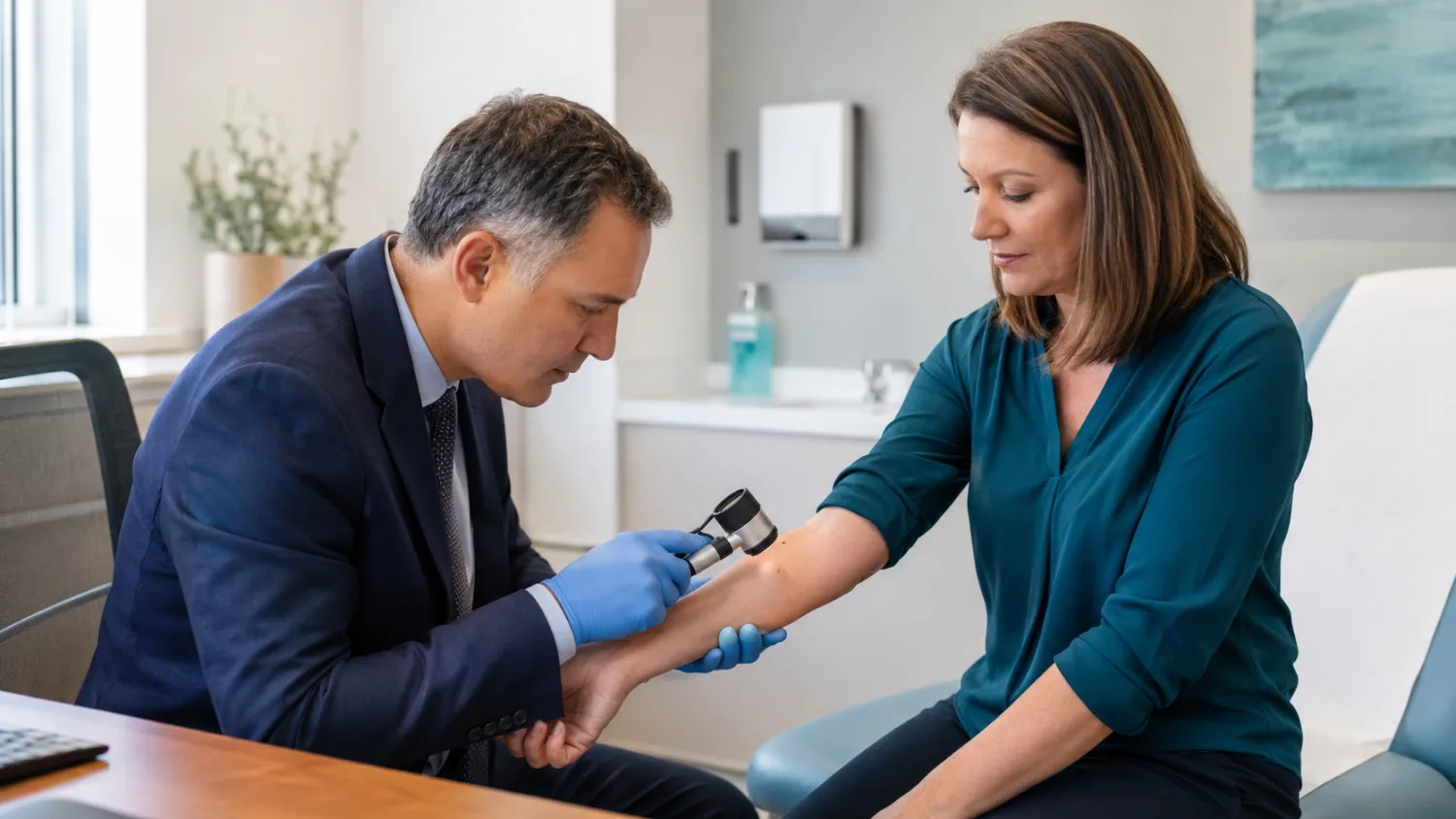
Acne is usually diagnosed clinically, which means a clinician can often identify it by looking at the skin and asking about symptoms, pattern, severity and any previous treatment.
The key is recognising the type of lesions and how much inflammation or scarring is present. NICE Clinical Knowledge Summaries describe acne diagnosis by clinical features and severity, while the main NICE guideline covers management in both primary and specialist care.
Pharmacy, GP or dermatologist?
Many people first speak to a pharmacist or GP. For mild acne, a pharmacist may recommend over-the-counter benzoyl peroxide or gentle skincare advice.
If acne is more persistent, more inflamed, scarring, or affecting mental wellbeing, GP review is sensible. If you are unsure whether to start with a pharmacy or book a doctor, our guide on when to see a pharmacist instead of a GP can help with that first step.
If acne is severe or not responding to standard treatment, referral may be made to a dermatology service or to another specialist pathway depending on local NHS arrangements.
If you want to understand that route better, our article on how hospital referrals work in the UK explains what usually happens next.
First-line acne treatment in the UK
One of the most important UK messages about acne treatment is this: the best treatment depends on the severity and type of acne, and most treatments need time.
NICE recommends 12-week first-line treatment courses for many patients, and the NHS says many treatments take 2 to 3 months before they start to work properly. That is why switching products too quickly or giving up after a couple of weeks is so common and so unhelpful.
For mild to moderate acne, first-line treatment often involves topical therapy. NICE recommends options such as combinations of adapalene with benzoyl peroxide, tretinoin with clindamycin, or benzoyl peroxide with clindamycin, depending on the type of acne and whether antibiotics are appropriate.
The full NICE acne treatment recommendations are useful if you want to see the UK treatment framework in more detail.
These combination treatments matter because acne is not caused by one single process. A good regimen may need to reduce blocked pores, calm inflammation and reduce bacterial overgrowth at the same time.
Topical treatments: creams and gels
Topical acne treatments are often the starting point, especially for milder acne or as part of a broader plan.
Common topical ingredients used in UK practice include benzoyl peroxide, retinoids such as adapalene, and combination gels that include an antibiotic or retinoid. NICE Clinical Knowledge Summaries note that topical retinoids are often used in combination with other topical drugs, including benzoyl peroxide and topical antibiotics.
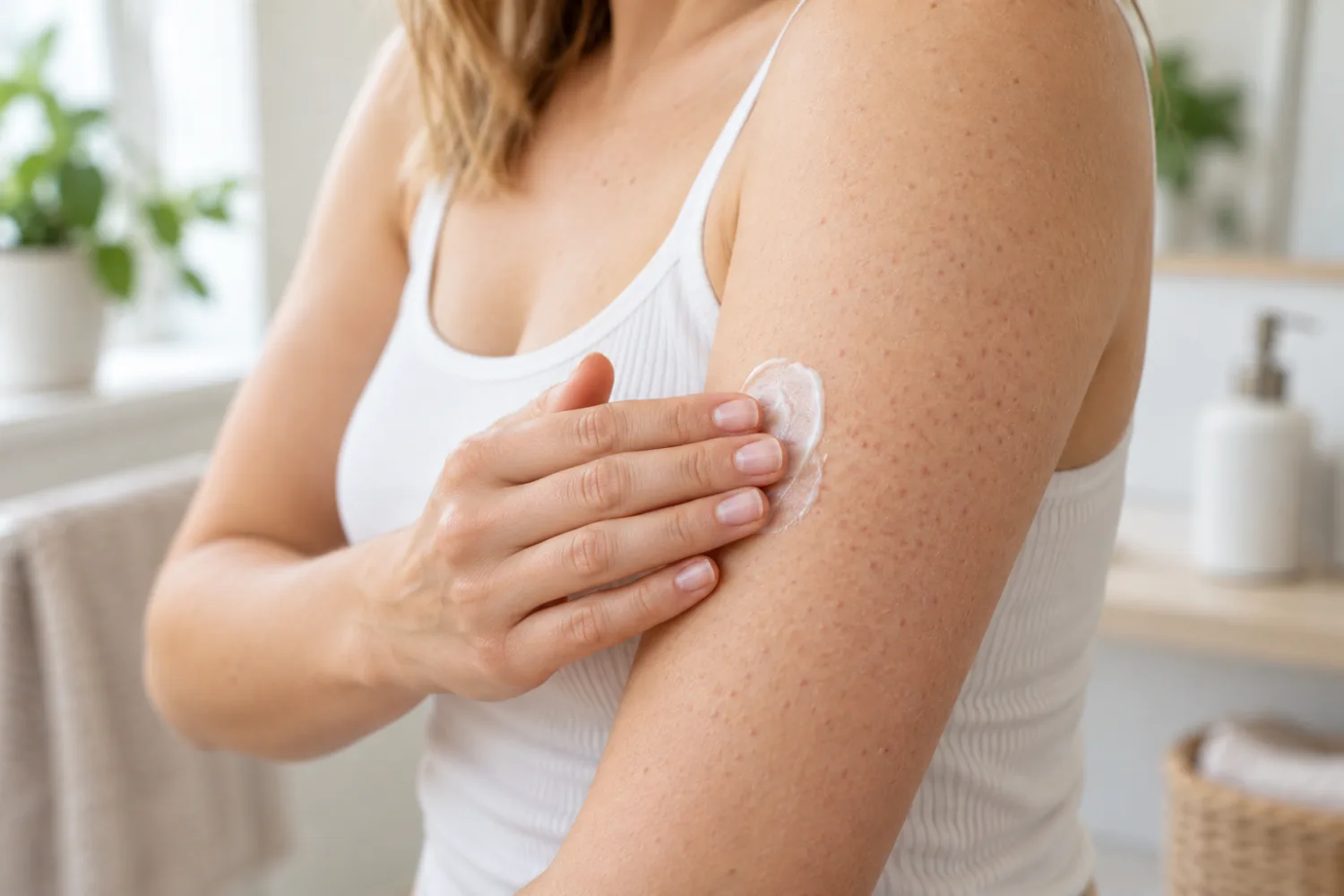
These treatments can be very effective, but they can also irritate the skin at first. Dryness, redness, peeling and stinging are common early on, especially if too much is applied too quickly.
That is one reason adult acne treatment needs a sensible, gradual approach rather than using lots of harsh products at once.
Oral antibiotics
If acne is more inflamed, widespread, or affecting the chest and back, oral antibiotics may be added to topical treatment.
The NHS says that for mild to moderate or moderate to severe acne, people are often started on a combination of topical treatments or antibiotic tablets combined with topical treatment.
This is important: antibiotics are not usually meant to be used on their own. NICE aims to reduce antibiotic resistance and recommends using antibiotics as part of a wider acne plan, not as a long-term stand-alone fix. Treatment is usually reviewed after 12 weeks.
For adults who have been on repeated antibiotic courses over the years, specialist review may be worth considering rather than cycling through the same approach again and again.
Hormonal treatment for women with adult acne
Hormonal treatment can be very useful in women whose acne has a hormonal pattern. The NHS notes that hormonal therapies and the combined oral contraceptive pill can help some women, while some progestogen-only options can worsen acne.
This is one reason adult female acne needs a tailored approach. Acne around the jawline, cyclical flares or persistent adult breakouts may respond better when hormonal factors are considered rather than just increasing topical treatments.
If you are also dealing with broader hormonal symptoms, your women’s health & gynaecology resources may be a useful internal next step as more related guides are added.
Isotretinoin for severe or scarring acne
Isotretinoin is one of the most effective treatments for severe acne, especially when there is scarring, nodules, cysts, or failure of standard treatments.
NICE includes oral isotretinoin within specialist care, and its guidance was updated in December 2023 to clarify recommendations in line with MHRA safety measures. The British Association of Dermatologists also has an isotretinoin FAQ page reflecting the current UK safety framework.
This is not a casual treatment. Isotretinoin requires careful prescribing, follow-up and safety checks. British Association of Dermatologists primary care referral guidance notes that isotretinoin is teratogenic, meaning it can seriously harm a developing pregnancy, so contraception requirements and pregnancy prevention measures are critical for patients who could become pregnant.
The same guidance also highlights the need to discuss patient information and baseline blood tests such as liver function and lipids.
That sounds daunting, but it is still an important treatment option because severe acne itself can cause permanent scarring and major psychological distress. For the right patient, it can be life-changing when managed properly.
Skincare that actually helps
A lot of adult acne sufferers spend money on complicated routines that irritate the skin more than they help it. In reality, acne-prone skin often responds best to consistency and simplicity.
- A gentle cleanser is usually enough.
- A non-comedogenic moisturiser can reduce irritation and help you tolerate active treatment.
- Daily sunscreen is especially important if you are using retinoids, acids, or treatments that make skin more sun-sensitive.
- Avoid over-cleansing, harsh scrubs, picking, and piling on too many “actives” at once.
The NHS specifically warns against squeezing spots because it can worsen symptoms and increase the risk of scarring.
How long treatment takes
This is one of the most important expectations to set. Acne treatment is usually slow.
The NHS says many acne treatments take 2 to 3 months before they start to work, and NICE’s first-line framework is based around 12-week courses before assessing response.
That means the early weeks can be misleading. Skin may feel dry, irritated, or even temporarily worse before it gets better. This is why a structured plan matters so much.
Good treatment is not usually about chasing instant perfection; it is about reducing breakouts, preventing scarring, and building a routine the skin can tolerate over time.
NHS and private acne treatment
Many people in the UK will begin acne treatment through a pharmacist or GP. The NHS acne page and treatment page explain that milder cases can often start with topical treatments, while more severe acne may need prescription options or referral.
NHS acne treatment pathway
On the NHS, acne management usually starts in primary care. Standard first-line options may be prescribed there, with review after around 12 weeks.
Referral becomes more likely if acne is severe, nodulocystic, scarring, treatment-resistant, or causing significant psychological distress. NICE and British Association of Dermatologists referral guidance both support this approach.
This pathway works well for many people, but delays can happen, especially when repeated first-line treatments have already failed or when specialist access is limited.
If getting seen is the real barrier, our guide on how to get a GP appointment quickly in the UK may help you move the process along.
Private acne treatment in the UK
Because adult acne often sits at the boundary between medical dermatology and aesthetic skin care, many patients also look at private options.
Private dermatology or skin clinics may offer faster appointments, broader access to consultant-led assessment, and quicker discussion of prescription treatments, hormonal strategies, scarring prevention and cosmetic aftercare.
Private treatment can be especially attractive if acne is persistent, if you are worried about scarring, or if you want a more detailed review of treatment history and skin goals. For some patients, private care is about speed; for others, it is about continuity and having enough time to discuss options properly.
If you are weighing up access, waiting times and costs, our guide to NHS vs private healthcare in the UK explains the main differences, and our page on private GP services in the UK: costs and what to expect may also be useful if you want a quicker starting point.
When to seek specialist help
You should seek proper medical advice if:
- your acne is painful or widespread
- your chest or back is affected
- you are getting scars or dark marks
- over-the-counter treatment is not helping
- your acne keeps coming back
- your acne is affecting confidence, relationships, or mental health
- you think hormonal factors may be involved
NICE and the British Association of Dermatologists both support specialist referral when acne is severe, scarring, treatment-resistant, or linked with significant psychological distress.
FAQ: acne treatment in the UK
What is adult acne?
Adult acne is acne that continues or begins after the teenage years. It can involve blackheads, whiteheads, inflamed spots, deeper painful lumps and marks or scarring.
What causes adult acne?
Adult acne can be linked with oil production, blocked pores, inflammation, bacteria, hormones, genetics, stress, cosmetics, friction and some medicines. It is not caused by poor hygiene.
Is adult acne common?
Yes. Many adults continue to have acne or develop it for the first time in adulthood. It is especially common in women and may have a hormonal pattern.
When should I see a GP about acne?
See a GP if acne is painful, persistent, widespread, affecting the chest or back, leaving marks or scars, not improving with pharmacy treatment, or affecting your confidence or mood.
What is the best treatment for acne?
The best treatment depends on the type and severity of acne. Options include topical treatments, oral antibiotics, hormonal treatments, isotretinoin in specialist care, and support for scarring or pigmentation.
How long does acne treatment take to work?
Most acne treatments take time. Many need around 2 to 3 months before full improvement can be judged, and NICE commonly uses 12-week treatment courses before review.
Can acne be treated on the NHS?
Yes. Many acne treatments are available through pharmacists, GPs and dermatology services. Referral may be needed for severe, scarring or treatment-resistant acne.
Can private dermatology help acne faster?
Private care may offer faster access to specialist assessment and treatment planning, but costs vary. It can be useful for persistent acne, scarring concerns or complex treatment histories.
Can acne cause scarring?
Yes. Inflamed, severe or untreated acne can cause scarring or long-lasting red or brown marks. Early treatment can reduce the risk.
Should I squeeze spots?
No. Squeezing spots can worsen inflammation, damage the skin and increase the risk of scarring.
Can contraception affect acne?
Yes. Some hormonal contraceptives can improve acne, while some progestogen-only options may worsen it. A GP or sexual health clinician can advise based on your situation.
Is isotretinoin safe?
Isotretinoin can be very effective for severe acne, but it needs specialist prescribing, monitoring and strict pregnancy prevention measures for patients who could become pregnant.
Final takeaway
Adult acne is common, treatable and much more medically important than people often realise. It can affect confidence, relationships, work and mental wellbeing, and it can leave lasting physical marks if not managed properly.
The good news is that the UK has clear treatment pathways through pharmacy care, GP treatment, dermatology referral and private specialist clinics.
The most effective next step is usually not buying another random cleanser or trying to “dry the spots out”. It is getting the right diagnosis, understanding the type of acne you have, and starting a treatment plan you can stick to for long enough to judge properly.
If your acne is persistent, painful, scarring, or affecting your confidence, it is worth getting assessed. Early, structured treatment can make a major difference, not just to your skin now, but to the marks and scarring you may otherwise still be dealing with years later.