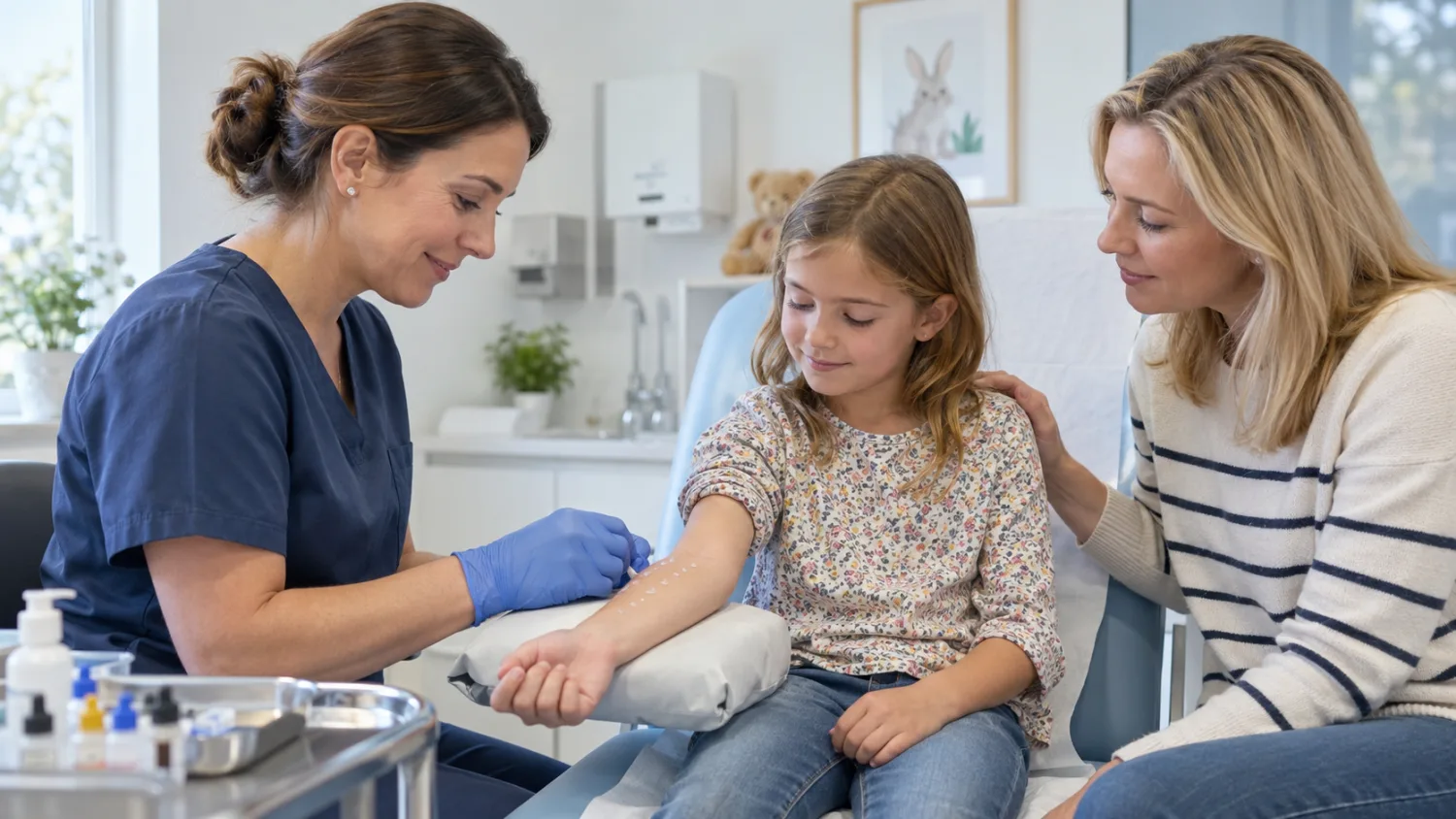
Private child allergy testing in the UK usually begins with a specialist consultation rather than a stand-alone test. An initial appointment commonly costs £200 to £350, with skin-prick testing either included or adding approximately £100 to £250.
If blood tests, a dietitian appointment or a supervised food challenge are needed, the total cost can rise substantially. A straightforward consultation with targeted testing may cost £300 to £600, while a more complex assessment involving laboratory tests and follow-up may reach £600 to £1,200 or more.
The important question is not how many allergens a clinic can test. It is whether the selected tests are appropriate for your child’s symptoms. Broad screening without a clear clinical history can produce misleading positive results and unnecessary dietary restrictions.
Call 999 immediately if a child has difficulty breathing, swelling of the tongue or throat, becomes pale or floppy, collapses or shows another sign of anaphylaxis. Allergy testing is not a substitute for emergency treatment.
The prices below are approximate self-pay figures. Fees vary by clinic, location, consultant, number of allergens and whether hospital facilities are required.
How much does private child allergy testing cost in the UK?
| Appointment or test | Typical private cost |
|---|---|
| Initial paediatric allergy consultation | £200–£350 |
| Follow-up consultation | £150–£250 |
| Skin-prick testing | Included to approximately £250 extra |
| Targeted specific-IgE blood tests | Approximately £80–£350+ |
| Component-resolved allergy testing | Approximately £150–£550+ |
| Patch testing for contact allergy | Approximately £300–£700+ |
| Supervised oral food challenge | Approximately £500–£1,500+ |
| Paediatric allergy dietitian | Approximately £100–£220 |
| Lung-function or asthma testing | Approximately £80–£200 per test |
| Prescription or adrenaline-device training | May be included or charged separately |
These services are not necessarily added together. A child with a convincing immediate reaction to one food may need a consultation and a small number of targeted tests. Another child with eczema, asthma, several suspected foods and restricted eating may need more extensive assessment.
Published prices illustrate how packages differ. Some clinics charge around £300 to £350 for the consultation and another £150 to £250 for skin-prick testing. Others quote approximately £300 to £350 for an appointment with skin testing included. One UK specialist clinic currently lists an oral food challenge at £500, although hospital-based and higher-risk challenges can cost considerably more.
Always request an individual quotation rather than assuming an advertised “allergy test” price covers the complete assessment.
What is the likely total cost?
The first appointment is only one part of the possible bill. These examples show how costs can build up:
| Example pathway | Possible total |
|---|---|
| Consultation with skin-prick testing included | £250–£400 |
| Consultation plus separately charged skin-prick tests | £350–£600 |
| Consultation, specific-IgE blood tests and follow-up | £450–£900+ |
| Consultation, testing, dietitian and follow-up | £600–£1,000+ |
| Assessment followed by a supervised food challenge | £800–£1,800+ |
A low headline price may cover only the blood draw or laboratory panel. It may exclude the clinician who requests the test, interprets the results and creates a safe management plan.
Before booking, ask for a written breakdown covering:
- the initial consultation;
- skin-prick reagents and testing;
- blood collection and laboratory charges;
- interpretation of the results;
- a written allergy-management plan;
- prescriptions and medical letters;
- dietitian support;
- follow-up appointments;
- school or nursery documentation;
- the cost of any food challenge.
If your child needs a broader medical assessment rather than an allergy-only appointment, see our guide to private paediatrician costs in the UK.
Which allergy tests might a child need?
The test should be chosen after an allergy-focused clinical history. The specialist will ask what happened, how quickly symptoms appeared, how much of the suspected food was eaten and whether the same reaction has occurred again.
Skin-prick testing
Small drops containing suspected allergens are placed on the forearm or back. The skin is lightly pricked through each drop, and any raised reaction is measured after approximately 15 to 20 minutes.
Skin-prick testing is mainly used for immediate, IgE-mediated allergies, including suspected reactions to foods, pollen, dust mites and animals. It can be performed in children, including infants when clinically appropriate.
Antihistamines can interfere with the result. The clinic should give clear instructions about medicines before the appointment. Do not stop prescribed medication without checking with the treating clinician.
Specific-IgE blood testing
A blood sample can be tested for IgE antibodies to selected allergens. It may be useful when skin testing is unsuitable, when antihistamines cannot be stopped or when severe eczema makes the skin difficult to assess.
The older term “RAST test” is still commonly used, although modern laboratories generally use different specific-IgE methods.
A blood result does not automatically prove that an allergen causes symptoms. Our guide to allergy blood-test results explains sensitisation, IgE levels and why results must be compared with the child’s reaction history.
Component-resolved testing
Component testing measures IgE against particular proteins within an allergen. In selected cases, it may help specialists distinguish primary food allergy from pollen-related cross-reactions or assess the likelihood of reacting to particular forms of a food.
It is more expensive than basic specific-IgE testing and is not necessary for every child.
Patch testing
Patch testing investigates allergic contact dermatitis rather than immediate food allergy. Potential contact allergens are applied to the back in small chambers and assessed over several appointments.
It may be considered for persistent dermatitis caused by substances such as fragrances, preservatives, metals or ingredients in personal-care products. It is different from skin-prick testing.
What is a supervised oral food challenge?
An oral food challenge involves giving a child carefully measured, gradually increasing amounts of a suspected food under medical supervision. The clinical team monitors the child and stops the challenge if a reaction develops.
It may be used to:
- confirm whether a suspected allergy is genuine;
- show that a child has outgrown an existing allergy;
- clarify an uncertain skin or blood-test result;
- assess tolerance to a particular form of food, such as baked egg or milk;
- avoid unnecessary long-term food restriction.
Oral food challenges take several hours and require trained staff, observation space, emergency medicines and suitable clinical governance. This explains why they are more expensive than skin or blood tests.
An oral food challenge is considered the most definitive way of confirming or excluding many food allergies, but it is not suitable or necessary in every case. It must not be attempted at home unless an allergy specialist has specifically provided a safe reintroduction plan.
Evelina London describes skin tests, blood tests and supervised challenges in its overview of food-allergy testing in children.
Why does the consultation matter as much as the test?
No allergy test should be interpreted in isolation. A positive result may indicate sensitisation, meaning that the immune system recognises the substance, without showing that the child will develop symptoms when exposed to it.
Testing many foods without a reason increases the chance of finding clinically irrelevant positives. This may result in a child avoiding foods they previously ate safely.
A proper consultation should consider:
- the child’s age and growth;
- the suspected trigger;
- how soon symptoms started after exposure;
- the amount eaten or encountered;
- skin, breathing and digestive symptoms;
- eczema, asthma or hay fever;
- previous reactions and emergency treatment;
- foods the child already eats safely;
- medicines taken around the time;
- the child’s current diet and nutritional intake;
- family history of allergic disease.
NICE guidance on food allergy in under-19s recommends an allergy-focused history before selecting investigations. For suspected immediate food allergy, skin-prick testing and/or blood testing for specific IgE should be directed at the suspected foods and likely co-allergens.
The British Society for Allergy and Clinical Immunology similarly advises that tests should focus on foods reported to cause symptoms.
Which symptoms may justify an allergy assessment?
An assessment may be appropriate when symptoms repeatedly follow a particular food, animal, pollen season, medicine or other exposure.
Possible immediate allergy symptoms include:
- hives or an itchy raised rash;
- swelling of the lips, face or eyes;
- itching or tingling in the mouth;
- vomiting soon after eating;
- coughing, wheezing or noisy breathing;
- difficulty breathing or swallowing;
- dizziness, pallor, floppiness or collapse.
Allergic rhinitis may cause sneezing, an itchy or blocked nose and watery eyes after exposure to pollen, animals or dust mites. Read our guide to spring allergies in children for practical advice about seasonal symptoms.
Some food-related symptoms are delayed and may include persistent digestive problems or worsening eczema. However, these symptoms have many possible causes and are not automatically evidence of food allergy.
Hives can occur with allergy, infection and several non-allergic triggers. Our guide to hives and urticaria explains the differences and urgent warning signs.
Can allergy tests diagnose eczema, asthma or food intolerance?
Allergy may contribute to eczema or asthma, but a positive test does not prove that it is the main cause of either condition.
Children with eczema frequently show sensitisation on allergy tests, particularly when large panels are used. Testing should be based on the clinical history rather than used to screen every food.
Removing several nutritious foods can create problems with calories, protein, calcium, iron, vitamins and normal feeding development. Young children with restricted diets may need support from a paediatric dietitian.
For delayed food allergy, ordinary skin-prick and specific-IgE tests may not be helpful. A clinician may instead recommend a time-limited elimination followed by planned reintroduction. The British Association of Dermatologists explains why delayed reactions require a different approach.
Food intolerance is also not the same as food allergy. For example, lactose intolerance involves difficulty digesting lactose rather than an IgE reaction to milk protein.
See our guides to eczema and psoriasis and asthma symptoms and treatment for a broader explanation of these conditions.
Which commercial allergy tests should parents avoid?
Be cautious about services offering to identify dozens or hundreds of food “intolerances” from a hair sample, bioresonance device or broad IgG panel.
Tests that should not be treated as reliable diagnoses of allergy include:
- food-specific IgG or IgG4 panels;
- hair analysis for allergy or intolerance;
- electrodermal or Vega testing;
- bioresonance testing;
- kinesiology or muscle testing;
- unselected panels with no symptom-based clinical assessment.
IgG antibodies to food commonly reflect exposure and may be found in healthy people. They do not establish that the food is causing an allergy or intolerance.
The BSACI Choosing Wisely programme warns against alternative food-allergy testing. The British Dietetic Association also distinguishes evidence-based tests from commercially promoted alternatives.
A colourful report listing numerous “reactive” foods may look comprehensive, but acting on it can lead to unnecessary restriction, anxiety and nutritional harm.
What should be included in a private allergy appointment?
A comprehensive initial service may include:
- an allergy-focused medical history;
- review of photographs or records of previous reactions;
- physical examination;
- review of growth, eczema, asthma and diet;
- targeted skin-prick testing where appropriate;
- interpretation of existing blood-test results;
- a diagnosis or plan for further investigation;
- advice about avoidance and accidental exposure;
- a written emergency plan when required;
- adrenaline auto-injector training if prescribed;
- information for school, nursery or other carers;
- a clinic letter sent to the family and GP.
Ask whether testing will occur at the first appointment. Some clinics require a consultation before scheduling tests, while others perform history-taking and skin-prick testing during the same visit.
If a blood sample is likely, check whether the clinic regularly takes blood from children of your child’s age. You may also want to ask about numbing cream and whether laboratory charges are included.
Bring:
- a list of suspected triggers and reaction dates;
- photographs of rashes or swelling;
- hospital, GP and previous allergy letters;
- existing test results;
- a list of medicines and inhalers;
- the child’s growth or health record when relevant;
- food packaging or ingredient lists connected with a reaction;
- adrenaline auto-injectors if already prescribed.
Can children receive allergy testing through the NHS?
Yes. Clinically appropriate allergy assessment and testing can be provided through the NHS without a direct charge to the family.
A GP may manage straightforward symptoms or refer the child to paediatrics, a specialist allergy service, dermatology, respiratory medicine or a dietitian. Local referral routes and waiting times vary.
The NHS food-allergy guide explains that specialist investigations may include skin-prick tests, blood tests and a supervised exclusion diet.
Private care may offer a faster appointment or greater choice of specialist, but it does not make inappropriate testing more accurate. Families should consider:
- how urgent the clinical question is;
- whether the child has already been referred;
- the complete private cost rather than the initial fee;
- whether continuing treatment can transfer to the NHS;
- whether the GP will issue prescriptions recommended privately;
- who will provide follow-up if symptoms change.
Urgent reactions should be managed through emergency services rather than waiting for either a routine NHS or private allergy appointment.
Will private health insurance cover child allergy testing?
Some private health-insurance policies cover a consultant assessment and medically necessary diagnostic tests. Coverage depends on the policy, excess, outpatient limit and whether symptoms began before the cover started.
Before booking, ask the insurer:
- whether a GP referral is required;
- whether the consultant must be recognised by the insurer;
- if skin-prick and laboratory tests are covered;
- whether dietitian appointments are included;
- if oral food challenges require separate authorisation;
- how much remains in the outpatient allowance;
- whether allergy is treated as a chronic or pre-existing condition.
A plan with limited outpatient cover may pay for the consultation but leave part of the testing bill to the family. Our guide to outpatient cover on private health insurance explains these limits.
Keep authorisation numbers, invoices, referral letters and test requests. Do not assume that an insurer will retrospectively reimburse an appointment arranged without approval.
How do you choose a suitable child allergy clinic?
Look for a clinician with relevant paediatric and allergy experience rather than choosing solely by the size of the advertised test panel.
Questions to ask include:
- Who will assess my child, and what are their qualifications?
- Do they regularly manage children of this age?
- Is the consultation with a paediatric allergy specialist?
- Which tests are recommended, and why?
- Is skin-prick testing included in the fee?
- Are laboratory and blood-collection charges included?
- Who interprets the results?
- Will we receive a written management plan?
- Can the clinic provide dietitian support?
- What emergency facilities are available during testing?
- Who provides help after the appointment?
Doctors can be checked through the General Medical Council register. You can also ask whether the clinician belongs to a relevant professional allergy organisation.
Warning signs include guaranteed diagnoses from one test, pressure to test hundreds of foods, claims that IgG results reveal intolerance, or advice to remove major food groups without nutritional assessment.
Frequently asked questions
How much is a private child allergy test in the UK?
An initial specialist consultation generally costs £200 to £350. Skin-prick testing may be included or add approximately £100 to £250. A consultation with targeted testing often totals around £300 to £600.
How much is a private allergy blood test for a child?
Targeted specific-IgE blood tests may cost approximately £80 to £350 or more, depending on the number and type of allergens. Blood collection, laboratory processing and interpretation may be charged separately.
Can a child have an allergy test without a consultation?
Some providers sell direct-access blood tests, but a specialist consultation is normally more useful. Testing needs to be selected and interpreted alongside the child’s symptoms, medical history and foods already tolerated.
Are skin-prick tests painful for children?
They involve several light pricks on the skin and can be uncomfortable or itchy, but they are not the same as injections or blood tests. Results usually develop within 15 to 20 minutes.
At what age can a child have allergy testing?
Skin-prick and specific-IgE blood testing can be performed in infants when clinically indicated. Age affects test interpretation, so results should be assessed by someone experienced in paediatric allergy.
Which test is best for food allergy?
There is no single best test for every child. Immediate reactions may be assessed with targeted skin-prick or specific-IgE testing. A medically supervised oral food challenge may be needed to confirm or exclude an uncertain allergy.
Can a blood test show how severe an allergic reaction will be?
No. Specific-IgE levels can help estimate the likelihood of allergy in context, but they do not reliably predict the severity of a future reaction.
Should every food be included in the test?
No. Testing should focus on foods suggested by the reaction history and relevant related allergens. Broad panels increase the risk of confusing, clinically irrelevant positive results.
Can allergy testing explain my child’s eczema?
Sometimes allergy contributes to eczema, but eczema alone does not prove food allergy. Unselected screening can produce misleading positives, particularly in children with moderate or severe eczema.
Are home food-intolerance tests reliable for children?
IgG panels, hair analysis and bioresonance tests are not recommended for diagnosing food allergy or intolerance. They can encourage unnecessary and potentially harmful dietary restriction.
Can a child outgrow a food allergy?
Some childhood allergies, particularly milk and egg allergy, are often outgrown. Peanut, tree-nut and certain other allergies are more likely to persist. Repeat testing or a supervised food challenge may be used to reassess the diagnosis.
Is allergy testing available free on the NHS?
Yes. A GP can assess the child and refer for NHS allergy testing when clinically appropriate. Availability and waiting times depend on local services.
When is an allergic reaction an emergency?
Call 999 for breathing difficulty, throat or tongue swelling, collapse, severe wheezing, marked drowsiness, pallor or floppiness. Use an adrenaline auto-injector immediately if one has been prescribed and the child’s emergency plan advises it.