Private hearing aids in the UK commonly cost between about £1,000 and £3,500 for a pair, although premium packages can exceed £5,000. The price depends on the devices, their technology level and the amount of professional assessment, fitting and aftercare included.
That last part matters. When you buy prescription hearing aids privately, you are rarely paying only for two pieces of technology. The package may include a hearing assessment, ear examination, device selection, programming, verification, follow-up adjustments, repairs, replacement parts and several years of support.
This is why two apparently similar quotes can differ by thousands of pounds. A £1,500 package may include limited aftercare, while a £3,000 package may include four years of adjustments, servicing and warranty protection. The cheaper quote is not necessarily poor value, and the more expensive quote is not automatically better.
Private hearing aids are also not the only option. The NHS provides modern digital hearing aids free on long-term loan, usually with batteries, repairs and follow-up care included. Paying privately may offer quicker access, more device styles or particular features, but it does not guarantee better hearing.
Before comparing products, it helps to understand the cause and pattern of the hearing problem. Our broader guide to hearing loss symptoms, tests and treatment in the UK explains how wax, middle-ear disease, inner-ear damage, medicines and neurological conditions can affect hearing.
The best hearing aid is not necessarily the smallest, newest or most expensive. It is the device that suits your hearing loss, ears, dexterity, lifestyle and budget—and is fitted well enough that you will continue wearing it.
Seek urgent medical advice for sudden hearing loss in one or both ears, especially when hearing changes over a few hours or days. Sudden sensorineural hearing loss can require time-sensitive treatment and should not be managed by simply booking a routine hearing-aid appointment.
Ask for medical or ENT assessment before buying hearing aids if hearing loss is strongly one-sided, rapidly worsening or accompanied by persistent ear pain, discharge, bleeding, facial weakness, severe dizziness, pulsatile tinnitus or another unusual neurological symptom.
Do not buy under pressure. You should understand the hearing assessment, exact devices, total price, trial terms, warranty and aftercare before committing to a contract worth several thousand pounds.
How much do private hearing aids cost in the UK?
Privately purchased hearing aids may cost from around £500 for one basic device to more than £5,000 for a premium pair.
Prices vary widely between national chains, independent audiologists and online providers. Consumer research from Which? on private hearing-aid prices shows that many buyers pay considerably more than the lowest prices shown in advertising.
A practical guide to current private price levels is:
| Technology level | Approximate price for a pair |
|---|---|
| Basic or entry-level | Around £1,000–£1,800 |
| Mid-range | Around £1,800–£3,000 |
| Advanced | Around £2,800–£4,000 |
| Premium or flagship | Around £3,500–£5,500+ |
These are broad planning figures rather than fixed tariffs. The same model may be sold at different prices because one provider includes several years of support while another prices appointments and repairs separately.
How much does one hearing aid cost?
A single private hearing aid may cost roughly £500 to £2,750.
One aid is not always exactly half the price of a pair because the consultation, assessment and fitting still require professional time. Some retailers also give a package discount when both ears are fitted together.
Why do hearing aids cost so much?
Modern hearing aids are miniature sound-processing systems. A device may include several microphones, wireless connectivity, rechargeable batteries, feedback control, motion sensors and software that continuously adapts to different environments.
However, the professional service surrounding the devices is equally important. The price may include:
- a full hearing assessment;
- examination of the ear canals and eardrums;
- selection of an appropriate hearing-aid style;
- custom ear impressions where required;
- individual programming;
- real-ear measurements;
- follow-up adjustments;
- cleaning and maintenance;
- warranty and repair support;
- professional advice over several years.
When comparing prices, ask what you will receive over the entire expected life of the devices—not only what happens on the fitting day.
Does everybody need premium hearing aids?
No.
Premium technology may be most useful for someone who regularly needs to follow conversation in meetings, restaurants, classrooms or busy family gatherings. A person who mainly needs help with one-to-one conversation and television at home may do very well with a mid-range or even basic model.
A good clinician should ask where you struggle before recommending a technology tier. They should be able to explain which premium feature addresses which real-life problem.
Can you negotiate the price?
Sometimes. Providers may match a comparable written quote, reduce the price during genuine promotions or adjust the package by shortening aftercare or removing accessories.
Make sure the competing quote covers the same manufacturer, model, technology level, warranty and support. Two devices with similar names may not be technically equivalent.
What determines the price of a hearing aid?
Price is influenced by technology, style, brand and the provider’s service model. The severity of hearing loss is not always the main factor.
A powerful behind-the-ear device for severe hearing loss may cost less than a tiny premium in-ear device for relatively mild hearing loss.
Technology level
Basic aids can provide clear amplification in quieter surroundings. They may have fewer automatic programmes and less sophisticated processing when noise is coming from several directions.
Mid-range aids commonly add better directional microphones, automatic environmental adjustment and more effective noise management. For many people, this level provides a sensible balance between price and everyday benefit.
Premium models may offer:
- more advanced speech-in-noise processing;
- greater coordination between the two aids;
- automatic recognition of complex environments;
- wind and sudden-noise reduction;
- more precise app-based personalisation;
- additional sensors or sound-processing channels.
These features can reduce listening effort, but they cannot restore normal hearing or remove every competing voice in a crowded room.
Rechargeable hearing aids
Rechargeable models are now widely available and may cost slightly more upfront.
They can be particularly useful for people who find small disposable batteries difficult to handle because of arthritis, poor vision, tremor or reduced sensation in the fingers.
Ask:
- how long one charge lasts;
- whether audio streaming reduces battery life;
- whether a charger is included;
- how much a replacement charger costs;
- whether the internal battery can be replaced;
- whether battery replacement is covered by the warranty.
Disposable batteries
Disposable zinc-air batteries remain useful. They can be replaced immediately, which may suit people who travel frequently or cannot reliably access a charger.
The ongoing cost is usually modest but should still be included when comparing the lifetime price of the devices.
Keep hearing-aid batteries securely away from children and vulnerable adults. Small button batteries can cause serious internal injury if swallowed.
Bluetooth and wireless features
Many private hearing aids can connect to phones, tablets and television accessories.
Depending on the model, this may allow you to:
- stream calls into both ears;
- listen to music, television or podcasts;
- change programmes through an app;
- find misplaced aids;
- receive remote adjustments from the audiologist.
Compatibility differs between Apple and Android devices. Ask the provider to demonstrate the connection using your own phone before the trial period ends.
Artificial intelligence
Manufacturers increasingly describe their latest devices as using artificial intelligence or machine learning.
These systems may analyse the sound environment, prioritise speech or learn preferred settings. That can be useful, but the term “AI” is also a powerful marketing label.
Ask what measurable difference the feature is expected to make in the situations you personally find difficult.
The service package
The same hearing aid can be cheaper when sold with limited support and more expensive when supplied with several years of professional care.
A comprehensive package may include:
- unlimited programming appointments;
- annual hearing reassessment;
- cleaning and servicing;
- replacement domes and wax filters;
- receiver or tubing replacement;
- loan aids while repairs are completed;
- remote support;
- an extended warranty.
Professional follow-up has real value. Hearing can change, and even a well-selected device often needs more than one adjustment.
Types of private hearing aids and their typical prices
The device style affects appearance, power, comfort, maintenance and ease of handling. It can also influence the cost, although the technology level usually has a greater effect than the physical shape.
Receiver-in-canal hearing aids
Receiver-in-canal, or RIC, aids are among the most commonly fitted private devices.
A small unit sits behind the ear, with a thin wire leading to a receiver inside the canal. They are discreet, flexible and suitable for a wide range of mild to severe hearing losses.
A pair may cost approximately £1,200 to £5,000.
Advantages include good sound quality, rechargeable options, Bluetooth and the ability to change the receiver without replacing the complete device. The receiver is exposed to earwax and moisture, however, so it may occasionally need replacement.
Behind-the-ear hearing aids
Traditional behind-the-ear, or BTE, devices sit behind the ear and send sound through tubing into a dome or earmould.
They may be slightly more visible, but they can be powerful, durable and easier to handle. They are often a good choice for severe hearing loss, frequent ear infections, substantial wax or reduced finger dexterity.
Private BTE pairs may cost roughly £1,000 to £4,500.
In-the-ear hearing aids
In-the-ear devices are custom-made to fit the visible part of the ear.
They can include larger controls and batteries than the smallest canal devices, making them easier to handle. Prices commonly range from about £1,500 to £5,000 for a pair.
In-the-canal hearing aids
In-the-canal and completely-in-canal aids sit partly or mostly within the ear canal.
They can be discreet, but their smaller size may mean:
- shorter battery life;
- greater sensitivity to earwax;
- smaller controls;
- fewer wireless features;
- more difficulty for people with limited dexterity.
A pair may cost around £1,500 to £5,000.
Invisible-in-canal hearing aids
Invisible-in-canal aids sit deeply in the canal and may be difficult for other people to see.
They are not suitable for every ear shape or hearing loss. They may also be unsuitable for people who experience recurrent ear infections, heavy wax production or difficulty inserting small devices.
Private prices are often around £2,000 to £5,000 for a pair.
Discretion may be important, but it should not come at the cost of comfort, battery life or hearing performance.
Extended-wear hearing aids
Some specialist devices are placed deeply in the ear by a trained professional and remain there for weeks or months.
They are usually purchased through an ongoing subscription rather than as a permanent device. The annual cost can reach several thousand pounds.
They require regular replacement appointments and are not suitable for every ear canal or medical history.
CROS and BiCROS hearing aids
A CROS system can help when one ear has little or no usable hearing. A microphone on the poorer side sends sound wirelessly to a hearing aid worn on the better side.
A BiCROS system works similarly but also amplifies sound for hearing loss in the better ear.
Private systems may cost around £2,000 to £5,000. RNID provides a useful explanation of CROS and BiCROS hearing aids.
Strongly one-sided hearing loss should be medically assessed before a CROS system is purchased, particularly when it is new or accompanied by one-sided tinnitus.
What should be included in a private hearing-aid package?
A safe and useful service begins before any device is ordered.
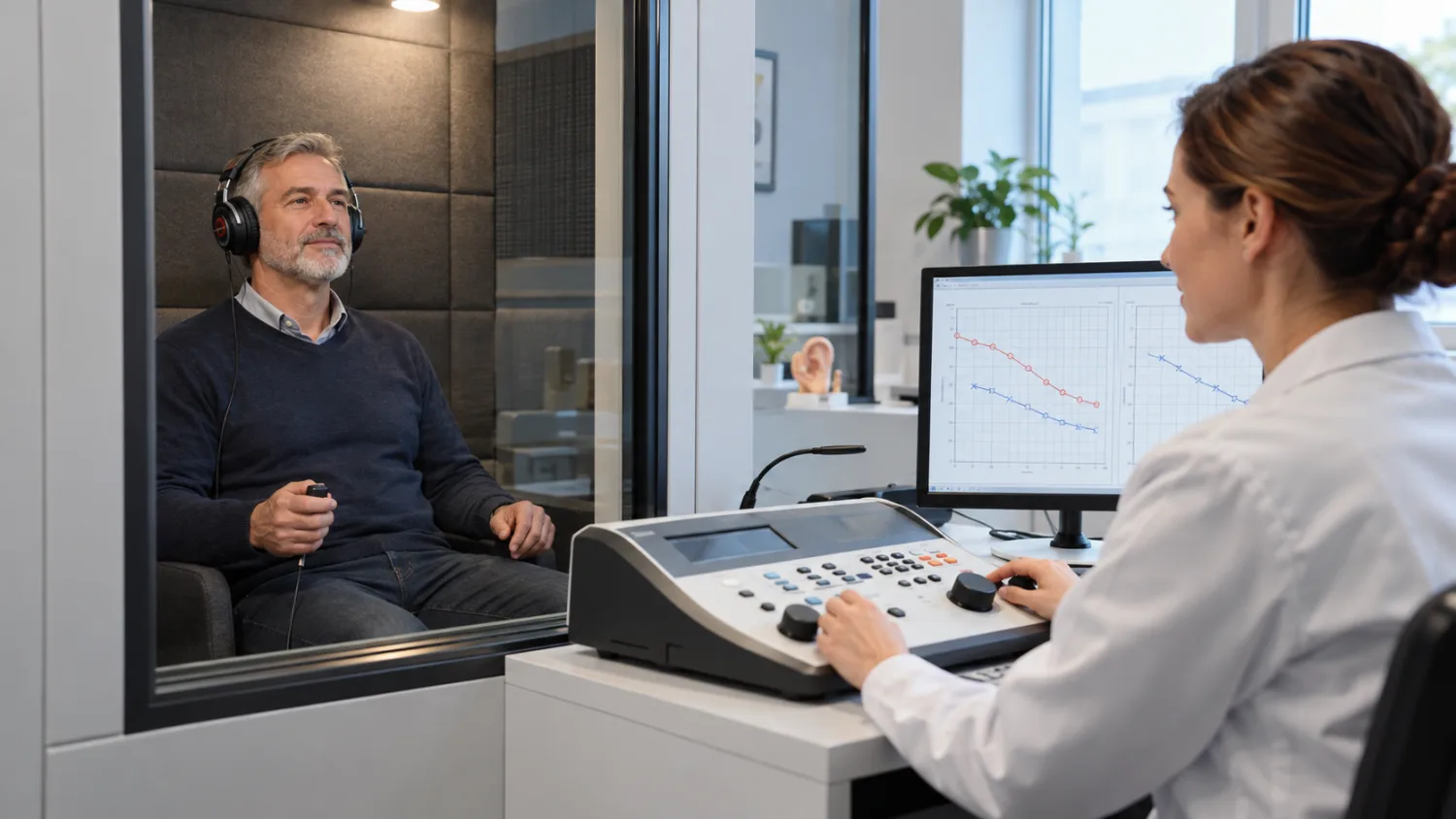
The provider should examine your ears, test your hearing and ask how hearing loss affects your daily life. A hearing graph alone cannot show whether your greatest difficulty is in meetings, on the telephone, in the car or during quiet conversation at home.
A full hearing assessment
The appointment may include:
- discussion of symptoms and medical history;
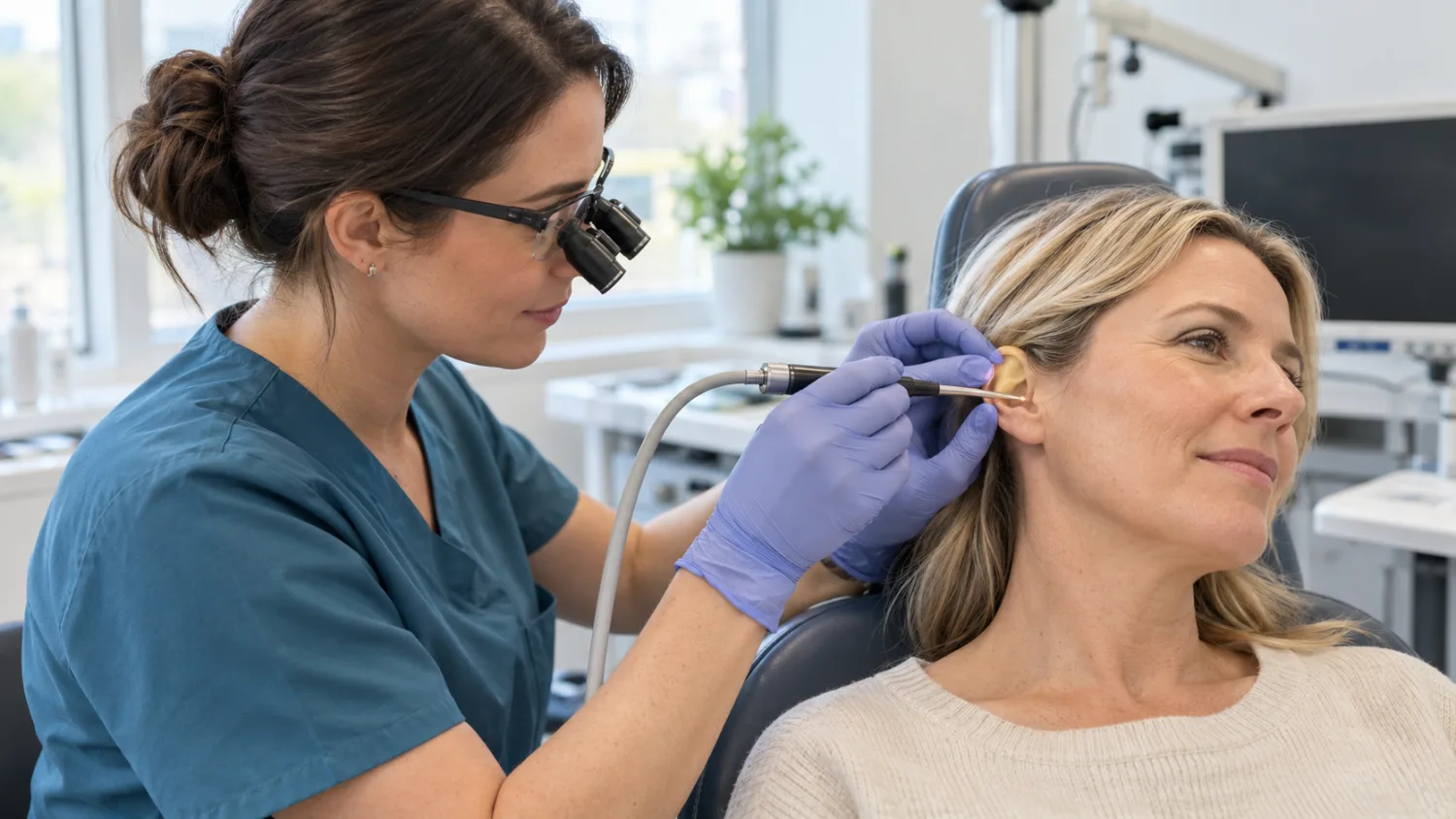
- otoscopy to inspect the ear canals and eardrums;
- pure-tone audiometry;
- bone-conduction testing;
- speech testing;
- tympanometry where appropriate;
- assessment of communication needs;
- discussion of NHS and private options.
The NHS guide to hearing tests explains the main tests and where they may be offered.
Many private providers offer free assessments. This can be useful, but remember that the clinic may earn its income through device sales. You should still receive balanced clinical advice and a medical referral when warning signs are present.
Ear examination before fitting
Wax can cause blocked or muffled hearing and may prevent an accurate hearing test.
Earache, discharge or a damaged eardrum may also require treatment before hearing aids are fitted. Our guide to earache, wax and ear infection in adults explains common symptoms and when medical advice is needed.
A private dispenser should not proceed directly to a sale when hearing loss may be caused by an untreated medical problem.
Fitting and programming
Prescription hearing aids are programmed using the hearing test and then adjusted for comfort, speech clarity and personal preference.
The fitting should cover:
- physical comfort;
- appropriate amplification;
- feedback or whistling;
- earpiece size;
- controls and programmes;
- phone and television connectivity;
- insertion and removal;
- cleaning and charging.
Real-ear measurement
Real-ear measurement checks what the hearing aid is actually producing within your ear canal.
A thin probe tube is placed near the eardrum while the hearing aid plays test sounds. The audiologist compares the measured output with a recognised prescription target.
This is valuable because every ear canal has a different size and shape. The manufacturer’s automatic “first fit” is only an estimate.
Ask whether real-ear measurement is routinely used, whether it is included in the price and what will happen if the measured response does not match the target.
Follow-up appointments
Hearing aids frequently need gradual adjustment.
At first, footsteps, paper, dishes, water and traffic may sound unexpectedly prominent. This does not always mean the aids are wrong; the brain may need time to adapt to sounds it has not heard clearly for years.
Follow-up care allows the provider to:
- adjust volume and sharpness;
- improve comfort in background noise;
- address feedback;
- change domes or moulds;
- review how consistently the aids are worn;
- help with apps and streaming;
- check that the devices still meet the prescription target.
RNID’s guide to getting the most from hearing aids includes practical advice for new and experienced users.
Warranty and repair support
Private hearing aids commonly come with a two- to five-year manufacturer warranty.
Ask whether it includes:
- manufacturing faults;
- receiver replacement;
- rechargeable batteries;
- charger failure;
- accidental damage;
- loss;
- loan aids during repairs;
- manufacturer servicing.
Loss is often excluded or covered only once with an excess.
Trial and refund terms
A provider may offer a trial, money-back guarantee or cancellation period, but the wording matters.
Before paying, ask:
- how long the trial lasts;
- when it begins;
- whether fitting fees are refundable;
- whether custom earmould charges are refundable;
- whether there is a cancellation fee;
- how the aids must be returned;
- whether the rules differ for custom in-ear aids.
A few days is rarely long enough to judge a hearing aid. Several weeks gives you a fairer opportunity to use the devices at home, outdoors and in social environments.
Private hearing aids versus NHS hearing aids
Modern digital hearing aids are available free through the NHS.
They are normally supplied on long-term loan rather than becoming the patient’s private property. The NHS also provides batteries, repairs and follow-up support, although local arrangements differ and a charge may sometimes apply when a device is repeatedly lost or damaged.
Advantages of NHS hearing aids
The main advantage is that the complete service is free at the point of use.
NHS care may include:
- a clinical hearing assessment;
- digital prescription hearing aids;
- fitting and programming;
- follow-up appointments;
- free disposable batteries;
- repairs and replacement parts;
- referral into specialist services when appropriate.
RNID confirms that modern, good-quality hearing aids are available free through the NHS.
Possible limitations of NHS provision
Depending on where you live, NHS care may involve:
- a narrower choice of manufacturers;
- fewer custom or invisible styles;
- longer waiting times;
- less choice over appointment location;
- fewer premium consumer features.
However, the idea that NHS hearing aids are universally old or basic is inaccurate. Some NHS services provide rechargeable, Bluetooth-enabled and advanced digital devices.
Advantages of paying privately
Private care may offer:
- faster appointments;
- a wider range of brands;
- more in-ear and invisible styles;
- earlier access to newly released technology;
- home visits;
- longer consultations;
- more convenient follow-up;
- advanced accessories.
These advantages can have genuine value when hearing is central to employment, study, family responsibilities or an active social life.
Will private hearing aids sound better?
Not automatically.
A premium private device fitted poorly may be less helpful than a carefully programmed NHS aid. Hearing outcomes depend on:
- the type of hearing loss;
- speech-discrimination ability;
- the fitting and verification;
- the listening environment;
- consistent device use;
- the quality of follow-up support.
Hearing aids amplify and process sound, but they cannot completely repair damaged inner-ear cells or guarantee effortless conversation in every noisy room.
Can you try NHS hearing aids first?
Yes.
Trying NHS aids can show how much properly fitted amplification helps before you spend several thousand pounds. You may find that the NHS devices meet your needs, or you may identify a specific private feature worth paying for.
You can also have a private hearing test and later ask your GP or local NHS service about an NHS referral. For a wider comparison of public and paid care, read our guide to NHS versus private healthcare in the UK.
Can you use both NHS and private aids?
Potentially, although the services are separate.
An NHS audiology department will not normally repair or reprogramme devices bought privately. A private provider may also charge to programme aids purchased from another retailer.
Hidden and ongoing hearing-aid costs
The purchase price may not be the final amount you spend.
Over five or six years, hearing aids may require batteries, wax filters, domes, receivers, tubing, repairs and eventual replacement.
Disposable batteries
Battery use depends on the device, hearing loss and amount of wireless streaming.
A regular private user might spend several tens of pounds per aid each year. Buying larger packs can reduce the cost, but check expiry dates before purchasing a very large supply.
Domes and wax filters
Receiver-in-canal aids commonly use silicone domes and replaceable wax guards.
Some aftercare packages include these. Other providers sell them separately or include only a limited initial supply.
A blocked wax filter is one of the common reasons a hearing aid suddenly appears weak or silent.
Receivers and tubing
The receiver sits in or near the ear canal and is exposed to wax and moisture. It may eventually need replacement.
Traditional BTE tubing can also harden, split or block with condensation. It normally needs periodic maintenance.
Ask whether receivers and tubing are included for the entire aftercare period or only during the manufacturer warranty.
Earwax removal
Hearing aids do not create wax, but an earpiece can interfere with the ear’s natural wax movement. Existing wax may also become more noticeable once hearing devices are fitted.
Private microsuction or other wax removal may cost approximately £50 to £100, depending on the provider and whether one or both ears require treatment.
Do not use cotton buds or insert tools into the ear canal. Ear pain, discharge, previous eardrum surgery and some other conditions may affect which wax-removal method is appropriate.
Chargers and rechargeable batteries
A replacement charger may cost £100 to £300 or more.
The internal rechargeable battery may lose capacity after several years. Ask whether the complete aid must be sent to the manufacturer, how long the repair takes and whether a loan aid is provided.
Television streamers and remote microphones
Wireless accessories are often sold separately.
Approximate costs may include:
- television streamer: £150–£300;
- remote microphone: £200–£800;
- additional charger: £100–£300;
- remote control: £100–£250.
A remote microphone can sometimes provide a greater improvement in a meeting, restaurant or classroom than moving from a mid-range aid to the most expensive premium tier.
Insurance and loss
Hearing aids are small and can be lost while changing clothes, travelling, visiting hospital or removing a face covering.
Check:
- the provider’s loss policy;
- home-contents insurance;
- personal-possessions cover;
- travel-insurance terms;
- the excess;
- whether each device must be listed individually.
For an older person living in residential care, hearing aids should ideally be labelled and documented in the care plan. Our guide to care-home contracts and personal belongings includes points families may want to clarify.
Out-of-warranty repairs
A manufacturer repair outside warranty can cost £100 to £300 or more per aid.
Ask whether the provider offers:
- a fixed-price repair;
- an extended warranty;
- a loan device;
- reduced replacement pricing when repair is uneconomical.
Replacement after five or six years
Hearing aids do not automatically become unusable after a set number of years.
Replacement may be reasonable when:
- hearing has changed beyond the device’s fitting range;
- repairs are becoming frequent;
- parts are no longer available;
- the rechargeable battery performs poorly;
- new technology addresses a genuine unmet need.
Do not replace working aids simply because a new product generation has been launched.
How to compare hearing-aid quotes properly
Comparing only the headline price is likely to produce the wrong decision.
Ask each provider for a written quotation identifying the exact product. Large retailers sometimes use exclusive or relabelled names, which can make direct comparisons difficult.
Get the exact product details
The quote should state:
- manufacturer;
- model family;
- technology tier;
- style;
- rechargeable or disposable battery;
- whether one or two devices are included;
- included accessories;
- warranty period;
- aftercare period.
Descriptions such as “advanced digital hearing system” are not specific enough.
Compare the aftercare
Ask:
- How many appointments are included?
- For how many years?
- Are annual hearing tests included?
- Are wax guards, domes and receivers included?
- Are home visits charged separately?
- Will I see the same audiologist?
- What happens if the branch closes?
- Can another branch access my records?
Ask how the fitting is verified
Useful questions include:
- Do you routinely perform real-ear measurements?
- Will you test speech understanding?
- How will you measure whether the aids have helped?
- Can the devices be reprogrammed during the trial?
- Will the settings be reviewed after I have worn them in real environments?
Compare providers as well as devices
The clinician’s skill and availability can matter as much as the hearing-aid brand.
An independent audiologist may offer a wider choice of manufacturers and greater continuity. A national chain may provide more locations, standardised support and easier repairs while travelling.
Neither model is automatically superior. The best service is the one that combines clinical competence, convenient follow-up and transparent pricing.
Check professional registration
Someone who dispenses hearing aids privately by retail sale or hire must be registered with the Health and Care Professions Council as a hearing aid dispenser.
Use the HCPC professional register to check the clinician by surname or registration number.
HCPC registration confirms that the professional must meet standards relating to assessment, fitting, programming, communication and safe practice. It does not prove that one provider offers the best commercial deal, but it is a basic safety check.
Watch for sales pressure
Be cautious when:
- a large discount expires that day;
- finance is discussed before the clinical findings;
- the provider dismisses all NHS aids as poor quality;
- the most expensive tier is recommended without exploring your lifestyle;
- medical warning signs are ignored;
- the trial terms are vague;
- the exact product name is withheld.
Hearing loss usually develops gradually. There is rarely a clinical reason to sign a costly agreement during the first consultation.
Are cheaper online and over-the-counter devices worth considering?
Low-cost products sold online may be prescription hearing aids, self-fitting hearing products, consumer earbuds or simple amplifiers. These are not all equivalent.
Prices range from under £50 to several hundred pounds.
Basic hearing amplifiers
Simple amplifiers make sounds louder, often across a broad range of frequencies.
They may help with television or occasional one-to-one conversation, but they can also amplify background noise and may not match the pattern of hearing loss.
They should not replace an ear examination when the cause of hearing difficulty is unknown.
Hearables and consumer earbuds
Some wireless earbuds now offer:
- conversation enhancement;
- hearing-check software;
- personalised amplification;
- active noise cancellation;
- live-listening features.
They may help someone with mild difficulty in selected situations, but comfort, battery life and all-day wear can be limiting.
Over-the-counter hearing aids
The UK market is changing, and products may increasingly be sold without a traditional clinic fitting.
RNID’s guide to over-the-counter hearing aids explains the distinction between these products and professionally prescribed devices.
A professional assessment can identify wax, infection, conductive hearing loss and other conditions that an online hearing check cannot diagnose.
When a lower-cost product may be reasonable
It may be worth considering when:
- hearing difficulty is mild;
- help is needed only in occasional situations;
- both ears are affected similarly;
- there are no medical warning signs;
- the return policy is clear;
- the buyer understands the limitations.
When not to buy online first
Arrange professional assessment when hearing loss is:
- sudden;
- strongly one-sided;
- rapidly worsening;
- accompanied by pain or discharge;
- associated with severe dizziness;
- linked with one-sided or pulsatile tinnitus;
- affecting a child;
- possibly caused by wax, infection or another treatable condition.
If the main symptom is ringing, buzzing or another sound without an external source, see our guide to tinnitus causes and treatment.
When hearing changes occur with spinning, imbalance or faintness, our article on dizziness, vertigo and when to worry may also be helpful.
Getting used to hearing aids and making the purchase worthwhile
Even a well-fitted hearing aid may sound strange at first.
The brain may not have heard certain frequencies clearly for years. Once they return, ordinary sounds such as running water, paper, footsteps and cutlery can seem unexpectedly sharp.
Adaptation normally requires time, consistent use and appropriate adjustments.
Wear the aids regularly
Many people adapt more successfully when they build up regular daily use rather than saving the devices for special occasions.
You might begin with:
- quiet conversation at home;
- television;
- short walks;
- small family groups;
- shops and cafés;
- larger social situations.
Sounds should not remain painfully loud. Return to the provider if the aids cause discomfort, headaches or a strong desire to remove them.
Wear two aids when both ears need help
When there is aidable hearing loss in both ears, two devices can improve:
- sound direction;
- balance between the ears;
- speech understanding;
- listening comfort;
- awareness of surrounding sounds.
One aid may still be appropriate when only one ear has useful hearing, one ear has a medical problem or a CROS-type system is more suitable.
Understand what hearing aids cannot do
Hearing aids improve access to sound, but they do not fully recreate normal inner-ear function.
Background noise remains challenging because many forms of hearing loss reduce the ability to distinguish speech, not merely its volume.
Communication strategies remain valuable:
- face the speaker;
- reduce competing sound where possible;
- ask people to speak clearly rather than shout;
- use television captions;
- sit where faces are well lit;
- use a remote microphone for difficult settings.
Describe problems precisely
Do not leave costly aids unused because the first fitting was imperfect.
Keep notes about specific difficulties. Tell the audiologist:
- my own voice sounds blocked;
- dishes sound painfully sharp;
- I cannot follow my partner in the car;
- the aid works loose;
- speech remains unclear even though it is louder;
- restaurant noise overwhelms conversation;
- the phone keeps disconnecting.
This is more helpful than simply saying the devices do not work.
Maintain the hearing aids
Routine care may involve:
- wiping the devices daily;
- checking the domes or moulds;
- changing wax filters;
- clearing microphone openings;
- drying moisture;
- charging regularly;
- storing the aids safely away from pets and children.
RNID also provides troubleshooting advice for common hearing-aid problems.
Frequently asked questions about private hearing-aid costs
How much do private hearing aids cost in the UK?
A pair commonly costs approximately £1,000 to £5,000 or more, depending on the technology, style and aftercare package.
What is the average cost of a pair?
Many private buyers spend somewhere in the middle of the range, often around £2,000 to £3,500 for two aids with professional support.
How much does one hearing aid cost?
One private device may cost roughly £500 to £2,750.
Is an advertised price normally for one aid or two?
It varies. Always ask whether the price covers one device, two devices or only a starting package.
Can I get hearing aids free through the NHS?
Yes. NHS hearing aids are provided free on long-term loan, with batteries, repairs and follow-up care normally included.
Are NHS hearing aids modern?
Yes. They are digital prescription devices. The exact models and styles available vary between local services.
Are private hearing aids better?
Not automatically. Private services may offer greater choice, speed and convenience, but fitting quality and aftercare remain critical.
Why would someone choose private hearing aids?
Common reasons include faster appointments, greater brand choice, rechargeable options, smaller styles, advanced wireless features and convenient long-term support.
Can I have a private hearing test and then use the NHS?
Yes. A private test does not remove your right to seek NHS assessment or NHS hearing aids.
Will the NHS repair private aids?
Usually not. Repairs and programming are normally handled by the private supplier or manufacturer.
Does private medical insurance cover hearing aids?
Many standard policies exclude routine hearing aids. Employer benefits or health cash plans may offer a limited contribution.
Can I pay monthly?
Many providers offer finance. Compare the cash price, interest rate, monthly payment and total amount repayable.
Are private hearing tests free?
Many high-street providers offer free assessments. Independent or specialist audiologists may charge a consultation fee.
Do I have to buy after a free hearing test?
No. Ask for a copy of the results and take time to compare NHS and private options.
How long do hearing aids last?
Many last around five to seven years, although well-maintained aids can remain useful for longer.
Do I need new aids every five years?
No. Replacement should depend on hearing changes, repairability and whether new technology offers a meaningful benefit.
How long is the warranty?
Private warranties commonly last between two and five years.
Does the warranty cover loss?
Often not. Loss may require separate insurance or may be covered once with an excess.
Are rechargeable hearing aids more expensive?
They may cost slightly more upfront but remove the need to buy and handle disposable batteries.
How long does one charge last?
Many devices last a full day, although heavy streaming and severe hearing loss can shorten operating time.
Can the rechargeable battery be replaced?
Usually, although the aid may need to be returned to the manufacturer and charges may apply outside warranty.
How much does a replacement charger cost?
A replacement may cost approximately £100 to £300 or more.
How much does an out-of-warranty repair cost?
A manufacturer repair may cost roughly £100 to £300 or more per device.
Are wax filters and domes included?
Sometimes. Check whether consumables are included for the full aftercare period or only provided initially.
How much does private earwax removal cost?
It commonly costs around £50 to £100, depending on the clinic and number of ears treated.
Do hearing aids cause earwax?
They do not create wax, but wearing an earpiece can interfere with natural wax movement and make blockage more noticeable.
Do I need one hearing aid or two?
Two are commonly recommended when both ears have aidable hearing loss because they support balanced and directional hearing.
Is one aid half the price of a pair?
Not always, because assessment and fitting costs remain and providers may discount pairs.
What type of hearing aid is best?
There is no universal best style. The right device depends on the hearing loss, ear health, dexterity, lifestyle and personal preferences.
Are invisible hearing aids better?
No. They are discreet but may have shorter battery life, fewer features and greater vulnerability to wax.
Are behind-the-ear hearing aids outdated?
No. Modern BTE and RIC devices are among the most capable hearing aids available.
Can hearing aids remove background noise?
No. They can reduce some noise and prioritise speech, but they cannot eliminate every competing sound.
Are premium aids worth the extra money?
They may be worthwhile for demanding listening environments, but not everyone will experience enough additional benefit to justify the price.
Are AI hearing aids better?
Some offer useful automatic processing. The value depends on how those features address your real listening needs.
Can hearing aids connect to a mobile phone?
Many can, but compatibility differs between hearing-aid models and phones.
Can hearing aids connect to a television?
Yes, often through a separate streamer or compatible wireless connection.
Is a television streamer included?
Usually not unless the package specifically lists it.
What is a remote microphone?
It is a microphone placed near a speaker that transmits their voice directly to the hearing aids.
How long should the trial period be?
Several weeks is preferable because you need to test the devices in different environments.
Can custom in-ear hearing aids be returned?
Return terms vary. Check whether custom manufacturing or fitting charges are refundable.
What are real-ear measurements?
They measure the sound produced by the aid inside your ear and help verify that the fitting matches a recognised prescription target.
Who regulates private hearing-aid dispensers?
The Health and Care Professions Council regulates hearing-aid dispensers working in private retail practice.
How can I check a dispenser?
Search the HCPC register using the clinician’s surname or registration number.
Can I buy hearing aids online?
Yes, but check whether the product is a prescription aid, self-fitting device or basic amplifier and what professional support is included.
Are cheap hearing amplifiers safe?
Some may help in limited circumstances, but they can amplify background noise and may delay diagnosis of a treatable problem.
Do I need a hearing test first?
A hearing assessment and ear examination are strongly recommended before prescription devices are fitted.
Can earwax make it seem as though I need hearing aids?
Yes. Wax can cause temporary conductive hearing loss and should be identified before fitting.
Can hearing aids help tinnitus?
They may reduce tinnitus awareness when hearing loss is present by restoring external sound.
Can hearing aids make tinnitus worse?
They usually do not, but uncomfortable amplification, wax blockage or a poor fitting can make symptoms more noticeable.
Can hearing aids restore normal hearing?
No. They improve access to sound but cannot completely restore normal inner-ear function.
Why do voices sound strange at first?
The brain needs time to adapt to sounds and frequencies that have not been heard clearly for some time.
How long does adaptation take?
Many people adjust over several weeks, although fine-tuning may continue for a few months.
Should hearing aids be worn all day?
Regular daily use generally helps adaptation, although wearing time may be increased gradually at first.
Why do hearing aids whistle?
Feedback may result from wax, a loose physical fit, excessive amplification or a blocked component.
Why does my own voice sound blocked?
This is called the occlusion effect. It may improve after changing the dome, venting or programming.
When is hearing loss urgent?
Sudden hearing loss over hours or days requires urgent medical assessment. Do not wait for a routine private hearing test.
When should hearing loss be assessed by ENT?
Referral may be needed for strongly one-sided loss, rapid deterioration, pain, discharge, severe dizziness, facial weakness, abnormal eardrum findings or one-sided or pulsatile tinnitus.
Are private hearing aids worth the cost?
They can be worthwhile when greater choice, faster access and high-quality continuing support meet a genuine need. They are poor value when expensive technology is oversold, the fitting is not verified or the free NHS service would meet the person’s needs equally well.