Waking up and suddenly being unable to hear properly through one ear can easily be mistaken for earwax, congestion or an ear that simply needs to “pop”.
Sometimes that is exactly what it is.
But sudden hearing loss can also come from the inner ear or hearing nerve. This is known as sudden sensorineural hearing loss, often shortened to SSNHL, and it needs urgent medical assessment because treatment may be more effective when started early.
NICE treats sudden unexplained hearing loss developing over three days or less as a medical emergency. If it began within the previous 30 days and cannot be explained by an obvious outer- or middle-ear problem, the recommendation is for specialist assessment within 24 hours.
That does not mean every suddenly blocked ear represents permanent hearing loss. Wax, infection and middle-ear fluid are common. The problem is that you usually cannot safely distinguish these from sudden inner-ear hearing loss just by how the ear feels.
This guide explains what sudden sensorineural hearing loss feels like, how it differs from a blocked ear, why timing matters, what tests are normally performed and when to seek urgent help.
What Is Sudden Sensorineural Hearing Loss?
Sudden sensorineural hearing loss is a rapid loss of hearing caused by a problem affecting the cochlea in the inner ear or the nerve pathways that carry sound towards the brain.
It usually affects one ear, although both ears can occasionally be involved.
The hearing change may happen:
- all at once;
- when you wake up in the morning;
- over several hours;
- over a period of up to about three days.
Some people notice a dramatic loss of hearing. Others describe the affected ear as muffled, distant or strangely distorted.
This is different from the gradual hearing loss that commonly develops over years with ageing or long-term noise exposure.
For a broader explanation of different types of hearing impairment, see our complete guide to hearing loss.
What Does Sudden Hearing Loss Feel Like?
The most obvious symptom is suddenly hearing much less through one ear.
But people do not always recognise it as hearing loss.
You might instead notice that:
- one ear suddenly feels blocked or full;
- speech sounds muffled;
- the television sounds different when you cover one ear;
- telephone audio suddenly sounds much quieter through one side;
- you develop new tinnitus in one ear;
- sounds become distorted rather than simply quieter;
- you feel dizzy or unsteady at the same time.
Tinnitus is particularly common alongside sudden sensorineural hearing loss. It may sound like ringing, buzzing, humming or a high-pitched tone.
If tinnitus itself is the main problem, our guide to tinnitus causes and treatment explains it in more detail.
Vertigo or dizziness can also occur because the hearing and balance organs sit together within the inner ear.
Why Does Sudden Hearing Loss Need Urgent Assessment?
The urgency comes from the possibility that the hearing loss is sensorineural rather than simply caused by wax or congestion.
NICE states that sudden hearing loss developing over three days or less and occurring within the previous 30 days should be referred immediately when there is no obvious external- or middle-ear cause.
“Immediately” in this context means being seen by an appropriate specialist service within 24 hours.
The reason is straightforward: some causes are treatable, and delayed treatment may reduce the chance of hearing recovery.
Corticosteroids are commonly considered for idiopathic sudden sensorineural hearing loss, particularly when treatment can be started early.
An NHS patient information service from University Hospitals Sussex advises people with a sudden change in hearing not to wait for it to improve by itself and notes that recovery prospects are better when appropriate treatment starts promptly.
If your hearing suddenly drops in one or both ears, seek an urgent GP appointment or contact NHS 111. Depending on the circumstances, you may be directed to ENT or an emergency department.
Could It Just Be Earwax or a Blocked Ear?
Yes — and this is exactly why sudden hearing loss can be confusing.
Common non-sensorineural causes include:
- impacted earwax;
- an outer-ear infection;
- a middle-ear infection;
- fluid behind the eardrum;
- congestion after a cold;
- Eustachian tube dysfunction.
These conditions interfere with the transmission of sound through the outer or middle ear and are described as conductive hearing loss.
They are often much less time-sensitive than sudden sensorineural hearing loss.
The problem is that both can create a very similar sensation.
An inner-ear hearing loss can feel as though the ear is simply plugged.
That is why assuming “it is probably wax” and waiting a week can be risky if the hearing loss appeared suddenly.
Our guide to blocked ears, wax, pressure and other causes explains some of the more common alternatives.
What Causes Sudden Sensorineural Hearing Loss?
In many cases, no definite cause is identified. Doctors may describe this as idiopathic sudden sensorineural hearing loss.
Several mechanisms have been proposed, including inflammation, viral illness, changes in the blood supply to the cochlea and autoimmune processes.
Less commonly, sudden hearing loss can be associated with an identifiable condition.
Possible causes include:
- certain infections;
- autoimmune disease;
- inner-ear disorders;
- head trauma;
- some medicines that can damage hearing;
- problems affecting the hearing nerve;
- rarely, neurological or vascular causes.
A vestibular schwannoma — a usually benign tumour affecting the nerve between the inner ear and brain — is one reason an MRI may later be recommended, particularly when hearing loss is asymmetrical.
This does not mean that suddenly losing hearing in one ear usually means a brain tumour. Most sudden sensorineural hearing loss remains unexplained even after investigation.
How Is Sudden Hearing Loss Diagnosed?
The first task is to work out whether the problem is conductive or sensorineural.
A doctor may examine the ear canal and eardrum to look for:
- wax;
- infection;
- a perforated eardrum;
- fluid behind the eardrum;
- another obvious mechanical cause.
Simple bedside tuning-fork tests can sometimes help distinguish outer- or middle-ear problems from inner-ear hearing loss.
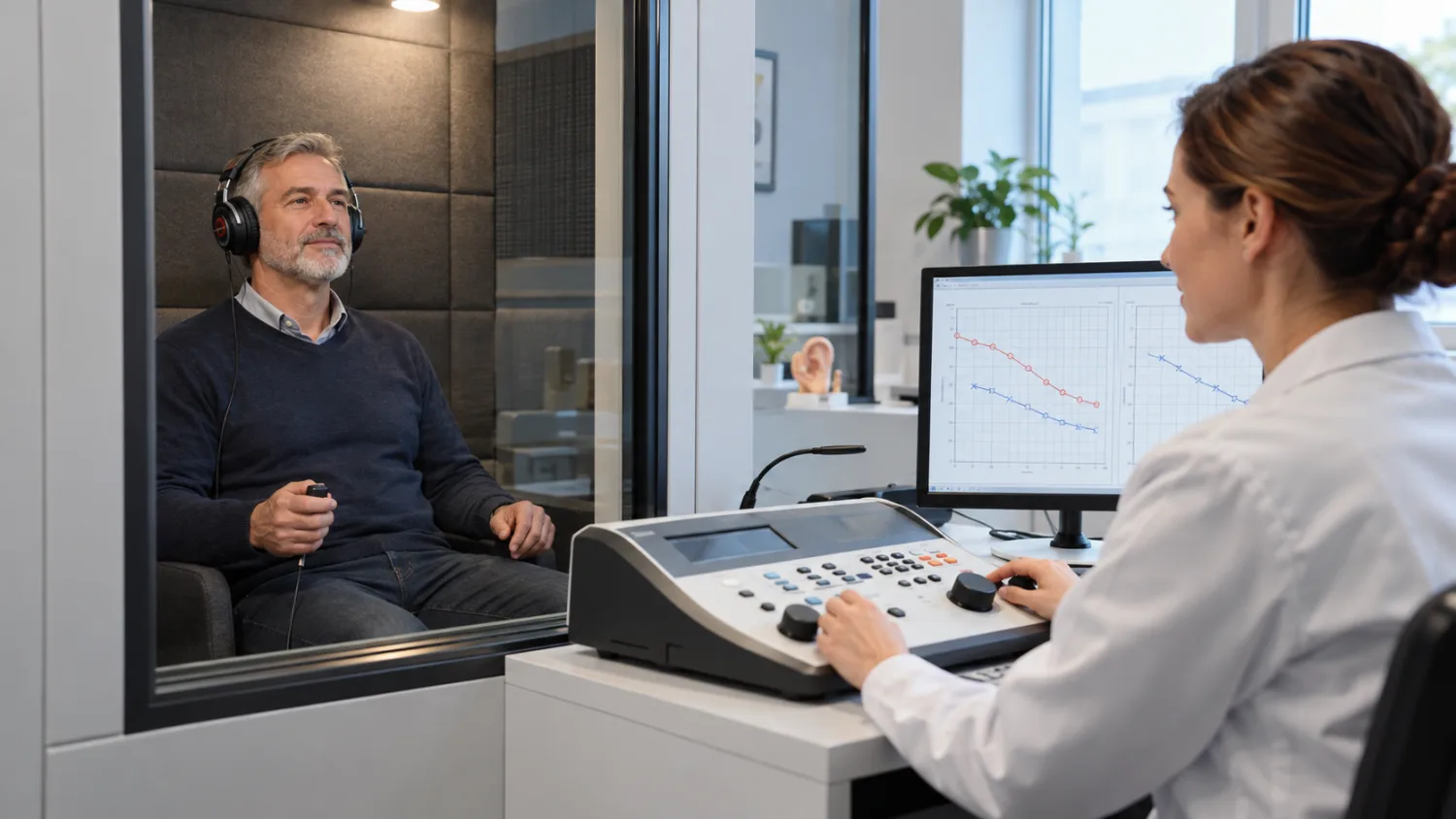
The key investigation is usually a formal hearing test, or audiogram.
Audiometry measures how quietly you can hear different frequencies and helps show the type and severity of hearing loss.
If sudden sensorineural hearing loss is confirmed, hearing may be retested after treatment to see whether it has improved.
Additional investigations depend on the clinical situation rather than being identical for everybody.
Will You Need an MRI Scan?
Not necessarily immediately, but an MRI is sometimes requested after sudden sensorineural hearing loss.
The purpose is usually to look at the hearing nerve and surrounding structures and exclude less common causes such as a vestibular schwannoma.
An MRI is especially relevant when hearing loss remains asymmetrical or when other neurological or balance symptoms are present.
The urgent priority, however, is generally not to wait several weeks for imaging before the hearing loss is assessed and treatment considered.
If you want to understand what the scan involves, see our guide to what an MRI scan shows.
How Is Sudden Sensorineural Hearing Loss Treated?
The main treatment commonly considered for idiopathic sudden sensorineural hearing loss is a course of corticosteroids.
These medicines are intended to reduce inflammation affecting the inner ear.
Steroids may be given as tablets. In some situations, an ENT specialist may also consider intratympanic steroids, where medicine is placed through the eardrum into the middle ear so that it reaches the inner ear at a high concentration.
Intratympanic treatment may be considered when:
- oral steroids are unsuitable;
- initial treatment has not produced sufficient recovery;
- an ENT specialist believes further treatment is appropriate.
Steroids are not suitable for everyone and can have important side effects, so treatment needs an individual medical decision rather than self-treatment.
If another specific cause is identified, treatment may instead be directed at that underlying problem.
Will Hearing Come Back?
Recovery varies considerably.
Some people regain most or all of their hearing. Others recover only part of it, and some are left with significant permanent hearing loss.
The outcome depends on several factors, including:
- how severe the initial hearing loss was;
- which frequencies were affected;
- whether vertigo was also present;
- the underlying cause;
- how quickly assessment and treatment occurred.
It is therefore difficult to predict an individual person's recovery at the first appointment.
This uncertainty is another reason not to wait several days to see what happens.
If hearing does not fully recover, audiology and ENT services can discuss rehabilitation options such as hearing aids and, for severe losses, other hearing technologies.
You can read more about the practical options in our guide to private hearing aid costs in the UK.
When Does Dizziness With Hearing Loss Become More Concerning?
Sudden inner-ear hearing loss can occur with dizziness or vertigo.
For example, labyrinthitis can affect both hearing and balance.
But new hearing loss combined with neurological symptoms needs particularly urgent assessment.
Call 999 for symptoms suggesting a possible stroke, such as:
- facial weakness;
- weakness or numbness down one side of the body;
- difficulty speaking;
- sudden severe problems with coordination;
- collapse or reduced consciousness.
Sudden severe dizziness with difficulty walking can also require emergency assessment, particularly when accompanied by neurological symptoms.
For more detail on different causes, see our guide to dizziness and when to worry.
What Should You Do If Your Hearing Suddenly Drops?
Do not spend several days repeatedly trying to pop the ear or using wax treatments while waiting to see whether hearing returns.
If hearing has suddenly dropped in one or both ears:
- Seek urgent medical advice. Contact your GP urgently or NHS 111 if you cannot obtain prompt assessment.
- Explain the timing clearly. Say that your hearing changed suddenly and when you first noticed it.
- Mention tinnitus or vertigo. These symptoms can support suspicion of an inner-ear problem.
- Do not assume it is wax. Wax should be checked, but sensorineural hearing loss also needs to be excluded.
- Report neurological symptoms immediately. Facial weakness, speech problems or one-sided weakness may require emergency assessment.
If the hearing loss developed suddenly more than a month ago and was never assessed, it is still worth seeking medical advice. NICE recommends urgent specialist referral even when sudden hearing loss occurred more than 30 days previously.
Frequently Asked Questions
Is sudden hearing loss an emergency?
Yes, when it develops over three days or less and cannot be clearly explained by an outer- or middle-ear cause. NICE recommends specialist assessment within 24 hours when the sudden loss occurred within the previous 30 days.
Can sudden hearing loss just be earwax?
Yes. Impacted wax is a common cause of sudden-feeling hearing loss. However, inner-ear hearing loss can feel almost identical, so a sudden significant change should not simply be assumed to be wax without assessment.
What does sudden sensorineural hearing loss feel like?
People may describe one ear becoming suddenly quiet, muffled, blocked or distorted. Tinnitus, ear fullness, dizziness or vertigo may occur at the same time.
Can you wake up with sudden hearing loss?
Yes. Some people first notice SSNHL when they wake up and realise one ear is hearing much less than the other.
Does sudden hearing loss always affect one ear?
No, but one-sided hearing loss is much more typical. Sudden loss affecting both ears is unusual and also needs urgent medical assessment.
How quickly should sudden hearing loss be treated?
Assessment should happen as quickly as possible. NICE recommends that sudden unexplained hearing loss arising within the past 30 days should be seen by an appropriate specialist service within 24 hours.
Are steroids used for sudden hearing loss?
Yes. Corticosteroids are commonly considered for idiopathic sudden sensorineural hearing loss. They may be given orally, and an ENT specialist may sometimes use steroid injections through the eardrum. Treatment suitability depends on the individual.
Can sudden hearing loss recover without treatment?
Some people do recover spontaneously, but it is impossible to know in advance who will. Waiting for spontaneous recovery can delay time-sensitive treatment, so sudden hearing loss should still be assessed urgently.
Can tinnitus be the first sign of sudden hearing loss?
Yes. New tinnitus can appear alongside SSNHL, sometimes with only subtle awareness of the hearing reduction. Sudden one-sided tinnitus with an obvious change in hearing deserves prompt assessment.
Can a cold cause sudden hearing loss?
A cold can cause congestion, middle-ear fluid and Eustachian tube dysfunction, all of which can temporarily reduce hearing. However, sudden sensorineural hearing loss can also occur around the time of an illness, so a major sudden reduction should still be checked.
Can stress cause sudden hearing loss?
Stress can affect how tinnitus and other symptoms are perceived, but a sudden measurable loss of hearing should not be dismissed as stress. It requires assessment to establish whether the problem comes from the outer, middle or inner ear.
Will I need a hearing test?
Usually, yes. Formal audiometry is important for confirming sensorineural hearing loss, measuring its severity and providing a baseline against which recovery can be compared.
Should I go to A&E for sudden hearing loss?
You need urgent assessment, but the best route varies locally. An urgent GP appointment or NHS 111 can direct you to the appropriate service. NICE pathways allow referral to ENT or an emergency department when sudden unexplained hearing loss needs immediate specialist care.
What if the hearing loss happened several weeks ago?
Do not assume it is too late to seek help. NICE recommends urgent specialist assessment even when sudden hearing loss occurred more than 30 days previously, although the treatment options and likelihood of recovery may differ.
This guide provides general information and should not be used to assess a sudden hearing change at home. Sudden unexplained hearing loss can be a medical emergency. Seek urgent medical assessment rather than waiting to see whether it improves.