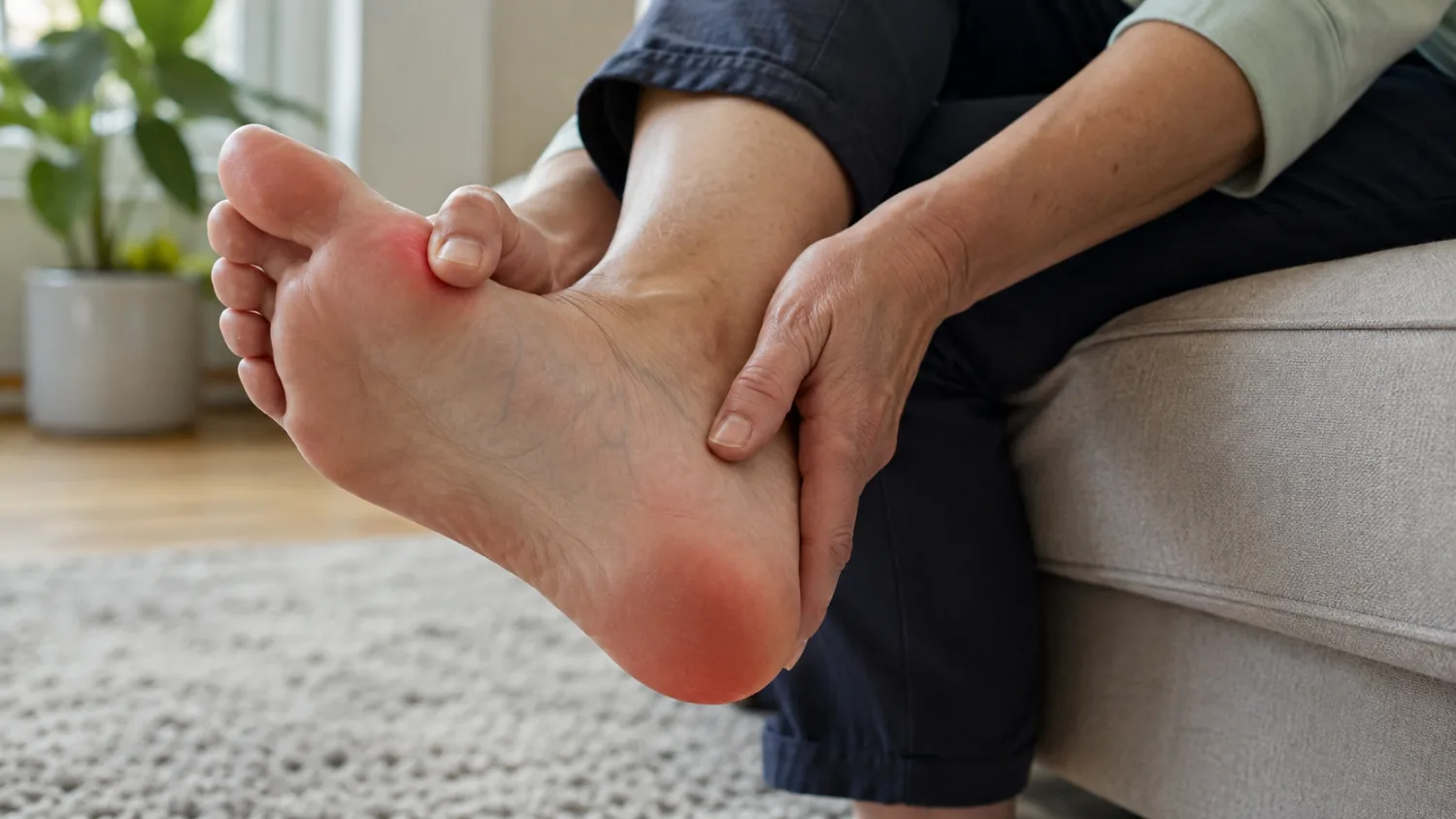
Bunions and plantar fasciitis are two very common causes of foot pain, but they affect different parts of the foot and need different approaches to treatment.
A bunion develops around the joint at the base of the big toe. The big toe gradually moves towards the smaller toes and the joint becomes more prominent on the inner side of the foot. Some bunions remain largely painless; others become sore, stiff and difficult to fit into normal shoes.
Plantar fasciitis usually causes pain underneath the heel or along the arch of the foot. A particularly typical symptom is pain during the first few steps after getting out of bed or standing after sitting for a while.
Neither problem necessarily means something serious is wrong, and both can often be managed without surgery. Footwear, activity changes and appropriate exercises can make a substantial difference.
However, persistent foot pain should not simply be put down to ageing, bad shoes or “flat feet”. Heel pain can occasionally come from an Achilles problem, stress fracture, nerve irritation or inflammatory disease, while pain around the big toe can also be caused by arthritis, gout or another joint disorder.
If you also develop areas of thickened skin because your footwear is rubbing against a bunion or changing the pressure underneath your foot, our guide to corns and calluses explains how these can be managed safely.
Seek medical advice more urgently if you suddenly cannot put weight on the foot, there has been significant injury, the foot becomes hot and very swollen, you develop fever, or you have a wound that is not healing.
Sudden severe pain and swelling around the big-toe joint may be caused by gout rather than an ordinary bunion flare. Sudden heel pain with a snapping or popping sensation can indicate an Achilles tendon injury or fracture.
If you have diabetes, poor circulation, loss of sensation in your feet or an open sore, get professional advice rather than treating significant foot problems yourself.
Bunions and plantar fasciitis: what is the difference?
The easiest way to tell these conditions apart is to look at where the pain is and when it occurs.
| Feature | Bunion | Plantar fasciitis |
|---|---|---|
| Main location | Base of the big toe | Bottom of heel or arch |
| Visible change | Often a prominent bump and big toe leaning inward | Usually no obvious visible deformity |
| Typical pain pattern | Pain from pressure, footwear or movement of the toe joint | Often worst during the first steps after rest |
| Main problem | Joint alignment and pressure | Overload and irritation of plantar fascia |
| Can exercises remove it? | No, exercises cannot reverse a structural bunion | Exercises are an important part of treatment |
| Does surgery sometimes help? | Yes, for significant painful bunions | Rarely; most cases improve without surgery |
The NHS describes a bunion as a bony lump on the side of the foot caused by the big toe moving towards the other toes. Plantar fasciitis, in contrast, causes pain where the thick band of tissue running from the heel towards the toes becomes overloaded or irritated. NHS bunion guidance and the NHS plantar fasciitis guide provide useful overviews.
Can you have both at the same time?
Yes.
The way someone walks, the shoes they can tolerate and the shape of the foot can influence pressure throughout the foot.
A painful bunion may cause someone to alter their gait, while plantar heel pain can make them shift weight towards the front or outside of the foot.
That does not mean one condition always causes the other. They can simply coexist.
What is a bunion?
The medical term for the usual bunion deformity is hallux valgus.
The big toe gradually angles towards the second toe while the first metatarsal—the long bone behind the big toe—moves in the opposite direction. This makes the joint at the base of the big toe look prominent.
NICE defines hallux valgus as lateral deviation of the great toe towards the lesser toes.
The bump itself is therefore not simply an extra piece of bone growing on an otherwise normal joint. The alignment of the bones has changed.
What does a bunion look like?
You may notice:
- a bump on the inner side of the foot at the base of the big toe;
- the big toe leaning towards the second toe;
- red or thickened skin over the joint;
- difficulty fitting comfortably into shoes;
- callus underneath or between the toes;
- overlapping or crowded toes in more advanced cases.
Do bunions always hurt?
No.
Some people have quite obvious bunions but very little discomfort.
Others have a relatively modest deformity that becomes painful because of footwear pressure or arthritis within the joint.
Guy's and St Thomas' NHS Foundation Trust notes that bunions that are not painful do not necessarily require treatment.
Can you get a bunion on the little-toe side?
Yes. A similar prominence can form near the base of the little toe and is sometimes called a bunionette or tailor's bunion.
It is a different deformity from the classic big-toe bunion but can cause similar problems with shoe pressure.
What causes bunions?
There is rarely one single cause.
Bunions often develop from a combination of inherited foot structure, joint mechanics and external pressure.
Family history
Bunions commonly run in families.
This does not necessarily mean inheriting a bunion itself. A person may inherit characteristics such as foot shape, joint flexibility or the way the foot functions when walking that make hallux valgus more likely.
Footwear
Narrow, pointed or high-heeled shoes can crowd the toes and increase pressure around an existing bunion.
Footwear is probably better thought of as a contributor rather than the sole cause in every case.
Someone may develop bunions despite wearing sensible footwear, while another person can wear narrow shoes for years without developing a major deformity.
Joint hypermobility and foot mechanics
Greater movement within some foot joints may contribute to altered loading around the big toe.
If you have widespread joint flexibility, our guide to hypermobility syndrome explains when joint hypermobility becomes clinically significant.
Arthritis
Inflammatory arthritis such as rheumatoid arthritis can affect the joints and structures of the forefoot and contribute to deformity.
Are bunions caused by flat feet?
Flat or pronating feet can alter foot mechanics, but having flat feet does not mean you will inevitably develop a bunion.
Likewise, correcting the arch with an insole cannot reliably reverse an established bunion.
Bunion symptoms and when they become a problem
The most common complaint is pain around the prominent joint when wearing shoes.
The NHS lists pain, swelling, redness and difficulty wearing normal shoes among common bunion problems.
Pain from shoe pressure
The skin and soft tissue over the prominent joint can become irritated where a shoe rubs against it.
You may notice:
- redness;
- tenderness;
- burning discomfort;
- thickened skin;
- occasional swelling.
Big-toe joint pain
Pain can also come from inside the joint itself.
If the big-toe joint is becoming very stiff rather than simply drifting sideways, another condition called hallux rigidus—arthritis of the big-toe joint—may need consideration.
Pain under the ball of the foot
As the big toe becomes less effective at carrying load, pressure may shift underneath the smaller metatarsal heads.
This can result in:
- callus;
- forefoot discomfort;
- pain beneath the second or third toes.
Second-toe problems
A larger bunion can crowd the second toe.
Over time the second toe may lift, bend or overlap.
When should you see someone?
See a GP, podiatrist or suitable foot specialist if:
- pain keeps returning;
- shoe choice has become very restricted;
- walking or exercise is being affected;
- the deformity is progressing;
- you are unsure whether the problem really is a bunion.
How are bunions treated without surgery?
Non-surgical treatment does not straighten an established bunion permanently.
Its purpose is to reduce pressure, discomfort and secondary problems.
The NHS explicitly states that surgery is the only way to remove/correct a bunion, although many people can manage symptoms without an operation.
Choose shoes with enough room
This is often the most useful change.
Look for:
- a broad toe box;
- soft upper material;
- enough depth around the toes;
- secure fastening;
- a low or moderate heel.
The shoe should follow the shape of the foot rather than squeezing the foot into the shape of the shoe.
Bunion pads
A soft pad can reduce friction between the prominent joint and the shoe.
It will not correct the underlying alignment.
Make sure the pad itself does not make the shoe tighter, because that can increase pressure instead.
Toe spacers
Silicone spacers may make the toes feel more comfortable for some people.
They cannot reliably reverse a structural bunion.
Insoles and orthotics
An insole may help redistribute pressure if the way the foot loads is contributing to symptoms.
Orthoses are more useful for symptom management than for permanently straightening the toe.
Pain relief
Simple pain relief can sometimes help during flare-ups.
Paracetamol or anti-inflammatory medicines may be appropriate for some people, although anti-inflammatory tablets are not suitable for everyone.
A pharmacist can advise if you have stomach, kidney, heart, blood-pressure or medication-related concerns.
Can bunion exercises work?
Exercises may help maintain mobility and foot strength.
They may reduce stiffness or improve comfort.
They cannot reliably move the bones of an established bunion back into normal alignment.
What about bunion splints?
Many online products promise to “correct” bunions overnight.
A splint may temporarily hold the toe straighter while it is worn and may relieve pressure for some people.
It should not be expected to permanently correct an established adult hallux valgus deformity.
When is bunion surgery considered?
Surgery is usually considered when a bunion causes meaningful pain or functional difficulty despite sensible non-surgical treatment.
It is not generally recommended simply because the foot looks different.
NHS services emphasise that bunion surgery is intended for painful functional problems rather than cosmetic correction alone.
What does bunion surgery actually do?
Modern bunion surgery normally involves more than shaving off the bump.
The surgeon realigns the bones and joint.
Depending on the deformity, procedures can involve:
- cutting and repositioning the first metatarsal;
- realigning the big toe;
- fixing bones with screws;
- soft-tissue balancing;
- occasionally fusing a joint in more complex cases.
The Royal College of Podiatry notes that there are many different operations grouped under the general term bunion surgery, so the procedure should be matched to the individual's deformity. Its bunion guide explains the surgical pathway in more detail.
Will the bunion come back?
Recurrence is possible.
The risk depends on the original deformity, procedure, healing and individual foot mechanics.
How long is recovery?
Recovery depends heavily on the operation.
The bone may need several weeks to heal, and swelling can continue considerably longer.
Some people can walk in a special surgical shoe relatively early, while normal shoes, driving, sport and prolonged standing may take longer.
If you are considering surgery, ask specifically about:
- weight-bearing after the operation;
- time away from work;
- driving;
- swelling;
- return to normal footwear;
- return to sport.
What is plantar fasciitis?
The plantar fascia is a strong band of connective tissue running from the heel towards the front of the foot.
It helps support the arch and deals with significant loads during walking and running.
Plantar fasciitis—or increasingly plantar fasciopathy—develops when this tissue becomes painful and irritated or undergoes overload-related changes.
The Royal College of Podiatry describes plantar heel pain as involving damaged and painful tissues beneath the foot, often including thickening and damage to the plantar fascia.
Where does plantar fasciitis hurt?
The pain is usually:
- under the heel;
- slightly towards the inner side of the heel;
- sometimes extending into the arch.
Pressing the underside of the heel may reproduce the discomfort.
The classic first-step pain
One of the strongest clues is pain during the first steps after getting out of bed.
The same thing can happen after:
- sitting at a desk;
- driving;
- watching television;
- another period of rest.
It may ease after walking for a few minutes and then become sore again after prolonged standing or exercise.
This pattern is described by both NHS and podiatry guidance.
What causes plantar fasciitis?
Plantar fasciitis is often an overload problem rather than the result of one dramatic injury.
The NHS says the exact reason is not always clear, but several factors increase the likelihood.
A sudden increase in activity
A classic scenario is going from relatively little walking to:
- a new running programme;
- a walking holiday;
- a job requiring all-day standing;
- long daily walks;
- much more gym activity.
The tissue has not had enough time to adapt to the increase in load.
Running
Runners are commonly affected, particularly after changes in:
- mileage;
- speed work;
- hills;
- surface;
- footwear.
Standing for long periods
Jobs involving prolonged standing can aggravate plantar heel pain.
Tight or weak calf muscles
Reduced ankle flexibility can alter how forces travel through the foot.
This is one reason calf stretching and strengthening frequently appear in rehabilitation programmes.
Body weight
Higher body weight increases the load the plantar fascia experiences during each step.
This does not mean weight is the sole cause, and thin people can develop plantar fasciitis too.
Foot shape
Both flatter feet and higher arches can alter loading patterns.
Again, foot shape alone does not diagnose the condition.
Age
Plantar heel pain becomes particularly common in middle age, although runners and other active people can develop it much younger.
How is plantar fasciitis treated?
Most plantar fasciitis improves without surgery, but it can be frustratingly slow.
Treatment usually revolves around reducing excessive load temporarily while gradually rebuilding the foot and calf's capacity.
Do not necessarily stop all activity
Complete rest for weeks is rarely the ideal long-term solution.
Instead, reduce the activity that repeatedly provokes significant pain.
For example, a runner might temporarily:
- reduce mileage;
- avoid hills;
- replace some running with cycling or swimming;
- build distance back gradually.
If standing at work is the problem, footwear, anti-fatigue surfaces and short sitting breaks may help.
Footwear
Choose supportive, comfortable shoes with:
- cushioning;
- a secure fit;
- adequate arch support;
- enough room for the toes.
Very flat, unsupportive footwear can aggravate symptoms in some people.
Walking barefoot on hard floors is also uncomfortable for many people during a flare.
Heel pads and insoles
Simple heel cushioning or an off-the-shelf insole may reduce symptoms.
You do not necessarily need expensive custom orthotics at the beginning.
The NHS notes that podiatrists may recommend insoles, appropriate footwear and night splints when symptoms persist.
Ice
An ice pack wrapped in a towel can provide short-term pain relief.
Some people find rolling the sole of the foot gently over a cold bottle comfortable.
Avoid applying ice directly to the skin.
Painkillers
Paracetamol or anti-inflammatory medication may help temporarily where suitable.
Pain relief should make rehabilitation easier rather than encourage repeated overloading of a painful foot.
Exercises for plantar fasciitis
Exercise is one of the most important parts of treatment.
NHS physiotherapy guidance commonly uses a combination of plantar-fascia stretching, calf stretching and progressive strengthening.
Plantar fascia stretch
Sit down and cross the painful foot over the opposite knee.
Gently pull the big toe and other toes back towards the shin until you feel tension through the arch.
You can feel along the sole of the foot with your other hand to make sure the plantar fascia has become taut.
Hold the stretch gently rather than forcing it.
Calf stretch with the knee straight
Stand facing a wall.
Place the painful leg behind you with:
- the heel on the floor;
- the knee straight;
- the toes pointing forwards.
Lean forwards until you feel a stretch through the upper calf.
Calf stretch with the knee bent
Use a similar position but allow the back knee to bend slightly while keeping the heel down.
This shifts the stretch towards the deeper calf muscles.
Calf raises
Strengthening becomes increasingly important as symptoms settle.
Start with controlled calf raises using both legs.
As strength improves, progress may include:
- single-leg calf raises;
- slower lowering;
- increased repetitions;
- additional resistance.
A physiotherapist can adapt loading if ordinary exercises repeatedly produce severe pain.
How painful should exercises be?
A small amount of manageable discomfort does not necessarily mean you are causing damage.
But rehabilitation should not repeatedly trigger severe pain that remains much worse the following day.
If every exercise flare lasts for days, the loading programme may be too aggressive.
Our guide to private physiotherapy costs in the UK explains what a private assessment and follow-up programme typically involve if you want individual guidance.
What if plantar fasciitis does not improve?
Plantar heel pain can take months to settle, particularly if the original loading problem continues.
Persistent symptoms are a reason to reconsider the diagnosis rather than automatically adding more treatments.
Podiatry
A podiatrist can assess:
- footwear;
- pressure distribution;
- foot mechanics;
- orthoses;
- whether the symptom pattern fits plantar fasciitis.
You can search for a registered professional through the Royal College of Podiatry's podiatrist finder.
Physiotherapy
A physiotherapist may look at more than the painful heel.
They may assess:
- ankle mobility;
- calf strength;
- running or walking load;
- hip and leg strength;
- training progression.
Night splints
A night splint holds the ankle and toes in a position intended to keep the plantar fascia and calf lengthened while sleeping.
Some people with persistent first-step pain find this useful.
Steroid injections
Corticosteroid injection is sometimes considered for difficult heel pain.
It may provide short-term relief for selected patients, but repeated injections are not a simple cure and can carry risks, including weakening or rupture of the plantar fascia and changes to the heel fat pad.
It should therefore be used selectively rather than as the automatic next step whenever exercises have not worked quickly.
Shockwave therapy
Extracorporeal shockwave therapy, or ESWT, delivers mechanical sound waves to the painful area.
Some NHS and private musculoskeletal services use it for plantar fasciitis that has persisted despite conservative treatment.
NICE states that ESWT for refractory plantar fasciitis raises no major safety concerns, but evidence about how well it works has historically been inconsistent.
It should therefore be viewed as an option for persistent cases rather than something every person with a few weeks of heel pain needs.
Does plantar fasciitis need surgery?
Very rarely.
The NHS says surgery may be discussed in persistent cases when other treatments have failed.
Before considering surgery, it is particularly important to be confident that the pain really is coming from the plantar fascia.
What else can cause heel or big-toe pain?
Not every painful heel is plantar fasciitis, and not every bump around the big toe is a straightforward bunion.
Achilles tendinopathy
Achilles pain is usually felt at the back of the heel rather than underneath it.
Heel stress fracture
A stress fracture can occur after a rapid increase in running, walking or impact exercise.
Pain often becomes progressively worse with weight-bearing rather than easing after the first few steps.
Heel fat-pad pain
The protective pad underneath the heel can become painful, producing a more bruised sensation directly under the centre of the heel.
Nerve irritation
Nerve problems may produce:
- burning;
- tingling;
- electric-shock sensations;
- numbness.
See our guide to numbness and tingling if altered sensation is a significant part of the problem.
Gout
Gout frequently affects the big-toe joint.
The typical attack is very different from gradual bunion discomfort: pain can become severe within hours, and the joint may be extremely tender, hot, red and swollen.
Our guide to gout symptoms and treatment explains the difference.
Hallux rigidus
Arthritis in the big-toe joint can produce pain and stiffness, particularly when the toe bends upwards while walking.
A bony prominence may develop, sometimes leading someone to assume they have an ordinary bunion.
Inflammatory arthritis
Pain in several joints, prolonged morning stiffness or recurrent swelling may require assessment for inflammatory disease rather than treating each foot symptom separately.
Frequently asked questions about bunions and plantar fasciitis
Are bunions and plantar fasciitis the same thing?
No. Bunions affect the alignment of the big-toe joint, while plantar fasciitis causes pain in the tissue beneath the heel and arch.
Can a bunion cause plantar fasciitis?
A painful bunion can alter how someone walks, which may change loading elsewhere in the foot, but bunions do not automatically cause plantar fasciitis.
Can you have both at once?
Yes.
What does plantar fasciitis feel like?
Typical symptoms include pain underneath the heel that is particularly strong during the first steps after getting out of bed or after a period of rest.
Where does plantar fasciitis hurt?
Usually underneath the heel, often towards the inner side, and sometimes into the arch.
Does plantar fasciitis hurt all day?
It can, particularly when severe. A common pattern is pain after rest that improves somewhat with movement and worsens again after prolonged standing or walking.
Why does plantar fasciitis hurt in the morning?
The plantar fascia and calf have been relatively unloaded overnight, and the first few weight-bearing steps place sudden tension through the painful tissue.
Can plantar fasciitis affect both feet?
Yes, although one side may be worse.
Is plantar fasciitis inflammation?
Inflammation may contribute, particularly early on, but chronic cases are increasingly described as plantar fasciopathy because structural tissue changes and overload are important too.
Will plantar fasciitis go away?
Most cases improve, although recovery may take several months.
How long does plantar fasciitis last?
There is no fixed recovery time. Mild cases may improve within weeks, while persistent cases can last many months.
Should I walk with plantar fasciitis?
Usually some walking is fine. Reduce excessive loading if walking is repeatedly making symptoms significantly worse.
Should I stop running?
You may need to reduce or temporarily pause running if it repeatedly aggravates symptoms, then build back gradually as the foot improves.
Is barefoot walking bad for plantar fasciitis?
Many people find barefoot walking on hard floors uncomfortable during a flare. Supportive footwear may feel better.
Are flip-flops bad for plantar fasciitis?
Very flat, poorly supportive footwear can aggravate symptoms in some people, although individual tolerance varies.
Are trainers good for plantar fasciitis?
Well-fitting cushioned trainers are often comfortable, but there is no single shoe suitable for everyone.
Do insoles cure plantar fasciitis?
They can reduce symptoms for some people but should usually be combined with sensible loading and exercise rather than used as the only treatment.
Do I need custom orthotics?
Not necessarily. Many people respond to ordinary supportive footwear or inexpensive off-the-shelf insoles.
Does rolling a tennis ball help?
Gentle massage of the sole can feel relieving. Avoid aggressive rolling that makes the tissue much more painful afterwards.
Does rolling a frozen bottle help?
It may provide temporary cooling and massage-based pain relief.
Are calf stretches good for plantar fasciitis?
Yes. Calf and plantar-fascia stretches commonly form part of treatment.
Should I strengthen my feet?
Progressive calf and foot strengthening can help the tissues tolerate load more effectively.
What is a heel spur?
A heel spur is a bony projection that may be visible on an X-ray near the heel.
Does a heel spur cause plantar fasciitis?
Not necessarily. Heel spurs are common and can exist without pain, so finding one on an X-ray does not automatically explain symptoms.
Do I need an X-ray for plantar fasciitis?
Usually not when the symptom pattern is typical. Imaging may be considered if the diagnosis is uncertain or another condition such as fracture is suspected.
Can an ultrasound show plantar fasciitis?
Ultrasound can show thickening and other changes in the plantar fascia, but imaging is not necessary in every straightforward case.
Does plantar fasciitis require an MRI?
Usually not.
Are steroid injections good for plantar fasciitis?
They can help some persistent cases, particularly in the short term, but they carry risks and are not usually the first treatment.
Does shockwave therapy work?
Some people improve after ESWT, but NICE has noted that evidence of effectiveness is inconsistent. It is generally considered for persistent cases rather than early symptoms.
Is plantar fasciitis surgery common?
No. Surgery is uncommon.
What does a bunion look like?
The big toe angles towards the smaller toes and a prominent bump develops on the inner side of the big-toe joint.
What causes bunions?
Genetics, foot structure, joint mechanics and footwear pressure can all contribute.
Are bunions hereditary?
They often run in families.
Are high heels responsible for bunions?
They can increase pressure and aggravate symptoms, but they are not the only cause.
Can tight shoes cause bunions?
Narrow shoes may contribute to toe crowding and can certainly aggravate an existing bunion.
Can bunions be reversed?
An established structural bunion cannot normally be permanently reversed without surgery.
Can exercises straighten a bunion?
Exercises may improve mobility and comfort but cannot reliably realign the bones permanently.
Do bunion correctors work?
They may temporarily change the toe position while worn and sometimes reduce rubbing, but they should not be expected to permanently correct an adult bunion.
Do toe separators help?
Some people find them comfortable, particularly if toes rub together.
Should I wear wide shoes?
Yes. A broad toe box is one of the simplest ways to reduce pressure over a bunion.
Can bunions cause corns?
Yes. Toe crowding and altered pressure can contribute to corns and calluses.
Can bunions cause pain under the foot?
Yes. Altered loading can sometimes contribute to pain and callus underneath the forefoot.
Can a bunion suddenly become painful?
Yes, particularly after footwear pressure or increased activity. However, sudden intense redness and swelling around the big toe should also raise the possibility of gout or another inflammatory problem.
Do bunions always get worse?
No. Some remain relatively stable for years.
When should bunion surgery be considered?
Usually when pain or functional problems remain significant despite appropriate footwear and other conservative measures.
Can you get bunion surgery on the NHS?
Yes, in selected patients with significant symptoms, although local referral and funding criteria can vary.
Is bunion surgery cosmetic?
It should primarily be performed to relieve pain and improve function rather than simply change appearance.
Do they just shave the bunion off?
Usually not. Modern surgery generally corrects the alignment of the bones rather than simply removing the visible prominence.
Can bunions return after surgery?
Yes. Recurrence is possible.
Does bunion surgery hurt?
Post-operative pain and swelling are expected, although pain relief is provided and severity varies between procedures and individuals.
How long does bunion surgery recovery take?
Bone healing typically takes several weeks, while swelling and return to normal footwear or sport can take considerably longer.
Should I see a podiatrist for a bunion?
A podiatrist can assess footwear, pressure and non-surgical management and advise when specialist surgical assessment may be appropriate.
Should I see a podiatrist for plantar fasciitis?
Yes, particularly if symptoms persist despite footwear, activity changes and basic exercises.
Should I see a physiotherapist?
Physiotherapy can be particularly useful for plantar fasciitis because progressive exercise and load management are central to recovery.
Can being overweight cause either condition?
Higher body weight can increase pressure through the feet and is a recognised risk factor for plantar fasciitis, but it is rarely the sole explanation for either condition.
Can foot pain come from arthritis instead?
Yes. Arthritis, gout and other joint conditions can all produce foot pain.
When should heel pain be investigated?
Seek assessment if pain is severe, follows injury, prevents weight-bearing, is associated with significant swelling or neurological symptoms, or fails to improve despite reasonable self-care.
When should big-toe pain be investigated?
Get advice if the joint becomes suddenly very swollen and hot, pain is persistent, walking is difficult or the diagnosis is uncertain.
What is the best first step for bunion pain?
Start with footwear that gives the toes enough width and reduces pressure over the joint.
What is the best first step for plantar fasciitis?
Reduce excessive aggravating activity, wear comfortable supportive footwear and begin appropriate calf and plantar-fascia stretches and strengthening.