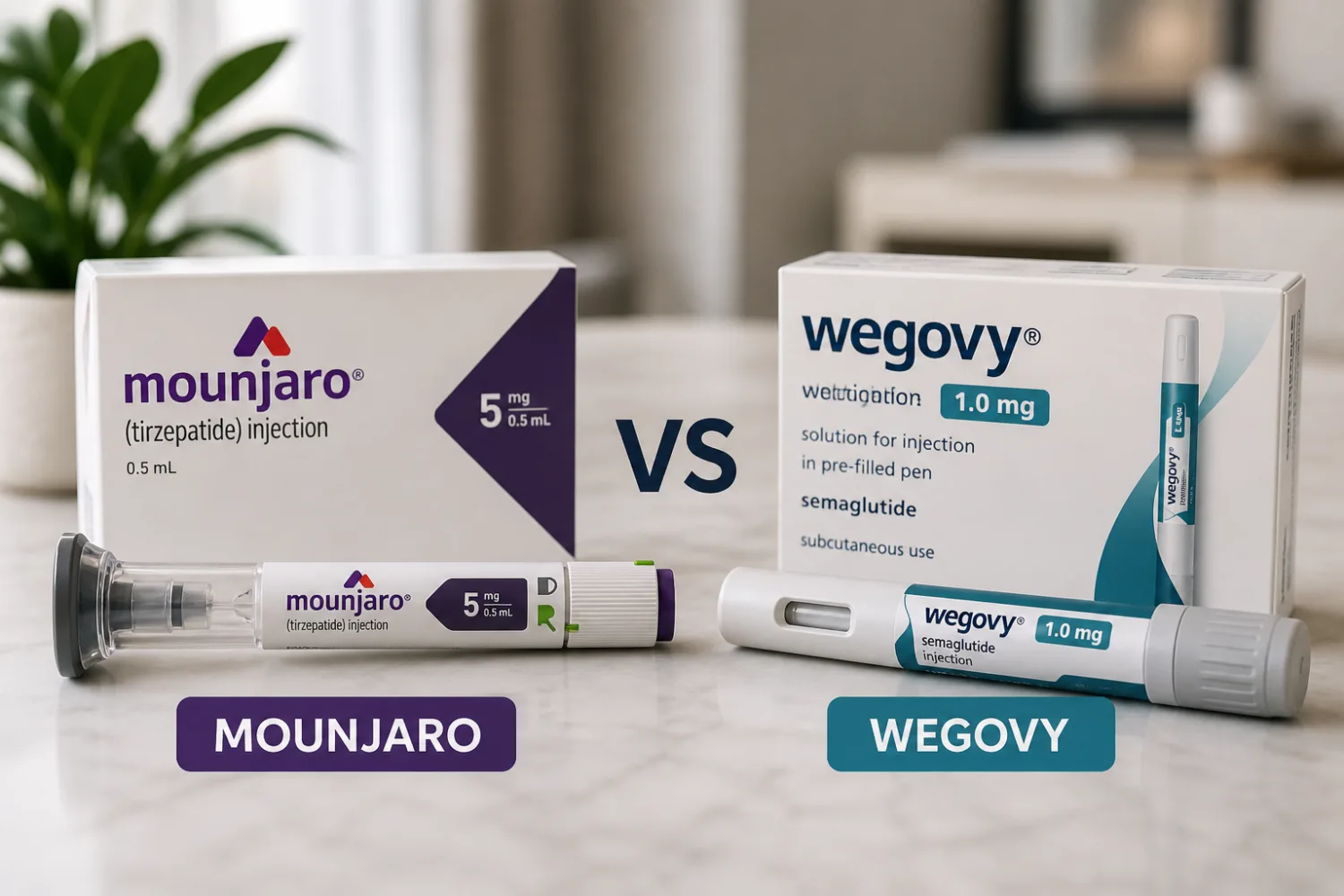
This is the question almost everyone asks once they start looking seriously at weight loss injections: Which one is better, Mounjaro or Wegovy?
It sounds like a simple comparison, but it usually is not. “Better” can mean different things to different people. Better for weight loss. Better for side effects. Better for NHS access. Better for long-term use. Better for someone with type 2 diabetes. Better for someone who mainly wants appetite control. Better for someone who is paying privately and worried about cost. The problem is not that the question is wrong. It is that it needs unpacking.
Both Mounjaro and Wegovy are genuine prescription medicines used in obesity treatment. The NHS says tirzepatide (Mounjaro) and semaglutide (Wegovy) are weight-loss injections that help reduce appetite and slow stomach emptying, and that they should only be prescribed alongside programmes that support healthier eating and physical activity.
But they are not identical. Mounjaro contains tirzepatide, while Wegovy contains semaglutide. The MHRA explains that semaglutide is a GLP-1 medicine, while tirzepatide acts on GLP-1 and a second hormone pathway involved in appetite and blood sugar control.
This guide explains how they compare, who each one is for, what NHS access looks like in the UK, how to think about side effects and safety, and what “better” really means in practice.
If you want the wider background too, it may help to read Weight Loss Injections in the UK: Who They’re For, Risks, Costs and What to Expect, Can You Get Weight Loss Treatment on the NHS? and How Weight Loss Really Works alongside this article.
What is the difference between Mounjaro and Wegovy?
The simplest difference is the active ingredient.
Wegovy contains semaglutide. Mounjaro contains tirzepatide. Both are weekly injections used in weight management, and both are meant to be combined with a reduced-calorie diet and increased physical activity rather than used on their own. The NHS obesity treatment page says exactly that for weight-management injections in general.
The more technical difference is how they work. The MHRA says GLP-1 medicines help people feel fuller by mimicking a natural hormone released after eating, and notes that some newer medicines, such as Mounjaro, also act on a second hormone involved in appetite and blood sugar control. In practical terms, that means both medicines can reduce appetite and help people eat less, but tirzepatide works through a slightly broader mechanism.
For most readers, though, the real question is not the hormone science. It is this: which one tends to lead to more weight loss, which one is easier to access, and which one is more tolerable?
Which one tends to lead to more weight loss?
If the question is purely about average weight-loss effect, current UK guidance strongly suggests that Mounjaro has the edge.
NICE’s 2024 technology appraisal on tirzepatide says the clinical evidence suggests tirzepatide is “more effective overall” for managing overweight and obesity than semaglutide and diet-and-exercise support alone. That is a major reason it was recommended as an option for adults with obesity who meet the criteria.
That does not mean Wegovy is weak. It is still an effective obesity treatment and remains an NHS option in specialist weight management services. NHS England said in April 2026 that semaglutide is already available on the NHS in England for people with obesity when offered through specialist weight management services in line with NICE guidance.
So if you mean “better” as in stronger weight-loss results on average, Mounjaro is currently the stronger contender. But that is not the whole story, because average results are not the same thing as the best choice for every individual.
Which one is easier to get on the NHS?
This is where the answer becomes more nuanced.
Wegovy has been available on the NHS in England for obesity through specialist weight management services in line with NICE guidance. NHS England reaffirmed that in April 2026. NICE’s tirzepatide appraisal also notes that semaglutide guidance recommends use within a specialist weight management service and, in the obesity setting, for a maximum of 2 years.
Mounjaro, by contrast, has been moving into NHS primary care on a phased basis. NHS England’s interim commissioning guidance says integrated care boards must fund access to tirzepatide for obesity in primary care settings from 23 June 2025, but on a phased basis for eligible patient cohorts rather than as open access for everyone immediately. NICE also says tirzepatide can be prescribed in primary care or specialist services if people meet the criteria and NHS England’s commissioning guidance.
So the short version is this: Wegovy has the more established specialist-service route, while Mounjaro is increasingly central to current NHS obesity-medicine rollout, but access is still phased and criteria-based. Which is “easier” often depends on where you live, which pathway exists locally and whether you meet current eligibility thresholds.
What are the NHS eligibility rules?
For Mounjaro, NICE recommends tirzepatide as an option for managing overweight and obesity in adults only if they have a BMI of at least 35 kg/m² and at least one weight-related comorbidity, alongside diet and physical activity changes. NICE also notes that lower BMI thresholds may apply for some ethnic groups at higher cardiometabolic risk.
For Wegovy, NICE’s semaglutide guidance is referenced in the tirzepatide appraisal as applying to adults with obesity within specialist weight management services, alongside diet and exercise, and for up to 2 years in that setting.
This is an important point for readers because people often assume that if a medicine is talked about in the news, it must now be easy to get from a GP. That is not how NHS obesity prescribing works. Both medicines sit inside rules, pathways and service limits.
Which one is better tolerated?
That is harder to answer in a simple way, because tolerability varies from person to person.
The NHS says weight-management injections such as tirzepatide and semaglutide can cause gastrointestinal side effects. The broader GLP-1 safety guidance from the MHRA also emphasises that these medicines are real prescription drugs with real risks and should only be used within their licensed use and with appropriate medical oversight.
In practice, the most common problems tend to be nausea, vomiting, diarrhoea, constipation and stomach discomfort. Some people tolerate one medicine better than the other, but there is no universal rule that one is always “easy” and the other is always difficult. Often the experience depends on dose escalation, how sensitive your digestion is, what you eat while taking it, and whether the provider manages titration well.
So if “better” means fewer side effects, the honest answer is usually: it depends on the person.
Is Mounjaro more powerful because it works on two hormones?
Broadly, yes — at least that is the implication of current evidence and NICE’s assessment.
The MHRA explains that Mounjaro acts on GLP-1 and a second hormone pathway, while semaglutide works through GLP-1. NICE’s appraisal concluded that tirzepatide was more effective overall than semaglutide in obesity management. Those two facts fit together, although it is still worth remembering that better average performance in trials does not guarantee that every patient will respond better to tirzepatide individually.
For readers, the useful takeaway is not “two hormones must always be better”. It is that current UK guidance sees tirzepatide as a very strong obesity treatment and, in the evidence NICE reviewed, stronger than semaglutide overall for weight loss.
What about Ozempic?
This is where online discussion often becomes messy.
Ozempic is also semaglutide, but it is widely prescribed on the NHS as a treatment for type 2 diabetes, not as the main obesity-branded treatment. NHS England said in April 2026 that Ozempic is widely prescribed by the NHS for people with type 2 diabetes, while Wegovy is the semaglutide option already available for obesity through specialist weight management services.
So when people compare Mounjaro with Wegovy, they are comparing the two main UK obesity-branded weekly injections. When they compare Mounjaro with Ozempic, they are often mixing obesity and diabetes discussions together.
Which one is better if you are paying privately?
If you are paying privately, the decision often comes down to a mix of effectiveness, price, side effects and service quality.
Mounjaro may look more attractive if your main goal is maximum weight-loss effect and you meet the medical criteria for treatment. Wegovy may still appeal to people who are more familiar with semaglutide, have already been advised about it, or find that private providers have clearer or more established pathways for it.
But the medicine itself is only one part of the story. The provider matters too. The MHRA has said GLP-1 medicines should only be used within their licensed use, and recent UK safety alerts have highlighted counterfeit and unsafe supply issues in this market. That means choosing a regulated provider is at least as important as choosing between brands.
If you are exploring private care, your article Are Online Weight Loss Jabs Safe? is the natural companion piece here.
Which one is better for long-term use?
That depends partly on access rules and partly on how you respond.
For Wegovy in the obesity setting, NICE guidance referenced in the tirzepatide appraisal says semaglutide is recommended within specialist weight management services and for a maximum of 2 years. Tirzepatide’s current NICE recommendation is framed differently, with prescribing and review guided by eligibility criteria and NHS England commissioning arrangements rather than the same 2-year statement.
For many readers, though, the more practical long-term question is not which drug has the neater rule attached to it, but what happens if you stop. NHS and specialist guidance consistently frame these medicines as part of wider weight management rather than one-off cures. If appetite rises again after stopping, regain can happen. That is one reason long-term planning matters whichever medicine you use.
Which one is safer?
Both are licensed medicines with known safety frameworks, and both need proper prescribing.
The MHRA has updated GLP-1 guidance for prescribers and patients and has reminded the public that these medicines are for specific licensed uses, not for casual or cosmetic weight loss. It also issued a February 2026 safety warning specifically about falsified Mounjaro pens in the UK supply chain, which is a reminder that product-source safety matters as much as medicine choice.
So if “safer” means the medicine molecule itself, the answer is not straightforward enough to declare one universally safer than the other for all people. If “safer” means the real-world experience of getting the medicine properly, then the biggest safety question is whether it is prescribed appropriately and supplied through a legitimate regulated route.
So which one is actually better?
If the question is which one tends to produce more weight loss on average, the current UK evidence base and NICE appraisal point towards Mounjaro. NICE explicitly judged tirzepatide to be more effective overall than semaglutide for obesity management.
If the question is which one is simpler or easier to understand, many readers may feel more familiar with Wegovy because semaglutide has been in the public conversation for longer.
If the question is which one is easier to get, the answer depends on whether you are looking at NHS specialist services, NHS primary care rollout, or private treatment.
If the question is which one is right for you, the answer depends on your BMI, health conditions, treatment goals, side-effect tolerance, budget, and access route.
So the most honest answer is this: Mounjaro is currently the stronger obesity medicine on average, but “better” still depends on the person and the setting.
Who should talk to a clinician rather than self-deciding?
Realistically, almost everyone considering these medicines should.
The NHS says weight-management injections should only be prescribed by a healthcare professional alongside support to change diet and physical activity. The MHRA also says GLP-1 medicines should only be used for their licensed medical purposes.
This is especially important if you have type 2 diabetes, other long-term conditions, a history of significant gastrointestinal symptoms, or uncertainty about whether you actually meet obesity-treatment criteria in the first place.
The bottom line
Mounjaro and Wegovy are both legitimate UK weight-loss injections, but they are not equal in every respect. Wegovy is semaglutide. Mounjaro is tirzepatide. Both reduce appetite and are used alongside diet and activity changes, but current NICE guidance concludes that tirzepatide is more effective overall than semaglutide for managing overweight and obesity.
That means if you are asking, “Which one is better for weight loss?” the current evidence points towards Mounjaro. But if you are asking, “Which one is better for me?” the answer depends on access, eligibility, side effects, cost and clinical suitability.
The smartest way to think about this is not brand first, but fit first.