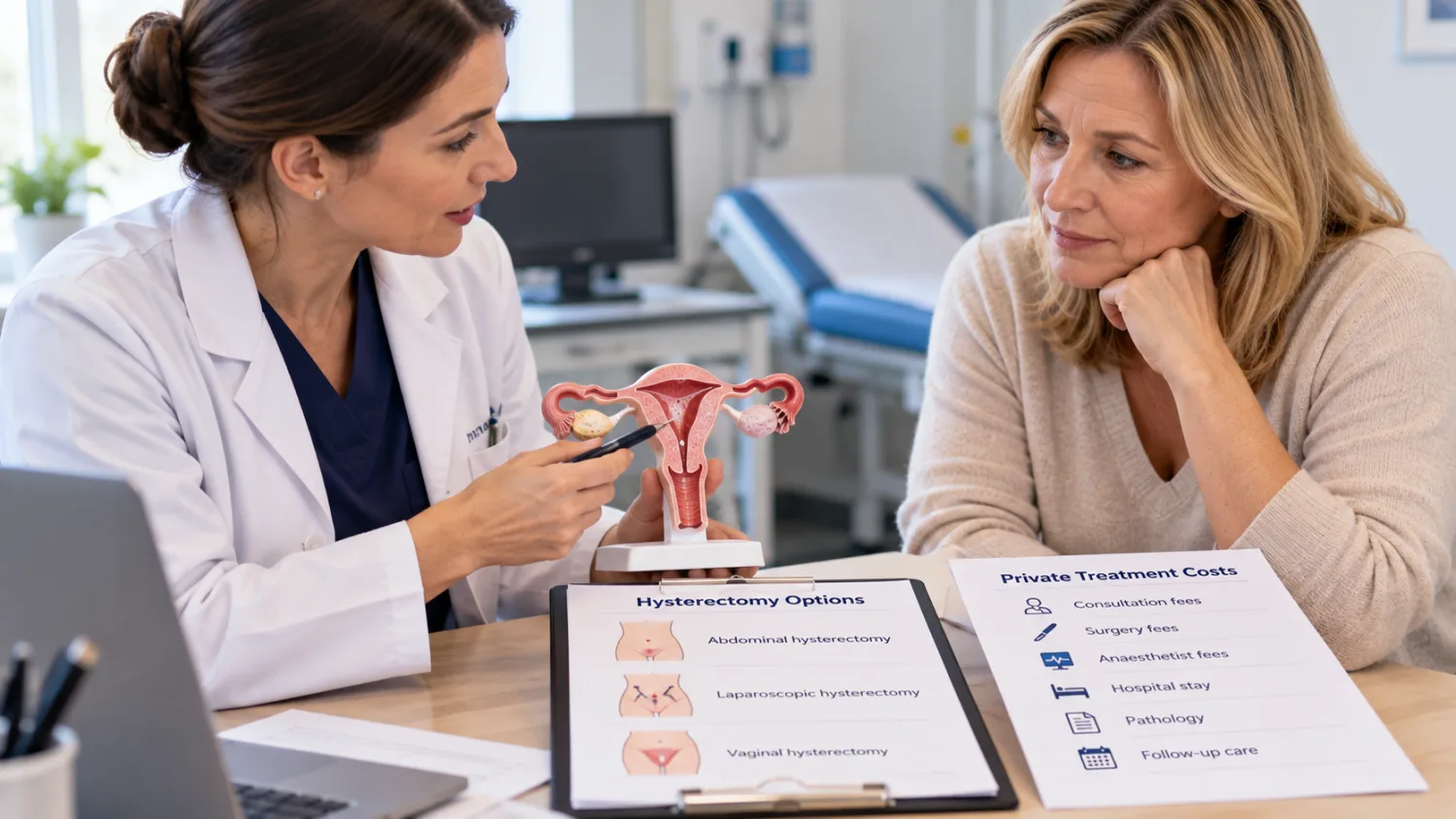
A private hysterectomy in the UK typically costs around £7,000 to £11,000 or more, depending on the type of operation, hospital, consultant and whether additional treatment is needed.
The headline surgery price is only part of the picture.
Some hospitals quote an all-inclusive package covering the surgeon, anaesthetist, hospital stay, theatre fees and routine aftercare. Others separate some of these charges, which can make a cheaper-looking quote more expensive once everything is added.
The final bill may also be affected by whether you have:
- an abdominal, vaginal or laparoscopic hysterectomy;
- your cervix removed;
- your ovaries or fallopian tubes removed;
- treatment for endometriosis or adhesions at the same time;
- fibroids that make surgery more complex;
- robotic surgery;
- a longer hospital stay than expected.
This guide explains private hysterectomy prices in the UK, what hospital fees usually include, what can cost extra and what to ask before agreeing to surgery.
How Much Does a Private Hysterectomy Cost in the UK?
A realistic 2026 self-pay guide is approximately:
| Private hysterectomy service | Typical cost |
|---|---|
| Initial private gynaecology consultation | About £180–£350 |
| Vaginal hysterectomy | About £7,000–£10,500+ |
| Laparoscopic or keyhole hysterectomy | About £7,500–£10,500+ |
| Abdominal hysterectomy | About £8,500–£10,500+ |
| Complex or robotic hysterectomy | Often £10,000–£15,000+ |
| Follow-up consultation if separate | About £150–£300 |
Prices vary significantly between hospitals.
For example, Practice Plus Group Southampton currently lists:
- vaginal hysterectomy at £6,949;
- keyhole hysterectomy at £7,399.
Spire Murrayfield Wirral lists laparoscopic total hysterectomy from around £9,375 including the initial consultation, abdominal hysterectomy from around £9,464 and vaginal hysterectomy from around £9,609.
Other Spire hospitals publish totals above £10,000 for some vaginal or abdominal procedures.
Nuffield Health Tees currently lists an abdominal hysterectomy guide price of £9,780, including a £160 initial consultation and £9,620 treatment package.
This variation is why it is better to compare all-inclusive written quotes rather than simply comparing one advertised operation price.
If you are still at the investigation stage rather than already booked for surgery, see our guide to private gynaecologist consultation and test costs.
What Does the Price Usually Include?
A private hysterectomy package commonly includes several major costs.
Surgeon's fee
This pays the consultant gynaecologist performing the operation.
Some hospitals include this within the package price.
Others allow consultants to set their own fees separately.
Anaesthetist's fee
Most hysterectomies are performed under general anaesthetic.
The anaesthetist's fee may be included or billed separately.
Hospital and theatre fees
These cover:
- operating theatre use;
- nursing staff;
- equipment;
- medicines used during surgery;
- recovery facilities.
Hospital stay
Most packages include an expected number of nights in hospital.
Laparoscopic and vaginal surgery usually involve shorter stays than open abdominal surgery.
Routine aftercare
Some hospitals include follow-up appointments and post-discharge advice within the package.
Nuffield, for example, states that its treatment pricing includes post-discharge care.
Always check whether additional outpatient appointments are included or charged separately.
What Tests Might You Need Before Surgery?
Before a hysterectomy, the surgeon needs to understand both the reason for surgery and whether you are medically fit for an operation.
Pre-operative assessment may involve:
- blood count;
- kidney function;
- blood group and antibody screen;
- ECG where appropriate;
- pelvic ultrasound;
- MRI in selected cases;
- pregnancy testing where relevant;
- general anaesthetic assessment.
Some tests are included in the package.
Others may already have been done before you reach the surgical stage.
If scans are needed to investigate heavy periods, fibroids, adenomyosis or pelvic pain, they can add several hundred pounds to the pre-operative bill.
For example, adenomyosis may be assessed with ultrasound or MRI. See our guide to adenomyosis symptoms, diagnosis and treatment.
Why Does the Type of Hysterectomy Affect the Cost?
There are several ways to perform a hysterectomy.
The NHS describes three main surgical routes:
- laparoscopic or keyhole hysterectomy;
- vaginal hysterectomy;
- abdominal hysterectomy.
The surgeon chooses the route based on your diagnosis, anatomy, previous surgery, uterine size and other factors.
Laparoscopic hysterectomy
Several small cuts are made in the abdomen and the uterus is removed using keyhole instruments.
This usually means a shorter hospital stay and faster recovery than open abdominal surgery.
It requires specialist equipment and operating time, so it is not necessarily the cheapest option.
Vaginal hysterectomy
The uterus is removed through the vagina without a large abdominal incision.
The NHS notes that vaginal hysterectomy is generally less invasive than an abdominal operation and tends to involve shorter hospital stays and faster recovery.
It is not suitable for every patient.
Abdominal hysterectomy
This involves a larger incision in the lower abdomen.
It may be needed when the uterus is very enlarged by fibroids, there are large pelvic masses or keyhole/vaginal removal is not practical.
Recovery is usually longer.
Does Removing the Ovaries Cost More?
Possibly.
A hysterectomy means removal of the uterus.
It does not automatically mean removal of the ovaries.
A total hysterectomy removes the uterus and cervix.
A hysterectomy with bilateral salpingo-oophorectomy also removes both fallopian tubes and ovaries.
NICE and NHS guidance emphasise that healthy ovaries should not simply be removed routinely; the decision depends on age, cancer risk, diagnosis and individual circumstances.
If the ovaries are removed before natural menopause, you enter surgical menopause immediately.
Symptoms can include:
- hot flushes;
- night sweats;
- vaginal dryness;
- sleep problems;
- mood changes.
HRT may be considered where appropriate.
You can read more about menopausal symptoms and treatment in our menopause and HRT guide.
What Conditions Can Lead to Hysterectomy?
Hysterectomy can be used to treat several gynaecological conditions.
Common reasons include:
- fibroids;
- very heavy periods;
- adenomyosis;
- persistent pelvic pain in selected cases;
- endometriosis in some circumstances;
- uterine prolapse;
- some gynaecological cancers.
The NHS describes hysterectomy as a major operation that is generally considered after less invasive treatments have been tried where appropriate.
Fibroids
Hysterectomy offers a definitive treatment because fibroids cannot recur once the uterus has been removed.
But other options may include medicine, uterine artery embolisation or myomectomy depending on symptoms and fertility goals.
See our guide to fibroids, heavy bleeding and treatment.
Heavy periods
NICE recommends discussing less invasive treatments before hysterectomy in many cases, including medication, intrauterine systems and endometrial ablation where appropriate.
Our guide to heavy periods, tests and treatment options explains the alternatives.
Adenomyosis
Hysterectomy is the definitive surgical treatment for adenomyosis because the condition occurs within the muscle of the uterus.
However, hormonal and other treatments may be tried first depending on symptoms and future fertility plans.
Endometriosis
Hysterectomy can sometimes form part of surgery for severe endometriosis, but removing the uterus alone does not automatically remove all endometriosis elsewhere in the pelvis.
See our guide to endometriosis symptoms, diagnosis and treatment.
What Can Increase the Final Price?
Several things can make the total bill higher than the advertised starting price.
Complex surgery
Large fibroids, severe endometriosis, adhesions or previous abdominal surgery can make the operation more difficult.
NICE specifically warns that hysterectomy can carry a higher risk of serious complications when fibroids are present, including haemorrhage and damage to surrounding organs.
Longer hospital stay
If recovery takes longer than expected, extra nights may be charged depending on your package.
Pathology
The removed uterus and any other tissue are usually sent to a laboratory for examination.
Histology may be included, but ask before booking.
Blood transfusion or complications
Heavy bleeding is an uncommon but recognised complication, and blood transfusion may occasionally be needed.
Ask whether unexpected treatment arising from a complication is covered by the fixed-price guarantee.
Extra procedures
If the surgeon also removes ovaries, treats endometriosis, removes adhesions or performs another pelvic procedure, costs may increase.
Robotic surgery
Some private hospitals offer robotic hysterectomy.
This can involve additional equipment and theatre costs and may push the total above standard laparoscopic pricing.
Ask what clinical advantage the robotic approach offers in your particular case rather than assuming it is automatically better because it is more expensive.
How Long Is the Hospital Stay and Recovery?
The NHS says people having vaginal or laparoscopic hysterectomy may leave hospital after around one to four days, while abdominal hysterectomy can require up to five days.
Private hospitals often discharge sooner where recovery is uncomplicated.
Full recovery depends on the operation.
After abdominal hysterectomy, the NHS says recovery commonly takes around six to eight weeks.
Recovery after vaginal or laparoscopic surgery is often faster.
You will usually need to avoid:
- heavy lifting;
- strenuous exercise;
- driving until safe to do so;
- sexual intercourse until healing is adequate.
The NHS generally advises waiting at least four to six weeks before sex, depending on healing and discharge.
If pelvic pain or painful intercourse is part of the reason surgery is being considered, see our guide to pain during sex and common causes.
What Are the Main Risks?
Hysterectomy is common but it is still major surgery.
Recognised complications include:
- bleeding;
- infection;
- blood clots;
- damage to the bladder;
- damage to the bowel;
- damage to the ureters;
- anaesthetic complications;
- earlier ovarian failure or menopause.
These risks are uncommon overall but important enough to discuss before consent.
If the ovaries are left in place, ovarian function can still decline earlier than expected in some women. NICE recommends discussing this possibility before surgery.
Can You Get a Hysterectomy on the NHS?
Yes.
If hysterectomy is clinically appropriate, it can be performed through the NHS without the patient paying for the operation.
You would normally be referred by your GP to gynaecology.
The specialist may first discuss less invasive treatments depending on the diagnosis.
Private surgery is usually chosen because somebody wants:
- faster access;
- a particular consultant;
- a particular hospital;
- greater choice of dates;
- more predictable scheduling.
Paying privately does not necessarily mean hysterectomy is medically more appropriate.
The same question remains: whether the expected benefit outweighs the risks and whether less invasive treatment could achieve the same goal.
How to Compare Private Hysterectomy Quotes
Ask for a written quote after the surgeon has assessed you.
The quote should make clear whether it includes:
- initial consultant appointment;
- pre-operative assessment;
- blood tests;
- imaging;
- surgeon's fee;
- anaesthetist's fee;
- operating theatre;
- hospital accommodation;
- medicines;
- pathology;
- follow-up appointment;
- treatment for complications;
- additional nights if needed.
If the hospital advertises a “from” price, ask what could realistically make your own price higher.
This matters particularly if you have:
- large fibroids;
- endometriosis;
- previous abdominal surgery;
- significant medical conditions;
- a high BMI;
- a need for ovary removal or other additional surgery.
If the diagnosis is still uncertain, paying first for a specialist assessment may be more sensible than trying to choose a surgery package yourself.
Our private hysteroscopy cost guide may also be useful when the investigation involves abnormal bleeding, polyps or the lining of the uterus.
Frequently Asked Questions
How much does a private hysterectomy cost in the UK?
Most private hysterectomies cost around £7,000 to £11,000 or more. Complex, robotic or premium-hospital procedures can cost above this range.
How much does a laparoscopic hysterectomy cost?
Current private examples range from around £7,400 to £10,000 or more, depending on the hospital, consultant and complexity.
How much does an abdominal hysterectomy cost?
Many current private hospital prices fall around £8,500 to £10,500+, with some hospitals charging more.
How much does a vaginal hysterectomy cost?
Published prices currently range from about £6,950 to more than £10,000 depending on provider and location.
Does the price include the surgeon?
Often, but not always. Some fixed-price packages include surgeon and anaesthetist fees, while other hospitals allow consultants to charge independently.
Does the price include the hospital stay?
Usually an expected number of nights is included in a package. Ask whether additional nights are charged separately.
Are pathology fees included?
They may be, but this varies. Ask whether laboratory examination of the removed uterus and any additional tissue is included in the fixed price.
Does a hysterectomy remove the ovaries?
Not automatically. The uterus can be removed while one or both ovaries are left in place. Ovary removal should be discussed separately.
Will I go through menopause after hysterectomy?
If both ovaries are removed, menopause begins immediately. If the ovaries remain, you do not automatically enter menopause, although ovarian function may decline earlier than it otherwise would have.
Can you still get cervical cancer after hysterectomy?
If the cervix is completely removed, you cannot later develop cervical cancer in that cervix. If a subtotal hysterectomy leaves the cervix in place, cervical screening may still be needed.
Can hysterectomy cure fibroids?
Yes. Because fibroids grow from the uterus, removing the uterus prevents them from recurring. Other less invasive treatments may still be suitable depending on symptoms and fertility goals.
Can hysterectomy cure endometriosis?
Not necessarily. Endometriosis can exist outside the uterus, so removing the uterus alone does not guarantee that all endometriosis-related pain will disappear.
How long do you stay in hospital?
It varies. Laparoscopic or vaginal surgery may involve one to four days in hospital, while abdominal hysterectomy may require up to around five days.
How long does recovery take?
Abdominal hysterectomy commonly takes around six to eight weeks for full recovery. Laparoscopic and vaginal recovery is often shorter.
Can private health insurance cover hysterectomy?
Often, if the surgery is clinically necessary and the condition is covered by the policy. Pre-existing conditions, excesses, hospital networks and authorisation requirements can affect cover.
Is private hysterectomy worth paying for?
It can be if hysterectomy is already medically appropriate and you value faster access or greater choice of consultant and hospital. The important decision is whether hysterectomy itself is the right treatment, not simply whether private surgery is affordable.
This guide provides broad UK self-pay estimates rather than guaranteed prices. Hysterectomy fees vary according to surgical route, consultant, hospital, diagnosis and complexity. Ask for an individual written fixed-price quote after specialist assessment.