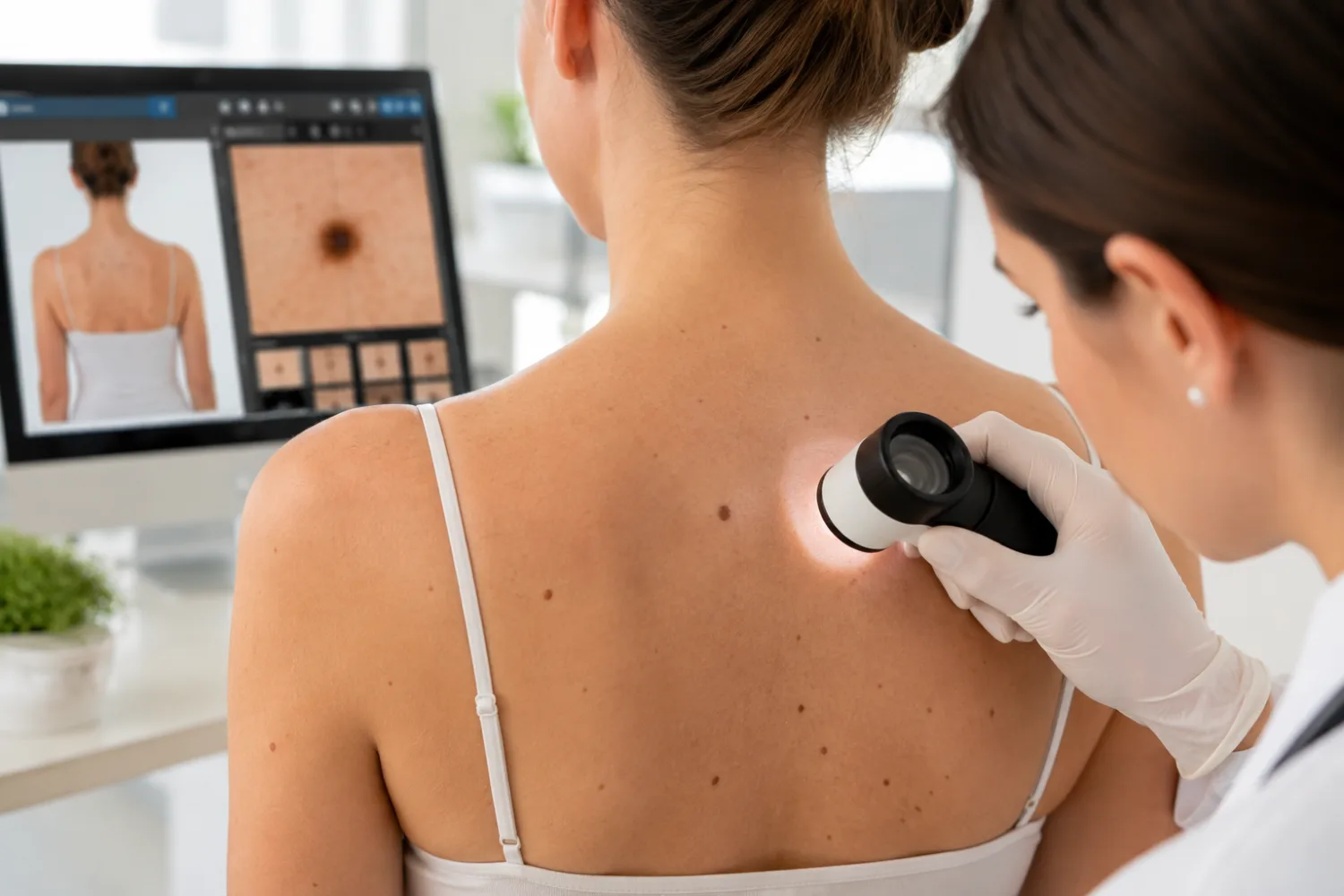
A private skin cancer check in the UK commonly costs around £150 to £300, while full digital mole mapping may cost roughly £300 to £700 or more once dermatologist review is included. If a mole needs biopsy or removal, the total can rise by several hundred pounds again.
That makes “skin cancer screening” one of those private healthcare services where the advertised price needs a little unpacking.
A £200 appointment may be a thorough full-body examination with dermoscopy and specialist review. A £300 mole-mapping session may primarily cover photography, with the dermatologist consultation charged separately. Some clinics assess one suspicious mole; others photograph almost the entire skin surface so changes can be compared over time.
None of these approaches is automatically better. The right choice depends on why you are booking.
If you have one mole that has recently changed, started bleeding or looks distinctly different from your other moles, you need assessment of that lesion rather than simply paying for routine photography. If you have dozens or hundreds of moles and struggle to notice changes yourself, digital mole mapping may be much more useful.
The NHS does not run a population-wide mole-screening programme for people without symptoms. However, if you have a suspicious mole or changing skin lesion, you can see your GP free of charge and, where skin cancer is suspected, be referred to specialist dermatology care.
Our existing guide to skin cancer checks in the UK explains what changes to look for and how NHS and private assessment work. This guide focuses mainly on the cost of private skin checks, mole mapping and what you actually get for the money.
Do not wait for your next routine mole-mapping appointment if a lesion is changing. See a GP or appropriate skin specialist if a mole changes size, shape or colour, becomes painful or itchy, bleeds or crusts, or if a new unusual mark does not go away.
A sore, crusted patch or lump that repeatedly bleeds or fails to heal can also represent non-melanoma skin cancer and deserves assessment even if it does not look like a typical dark mole.
If a clinician thinks melanoma is possible, diagnosis usually requires removal of the suspicious lesion and examination in a laboratory. Photography or AI analysis alone cannot confirm or exclude melanoma.
How much does a private skin cancer check cost?
For a straightforward private skin examination, around £150 to £300 is a useful budgeting range.
The exact price depends on who examines you and whether the appointment includes dermoscopy, photography and specialist reporting.
| Private skin service | Typical UK cost |
|---|---|
| Single suspicious-mole assessment | Around £100–£250 |
| Full-body skin check | Around £150–£300 |
| Consultant dermatologist mole check | Around £200–£400 |
| Digital full-body mole mapping | Around £300–£700+ |
| Follow-up mole mapping | Often £200–£500 |
| Histology after biopsy/removal | Often £150–£300+ |
| Private mole removal | Often £300–£1,000+, depending on technique and complexity |
These are broad planning figures rather than standard national tariffs.
Current provider examples illustrate the range. Check4Cancer charges £210 for a full-body screening appointment that includes specialist nurse examination, high-resolution imaging, storage of images and consultant review of suspicious lesions. SkinDoc lists a £199 consultant-led full skin check. OneWelbeck currently lists 360° mole mapping from £315, with a separate consultant assessment costing £250 to £400.
Why can mole mapping cost much more than a mole check?
A conventional mole check involves examining the skin as it looks today.
Mole mapping creates a photographic baseline that can be used to compare your skin later.
Depending on the system, this may include:
- standardised full-body photographs;
- close-up photographs of individual lesions;
- dermoscopic images;
- computer-assisted identification of new lesions;
- comparison with previous appointments;
- specialist review.
The value comes partly from the comparison over time. A first mapping appointment creates the baseline; later visits may reveal a mole that is new or changing.
Does London cost more?
Often.
A consultant dermatologist consultation in central London may cost around £250 to £400 before photography, biopsy or treatment is added.
Regional dermatology services and nurse-led screening programmes may be considerably cheaper.
The higher price is not necessarily evidence of a better cancer-detection service. What matters is the quality of examination, appropriate use of dermoscopy and a clear route for suspicious lesions.
What is the difference between a mole check and mole mapping?
The terms are frequently used interchangeably in clinic marketing, which can make comparison difficult.
They are not quite the same thing.
A mole check
During a mole check, a clinician examines existing moles and other skin lesions.
This may be limited to one concern or may cover most of the skin.
A dermatologist or other trained clinician will usually look for:
- asymmetry;
- irregular borders;
- unusual colours;
- recent growth;
- signs of bleeding or inflammation;
- lesions that look different from the person's other moles.
They may use a dermatoscope—a handheld magnifying instrument with specialised lighting—to see structures beneath the skin surface.
Mole mapping
Mole mapping adds systematic photography.
The aim is to document where lesions are located and what they look like so future images can be compared.
This can be especially useful for someone who has:
- many moles;
- several atypical-looking moles;
- difficulty checking their own back or scalp;
- a personal history of melanoma;
- a strong family history;
- significant past UV exposure.
What is 360-degree mole mapping?
Some modern clinics use multiple cameras to photograph the entire body from different angles.
Software may build a three-dimensional avatar or body map and identify lesions automatically.
At follow-up, the system can flag:
- new moles;
- changes in existing lesions;
- lesions selected for closer dermoscopic review.
This technology can make monitoring easier, but it does not replace clinical judgement.
What is digital dermoscopy?
Dermoscopy is close examination of a mole using magnification and specialised lighting.
Digital dermoscopy stores those close-up images so the internal pattern of an individual mole can be compared later.
This is particularly useful for borderline-looking moles where immediate removal may not be necessary but careful monitoring is appropriate.
Is AI mole mapping the same as diagnosis?
No.
Artificial-intelligence software may help identify lesions that have changed or look unusual, but it should be used as an aid rather than a substitute for an appropriately trained clinician.
If melanoma is suspected, the definitive diagnosis generally comes from histopathological examination after the lesion is removed.
Who is mole mapping most useful for?
There is no recommendation that every adult in the UK should pay for annual full-body photography.
For someone with three ordinary moles that are easy to monitor, repeated 360-degree imaging may add little.
For someone with 150 moles scattered across their back, shoulders and legs, the calculation can be very different.
People with many moles
A large number of moles is associated with increased melanoma risk.
It also makes self-checking harder.
The NHS lists having many moles as one factor associated with higher melanoma risk, alongside pale skin, significant UV exposure, previous sunburn, sunbed use and personal or family history of skin cancer.
People with atypical moles
Some people naturally have moles that are larger, less symmetrical or more varied in colour than average.
If many lesions look unusual, remembering whether one has actually changed can be difficult.
Photography can provide objective comparison.
Previous melanoma
Someone who has previously had melanoma is at higher risk of developing another melanoma.
Specialist follow-up is usually organised according to the original diagnosis and stage.
Private mole mapping may sometimes be used in addition, but it should not replace clinically recommended NHS surveillance.
Family history
A strong family history can increase concern, particularly when close relatives have had melanoma.
If several family members have been affected, specialist advice may be more useful than repeatedly purchasing commercial screening without first understanding the level of inherited risk.
Significant UV exposure
People with substantial lifetime exposure to ultraviolet radiation may benefit from greater vigilance.
This includes those who have:
- experienced repeated sunburn;
- spent long periods living or working in strong sunlight;
- used sunbeds regularly;
- outdoor occupations or hobbies.
UV exposure is the main preventable cause of melanoma and most non-melanoma skin cancers.
Very fair skin
People with skin that burns easily have a higher skin-cancer risk.
However, melanoma can occur in every skin tone.
In darker skin it may sometimes appear in less sun-exposed sites including the palms, soles or beneath a nail, so these areas should not be ignored.
What happens during a private skin cancer screening appointment?
A good skin check should feel methodical rather than rushed.
You may be asked to undress to underwear so the clinician can inspect areas that you might not routinely see yourself.
You should be given privacy to change and can tell the clinician if there are areas you do not consent to having examined.
Your skin and medical history
The clinician may ask about:
- previous skin cancer;
- family history of melanoma;
- number of moles;
- sunburn history;
- sunbed use;
- medicines that suppress immunity;
- any lesion you have noticed changing.
Full skin examination
The examination may include:
- face and scalp;
- ears;
- neck;
- torso;
- arms and hands;
- legs and feet;
- back.
Ask beforehand whether the service genuinely performs a full-body examination. Some low-cost “mole checks” assess only a small number of lesions that you nominate yourself.
Dermoscopy
Suspicious or atypical lesions may be examined using a dermatoscope.
Dermoscopy can reveal structures and pigment patterns that are not visible to the naked eye and is a standard part of specialist mole assessment.
Photography
The clinic may photograph individual lesions or the whole body.
Ask:
- where images are stored;
- how long they are retained;
- who has access;
- whether you receive copies;
- whether they can be transferred if you change clinic.
Whole-body mole mapping creates unusually sensitive medical images, so data security is worth considering rather than treating the photos like ordinary cosmetic photography.
Your results
You may be told immediately that everything appears reassuring.
Other services send photographs for consultant review and provide the final report several days later.
Check4Cancer, for example, currently says results from its screening service are normally provided within five working days.
If something looks suspicious
The clinician may recommend:
- monitoring it photographically;
- dermatologist review;
- biopsy;
- complete excision;
- NHS referral.
This is where it becomes important to understand what the original screening fee does and does not include.
What skin changes should be checked rather than simply mapped?
Mole mapping is useful for surveillance. It should not become a reason to postpone assessment of an active symptom.
The NHS advises seeing a GP if a mole changes size, shape or colour, becomes painful or itchy, becomes inflamed, bleeds or crusts, or if a new unusual mark persists for several weeks.
The ABCDE approach
A commonly used way to remember melanoma warning signs is:
- A – Asymmetry: one half does not resemble the other;
- B – Border: edges become irregular, blurred or jagged;
- C – Colour: several colours or an unusual distribution of pigment;
- D – Diameter: larger lesions may attract attention, although melanoma can be smaller than 6 mm;
- E – Evolving: the lesion is changing over time.
The final point is particularly important. A change from that person's normal pattern may matter more than whether a mole perfectly matches a checklist.
The ugly duckling sign
Many people's moles share a general appearance.
A lesion that looks noticeably different from everything else—the so-called ugly duckling—deserves attention even when it does not tick every ABCDE box.
Not every skin cancer is a mole
This is an important limitation of focusing too narrowly on mole mapping.
Basal cell carcinoma and squamous cell carcinoma can appear as:
- a persistent pink or red patch;
- a pearly lump;
- a scaly area;
- a crusted growth;
- a sore that repeatedly heals and returns;
- a lesion that bleeds easily.
The NHS advises assessment of a growth or patch that is enlarging or changing, or that continues to hurt, itch, bleed, crust or scab for more than about four weeks.
Our broader guide to skin conditions and dermatology care in the UK can help when you are unsure whether a lesion is likely to need medical rather than cosmetic assessment.
Private mole biopsy and removal costs
The cost changes considerably once a lesion needs removing.
There is also an important distinction between cosmetic mole removal and removal because cancer is suspected.
Suspicious mole removal
When melanoma is possible, the usual diagnostic procedure is an excision biopsy.
The mole is removed with a small margin of surrounding skin and sent to a laboratory for histopathology.
The NHS describes excision biopsy as the main diagnostic test for suspected melanoma.
A private procedure may involve separate charges for:
- consultation;
- local anaesthetic;
- procedure;
- dressings;
- histology;
- follow-up;
- suture removal.
How much might private removal cost?
A relatively simple lesion may cost several hundred pounds to remove.
More complex excision can cost £1,000 or more, especially in a private hospital or when a plastic surgeon is involved.
As a real-world example, one Harley Street dermatology clinic currently lists an initial mole consultation at £275 and skin-lesion removal at around £500 to £1,500 depending on the procedure.
SkinDoc separately lists histology from £180.
Histology is important
If a mole is being removed because there is diagnostic uncertainty, laboratory examination is important.
Do not choose laser destruction or another purely cosmetic technique for a suspicious pigmented lesion simply because it avoids a scar.
Destroying the tissue may mean there is nothing left for a pathologist to examine properly.
What about a mole that is clearly harmless?
A benign mole may still be removed privately because it:
- catches on clothes;
- is repeatedly irritated;
- causes cosmetic concern.
Our separate guide to mole removal in the UK explains shave excision, surgical excision, costs, scarring and when histology may be needed.
Will the NHS remove a benign mole?
Usually not for purely cosmetic reasons.
If a lesion is suspicious for cancer, however, assessment and medically necessary treatment are available through the NHS.
This distinction is important. Someone worried that a mole might be cancerous should not assume they need to pay simply because cosmetic mole removal is not routinely NHS funded.
NHS skin cancer checks versus private screening
There is currently no routine NHS programme inviting every adult for annual skin checks in the way that eligible people are invited for breast, bowel or cervical screening.
Instead, NHS skin-cancer diagnosis is largely symptom-led and risk-led.
If you notice a suspicious mole
Book a GP appointment.
The GP may:
- examine the lesion;
- use dermoscopy if appropriately trained;
- take a clinical photograph;
- ask a dermatologist to review photographs remotely;
- refer you to a specialist.
If melanoma or another skin cancer is suspected, an urgent specialist referral may be made.
The NHS advises getting new or changing moles checked promptly because detecting melanoma earlier generally makes it easier to treat.
Why pay privately?
Private screening may be attractive when someone:
- wants a proactive full-body check despite having no particular lesion of concern;
- has many moles and wants a photographic baseline;
- wants rapid access;
- wants regular comparison of digital photographs;
- finds self-checking difficult;
- wants to see a particular dermatologist.
What private screening does not buy
It does not guarantee that skin cancer will never be missed.
Nor does a reassuring appointment mean that every future lesion is safe until the next annual check.
A melanoma can appear between appointments.
You still need to notice new or changing lesions and seek assessment when necessary.
Can you have private screening and NHS treatment?
Yes.
If a private clinic identifies a suspicious lesion, you can discuss the result with your NHS GP.
However, an NHS clinician will make their own decision about the appropriate referral and treatment pathway.
If the private clinic believes cancer may be present, ask exactly how quickly assessment or biopsy is required rather than simply joining a routine queue without context.
Is annual mole mapping worth the cost?
For the right person, it can be genuinely useful.
For everyone else, it can become an expensive annual reassurance ritual without much additional benefit.
When repeat mapping makes sense
Regular photography may be particularly valuable when:
- you have a very large number of moles;
- several lesions are atypical;
- a dermatologist has specifically recommended monitoring;
- you have previously had melanoma;
- you are considered at substantially increased risk.
How often is mole mapping repeated?
There is no universal interval appropriate for every person.
A clinic may recommend:
- three-month review of one particular lesion;
- six-month mapping;
- annual mapping;
- longer intervals for lower-risk people.
The interval should reflect actual risk rather than simply the clinic's subscription schedule.
Could ordinary photographs work?
For someone with a small number of easily visible moles, good-quality personal photographs can sometimes help identify obvious change.
Try to:
- use similar lighting;
- include a size reference;
- photograph the same angle;
- date the image;
- avoid relying on photographs alone if something looks suspicious.
Professional mapping becomes more useful as the number of lesions and difficulty of self-monitoring increase.
Do phone mole-checking apps replace screening?
No.
An app may help store photographs or remind you to check your skin, but an automated risk score should not determine whether a changing lesion receives medical assessment.
Skin checking between appointments
Even if you pay for annual mapping, periodically look at your own skin.
A mirror or partner can help check:
- back;
- scalp;
- behind the ears;
- soles of the feet;
- between the toes.
Some melanomas develop in apparently normal skin rather than an existing mole.
Private health insurance and mole screening
Private health insurance may cover assessment of a suspicious lesion, but routine screening is more variable.
This distinction is common across private medical insurance.
Symptoms versus screening
If you have a mole that has recently changed, the insurer may classify the consultation as investigation of a symptom.
A routine annual mole map performed solely for reassurance may instead be considered screening and excluded.
Check before booking
Ask the insurer:
- whether dermatologist consultation is covered;
- whether you need a GP referral;
- whether the dermatologist must be recognised by the insurer;
- whether dermoscopy is included;
- whether digital mole mapping is covered;
- whether biopsy and histology are covered;
- what excess applies.
Private removal of a suspicious mole
If a dermatologist recommends removal because of genuine clinical concern, insurance is more likely to cover the procedure than if removal is purely cosmetic.
One UK private dermatology provider, for example, states that most insurers cover consultations, mole checks and medically required minor skin surgery depending on the policy.
Never assume this from the clinic's general statement—your own policy rules still apply.
Cosmetic mole removal
Routine cosmetic removal is commonly excluded.
The fact that a dermatologist first confirmed the mole is benign does not necessarily make cosmetic removal medically insured.
How to choose a private mole-mapping or skin-check clinic
A reassuring website full of sophisticated camera technology can make a service look impressive.
The more important question is who takes responsibility when a lesion does not look right.
Ask who examines the skin
The appointment may be carried out by:
- a consultant dermatologist;
- a GP with specialist dermatology experience;
- a specialist skin-cancer nurse;
- another appropriately trained clinician.
A nurse-led service can be entirely appropriate when there is a clear specialist-review pathway.
For example, some national screening providers use specialist nurses to obtain detailed images while suspicious lesions are reviewed by consultant skin-cancer specialists.
Ask who reports suspicious images
Find out whether:
- every image is reviewed by a doctor;
- only computer-flagged lesions are reviewed;
- only suspicious lesions selected by the nurse are reviewed;
- a dermatologist is available directly.
These are different service models.
Ask what happens after an abnormal result
The clinic should be able to explain:
- who contacts you;
- how quickly;
- whether a dermatologist appointment is included;
- whether biopsy can be arranged;
- how much biopsy costs;
- whether they can communicate with your GP.
Check dermatologist registration
Doctors practising in the UK should be registered with the General Medical Council.
If someone is advertised as a consultant dermatologist, you can use the GMC medical register to check their registration and specialist status.
Do not confuse dermatology and aesthetics
A clinic offering fillers, laser treatments and cosmetic mole removal may also provide excellent medical dermatology—but the two areas should not be assumed to be equivalent.
When cancer is the concern, choose a service with clear medical diagnostic expertise.
Our guide to choosing a safe aesthetic clinic or practitioner explains why professional qualifications and the ability to manage complications matter more than branding.
Ask for the full price
Before booking, ask:
“If one of the moles looks suspicious, what would I pay from today's screening appointment through dermatologist review, removal and laboratory testing?”
That question often gives a much clearer idea of the potential cost than the screening price alone.
Frequently asked questions about private mole mapping costs
How much does a private mole check cost in the UK?
A straightforward private mole or full-body skin check commonly costs around £150 to £300.
How much does full mole mapping cost?
Digital full-body mapping commonly costs around £300 to £700 or more when specialist consultation is included.
Why does mole mapping cost more?
It involves systematic photography, digital storage and future image comparison in addition to ordinary clinical examination.
Is mole mapping the same as a skin cancer check?
No. A skin cancer check assesses the skin for suspicious lesions. Mole mapping adds photographic documentation for future comparison.
What is 360-degree mole mapping?
Multiple cameras photograph the body from different angles and software creates a detailed digital map of skin lesions.
Does 360 mole mapping use AI?
Some systems use artificial intelligence or computer vision to identify new or changing lesions.
Can AI diagnose melanoma?
It can assist clinicians but should not replace medical assessment. Confirmation of suspected melanoma usually requires histology.
What is dermoscopy?
It is examination of a skin lesion using specialised magnification and lighting that reveals structures not easily visible with the naked eye.
Does mole mapping hurt?
No. Photography and dermoscopy are non-invasive.
Do I have to remove my clothes?
A genuine full-body skin check usually requires enough clothing to be removed for the skin to be examined, although your consent and dignity should be respected throughout.
Will intimate areas be checked?
This depends on the service and clinical circumstances. Ask beforehand and tell the clinician about any lesion you are concerned about in a covered area.
Does mole mapping include the scalp?
Some full-body examinations include the scalp, but photography systems may not capture hair-covered skin well. Ask the provider.
Does it include the soles of the feet?
A clinical full-body check should consider areas such as the feet, particularly if a lesion is present. Automated photography coverage varies.
Who should consider mole mapping?
It can be most useful for people with many moles, atypical moles, previous melanoma or another significantly increased risk.
Should everyone get annual mole mapping?
No. There is no general recommendation that every adult needs annual private mole mapping.
How often should mole mapping be done?
The interval depends on risk and findings. It may range from a few months for a particular lesion to yearly or longer for broader surveillance.
Can I check my moles myself?
Yes. Regular awareness of your own skin is useful even if you also receive professional checks.
What is the ABCDE rule?
It is a guide to asymmetry, border irregularity, colour variation, diameter and evolution or change.
Does a mole have to be bigger than 6 mm to be melanoma?
No. Melanoma can be smaller. Change and overall appearance matter too.
Can melanoma be pink?
Yes. Not every melanoma is dark brown or black.
Can skin cancer look like a sore?
Yes. Non-melanoma skin cancers may appear as persistent lumps, scaly patches, crusted areas or sores that do not heal.
Can melanoma appear without a mole?
Yes. Melanoma may develop in previously normal-looking skin.
Does the NHS offer mole checks?
The NHS assesses suspicious lesions rather than running routine population-wide annual mole screening.
Should I see my GP about a changing mole?
Yes. A changing, bleeding, itchy or unusual mole should be assessed rather than waiting for routine private screening.
Will the GP refer me to dermatology?
If the GP considers the lesion suspicious, they can refer you for specialist assessment.
Can I book a private dermatologist without a GP referral?
Many self-pay dermatology services accept direct bookings, although insurers may require a referral.
How quickly can I get a private mole check?
Many private services offer appointments within days, although availability varies by location.
Can a nurse perform a mole check?
Specialist nurses can provide screening in some services, ideally with a clear consultant-review pathway for suspicious findings.
Should I see a dermatologist rather than a screening nurse?
If you already have a particular lesion that is strongly concerning, direct dermatologist assessment may be more efficient than routine screening.
Can photographs tell whether a mole is cancerous?
They can help identify concerning changes, but they cannot provide a definitive cancer diagnosis.
What happens if the mole looks suspicious?
You may be advised to see a dermatologist, have the lesion monitored or have it removed for laboratory examination.
How much does a private mole biopsy cost?
The complete cost can be several hundred pounds once consultation, procedure and histology are included.
How much does private mole removal cost?
Simple removal may cost a few hundred pounds, while complex surgical excision can cost £1,000 or more.
Does mole-removal price include histology?
Not always. Ask specifically whether laboratory analysis is included.
What is histology?
It is examination of removed tissue under a microscope by a pathology laboratory.
Should every suspicious mole be sent for histology?
Tissue removed because of concern about cancer should be appropriately assessed histologically.
Can a suspicious mole be removed with laser?
Laser is generally inappropriate when melanoma needs to be excluded because it destroys tissue needed for pathological examination.
Will the NHS remove a suspicious mole?
Yes, when clinically necessary within an NHS diagnostic or treatment pathway.
Will the NHS remove a harmless mole for cosmetic reasons?
Usually not.
Does private insurance cover mole checks?
It may cover assessment of a suspicious lesion. Routine screening and mole mapping are more commonly restricted or excluded.
Does insurance cover mole removal?
It may cover medically necessary biopsy or removal but generally not cosmetic removal.
Do I need insurer authorisation?
Usually. Contact the insurer before booking if you want to claim.
Can I return to the NHS after a private mole check?
Yes. You can share the report with your GP, who can decide whether NHS referral or treatment is appropriate.
Can I take my mole-map images to another clinic?
Ask the provider whether images can be exported or transferred. This is worth checking before starting long-term monitoring.
Are mole-mapping photographs secure?
They are sensitive medical data. Reputable providers should explain how images are stored, accessed and retained.
Can phone apps check skin cancer?
Apps may help track photographs, but they should not be relied on to rule out skin cancer.
Can I photograph moles myself?
Yes. Consistent photographs can help notice change, although professional review is needed when something is concerning.
Do sunbeds increase melanoma risk?
Yes. Sunbeds expose the skin to ultraviolet radiation and should be avoided.
Does sunscreen completely prevent melanoma?
No. Sunscreen helps reduce UV exposure but should be combined with shade, clothing and avoiding excessive sun exposure.
Can people with dark skin get melanoma?
Yes. Overall risk is lower, but melanoma can occur in all skin tones.
Where can melanoma occur in darker skin?
It can occur anywhere, but melanomas on the palms, soles and beneath nails are particularly important not to overlook.
Is skin cancer screening worth paying for?
It can be worthwhile when you have many moles, difficulty checking your skin or significant melanoma risk. Someone worried about one actively changing lesion may get better value by arranging direct clinical assessment rather than purchasing a broad screening package.
What should I ask before booking mole mapping?
Ask who performs and reports the examination, whether dermoscopy is included, how images are stored, how follow-up comparison works and what the total cost would be if a suspicious lesion needs biopsy.