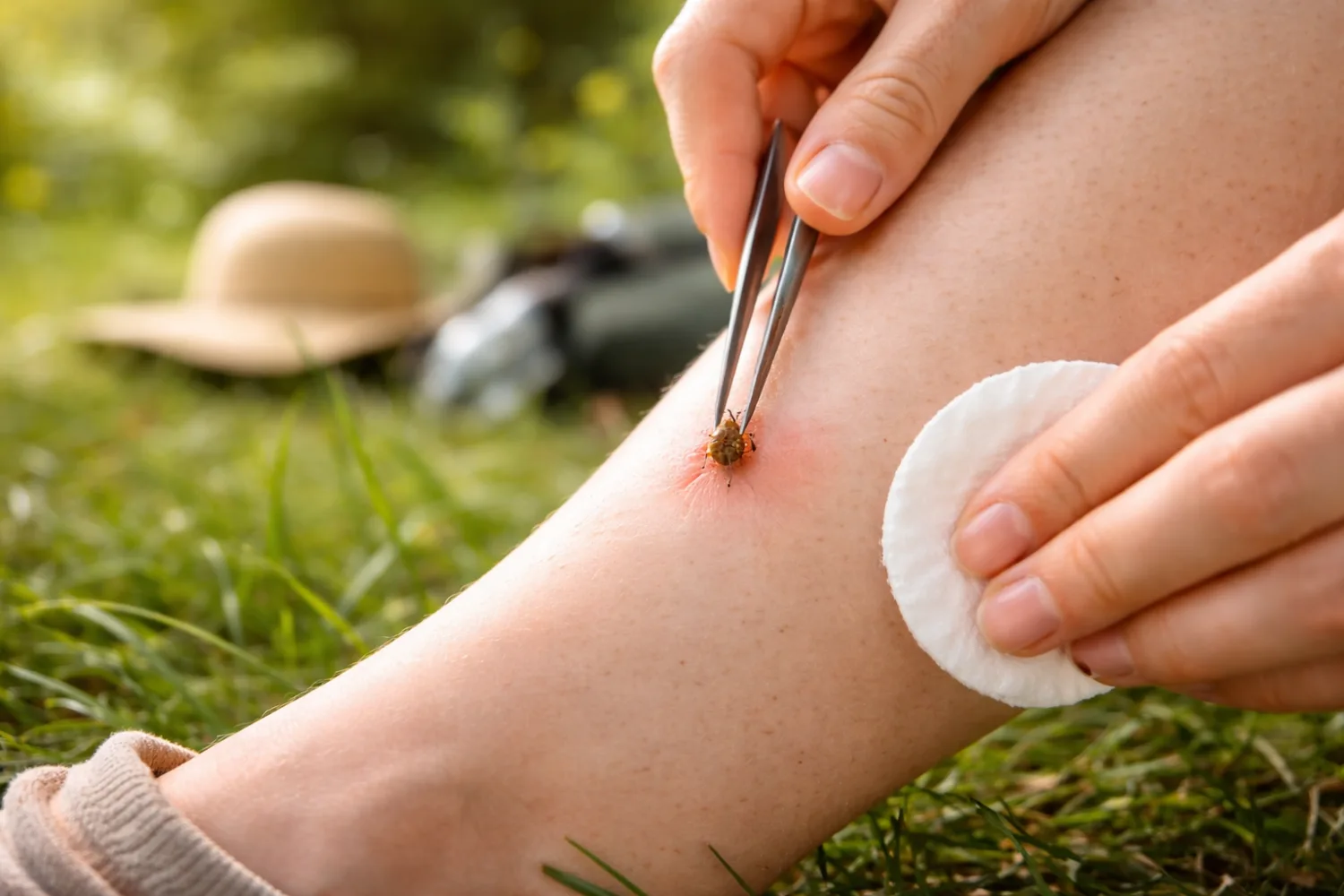
A tick bite can feel like one of those half-accidents of British outdoor life: you go for a walk, sit on the grass, take the dog out, come back from a camping trip, and later notice a small dark speck attached to the skin. For many people, that is the end of it. The tick is removed, the skin settles, and nothing else happens.
But tick bites matter because some ticks in the UK carry the bacteria that cause Lyme disease. The overall chance of becoming ill after a tick bite is still low, and most tick bites do not lead to Lyme disease, but it is important to know what to watch for, how to remove a tick properly, and when symptoms should prompt a call to your GP.
This guide is written for UK patients and families. It covers what ticks are, where you are most likely to come across them, how Lyme disease usually starts, what the rash can look like, how to remove a tick safely, and when it is sensible to seek help rather than just “keeping an eye on it”.
What ticks are, and where people pick them up
Ticks are tiny spider-like creatures that feed on blood. They do not jump or fly. Instead, they wait on long grass, low plants or vegetation and attach when a person or animal brushes past. The NHS Lyme disease guidance says ticks are found all over the UK, especially in woods, grassy areas, and sometimes even urban parks and gardens. UKHSA also reminds people that ticks are particularly active from spring into summer, although they can be active at other times of year too.
That means you do not need to be deep in the Highlands or on a remote moor to be bitten. A family picnic, a day in the countryside, gardening, trail running, a school field trip or simply walking the dog through rough grass can be enough.
A common example is the person who feels perfectly well after a weekend walk, then spots a tick attached behind the knee while changing clothes that evening. Another is the child who comes back from forest school or a park and has a small tick hidden near the hairline or behind the ear. Tick bites are often painless, so many people do not notice them until they see the tick itself.
Does every tick bite cause Lyme disease?
No. Most tick bites do not cause Lyme disease. Only some ticks carry the bacteria, and even then, not every bite leads to infection. That is why it is important not to panic if you find a tick on your skin.
The more useful approach is calm, practical and watchful: remove the tick properly, clean the area, and then keep an eye out for symptoms over the following days and weeks. NICE guidance is clear that Lyme disease should not be diagnosed in people who have no symptoms just because they had a tick bite. In other words, a tick bite on its own is not the same thing as Lyme disease.
That point matters because people often go down an internet rabbit hole after finding a tick and assume infection is inevitable. It is not. What matters is what happens next.
What Lyme disease is
Lyme disease is a bacterial infection spread through the bite of an infected tick. Early treatment is important because Lyme disease is usually easier to treat when it is recognised promptly. According to NICE information for the public, Lyme disease often begins with flu-like symptoms and, in some people, an expanding red rash. If treatment is delayed, it can lead to more significant symptoms affecting the joints, nerves or, more rarely, the heart.
That does not mean every headache or ache after a countryside walk is Lyme disease. It does mean that a pattern of symptoms after possible tick exposure deserves proper attention, especially if there is a spreading rash or a cluster of flu-like symptoms that do not quite fit a normal virus.
What the Lyme disease rash can look like
The rash is the symptom many people have heard of, but it is also one of the most misunderstood. People often imagine a perfect red ring with a clear middle, like a target drawn with a compass. Sometimes it does look like that. Sometimes it does not.
The NHS says Lyme disease can cause a round or oval rash, and on some people it does have the classic “bullseye” appearance. But the rash may also simply look like an expanding red patch that slowly gets larger over days. It is usually not the small, ordinary mark you might expect from a minor bite. The important clue is that it spreads.
It also does not always appear immediately. Symptoms can develop days or even weeks later, and some people with Lyme disease never notice a rash at all. That is one reason Lyme disease can be tricky: if you are waiting for the textbook bullseye and nothing else, you may miss earlier signs.
If you already have concerns about suspicious skin changes more generally, readers may also find your article on skin cancer checks in the UK helpful, though a Lyme rash behaves very differently from a mole or skin cancer warning sign.
Other early symptoms of Lyme disease
Not everyone develops the rash first. Some people instead feel unwell in a more general way. Early Lyme disease can cause flu-like symptoms such as tiredness, headaches, feverishness, aching muscles, joint pain, feeling hot and cold, or swollen glands. The problem is that these symptoms are easy to mistake for a viral infection, overexertion or simply feeling run down.
A realistic example is someone who had a tick bite after a weekend camping trip, removed it, then ten days later develops aching legs, shivery episodes, a headache and unusual fatigue. If those symptoms arrive in the context of recent tick exposure, Lyme disease should be on the list of possibilities, especially if a rash also appears.
In children, the story can be similar. A child may become unusually tired, complain of aches, seem off-colour, or develop a rash after outdoor activities. If symptoms follow a known tick bite, or even just likely exposure in grass or woods, it is worth mentioning that clearly when speaking to a GP.
Later or more serious symptoms
If Lyme disease is not recognised early, other symptoms can develop later. NICE notes that untreated or delayed Lyme disease can sometimes lead to joint swelling and pain, nerve symptoms such as numbness or facial weakness, problems with concentration, and more rarely heart-related complications. That is not the most common presentation, but it is why persistent or unusual symptoms after tick exposure should not be brushed off for weeks.
One important point for patients is that you may not remember a tick bite. Ticks are small, bites are often painless, and they can attach in places that are hard to see. So if a doctor asks about recent walks, grassy areas, woodland, gardening or outdoor activities, that is not a random question. It is part of building the picture.
How to remove a tick safely
If you find a tick attached to your skin, remove it as soon as you can. This is one of the few parts of tick advice that is simple and consistent across NHS guidance: quick, careful removal is the goal.
The NHS advice on Lyme disease recommends using fine-tipped tweezers or a tick-removal tool. Grasp the tick as close to the skin as possible, then pull upwards slowly and steadily. Try not to squeeze, twist or crush the tick. Once it is out, clean the bite area with soap and water or antiseptic.
What you should not do is just as important. Do not try to smother the tick with petroleum jelly or other creams. Do not burn it with a match. Do not soak it in alcohol while it is still attached. These methods are not recommended and can make removal harder or more irritating to the skin.
If part of the tick appears to remain in the skin, do not dig aggressively at the area. A tiny retained fragment may cause local irritation, but repeatedly picking at the skin can do more harm than good. If you are worried that you have not removed it properly, or it is in an awkward place such as near the eye, scalp or genitals, seek advice.
What to do after you remove a tick
In most cases, nothing dramatic is needed. Clean the skin, wash your hands, and keep an eye on the site and on your general health over the next few weeks. The NHS says you do not usually need to do anything else unless you notice a rash or become unwell.
Some people choose to take a quick photo of the bite area over the next few days if they are concerned. That can be useful because it helps show whether an area is genuinely expanding or simply settling down as a normal bite reaction. A small bit of redness immediately after removal is not unusual. The concern is a rash that enlarges or symptoms that build over time.
This is also where good common sense matters. If the area becomes more painful, hot, swollen or weepy in a way that suggests a local skin infection rather than Lyme disease, you may need medical advice for that reason alone.
When you should see a GP
You should contact a GP, or use NHS 111 if appropriate, if you have been bitten by a tick or were in an area where ticks may be present in the past few months and then develop a rash or flu-like symptoms. NHS advice specifically highlights a round or oval rash, headaches, aching muscles, shivery episodes, fever-like symptoms and feeling unwell after tick exposure.
This is one of those situations where context really helps. Do not just say, “I feel tired.” Say, “I removed a tick two weeks ago and now I have a spreading rash and aches,” or “My child had a tick bite after a school trip and now has feverish symptoms.” That makes it much easier for the clinician to think in the right direction.
If you are struggling with access, your article on how to get a GP appointment quickly in the UK is a useful internal link for readers who need practical help navigating the system.
Will you need a blood test?
Sometimes yes, sometimes no. This is where Lyme disease can be confusing. If a clinician sees the typical expanding rash known as erythema migrans, NICE says Lyme disease should be diagnosed and treated without waiting for laboratory testing. In plain English, a convincing rash can be enough to start treatment.
Blood tests are more useful in people without the typical rash, where symptoms and timing need to be assessed more carefully. Even then, testing has limitations, especially early on. NICE guidance explains that diagnosis in people without erythema migrans involves a combination of symptoms, exposure history and laboratory testing, and early tests are not always straightforward.
This is one reason self-diagnosing online can be risky. A rash that looks worrying to you may be a simple bite reaction, and symptoms that feel “viral” may or may not be related to a tick bite. The role of the GP is to put those pieces together.
Do you need antibiotics after every tick bite?
No. This is a common misconception. In the UK, routine antibiotics are not given to everyone who has a tick bite and no symptoms. NICE is clear that Lyme disease should not be diagnosed in people without symptoms purely because they were bitten by a tick, and the NHS says that if you remove the tick and feel well, you usually do not need further treatment.
That can feel surprising, especially if you have read American advice online, where some recommendations and local risks differ. For UK patients, the message is more measured: remove the tick promptly, monitor for symptoms, and seek help if symptoms appear.
Children and tick bites
Children pick up ticks for obvious reasons: they roll in grass, sit on logs, build dens, run through undergrowth and do not always notice small bites. The basic advice is the same as for adults, but parents need to think about checking places children cannot easily see themselves, such as the scalp, behind the ears, under arms and behind knees.
If a child develops unusual tiredness, aches, feverish symptoms, facial weakness or a spreading rash after outdoor exposure, speak to a GP. Parents who are also dealing with seasonal outdoor symptoms may want to read your related guide on spring allergies in children, because itchy eyes, sneezing and coughs are much more likely to be allergies than Lyme disease, but the two can overlap in timing and cause confusion.
When it is more urgent
Most tick bites are not emergencies. But urgent medical advice is sensible if you develop facial drooping, severe headache, neck stiffness, chest pain, palpitations, significant weakness, or rapidly worsening symptoms after a tick bite or likely exposure. Those symptoms are not the standard “watch and wait” scenario.
Likewise, if you are immunocompromised, pregnant, or have a more complicated medical background and are unsure what to do after a tick bite, it is reasonable to seek advice earlier rather than later.
How to reduce the chance of tick bites in the first place
You do not have to stop enjoying the outdoors. But a few boring precautions really do help. The NHS and UKHSA recommend staying on clearer paths where possible, avoiding brushing against long grass and vegetation, covering exposed skin, and using insect repellent containing DEET where appropriate. Light-coloured clothing makes ticks easier to spot before they attach.
After outdoor activities, check your skin and clothing. Check children carefully, and check pets too, because ticks can hitch a lift home. People often think of this as something you do on holiday, but it makes just as much sense after a UK hike, picnic or camping weekend.
The bottom line
A tick bite is usually not a disaster, and most do not lead to Lyme disease. But it is not something to ignore completely either. The best approach is simple: remove the tick properly, do not use old-fashioned remedies like petroleum jelly or burning, and watch for a spreading rash or flu-like symptoms over the following days and weeks.
Early Lyme disease is usually much easier to deal with than delayed Lyme disease. If you develop the typical rash or start to feel unwell after a tick bite or outdoor exposure, contact a GP and mention the tick connection clearly. That one detail can make all the difference.
Frequently asked questions
How soon do Lyme disease symptoms start after a tick bite?
Symptoms can start within days, but they may also appear weeks later. The NHS advises being alert for symptoms in the weeks after a tick bite, and to seek advice if you develop a rash or flu-like illness after recent exposure.
Do all tick bites leave a bullseye rash?
No. Some Lyme rashes do have a bullseye appearance, but others are simply expanding red or pink patches. Some people with Lyme disease do not notice a rash at all.
Should I go to A&E for a tick bite?
Usually no. Most tick bites can be dealt with at home by careful removal. You should seek more urgent medical help if you have serious symptoms such as facial weakness, chest symptoms, severe headache, or you are very unwell.
Can I get Lyme disease even if I did not see a tick?
Yes. Ticks can be very small and their bites are often painless. Some people with Lyme disease do not remember ever seeing a tick attached.
Do I need antibiotics just because I was bitten by a tick?
No. In the UK, routine antibiotics are not usually given after a tick bite if you have no symptoms. What matters is whether you later develop signs of Lyme disease.
What is the safest way to remove a tick?
Use fine-tipped tweezers or a tick-removal tool, grasp the tick as close to the skin as possible, and pull upwards slowly and steadily without crushing it. Then clean the area.
What should I not put on a tick?
Do not use petroleum jelly, oils, alcohol, nail varnish remover or a hot match. These are not recommended ways to remove ticks.
Can children get Lyme disease?
Yes. Children can get Lyme disease after being bitten by an infected tick. Parents should check children carefully after outdoor activities and seek advice if a rash or flu-like symptoms develop.