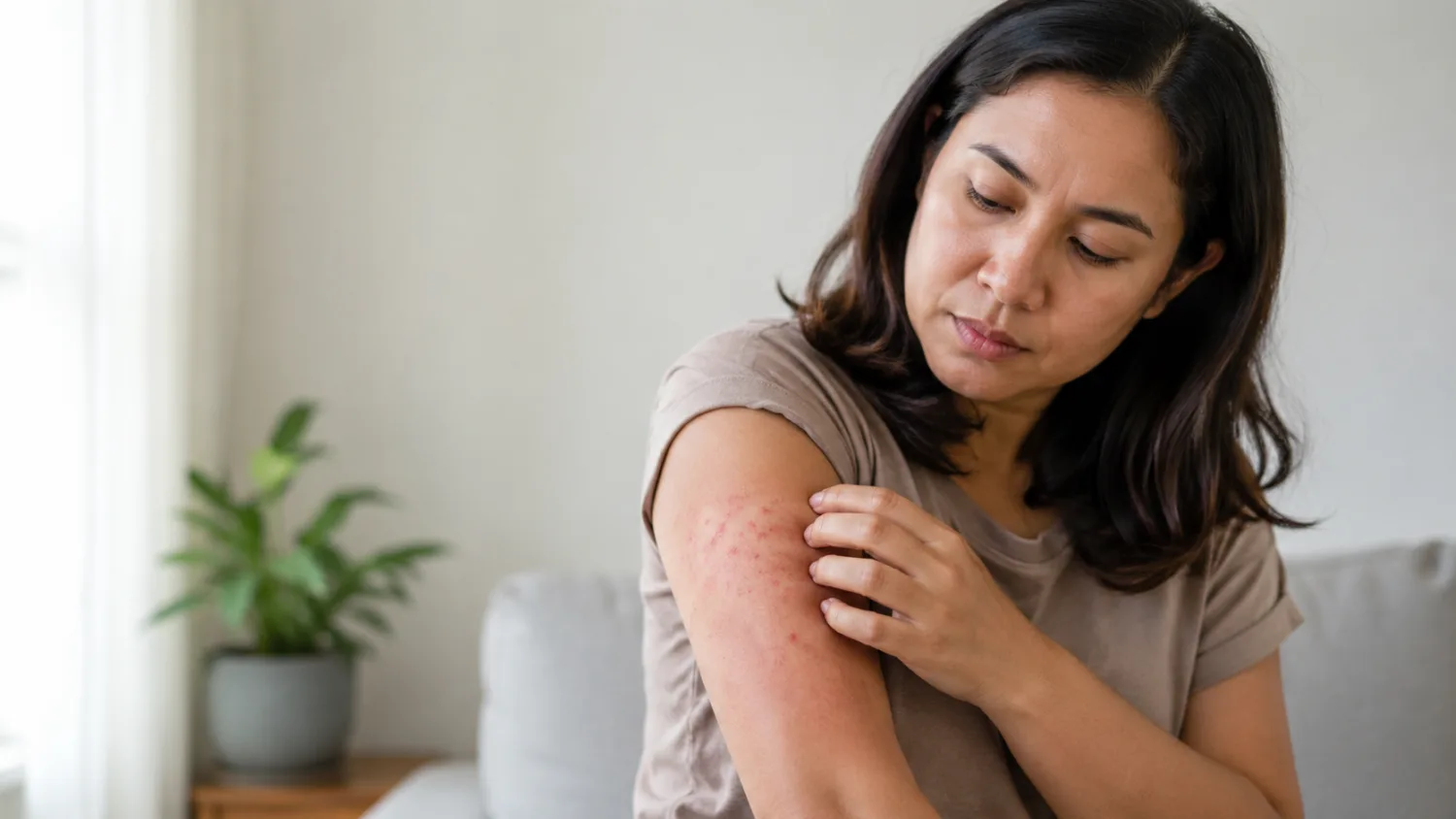
A rash in adults can appear suddenly or develop gradually over hours, days or weeks. It may be itchy, painful, raised, blistered, dry, scaly, red, purple, brown, swollen or warm.
Some rashes are mild and settle with simple self-care or pharmacy treatment. Others can be a sign of infection, allergy, inflammation or a medical emergency.
The difficult part is that many rashes look similar, especially in the early stages. A viral rash, allergic reaction, insect bite reaction, eczema flare, shingles, cellulitis or meningitis-related rash can all look different from person to person.
Rash colour can also be harder to see on brown or black skin, so it is important to notice texture, swelling, warmth, pain, blisters, tenderness, fever and how quickly the rash is spreading.
This guide explains common causes of rashes in adults, what may help at home, when to ask a pharmacist, and when to contact a GP, NHS 111 or 999.
Important: Seek urgent help if a rash does not fade when pressed, appears with fever and you feel very unwell, spreads rapidly, is painful and hot, causes swelling of the lips, tongue, throat or face, or comes with breathing difficulty, confusion, collapse, a stiff neck or severe headache.
What a rash is
A rash is a visible or noticeable change in the skin. It may affect a small patch or spread across large areas of the body. It may feel itchy, sore, burning, tight or tender. Some rashes are flat; others are raised, bumpy, blistered or scaly.
Rashes can be caused by many things, including infections, irritation, allergies, medicines, heat, bites, autoimmune conditions and long-term skin problems.
NHS Inform explains that rashes and swelling can affect the skin’s colour, texture, size or appearance and may be caused by infections, irritation, allergies, temperature changes or other triggers.
Because the same rash can look different on different skin tones, do not rely only on redness. Also look for:
- itching
- pain or tenderness
- warmth
- swelling
- blisters
- scaling or cracking
- purple, brown or bruise-like marks
- spots that do not fade when pressed
- fever or feeling unwell
- how quickly the rash is spreading
Common causes of rash in adults
Many adult rashes are caused by everyday problems such as irritation, allergy, infection or dry skin. Others are linked with a specific illness or need prescription treatment.
Common causes include:
- contact dermatitis
- eczema
- psoriasis
- hives
- heat rash
- insect bites and stings
- fungal infections such as ringworm or athlete’s foot
- shingles
- cellulitis
- viral rashes
- medicine reactions
- scabies
- impetigo
- rosacea or acne-related inflammation
- allergic reactions
If the rash is linked with fever, see our guide to Fever in Adults: What Temperature Means and When to Worry. If it started after a bite or sting, read Insect Bites and Stings: Swelling, Infection, Allergy and When to Get Help.
Irritation, eczema and psoriasis
Some of the most common adult rashes are linked with skin irritation or long-term inflammatory skin conditions. These can be uncomfortable and persistent, but they are not usually emergencies unless infection, severe swelling or widespread symptoms develop.
Contact dermatitis
Contact dermatitis happens when the skin reacts to something it has touched. This can be an irritant, such as soap or cleaning products, or an allergen, such as nickel, fragrance, hair dye, plants, latex or certain cosmetics.
Symptoms may include:
- itchy or sore skin
- redness or darker discolouration
- dryness or cracking
- small blisters
- swelling
- a rash in the area that touched the trigger
Common triggers include new skincare products, hand sanitiser, washing powder, gloves, jewellery, hair dye, occupational chemicals, plants and cleaning sprays.
What may help:
- stop using the suspected trigger
- wash the area gently with water
- avoid scratching
- use a bland moisturiser
- ask a pharmacist about suitable creams
- wear gloves for cleaning, but avoid gloves that make symptoms worse
Contact a GP if the rash is severe, spreading, infected, affecting your face or genitals, or not improving after avoiding the trigger.
Eczema
Eczema is a common long-term skin condition that can cause dry, itchy, inflamed skin. It may flare after contact with irritants, stress, infection, weather changes, allergens or frequent washing.
Eczema can look different depending on skin tone. It may appear red on lighter skin, or darker brown, purple, grey or ashen on darker skin. The skin may feel rough, dry, thickened or cracked.
Symptoms can include:
- itching
- dry or cracked skin
- rough patches
- scaling
- weeping or crusting if infected
- flare-ups that come and go
Regular moisturising, avoiding triggers and using prescribed treatments correctly can help. If you are unsure whether your rash is eczema, psoriasis or something else, see our guide to Eczema and Psoriasis: Symptoms, Differences and Treatment.
Psoriasis
Psoriasis is an inflammatory skin condition that often causes well-defined patches of thickened, scaly skin. It can affect the elbows, knees, scalp, lower back, nails and other areas. Some people also develop joint pain or stiffness.
Psoriasis patches may look pink or red with silvery scale on lighter skin. On darker skin, patches may look purple, brown or darker than the surrounding skin, and scaling may still be visible.
Seek advice if you think you may have psoriasis, if it is affecting your quality of life, if you have joint pain, or if over-the-counter treatments are not helping.
Hives and allergic reactions
Some rashes are caused by allergy or immune system reactions. These can range from mild itching to a life-threatening allergic reaction.
Hives
Hives, also called urticaria, usually causes an itchy raised rash. The rash may appear as bumps, wheals or patches that change shape, move around or come and go.
NHS guidance says hives can appear anywhere on the body, may sting or burn, and often improves within a few days.
Common triggers include:
- viral infections
- food allergy
- medicines
- insect stings
- heat or cold
- pressure on the skin
- stress
Many mild cases can be managed with antihistamines from a pharmacy, if suitable. Avoid the suspected trigger if you know what caused it.
Get urgent help if hives come with swelling of the lips, tongue, throat or face, wheezing, breathing difficulty, dizziness, fainting, confusion, or a feeling that something is seriously wrong. These can be signs of anaphylaxis, a severe allergic reaction.
When an allergic rash is serious
An allergic rash may be mild, such as itchy hives after contact with a trigger. But allergic reactions can sometimes become serious very quickly.
Call 999 if a rash comes with signs of anaphylaxis, such as:
- swelling of the lips, tongue, throat or face
- difficulty breathing
- wheezing or noisy breathing
- difficulty swallowing
- tightness in the throat
- feeling faint or dizzy
- collapse
- confusion
- cold, pale, blue, grey or blotchy skin
NHS guidance on anaphylaxis explains that this type of reaction can be life-threatening and needs emergency treatment.
Heat rash, bites and fungal infections
Some rashes are linked with heat, sweating, insect bites or fungal infections. These are often manageable with self-care or pharmacy advice, but they still need medical review if they spread, become painful, look infected or come with fever.
Heat rash or prickly heat
Heat rash, also called prickly heat, can happen when sweat ducts become blocked. It is more common in hot weather, humid conditions, during exercise, or when wearing tight clothing.
Symptoms may include:
- small raised spots or bumps
- itching or prickling
- a stinging feeling
- rash in sweaty areas, such as the chest, back, neck, groin or under the breasts
What may help:
- move somewhere cooler
- wear loose cotton clothing
- keep the skin dry
- avoid heavy creams that block pores
- take cool showers
- avoid overheating
If you also feel dizzy, weak, confused, very hot or dehydrated, consider heat illness. Read Heat Exhaustion and Heatstroke: Symptoms, First Aid and When to Get Help and How to Prevent Heat Exhaustion and Heatstroke in Hot Weather.
Insect bites and stings
Bites and stings often cause a small itchy or painful bump. The skin may be swollen, red or warm. On darker skin, redness may be less visible, so look for swelling, tenderness, heat and changes in texture.
Most mild bite reactions improve with simple care, such as cleaning the area, avoiding scratching, using a cold compress and asking a pharmacist about antihistamines or creams.
Seek medical advice if:
- swelling is severe or spreading
- the area becomes increasingly painful, hot or tender
- there is pus
- you develop fever
- redness or discolouration spreads away from the bite
- you feel generally unwell
- you have signs of an allergic reaction
For more detail, see Insect Bites and Stings: Swelling, Infection, Allergy and When to Get Help. If you have been bitten by a tick, read Tick Bites and Lyme Disease: Symptoms, Removal and When to See a GP.
Ringworm and fungal rashes
Ringworm is a fungal skin infection. Despite the name, it is not caused by a worm. It often causes a circular or ring-shaped rash that may be itchy, scaly or raised at the edge. It can appear on the body, scalp, groin or feet.
Athlete’s foot is a fungal infection of the feet. It often affects the skin between the toes and can cause itching, peeling, cracking or soreness.
Fungal rashes often need antifungal treatment, which a pharmacist can advise on. Steroid creams can sometimes make fungal infections worse if used alone, so ask for advice if you are unsure.
Read more in our guide to Ringworm: Symptoms, Treatment and How It Spreads.
Infections that can cause a rash
Some rashes are caused by infection. These may need prescription treatment, especially if the rash is painful, spreading, near the eye, linked with fever, or you are pregnant, diabetic or immunosuppressed.
Shingles
Shingles is caused by the same virus that causes chickenpox. It usually causes a painful rash on one side of the body or face. Pain, tingling, burning or sensitivity may start before the rash appears.
Symptoms may include:
- burning, tingling or shooting pain
- a rash on one side of the body
- clusters of blisters
- skin sensitivity
- feeling unwell
- headache or fever in some cases
Contact a GP or NHS 111 if you think you have shingles, especially if the rash is near your eye, you are pregnant, you have a weakened immune system, or symptoms are severe. Antiviral medicines work best when started early, usually within the first few days.
Cellulitis
Cellulitis is a bacterial infection of the deeper layers of the skin. It can become serious if not treated. It often affects the legs, but it can happen anywhere.
Signs can include:
- skin that is hot, swollen and painful
- redness or darker discolouration
- tenderness
- rapid spreading
- fever or chills
- feeling generally unwell
Cellulitis can sometimes follow a cut, bite, eczema crack, athlete’s foot, ulcer or injury. It may need antibiotics, so seek medical advice promptly if you suspect it.
Get urgent help if the area is spreading quickly, you have fever, feel very unwell, have diabetes, are immunosuppressed, or the rash is near the eye.
Scabies
Scabies is caused by tiny mites that burrow into the skin. It causes intense itching, often worse at night.
The rash may affect the hands, wrists, between the fingers, elbows, waistline, buttocks, genitals, feet or under the breasts.
Scabies spreads through close skin contact and often affects households, care homes, shared accommodation or sexual contacts. Treatment usually needs to include close contacts at the same time, even if they do not yet have symptoms.
Speak to a pharmacist or GP if you suspect scabies. Bedding, towels and clothing may also need washing according to treatment advice.
Viral rash
Viral infections can cause widespread rashes, sometimes with fever, sore throat, cough, diarrhoea, fatigue or swollen glands. Many viral rashes improve as the illness settles, but some need assessment.
Seek advice if a rash comes with:
- high or persistent fever
- stiff neck
- severe headache
- light sensitivity
- confusion or drowsiness
- breathing difficulty
- non-blanching spots
- severe pain
- pregnancy or a weakened immune system
If fever is part of the illness, see Fever in Adults: What Temperature Means and When to Worry. If sore throat is also present, read Sore Throat: Causes, Home Relief and When to See a GP.
Medicine-related rashes
Some medicines can cause rashes. This may happen soon after starting a medicine or after several days. Antibiotics, anti-seizure medicines, anti-inflammatory medicines and many other medicines can sometimes trigger reactions.
Most medicine rashes are mild, but some are serious.
Seek urgent medical help if a medicine-related rash comes with:
- swelling of the lips, tongue, throat or face
- breathing difficulty
- blistering or peeling skin
- mouth, eye or genital sores
- fever
- facial swelling
- purple or bruise-like rash
- feeling very unwell
Do not ignore a rash after starting a new medicine. Ask a pharmacist, GP or NHS 111 what to do, especially before taking the next dose if the reaction seems significant.
Emergency warning signs
Most rashes are not emergencies, but some combinations of symptoms need urgent help. The most important warning signs are a non-blanching rash, signs of anaphylaxis, symptoms of sepsis or meningitis, and rapidly worsening painful infection.
Non-blanching rash and the glass test
A non-blanching rash does not fade when pressed. The “glass test” is sometimes used: press the side of a clear glass firmly against the rash and check whether the marks fade. If the rash remains visible through the glass, it may be non-blanching.
A non-blanching rash can have several causes, but it can also be a warning sign of meningitis or sepsis.
NHS guidance says if a rash does not fade under a glass, it can be a sign of sepsis caused by meningitis and you should call 999 straight away.
Call 999 if you have a non-blanching rash, especially with:
- fever
- severe headache
- stiff neck
- dislike of bright lights
- confusion
- extreme drowsiness
- cold hands and feet
- fast breathing
- severe muscle pain
- feeling seriously unwell
Do not wait for a rash if someone has other symptoms of meningitis or sepsis. A rash may appear late or not at all.
Rash with fever
A rash with fever needs more caution than a rash alone. It may still be caused by a mild viral illness, but it can also happen with scarlet fever, shingles, cellulitis, meningitis, sepsis, measles, drug reactions or other infections.
Get medical advice if you have a rash with fever and:
- you feel very unwell
- the rash is spreading quickly
- the rash is painful, hot or swollen
- the rash is purple, bruise-like or non-blanching
- you have a severe headache or stiff neck
- you are confused or very drowsy
- you have breathing difficulty
- you recently started a new medicine
- you are pregnant or immunosuppressed
When to call 999
Call 999 if a rash comes with emergency symptoms.
Call 999 if you or someone else has:
- a rash that does not fade when pressed
- difficulty breathing
- swelling of the lips, tongue, throat or face
- confusion or severe drowsiness
- collapse or fainting
- blue, grey, pale or blotchy skin, lips or tongue
- a stiff neck
- severe headache with fever
- dislike of bright lights
- severe pain
- a rapidly spreading purple or bruise-like rash
- signs of sepsis
Trust your judgement. If someone looks seriously unwell or is deteriorating quickly, seek emergency help.
What to do for a mild rash
If the rash is mild, you feel well, and there are no red flags, simple self-care may help while you monitor it.
General steps include:
- avoid scratching
- keep the skin cool
- avoid hot showers or baths
- use fragrance-free moisturiser if the skin is dry
- avoid new creams, perfumes or washing products
- wear loose cotton clothing
- use a cold compress for itching or swelling
- ask a pharmacist about antihistamines or creams if suitable
Avoid using strong steroid creams, antibiotic creams or antifungal creams without advice if you are unsure what the rash is. The wrong treatment can sometimes make a rash worse or hide important signs.
When to see a pharmacist
A pharmacist can often help with mild rashes, itching, hives, insect bites, fungal infections, heat rash, contact irritation and dry skin.
They can suggest suitable over-the-counter treatments and tell you when a GP or urgent service is needed.
Speak to a pharmacist if:
- the rash is itchy but you feel well
- you think it may be hives
- you suspect a mild fungal infection
- you have an insect bite reaction
- you need advice on antihistamines or creams
- you are not sure whether a rash needs a GP appointment
For more about pharmacy advice, see When to See a Pharmacist Instead of a GP.
When to contact a GP or NHS 111
Contact a GP, out-of-hours service or NHS 111 if:
- the rash is getting worse or spreading
- the rash is painful, hot or swollen
- you have fever or feel unwell
- there is pus, crusting or signs of infection
- you think you may have shingles
- the rash is near your eye
- you recently started a new medicine
- the rash is severe or widespread
- the rash keeps coming back
- the rash is not improving with appropriate self-care
- you are pregnant
- you have diabetes
- you have a weakened immune system
- you are worried or unsure what it is
You can use NHS 111 online in England if you need urgent advice but it is not a 999 emergency.
If you need help arranging care, see How to Get a GP Appointment Quickly in the UK.
How to describe a rash to a clinician
If you contact a pharmacist, GP or NHS 111, it helps to describe the rash clearly.
Useful details include:
- when it started
- where it started
- whether it is spreading
- whether it is itchy, painful, hot or tender
- whether there are blisters, scaling, pus or crusting
- whether it fades when pressed
- whether you have fever or feel unwell
- whether you recently started a new medicine
- whether you used a new product, food, plant, chemical or detergent
- whether you were bitten or stung
- whether anyone else at home has itching or a rash
- whether you have travelled recently
If you are using an online consultation system, a clear photo in good light can be helpful. Take one close-up and one wider photo showing where the rash is on the body. Do not delay urgent care to take photos if emergency symptoms are present.
FAQ: rashes in adults
How do I know if a rash is serious?
A rash may be serious if it does not fade when pressed, spreads rapidly, is very painful, is hot and swollen, comes with fever, confusion, breathing difficulty, facial or throat swelling, a stiff neck, severe headache, or you feel very unwell. Seek urgent help if any of these apply.
What does a non-blanching rash mean?
A non-blanching rash does not fade when you press it. It can have several causes, but it can be a warning sign of meningitis or sepsis, especially with fever or feeling very unwell. Call 999 if you have a non-blanching rash with worrying symptoms.
Can stress cause a rash?
Stress can trigger or worsen some skin conditions, including eczema, psoriasis and hives. However, a new rash should not automatically be blamed on stress, especially if it is painful, spreading, infected-looking or linked with fever.
Can allergies cause a rash?
Yes. Allergies can cause hives, itching, swelling or contact dermatitis. A mild allergic rash may improve with antihistamines and avoiding the trigger. Call 999 if a rash comes with breathing difficulty, throat tightness, facial swelling, dizziness or collapse.
What is the difference between hives and a normal rash?
Hives are usually raised, itchy wheals or patches that can change shape, move around and come and go. Other rashes may be fixed in one place, scaly, blistered, painful, infected or linked with a skin condition. A pharmacist can often help if you are unsure.
Should I put steroid cream on a rash?
Not always. Mild steroid creams may help some inflammatory rashes, but they can make some infections, such as fungal rashes, worse if used incorrectly. Ask a pharmacist or GP if you are unsure what the rash is.
Can a rash be caused by a medicine?
Yes. Medicines can cause mild or serious rashes. Seek advice if a rash starts after a new medicine. Get urgent help if there is swelling, breathing difficulty, blistering, peeling skin, mouth ulcers, fever or you feel very unwell.
When should I see a GP about a rash?
See a GP or contact NHS 111 if the rash is worsening, painful, infected-looking, widespread, near the eye, linked with fever, not improving, keeps returning, or you are pregnant, immunosuppressed or have diabetes.
Can insect bites cause a spreading rash?
Yes. Bites can cause local swelling and itching, but spreading redness, warmth, pain, pus or fever may suggest infection. A circular expanding rash after a tick bite may suggest Lyme disease and should be assessed.
Why is rash colour harder to judge on darker skin?
Redness may be less obvious on brown or black skin. Look for changes in texture, swelling, warmth, tenderness, purple or darker patches, raised bumps, blistering, scaling, and how the skin compares with surrounding areas.
Final takeaway
Most rashes in adults are caused by common problems such as irritation, allergy, eczema, hives, bites, fungal infections or viral illnesses. Many can be managed with self-care or pharmacy advice.
But some rashes need urgent attention, especially if they are non-blanching, painful, hot, spreading, linked with fever, or come with breathing difficulty, swelling, confusion or severe illness.
If you are unsure what a rash is, seek advice rather than guessing. A pharmacist can help with many mild rashes, while a GP or NHS 111 can advise if symptoms are worsening or concerning. Call 999 for emergency warning signs.
For official guidance, see NHS Inform on rashes, irritation and swelling, NHS guidance on hives, NHS information on anaphylaxis, and NHS guidance on meningitis symptoms.
This article is for general information only and should not replace medical advice. If you are worried about your symptoms or someone else’s, contact NHS 111, your GP, or call 999 in an emergency.