In the UK, people tend to think of sunburn as a July problem. It belongs, in the popular imagination, to beach days, heatwaves, school holidays and the sort of afternoons when everyone suddenly regrets underestimating the weather. Spring feels different. The air can still be cool. The breeze can feel fresh rather than hot. You may not even think of it as “sunbathing weather”.
And that is exactly why spring sun catches people out.
Skin damage from the sun is caused by ultraviolet radiation, not by how hot the air feels. Cancer Research UK explains that the UV index measures how strong the sun’s UV rays are, and that when the UV index is 3 or above, the sun is strong enough to damage some skin types, especially people who burn easily. They also note that UV rays can still cause damage even when it does not feel particularly hot.
That makes spring a surprisingly important time for sun safety. The first warm days of the year often mean people spend longer outside than they realise: lunch in the garden, a park visit, a run, a beer outside a pub, children’s sports, gardening, a long dog walk, or simply sitting by a sunny window. Because it does not feel like midsummer, sunscreen and shade are easy to forget.
Why spring sun can still burn you
The basic point is simple: cool weather does not mean low UV. The heat you feel from the sun is not the same thing as the ultraviolet radiation that damages skin. Cancer Research UK specifically warns that the sun is not necessarily strongest when it feels hottest, because UV and heat are different things.
This is why people get caught out on bright April and May days. You feel comfortable, not sweaty. You may even say, “It’s not that hot.” But if the UV index is high enough, your skin can still burn. The NHS advises using shade, clothing and sunscreen with an SPF of at least 30 to avoid getting caught out by sunburn.
A very ordinary UK example is the parent watching Saturday football in a T-shirt, the grandparent gardening for three hours after a long winter indoors, or the office worker eating lunch outside every day during a run of sunny weather. None of these people are trying to tan. But all of them can pick up enough UV exposure to burn.
What sunburn actually is
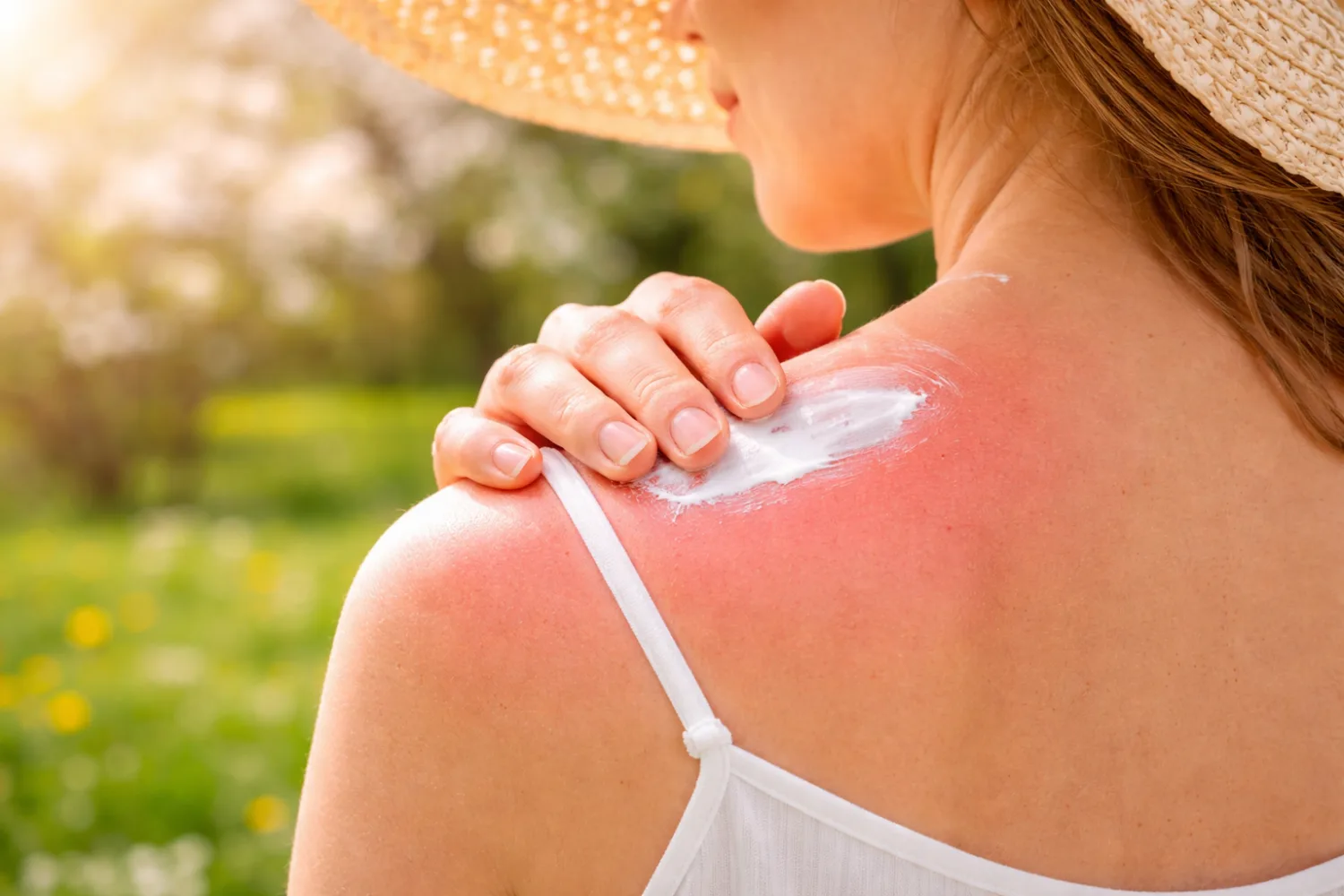
Sunburn is skin damage caused by too much ultraviolet radiation. Mild sunburn may look like pink or red skin that feels warm and sore. More severe sunburn can cause marked redness, tenderness, swelling and blistering. Repeated sunburn matters because UV damage increases the risk of skin cancer over time, which is why both the NHS and Cancer Research UK put so much emphasis on prevention rather than just aftercare.
People often judge the situation too late because sunburn usually develops after the exposure, not during it. You can sit outside feeling perfectly comfortable and only realise that you overdid it when your shoulders, chest or scalp start stinging later that evening.
Who is most likely to burn in spring?
Anyone can get UV damage, but some people burn more easily than others. Cancer Research UK notes that the risk of sunburn depends partly on skin type, and the NHS advises extra care for people with lots of moles or freckles because their risk of skin cancer is higher than average.
In real life, the people most often caught out in spring include:
the fair-skinned runner who switches back to short sleeves the minute the weather improves; the child with pale shoulders at the first sports day of the year; the gardener who forgets the back of the neck; the driver whose arm sits in sunlight through the car window; and the person who assumes cloud means safety, even though UV can still get through cloud cover. Cancer Research UK has specifically warned that UV rays can travel through clouds and that you can still burn on overcast days.
The spring situations people forget about
One reason spring burns happen is that they rarely happen in an obvious “sunbathing” setting. They happen in the margins of normal life.
It might be the first barbecue of the year, where someone sits in a sunny corner for four hours because the air still feels mild. It might be a long Easter weekend walk with a cap but no sunscreen, or a school fair where children spend the whole afternoon outdoors. It might be a city break, where you are walking continuously in open sunlight and only notice the red nose and cheeks once you get back to the hotel.
That is why checking the UV index is more useful than judging by temperature. Cancer Research UK advises that when the UV index is 3 or more, it is worth thinking about protecting your skin.
What good sun safety looks like in the UK
Good sun safety is not about hiding indoors all summer. It is about reducing avoidable damage. The NHS recommends using shade, covering up with suitable clothing, and applying sunscreen with an SPF of at least 30. They also advise protecting the eyes and watching for changes to moles or skin.
In practical terms, that usually means thinking ahead a little. If you know you will be outside for a while, apply sunscreen before you go out rather than once you are already in the sun. Wear clothing that covers the areas most likely to burn. Seek shade when the sun is strongest. Bring a hat if you are going to be out longer than expected. These are not dramatic measures. They are simply more effective than trying to undo damage afterwards.
The British Association of Dermatologists also advises broad-spectrum sunscreen that protects against UVA and UVB, along with clothing, hats and avoiding the strongest sun where possible.
Does sunscreen matter in spring?
Yes. Spring is exactly when sunscreen helps, because it is the season when people most often underestimate their exposure. The NHS advises sunscreen with an SPF of at least 30, and the BAD recommends broad-spectrum protection covering both UVA and UVB.
But sunscreen only works properly if you use enough of it and reapply it when needed. BAD guidance says sunscreen should be applied generously before going out and reapplied regularly, especially after swimming or towel-drying. NHS-linked sun safety advice from local services also emphasises reapplication every two hours once outside.
A common spring mistake is putting a small amount on the nose and forgetting everything else. Ears, scalp partings, the back of the neck, shoulders, tops of feet and backs of hands are classic missed areas. Another mistake is assuming one morning application is enough for a whole day outdoors. It usually is not.
Children and spring sun
Children are especially easy to catch out because spring outdoor time rises quickly: parks, PE lessons, football, trampolines, school trips, garden play, family days out. The NHS advises that babies under 6 months should be kept out of direct sunlight, while babies over 6 months and older children should have appropriate sun protection, including sunscreen of at least SPF 30 and products that protect against both UVA and UVB. They also advise regular reapplication.
One familiar scenario is the child who is bundled up in the morning chill but ends up in a short-sleeved top by lunchtime. Another is the child at sports practice who is moving around too much for anyone to notice how pink their face has become until they get home. Spring sun safety for children works best when it becomes part of the routine rather than an afterthought.
Parents reading this may also find your guide on spring allergies in children useful, because spring often brings a mix of pollen symptoms, outdoor play and sun exposure all at once.
What to do if you have sunburn
If you do get burnt, the priority is to get out of the sun and cool the skin. Drink fluids, cover the area, and avoid further UV exposure while the skin settles. Mild sunburn often improves with time and simple care, but severe sunburn can be very painful and sometimes needs medical advice.
The more important lesson is not to treat sunburn as a harmless seasonal inconvenience. Sunburn is skin damage. If it becomes a pattern every spring and summer, that is worth changing.
When sunburn is not the only problem
Sometimes spring sun triggers more than straightforward burning. Some people develop an itchy rash after the first strong sun exposure of the year. The NHS notes that polymorphic light eruption, often called “sun allergy”, is more common in spring and summer. The BAD also gives similar advice on this condition, including sun protection and covering up.
That matters because not every spring sun reaction is classic sunburn. If someone keeps getting an itchy bumpy rash shortly after sunshine, especially on areas newly exposed after winter, they may need assessment for a sun-triggered rash rather than just stronger sunscreen.
If readers are worried about changes in moles or lesions rather than simple redness, your article on skin cancer checks in the UK is a natural internal link. And if the concern is about a particular mole catching the eye after more skin exposure in warmer weather, your guide to mole removal in the UK may also be helpful.
When to see a GP
You should speak to a GP if sunburn is severe, blistering, unusually painful, associated with signs of infection, or you feel systemically unwell. It is also sensible to seek advice if you or your child keep developing a strange rash after sun exposure, or if you notice changing moles, new lumps or patches of skin that are changing in size, shape or colour. The NHS specifically advises watching for skin changes and taking extra care if you have many moles or freckles.
That is particularly relevant in spring because people often notice skin changes once they start wearing lighter clothing. Sometimes that is nothing serious. Sometimes it is exactly the right moment to get something checked rather than waiting.
What about people with darker skin tones?
Sunburn risk is not identical for everyone, and darker skin tones usually burn less easily than very fair skin. But UV can still damage skin, and sun protection may still be important depending on your personal risk and medical background. The BAD notes that routine sun protection in the UK is often less necessary for people with black or dark brown skin than for lighter skin types, but there are important exceptions, including photosensitive conditions and higher-risk groups.
So the sensible takeaway is not “this does not apply to me”, but “my level of risk may be different”. If you have a photosensitive condition, take immunosuppressive treatment, or have been told you are at higher skin cancer risk, standard spring advice may need to be stricter.
The bottom line
Spring sun in the UK can absolutely damage skin, even when the air still feels cool. That is because UV, not temperature, causes sunburn. Cancer Research UK advises using the UV index as your guide, and the NHS recommends shade, protective clothing and sunscreen of at least SPF 30 to reduce the risk of burning.
The people who burn in spring are often not the ones lying on a beach. They are gardening, watching sport, eating lunch outside, walking the dog, driving, or spending just a bit longer outdoors than planned. That is why spring sun safety is mostly about awareness. If you know the sun can still damage skin before summer fully arrives, you are much less likely to get caught out.
Frequently asked questions
Can you get sunburn in spring in the UK?
Yes. You can burn in spring if the UV level is high enough, even when the weather feels cool. Cancer Research UK says the UV index is the best guide, and when it is 3 or above the sun can damage some skin types.
Why do I burn when it does not feel hot?
Because UV rays damage the skin, and UV is not the same as heat. Cancer Research UK notes that the sun is not necessarily strongest when it feels hottest.
What SPF should I use in the UK?
The NHS advises using sunscreen with an SPF of at least 30. Broad-spectrum protection against UVA and UVB is also recommended.
Do I need sunscreen on cloudy days?
Sometimes yes. UV can still pass through cloud, so you can still burn on overcast days depending on the UV level and how long you are outside.
How often should sunscreen be reapplied?
Guidance from the BAD and NHS-linked local advice says sunscreen should be reapplied regularly, especially after swimming, towel-drying, and roughly every two hours when outdoors for ongoing exposure.
Is spring sun dangerous for children?
It can be, because children often spend long periods outdoors in spring without anyone thinking of it as “hot weather”. The NHS advises keeping babies under 6 months out of direct sun and using appropriate sun protection for older babies and children.
When should I see a GP about a sun reaction?
See a GP if sunburn is severe, blistering, getting worse, or if you keep getting an itchy rash after sun exposure. It is also important to seek advice about changing moles or unusual skin lesions.