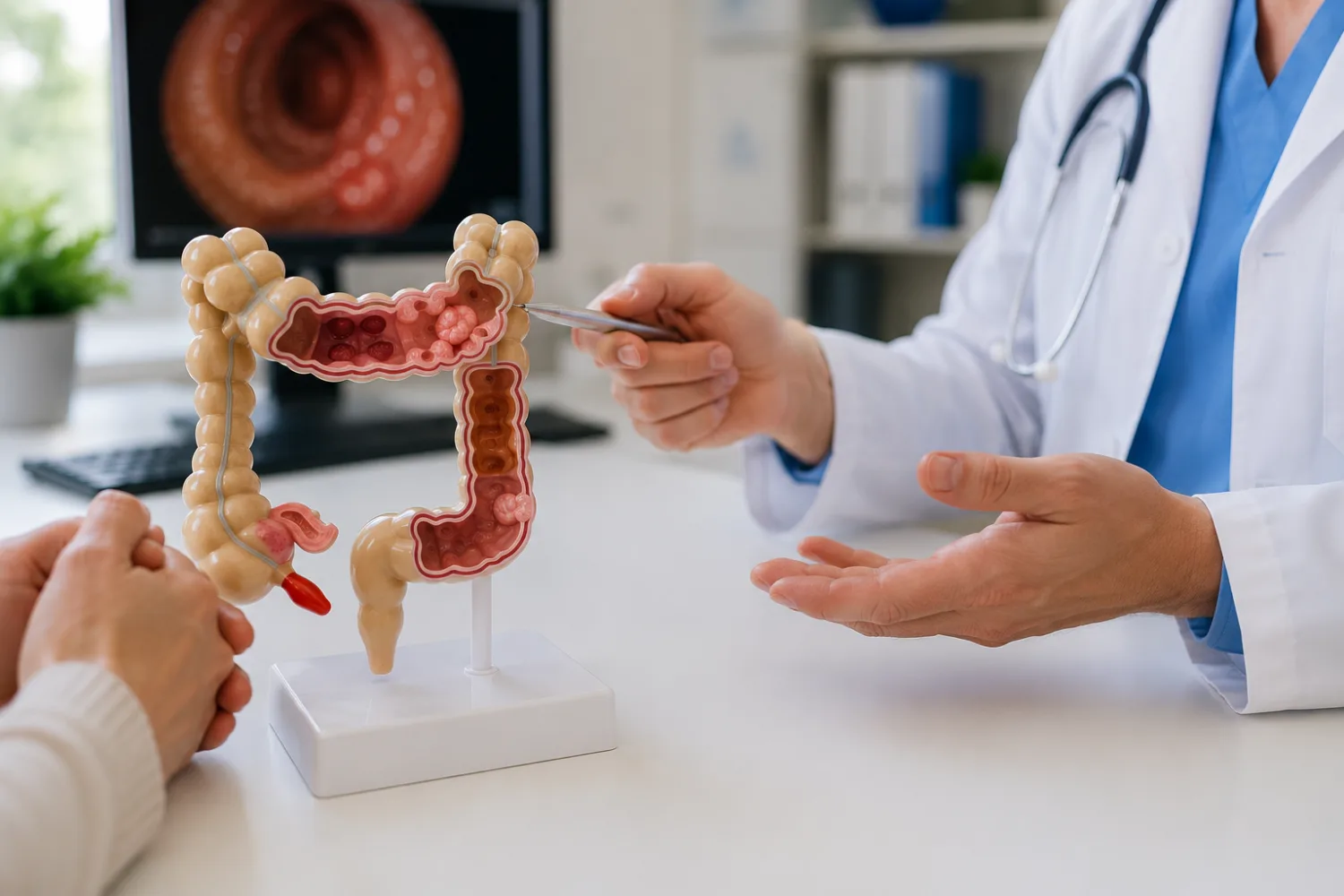
Bowel cancer can cause bleeding, changes in bowel habits, abdominal discomfort, unexplained weight loss and tiredness. However, these symptoms are common and are often caused by conditions that are not cancer, including haemorrhoids, constipation, irritable bowel syndrome, diverticular disease and inflammatory bowel disease.
Symptoms alone cannot confirm or rule out bowel cancer. The important step is to notice what is different from your normal pattern and seek medical advice when the change is persistent, unexplained or accompanied by warning signs.
In the UK, investigation will often begin with a GP assessment, blood tests and a faecal immunochemical test, usually called FIT. If the results or symptoms are concerning, you may be referred for a colonoscopy, CT colonography or another hospital investigation.
Most people investigated for possible bowel cancer will not be diagnosed with it. Nevertheless, timely assessment matters because bowel cancer is generally easier to treat when it is found before it has spread.
What is bowel cancer?
Bowel cancer is cancer that begins in the large bowel. The large bowel is made up of the colon and rectum, so the condition may also be described as:
- colorectal cancer;
- colon cancer;
- rectal cancer; or
- cancer of the large bowel.
The colon absorbs water from digested food and turns the remaining waste into stool. The rectum stores stool until you are ready to open your bowels.
Most bowel cancers begin in the inner lining of the bowel. Many develop from small growths called polyps. Most polyps are not cancerous, and many will never become cancer. However, some types can gradually develop abnormal cells and become cancerous over time.
Removing suitable polyps during a colonoscopy can therefore prevent some bowel cancers from developing.
Bowel cancer should not be confused with cancer of the small intestine, anus or stomach. These are different conditions with different investigation and treatment pathways, although some symptoms can overlap.
What are the symptoms of bowel cancer?
The symptoms vary according to where the cancer is located, how large it is and whether it has caused bleeding or narrowing of the bowel.
Possible symptoms include:
- blood in the stool;
- bleeding from the bottom;
- a persistent change in bowel habits;
- going to the toilet more or less frequently than usual;
- looser stools or persistent diarrhoea;
- new or worsening constipation;
- feeling that you still need to pass stool after going to the toilet;
- abdominal pain or cramping;
- a lump or swelling in the abdomen;
- persistent bloating;
- unexplained weight loss;
- reduced appetite;
- unusual tiredness or weakness; and
- breathlessness caused by anaemia.
The NHS bowel cancer symptoms guidance includes changes in stool consistency or frequency, blood in the stool, bleeding from the bottom, abdominal pain, a lump, bloating and unexplained weight loss.
You do not need to have every symptom. Some people have only one noticeable change, while others have symptoms that come and go.
Early bowel cancer may cause few symptoms. This is one reason why NHS bowel screening is offered to eligible people who feel well.
Blood in the stool
Blood may look bright red, dark red or black. It may appear:
- on toilet paper;
- on the outside of the stool;
- mixed through the stool;
- in the toilet water; or
- only in tiny amounts detectable by FIT.
Bright red blood often comes from haemorrhoids or an anal fissure, particularly after straining or passing a hard stool. However, its appearance cannot reliably identify the source.
Repeated bleeding, blood mixed into the stool or bleeding accompanied by a bowel-habit change should be assessed. Our guide to blood in stool explains the possible causes in more detail.
A change in bowel habits
A bowel-habit change means something has become persistently different from what is normal for you. This might include looser stools, constipation, increased frequency, greater urgency or repeatedly feeling that your bowel has not emptied.
A single unusual bowel movement is rarely a sign of cancer. What matters is a change that persists, keeps returning or has no obvious explanation.
Read more in our guide to changes in bowel habits.
Abdominal pain or a lump
Bowel cancer can cause persistent discomfort, cramping or a feeling of fullness. A tumour may sometimes be felt as a lump in the abdomen, although many abdominal lumps have other causes.
Pain that becomes severe, occurs with vomiting or is accompanied by an inability to pass stool or wind may indicate an obstruction and needs urgent assessment.
Tiredness and anaemia
Slow bleeding from the bowel may lead to iron-deficiency anaemia without producing obvious blood in the toilet.
Possible symptoms include:
- unusual tiredness;
- weakness;
- breathlessness;
- dizziness;
- headaches;
- pale skin; or
- heart palpitations.
Some people discover anaemia during a routine blood test before they notice bowel symptoms.
Do bowel cancer symptoms come and go?
Yes. Bowel cancer symptoms do not always remain constant.
Bleeding may be intermittent. Bowel habits may improve for several days before changing again. Abdominal discomfort may fluctuate according to meals, bowel movements or the degree of narrowing inside the bowel.
Symptoms that come and go should not automatically be dismissed. What matters is whether the same unexplained problem repeatedly returns or whether your overall bowel pattern has changed.
At the same time, fluctuating symptoms are extremely common in non-cancerous conditions. IBS, constipation, diverticular disease, haemorrhoids and food-related digestive symptoms can all improve and worsen.
The pattern alone cannot determine the cause. Arrange a GP appointment when symptoms:
- persist for around three weeks;
- keep returning;
- are becoming more frequent or severe;
- occur with bleeding or unexplained weight loss;
- wake you during the night;
- are associated with anaemia; or
- remain unexplained despite initial treatment.
You do not need to wait three weeks if symptoms are severe or worrying.
Who is more likely to develop bowel cancer?
Anyone can develop bowel cancer, but certain factors increase the likelihood.
Age
The risk increases with age, and most cases occur in older adults. However, younger people can also develop bowel cancer.
Being young should not prevent you from seeking help for persistent bleeding, a significant bowel change, unexplained weight loss or iron-deficiency anaemia. Symptoms should be assessed according to the whole clinical picture rather than age alone.
Family history and inherited conditions
Your risk may be higher if a close relative has had bowel cancer, particularly if they were diagnosed at a younger age or several relatives have been affected.
Inherited conditions that can substantially increase risk include:
- Lynch syndrome;
- familial adenomatous polyposis;
- MUTYH-associated polyposis; and
- some rarer polyposis syndromes.
Tell your GP if bowel cancer, womb cancer or numerous bowel polyps occur in your family, especially across several generations.
Bowel polyps
Certain types of adenomatous or serrated polyps can develop into cancer. Previous polyps may lead to surveillance colonoscopies, depending on their number, size and laboratory features.
Inflammatory bowel disease
Long-standing ulcerative colitis or Crohn’s disease affecting the colon can increase bowel cancer risk. The level of risk depends on factors such as how much of the colon is affected, how long the disease has been present and how active the inflammation has been.
This does not mean that most people with inflammatory bowel disease will develop cancer. Specialist surveillance is used to detect precancerous changes at an earlier stage.
Lifestyle and general health
Risk is also associated with factors including:
- smoking;
- higher alcohol consumption;
- being overweight or living with obesity;
- low physical activity;
- a diet high in processed meat;
- a diet low in fibre; and
- type 2 diabetes.
A person can have several risk factors and never develop bowel cancer. Someone with no obvious risk factors can still be diagnosed. Risk factors help explain probability; they are not a diagnosis.
When should you see a GP or seek urgent help?
Contact your GP if you have a persistent or unexplained bowel symptom, particularly when it differs from your normal pattern.
Arrange an appointment if you have:
- blood in your stool;
- repeated bleeding from your bottom;
- a bowel-habit change lasting around three weeks;
- unexplained weight loss;
- persistent abdominal pain;
- a lump or swelling in your abdomen;
- unexplained tiredness or breathlessness;
- iron-deficiency anaemia;
- ongoing loss of appetite; or
- symptoms that keep returning despite treatment.
Do not assume bleeding is caused by piles simply because you have had haemorrhoids before. Piles are common, but they do not prevent another bowel condition from being present.
When to contact NHS 111 or seek same-day advice
Seek urgent advice if you have:
- persistent or increasing bleeding;
- significant abdominal pain;
- vomiting with a swollen abdomen;
- difficulty keeping fluids down;
- symptoms of dehydration;
- rapidly worsening weakness; or
- black stools without an obvious explanation such as prescribed iron.
When to call 999 or attend A&E
Emergency assessment is needed for:
- heavy rectal bleeding;
- passing large blood clots;
- collapse, fainting or confusion;
- severe or rapidly worsening abdominal pain;
- black tar-like stool with dizziness or weakness;
- a markedly swollen abdomen with repeated vomiting; or
- an inability to pass stool or wind alongside severe pain.
The last group of symptoms can indicate bowel obstruction. This can occur for several reasons, including severe constipation, a hernia, scar tissue from previous surgery or a tumour.
What happens when you visit your GP?
Your GP will try to understand exactly what has changed and whether any features suggest that urgent investigation is needed.
You may be asked:
- when the symptoms started;
- whether they are constant or intermittent;
- how often you now open your bowels;
- whether stools are harder, looser or narrower;
- whether you have seen blood or mucus;
- whether you feel that your bowel empties completely;
- whether you have abdominal or rectal pain;
- whether you have lost weight unintentionally;
- whether your appetite has changed;
- whether you feel unusually tired or breathless;
- which medicines and supplements you take;
- whether you have had previous polyps or bowel disease; and
- whether bowel cancer or polyps run in your family.
It may help to keep a brief symptom diary before the appointment. Include stool frequency, consistency, bleeding, pain, appetite and any changes in weight.
Abdominal examination
The GP may feel your abdomen for tenderness, swelling or a lump. They may listen to bowel sounds and assess whether you appear pale, dehydrated or generally unwell.
Rectal examination
A digital rectal examination involves a clinician gently inserting a gloved, lubricated finger into the rectum.
It can help identify:
- a low rectal lump;
- blood;
- impacted stool;
- haemorrhoids;
- an anal fissure; or
- another abnormality near the back passage.
The examination is usually brief. You can ask for a chaperone and tell the clinician if you are uncomfortable or anxious.
Blood tests
Tests may include:
- a full blood count to look for anaemia;
- ferritin and iron studies;
- kidney and liver function;
- inflammation markers;
- coeliac antibodies; or
- other tests suggested by your symptoms.
Normal blood tests do not completely rule out bowel cancer. Their purpose is to add information and identify problems such as iron-deficiency anaemia.
How is FIT used when bowel cancer is suspected?
The faecal immunochemical test checks a small stool sample for human haemoglobin. It can detect blood that is not visible in the toilet.
A symptomatic FIT is commonly offered when someone has symptoms that could be caused by bowel cancer. This is different from the FIT sent through the NHS bowel screening programme.
Under NICE guidance, adults with relevant symptoms should normally be referred through a suspected colorectal cancer pathway when FIT is at least:
10 micrograms of haemoglobin per gram of stool — 10 µg Hb/g
A raised result does not mean that cancer has been found. It means that enough blood was detected to justify prompt investigation.
Possible non-cancerous causes of a raised FIT include:
- haemorrhoids;
- an anal fissure;
- bowel polyps;
- diverticular disease;
- inflammatory bowel disease;
- infection; and
- other sources of lower-bowel bleeding.
Our guide to FIT test results explains low, positive and high results in detail.
Can bowel cancer be present with a low FIT result?
Yes, although it is less likely.
Some bowel cancers bleed intermittently, release very little blood or were not bleeding when the sample was collected. FIT therefore reduces uncertainty but does not eliminate it.
NICE advises safety-netting for people whose result is below 10 µg Hb/g. Your GP may still refer you when there is strong clinical concern, such as:
- a rectal or abdominal mass;
- persistent iron-deficiency anaemia;
- continued bleeding;
- progressive weight loss;
- worsening symptoms;
- possible bowel obstruction; or
- a combination of concerning findings.
Return to your GP if symptoms persist despite a low result. A negative FIT should not become the end of the investigation when the clinical picture remains unexplained.
Is faecal calprotectin a bowel cancer test?
No. Faecal calprotectin measures intestinal inflammation. It is primarily used to help distinguish inflammatory bowel disease from non-inflammatory conditions such as IBS.
Cancer and polyps can sometimes raise calprotectin, but a low result cannot rule out cancer. Our article on faecal calprotectin results explains how this test should be interpreted.
Which hospital tests diagnose bowel cancer?
If your FIT, symptoms, examination or blood tests are concerning, you may be referred to a specialist bowel pathway.
Being referred on a suspected cancer pathway does not mean you have cancer. Its purpose is to make sure potentially important symptoms are investigated promptly.
Colonoscopy
A colonoscopy is the main test used to examine the inside of the whole large bowel. A thin, flexible tube containing a light and camera is passed through the rectum and guided around the colon.
The procedure can identify:
- bowel cancer;
- polyps;
- inflammation;
- diverticular disease;
- areas of bleeding; and
- other abnormalities in the colon or rectum.
If the endoscopist sees an abnormal area, they can take small tissue samples called biopsies. Many polyps can also be removed during the procedure.
The bowel must be emptied beforehand using strong laxative medicine. Sedation, pain relief or gas and air may be offered according to the service and your medical needs.
Our complete guide to colonoscopy preparation, procedure and sedation explains what to expect.
The NHS describes colonoscopy as the main diagnostic test for bowel cancer. It allows the bowel lining to be inspected directly and biopsies to be collected when needed.
Flexible sigmoidoscopy
A flexible sigmoidoscopy examines the rectum and lower part of the colon rather than the entire large bowel.
It may be used when symptoms appear to come from the lower bowel or when a full colonoscopy is not immediately required. Biopsies and polyp removal may still be possible within the examined area.
CT colonography
CT colonography is sometimes called a virtual colonoscopy. It uses CT images to assess the colon after bowel preparation and gentle inflation with gas.
It may be offered when:
- colonoscopy is unsuitable;
- a colonoscopy could not be completed;
- sedation carries additional risk; or
- another detailed view of the bowel is needed.
CT colonography can identify cancers and larger polyps, but it cannot take a biopsy or remove a polyp. If an abnormality is found, a conventional colonoscopy may still be required.
Biopsy
A biopsy is the test that confirms whether an abnormal area contains cancer cells.
The tissue is examined by a pathologist, who may report:
- whether cancer is present;
- the type of cancer;
- how abnormal the cells appear;
- whether specific molecular changes are present; and
- information that may help guide treatment.
Most bowel cancers are adenocarcinomas, meaning they begin in gland-forming cells in the bowel lining. Other types are much less common.
What happens after bowel cancer is confirmed?
If a biopsy confirms cancer, further tests are used to determine its location, size and whether it has spread. This process is called staging.
Staging helps the multidisciplinary team decide which treatment is most appropriate.
CT scan
A CT scan of the chest, abdomen and pelvis is commonly used to assess:
- the bowel tumour;
- nearby lymph nodes;
- the liver;
- the lungs; and
- other areas where bowel cancer may spread.
Contrast dye may be injected into a vein or given as a drink to make particular structures easier to see.
MRI scan
MRI is particularly important for rectal cancer because it provides detailed images of the rectum and surrounding tissues. It can help surgeons and oncologists plan treatment.
Liver MRI may also be used when CT shows an area that needs more detailed assessment.
Tests on the cancer cells
The biopsy or surgical specimen may be tested for molecular changes. These can include mismatch repair or microsatellite instability testing and, in advanced disease, changes in genes such as RAS or BRAF.
These results may:
- help identify possible Lynch syndrome;
- provide information about the tumour;
- influence chemotherapy or targeted treatment choices; and
- indicate whether genetic counselling should be considered.
Blood tumour markers
A blood test called CEA may be checked around the time of diagnosis. CEA is not reliable enough to diagnose bowel cancer on its own.
Some bowel cancers do not raise it, and non-cancerous conditions can also increase it. Its main value is as a baseline that may help monitor treatment or detect recurrence in selected patients.
How are bowel cancer stages explained?
Staging describes how far the cancer has grown and whether it has spread.
Doctors commonly use the TNM system:
- T describes how deeply the tumour has grown through the bowel wall;
- N describes whether nearby lymph nodes contain cancer; and
- M describes whether cancer has spread to distant organs.
This information is grouped into broader numbered stages.
Stage 1
The cancer has grown into the bowel wall but has not spread to nearby lymph nodes or distant organs.
Stage 2
The cancer has grown further through the bowel wall or into nearby tissue, but no cancer is found in the regional lymph nodes.
Stage 3
The cancer has spread to nearby lymph nodes but not to distant organs.
Stage 4
The cancer has spread to another part of the body. Common sites include the liver, lungs or lining of the abdomen.
Stage 4 bowel cancer is also called metastatic or advanced bowel cancer. It is not one single situation. Some people have one or a small number of areas that can be treated with surgery, ablation or other targeted procedures. Others need systemic treatment to control cancer in several areas.
The stage alone does not determine an individual outlook. Age, general health, tumour biology, treatment response and whether all visible disease can be removed also matter.
What is the difference between screening and investigating symptoms?
Bowel screening is offered to eligible people who do not have symptoms. It uses FIT to look for tiny traces of blood that may come from a cancer or significant polyp.
In England, eligible people aged 50 to 74 who are registered with a GP are offered NHS bowel screening every two years. People aged 75 and over can request a kit. Age ranges and arrangements vary between England, Scotland, Wales and Northern Ireland, so check the programme in your nation.
The NHS bowel screening guide explains how the home kit works.
A screening test is not intended to assess symptoms. Contact your GP rather than waiting for a screening invitation if you develop:
- rectal bleeding;
- blood in your stool;
- a persistent bowel-habit change;
- unexplained weight loss;
- abdominal pain or a lump; or
- unexplained iron-deficiency anaemia.
You should also contact your GP if symptoms develop after a normal screening result. Screening reduces risk but cannot rule out every bowel cancer.
A screening FIT and a symptomatic FIT follow different pathways and may use different thresholds. Do not compare the number in a screening programme with the 10 µg Hb/g threshold used in NICE symptomatic guidance.
What if your tests are normal but symptoms continue?
A normal initial test is reassuring, but it should not be used to dismiss symptoms that remain unexplained.
Return to your GP if:
- bleeding continues;
- your bowel habit remains different;
- you continue to lose weight;
- pain is worsening;
- you develop night-time symptoms;
- your appetite is declining;
- you become increasingly tired or breathless; or
- a treatment for a presumed benign condition has not helped.
Depending on what has already been done, your clinician may consider:
- repeating the examination;
- repeating or extending blood tests;
- reviewing the exact FIT result;
- another stool test;
- gastroenterology referral;
- colonoscopy;
- CT colonography;
- abdominal imaging; or
- investigation for a non-cancerous digestive condition.
Symptoms may ultimately be caused by IBS, haemorrhoids, an anal fissure, constipation, coeliac disease, inflammatory bowel disease, diverticular disease, medication or another condition. These diagnoses can also deserve proper treatment.
Do not be embarrassed about returning. Safety-netting is an expected part of investigating bowel symptoms, particularly when an initial FIT is low but the problem has not resolved.
Frequently asked questions
What is usually the first symptom of bowel cancer?
There is no single first symptom. Some people notice bleeding, while others develop a persistent change in bowel habits, abdominal pain, unexplained tiredness or weight loss. Early cancer may produce no obvious symptoms.
What does bowel cancer blood look like?
It may be bright red, dark red, mixed through the stool or present only in tiny amounts detected by FIT. Black tar-like stool can indicate bleeding higher in the digestive tract and needs urgent medical advice.
Can bright red blood still be bowel cancer?
Yes, although bright red bleeding is commonly caused by haemorrhoids or an anal fissure. The colour cannot reliably identify the cause. Recurrent or unexplained bleeding should be assessed.
Can bowel cancer cause constipation?
Yes. A tumour can alter how stool moves through the bowel and may cause new constipation, narrower stools or a feeling of incomplete emptying. Constipation is much more commonly caused by diet, medicines, inactivity or functional bowel problems.
Does bowel cancer always cause weight loss?
No. Many people do not lose weight, particularly during the earlier stages. Unexplained weight loss is a warning symptom, but its absence does not rule out cancer.
Does bowel cancer cause pain?
It can cause abdominal pain, cramps or discomfort, but some cancers cause little or no pain. Pain can also result from many common non-cancerous digestive problems.
Can bowel cancer symptoms appear suddenly?
Some symptoms develop gradually, while others become noticeable more suddenly. An obstruction can cause acute pain, swelling, vomiting and inability to pass stool or wind and requires emergency assessment.
Can young adults get bowel cancer?
Yes. Risk increases with age, but younger adults can be affected. Persistent bleeding, iron-deficiency anaemia, unexplained weight loss or a lasting bowel change should not be ignored because of age.
Does a negative FIT rule out bowel cancer?
No. A low FIT makes bowel cancer less likely but does not exclude it completely. Return to your GP if symptoms persist, worsen or remain unexplained.
Does a positive FIT mean I have cancer?
No. A positive symptomatic FIT means that blood was detected at a level requiring further investigation. Polyps, piles, fissures, inflammatory bowel disease and other non-cancerous conditions can also raise the result.
Can a blood test diagnose bowel cancer?
No routine blood test can diagnose bowel cancer. Blood tests may reveal anaemia or other abnormalities, but colonoscopy and biopsy are generally needed to confirm a diagnosis.
Can an ultrasound detect bowel cancer?
An abdominal ultrasound may identify liver abnormalities, fluid or a large mass, but it is not the main test for examining the inside of the colon. Colonoscopy and CT colonography are more appropriate for diagnosing most bowel cancers.
Can a colonoscopy miss bowel cancer?
Colonoscopy is highly effective but no test is perfect. A cancer can occasionally be missed because of poor bowel preparation, an incomplete procedure, difficult anatomy or an abnormality that is hard to see. Ongoing symptoms should be reviewed even after a reassuring test.
How long do biopsy results take?
Timing varies between hospitals and according to whether additional laboratory testing is needed. The clinical team should tell you how and when the result will be communicated. Contact the service if the expected date passes without an update.
Are all bowel polyps cancerous?
No. Most polyps are benign. Certain types have the potential to develop into cancer over time, which is why they are often removed and examined in a laboratory.
Can piles and bowel cancer occur together?
Yes. Having haemorrhoids does not prevent another bowel condition from being present. Persistent bleeding or a bowel-habit change should not automatically be attributed to piles.
Should I wait for bowel screening if I have symptoms?
No. Screening is designed for people without symptoms. Contact your GP when you have bleeding, a persistent change in bowel habits, unexplained weight loss, abdominal pain or another concerning symptom.
Is bowel cancer treatable?
Yes. Treatment may include surgery, chemotherapy, radiotherapy, targeted medicines, immunotherapy or combinations of these. The options depend on whether the cancer is in the colon or rectum, its stage, molecular features and your general health.