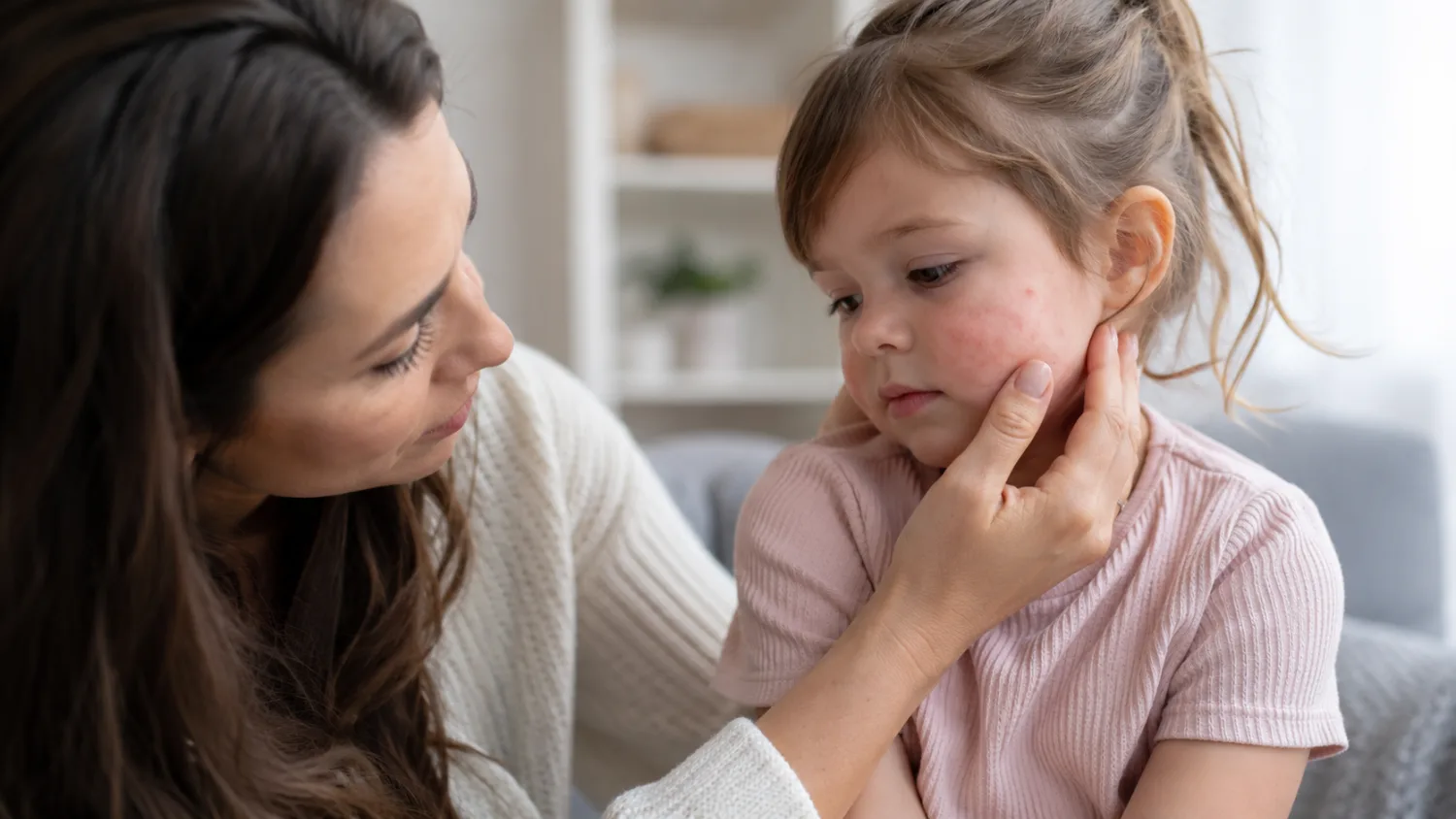
Rashes are extremely common in babies and children. Most are caused by harmless viral infections, skin irritation, eczema or mild allergies, and many settle with simple care at home. But some rashes need urgent medical attention, especially if your child is very unwell, has a fever, or the rash does not fade when pressed.
Finding a rash on your child can be unsettling. One minute their skin looks normal; the next, there are red patches, spots, blisters, bumps or blotches. Some rashes itch. Some come with a temperature. Some appear after a cough, cold or tummy bug. Others seem to come from nowhere.
The difficult part for parents is that many childhood rashes look similar at first. A viral rash, heat rash, eczema flare, chickenpox, scarlet fever, hand, foot and mouth disease, an allergic reaction and meningitis-related rash can all start with “spots” or “redness”. That does not mean every rash is dangerous. It means the safest approach is to look at the whole child, not just the skin.
This guide explains the common causes of rashes in children, how to think about fever and rash, which symptoms suggest a child can be cared for at home, and which warning signs mean you should call NHS 111, contact your GP, or call 999.
You can also find more parent-friendly health guides in our Children’s Health section.
First: does the rash fade when pressed?
If your child has a rash, especially with a fever or seems unwell, one of the most important checks is whether the rash fades under pressure. This is often called the glass test.
Press the side of a clear glass firmly against the rash. If the rash fades or turns paler under pressure, it is described as a blanching rash. Many common childhood rashes blanch. If the rash does not fade under pressure, it is called a non-blanching rash. This can look like tiny red, purple or brown pinpricks, or larger bruise-like marks under the skin.
A fever with a rash that does not fade under pressure can be a sign of meningitis or sepsis and needs emergency medical help. The NHS advises calling 999 straight away if a rash does not fade when a glass is pressed against it. You can also read more about the NHS meningitis symptoms and the Meningitis Now glass test.
Important safety note
Do not wait for a rash to appear if your child is seriously unwell. Meningitis and sepsis can happen without a rash, or before a rash develops. If your child is very drowsy, floppy, confused, has a stiff neck, dislikes bright light, is struggling to breathe, has blue or mottled skin, or you are seriously worried, call 999.
Look at the child, not just the rash
The same rash can feel very different depending on how your child is behaving. A child with a mild viral rash who is playing, drinking, passing urine and responding normally is usually less concerning. A child with a rash who is sleepy, floppy, breathless, dehydrated or difficult to wake needs urgent help, even if the rash itself does not look dramatic.
Ask yourself: is your child breathing normally? Are they drinking? Are they passing urine or having wet nappies? Are they alert when awake? Do they recognise you and respond normally? Is the rash spreading quickly? Is there swelling of the lips, tongue, eyes or face? Is there fever, pain, vomiting, diarrhoea or neck stiffness?
The NHS has a useful visual guide to rashes in babies and children, but no online picture guide can safely diagnose every rash. If your child is unwell or you are unsure, get medical advice.
Common viral rashes in children
Viral rashes are one of the most common reasons children develop spots or blotches. They often appear with, or shortly after, a fever, cough, runny nose, sore throat, vomiting or diarrhoea. The rash may be pink, red, blotchy, slightly raised or widespread across the body.
Many viral rashes are harmless and settle as the infection improves. The rash itself may not need specific treatment. The focus is usually on comfort, fluids and watching for warning signs.
Viral rashes can be confusing because the rash sometimes appears just as the fever is settling. This can make parents worry that the illness is getting worse, when in some cases it is part of the normal pattern of a viral infection. However, a child with fever and rash who is becoming more unwell, very sleepy, dehydrated or breathless should be assessed.
If your child has fever alongside a rash, read our guide to fever in children. If the rash has followed a recent cold or respiratory illness, our guide to coughs and colds in children may also help.
Chickenpox
Chickenpox usually starts with small red spots that become fluid-filled blisters, then crust over into scabs. The spots often appear in crops, so your child may have new red spots, blisters and scabs at the same time. The rash is usually itchy and can appear on the face, scalp, chest, back, arms and legs.
Children with chickenpox may also have a fever, tiredness, headache and reduced appetite. Most children recover at home, but chickenpox can be more serious in newborn babies, pregnant women, adults and people with weakened immune systems.
Do not give ibuprofen for suspected chickenpox unless a doctor advises it, as it may increase the risk of skin complications. Keep nails short, discourage scratching, offer fluids and ask a pharmacist about suitable itch relief.
Children with chickenpox should usually stay away from school or nursery until all the spots have crusted over. UK Health Security Agency guidance provides exclusion advice for chickenpox and other infections in schools and childcare settings.
Hand, foot and mouth disease
Hand, foot and mouth disease is a common childhood viral infection. It can cause small blisters or spots on the hands and feet, and painful ulcers in the mouth. Some children also develop spots around the bottom or elsewhere on the body.
Children may have a fever, sore throat, reduced appetite and feel generally unwell. The mouth ulcers can make drinking uncomfortable, so dehydration is the main thing to watch for. Offer small, frequent drinks and soft foods if your child wants to eat.
Most children recover without treatment. Antibiotics do not help because it is usually viral. UKHSA guidance says children with hand, foot and mouth disease do not usually need to be excluded from childcare or school if they are otherwise well, although settings may have their own policies during outbreaks.
Scarlet fever
Scarlet fever is a bacterial infection that can cause a sore throat, fever, swollen glands and a rough-feeling rash. Parents often describe the rash as feeling like sandpaper. It may be more obvious on the chest, tummy, neck or skin folds. The tongue can look red and bumpy, sometimes called a “strawberry tongue”.
Scarlet fever needs medical advice because it is usually treated with antibiotics. Treatment helps your child recover faster, reduces spread, and lowers the risk of complications.
Contact your GP or NHS 111 if your child has symptoms that could be scarlet fever. UKHSA guidance advises that children with scarlet fever should stay away from school or nursery until 24 hours after starting antibiotics.
Measles
Measles is a highly infectious viral illness. It can begin with fever, cough, runny nose, red sore eyes and tiredness before a rash appears. The rash usually starts on the face or behind the ears and then spreads down the body. It may look red or brown and blotchy.
Measles can be serious, especially in babies, young children, pregnant women and people with weakened immune systems. It can lead to complications such as ear infections, pneumonia and, rarely, brain inflammation.
If you think your child may have measles, phone your GP surgery or NHS 111 before attending in person. This helps reduce the risk of spreading measles to other people in the waiting room. The MMR vaccine helps protect against measles, mumps and rubella.
UKHSA guidance advises that children with measles should stay away from school or nursery until 4 days after the rash started.
Slapped cheek syndrome
Slapped cheek syndrome, also called fifth disease or parvovirus B19, often causes bright red cheeks, followed by a lacy-looking rash on the body, arms or legs. Children may have mild fever, headache, runny nose or feel slightly unwell before the rash appears.
Most children recover without treatment. The infection is usually mild in children, but it can matter for pregnant women and some people with blood disorders or weakened immune systems. If your child has slapped cheek syndrome and has been in close contact with someone pregnant, it is sensible for that person to seek advice from their midwife or GP.
Heat rash
Heat rash can appear as tiny red or clear bumps, often on the neck, chest, back, skin folds or areas covered by clothing. It happens when sweat glands become blocked. Babies are particularly prone to it because they can overheat more easily and have more skin folds.
Heat rash is usually harmless and improves when the skin cools. Move your child to a cooler room, remove extra layers, use loose cotton clothing and avoid heavy blankets. Seek advice if the rash does not improve, seems infected, or your child also appears unwell.
Eczema
Eczema is a long-term skin condition that causes dry, itchy, inflamed skin. In children, it often affects the cheeks, elbows, knees, wrists, ankles and skin folds, although it can appear anywhere. The skin may look red on lighter skin, and darker brown, purple, grey or ashen on darker skin.
Eczema is not contagious. It tends to flare and settle. Common triggers include soaps, fragrances, heat, sweat, cold weather, some fabrics, dust, infections and sometimes allergens.
Regular moisturising with emollients is the foundation of eczema care. During flares, prescribed steroid creams or ointments may be needed. If the skin becomes weepy, crusted, painful, swollen or your child develops fever, seek medical advice because eczema can become infected.
You can read more in our guide to eczema and psoriasis symptoms, differences and treatment.
Hives and allergic rashes
Hives, also called urticaria, are raised, itchy welts that can appear suddenly and move around the body. They may be triggered by a viral infection, food, medicine, insect stings, heat, cold or sometimes no obvious cause.
Mild hives without breathing problems or swelling may settle on their own or with an age-appropriate antihistamine recommended by a pharmacist. But an allergic reaction can become serious.
Call 999 if your child has a rash with swelling of the lips, tongue, throat or face, breathing difficulty, wheezing, dizziness, collapse, or seems suddenly very unwell. These can be signs of anaphylaxis, a medical emergency.
Impetigo
Impetigo is a contagious bacterial skin infection. It often causes red sores or blisters that burst and leave golden-yellow crusts. It commonly appears around the nose and mouth but can occur anywhere, especially where skin is already broken by eczema, bites or scratches.
Impetigo usually needs advice from a pharmacist, GP or nurse, and may need antibiotic cream or oral antibiotics depending on how widespread it is.
To reduce spread, avoid sharing towels, wash hands regularly, keep sores covered if possible and discourage scratching. UKHSA guidance advises that children with impetigo should stay away from school or nursery until all blisters have crusted over or until 2 days after starting antibiotics.
Ringworm
Ringworm is a fungal skin infection, not a worm. It often appears as a round or ring-shaped patch with a clearer centre and a red, scaly or raised edge. It can be itchy and may spread to other areas or to other people through close contact, towels, clothing, bedding, pets or shared surfaces.
Ringworm is usually treated with antifungal cream from a pharmacy, but scalp ringworm needs medical assessment and often requires prescription treatment. Children with ringworm should usually stay away from school or nursery until treatment has started, according to UKHSA exclusion guidance.
We also have a full guide to ringworm symptoms and treatment.
Nappy rash
Nappy rash is very common in babies and toddlers. The skin may look red, sore, shiny or spotty in the nappy area. It is often caused by contact with urine and poo, friction, wipes, soaps, diarrhoea, antibiotics or thrush.
Change nappies regularly, clean gently, allow nappy-free time and use a suitable barrier cream. If the rash is very red, has satellite spots, is not improving, or your baby seems in pain, ask a pharmacist, health visitor or GP for advice. Thrush or bacterial infection may need specific treatment.
If your child has nappy rash after a stomach bug, our guide to vomiting and diarrhoea in children may also be useful, especially for hydration and nursery return advice.
Insect bites and stings
Insect bites often cause small itchy bumps, redness and mild swelling. Children may scratch them, which can make the skin sore or infected. A cold compress, avoiding scratching and age-appropriate antihistamines or creams from a pharmacy may help.
Seek medical advice if the redness is spreading, the area becomes hot, painful or swollen, pus develops, your child has a fever, or there are red streaks tracking away from the bite. These can be signs of infection.
Call 999 if a bite or sting is followed by breathing difficulty, swelling of the lips, tongue or throat, dizziness, collapse or a widespread severe allergic reaction.
You can read more in our guide to insect bites and stings.
When a rash follows vomiting or diarrhoea
Some viral infections can cause both stomach symptoms and a rash. Mild, blotchy viral rashes can appear as the body fights infection. However, vomiting or diarrhoea with a rash can also be more concerning if your child is dehydrated, very sleepy, has a stiff neck, has a non-blanching rash, or seems seriously unwell.
If your child has vomiting, diarrhoea and a rash, look carefully at hydration and behaviour. Are they drinking? Passing urine? Alert when awake? Breathing normally? Does the rash fade under pressure? If you are unsure, contact NHS 111.
For fluid and dehydration advice, see our guide to vomiting and diarrhoea in children.
Rashes on darker skin
Rashes can be harder to see on darker skin. Redness may look purple, brown, grey or darker than the surrounding skin rather than bright red. A non-blanching rash may be harder to spot.
Check areas where changes may be easier to see, such as the palms, soles, inside the eyelids, lips, tongue, roof of the mouth and tummy. Use good lighting. If your child seems unwell and you are worried, seek advice even if the rash is difficult to judge.
Should my child stay off school or nursery?
It depends on the cause of the rash and how well your child is. A child with a mild rash who is otherwise well may not always need to stay home. But a child with fever, vomiting, diarrhoea, suspected contagious infection or who feels too unwell to join normal activities should stay at home.
Some rash illnesses have specific exclusion periods. For example, UKHSA guidance advises exclusion for measles until 4 days after the rash started, scarlet fever until 24 hours after starting antibiotics, impetigo until lesions are crusted or 2 days after antibiotics, and ringworm until treatment has started. Chickenpox usually requires staying away until spots have crusted over.
If you are unsure, check your school or nursery policy, speak to a pharmacist or GP surgery, or use NHS 111. Official UKHSA health protection guidance for education and childcare settings is also useful for infectious illnesses.
How to care for a mild rash at home
If your child is well, the rash fades under pressure, and there are no urgent warning signs, simple care is often enough. Keep the skin cool and comfortable. Avoid heavily fragranced soaps, bubble baths and lotions. Dress your child in soft, loose clothing and try to stop scratching where possible.
For itchy rashes, a pharmacist can advise on suitable creams or antihistamines for your child’s age. Keep nails short to reduce skin damage from scratching. If the skin becomes broken, weepy, crusted, painful or hot, seek advice because it may be infected.
If the rash is linked with fever, cough, cold symptoms or tummy symptoms, support your child with fluids and rest. Children often eat less when unwell, but drinking and passing urine are important.
When to contact a GP or NHS 111
Contact your GP or NHS 111 if your child has a rash and fever, the rash is spreading or worsening, the rash is painful, the skin looks infected, your child has a sore throat and sandpapery rash, your baby is under 3 months, or your child is not improving.
You should also seek advice if the rash appears after starting a new medicine, if there is swelling of the face or joints, if the rash is bruised-looking, or if your child has recently been exposed to measles, scarlet fever or chickenpox and is unwell.
Call 999 if the rash does not fade under pressure and your child has a fever or seems unwell, or if there are signs of serious illness such as breathing difficulty, blue lips, confusion, severe drowsiness, stiff neck, seizure, or collapse.
What not to do
Do not send a child with fever and a new rash to nursery or school without advice. Do not use leftover antibiotic creams or steroid creams unless they were prescribed for this specific rash and you have been told how to use them. Do not give adult antihistamines or medicines to children unless a pharmacist or clinician confirms they are suitable.
Do not assume every rash is an allergy. Viral rashes are common. Equally, do not ignore swelling of the lips, tongue, throat or breathing difficulty, as these may suggest a serious allergic reaction.
Do not wait for a rash to become dramatic before seeking help if your child is very unwell. Serious infections can progress quickly.
Key takeaways
Rashes in children are common and usually not serious. Many are caused by viral infections, eczema, heat, allergies, bites or mild skin infections. The most important thing is to assess your child’s overall condition as well as the rash.
Use the glass test for a rash with fever or illness. If the rash does not fade under pressure, call 999. Also seek urgent help for breathing difficulty, blue lips, severe drowsiness, confusion, stiff neck, seizure, dehydration or a child who seems seriously unwell.
If your child is well but the rash is new, spreading, painful, infected-looking, linked with fever, or you are unsure what it is, contact your GP, pharmacist or NHS 111 for advice.
Medical disclaimer: This guide is for general information only and does not replace medical advice. If you are worried about your child, contact your GP, pharmacist, NHS 111, or call 999 in an emergency.
FAQs about common rashes in children
What is the most common cause of a rash in children?
Viral infections are one of the most common causes. Children may develop a blotchy or spotty rash during or after a fever, cold, sore throat, vomiting or diarrhoea. Eczema, heat rash, allergies, bites and skin infections are also common.
When should I worry about a child’s rash?
Worry if your child has a rash and is very unwell, has a fever, breathing difficulty, blue lips, severe drowsiness, confusion, a stiff neck, dehydration, swelling of the face or mouth, or a rash that does not fade when pressed with a glass.
What rash needs 999?
Call 999 if your child has a rash that does not fade under pressure and they have a fever or seem unwell. Also call 999 for a rash with breathing difficulty, blue lips, collapse, seizure, severe drowsiness, confusion or signs of a serious allergic reaction.
How do I do the glass test?
Press the side of a clear glass firmly against the rash. If the rash fades, it is blanching. If it does not fade, it is non-blanching and may be a medical emergency, especially if your child has a fever or seems unwell.
Can a viral rash be itchy?
Yes, some viral rashes can be itchy, although many are not. Chickenpox, hand, foot and mouth disease and some non-specific viral rashes may cause itching or discomfort.
Can teething cause a rash?
Teething can cause dribbling, which may irritate the skin around the mouth or chin. It should not cause a widespread rash, high fever or a child who seems very unwell. Seek advice if you are unsure.
Can my child go to school with a rash?
It depends on the cause and how well your child is. A mild rash in a well child may be fine, but children with fever, vomiting, diarrhoea or suspected contagious infections may need to stay home. Some infections have specific exclusion rules.
What does chickenpox look like?
Chickenpox often starts as small red spots that become itchy fluid-filled blisters, then crust over. Children may have spots at different stages at the same time.
What does scarlet fever rash feel like?
Scarlet fever rash often feels rough, like sandpaper. It may come with fever, sore throat, swollen glands and a red bumpy tongue. Contact your GP or NHS 111 if you suspect scarlet fever.
What does hand, foot and mouth disease look like?
It can cause small blisters or spots on the hands and feet, and painful ulcers in the mouth. Some children also have fever, sore throat and reduced appetite.
Can a rash be caused by antibiotics?
Yes, some children develop rashes after medicines, including antibiotics. Not every rash means a true allergy, but you should seek medical advice before giving the next dose if you are concerned, especially if there is swelling, breathing difficulty or the child seems unwell.
What if my child has a rash after vomiting and diarrhoea?
Some viral infections can cause both stomach symptoms and a rash. Seek advice if your child is dehydrated, very drowsy, has a fever, has a non-blanching rash, or seems seriously unwell.
Can eczema look like a rash?
Yes. Eczema causes dry, itchy, inflamed patches and can flare during illness, heat, cold weather or after contact with irritants. If eczema becomes weepy, crusted, painful or swollen, it may be infected and needs medical advice.
Should I use steroid cream on my child’s rash?
Only use steroid cream if it has been prescribed or recommended for that rash and you understand where and how long to use it. Steroid creams are helpful for eczema flares but may be unsuitable for some infections.
What should I do if I cannot see the rash clearly on darker skin?
Use good lighting and check areas such as the palms, soles, lips, tongue, inside the eyelids and roof of the mouth. If your child seems unwell and you are worried, seek medical advice even if the rash is hard to assess.