Eye twitching is usually a brief, harmless flutter in one eyelid. It may appear during a stressful week, after several poor nights of sleep or when someone has been relying heavily on coffee. The movement can feel surprisingly strong to the person experiencing it, even when it is barely visible to anyone else.
This common type of twitch is called eyelid myokymia. It usually affects part of one upper or lower eyelid, comes and goes, and settles without medical treatment.
Not every involuntary eyelid movement is ordinary myokymia, however. Blepharospasm causes repeated involuntary blinking or forceful closure of both eyes. Hemifacial spasm affects muscles on one side of the face, often beginning around one eye before spreading towards the cheek or mouth.
The pattern matters more than the word “twitch”. A fine flutter in one lower eyelid after too much caffeine is very different from both eyes repeatedly clamping shut or one side of the face pulling involuntarily.
Call 999 immediately if facial movement begins suddenly with facial drooping, arm weakness, speech difficulty, severe confusion, sudden loss of balance or another possible stroke symptom.
Seek urgent eye care if twitching occurs with sudden vision loss, severe eye pain, marked sensitivity to light, a very red eye, a new drooping eyelid, double vision or severe headache and vomiting.
Arrange a GP or optician assessment when twitching persists for more than about two weeks, spreads beyond one eyelid, repeatedly closes the eye, affects driving or daily activities, or occurs with muscle weakness, stiffness or wasting.
What does eye twitching mean?
“Eye twitching” is an everyday description rather than one precise diagnosis. People use it for several different experiences, including a tiny eyelid flutter, frequent blinking, forceful eye closure or movement involving the cheek and mouth.
The eyeball itself is not normally twitching. The movement usually comes from one or more muscles surrounding the eye, particularly the circular orbicularis oculi muscle that closes the eyelids.
In ordinary eyelid myokymia, small groups of muscle fibres contract repeatedly. This creates a rippling, flickering or quivering sensation beneath the skin. The movement is usually:
- confined to part of one eyelid;
- more common in the lower eyelid, although either lid can be affected;
- intermittent rather than continuous;
- not painful;
- not associated with facial weakness;
- not strong enough to force the whole eye closed.
The episodes may last seconds or minutes and recur at intervals throughout the day. In some people, the pattern continues for several days before disappearing.
Why can a tiny twitch feel so noticeable?
The eyelid skin is exceptionally thin and richly supplied with nerves. Even a small muscle contraction can therefore feel intense.
People also become highly aware of anything happening near their vision. Once someone begins checking for the twitch, every small movement may become more noticeable. Worry can then increase stress and sleep disruption, which may keep the cycle going.
Is the twitch usually visible?
Sometimes, but often much less than it feels. A close look in a mirror may show a fine ripple in the lid rather than the entire eye jumping.
Recording a short video can be useful if the movement is intermittent and has disappeared by the time of an appointment. The recording should show the whole face rather than only an extreme close-up, because the distribution of movement helps distinguish myokymia from hemifacial spasm.
Common causes of an eyelid twitch
Most short-lived eyelid twitches are not caused by disease. They appear when the eyelid muscles and nerves become temporarily more excitable.
Often there is no single trigger. Several small factors may combine: poor sleep, long hours at a screen, more coffee than usual and a stressful deadline.
Tiredness and lack of sleep
Sleep deprivation is one of the most frequently reported triggers. Muscle control can become less stable when the nervous system is tired, and people may also use more caffeine to compensate.
A twitch that begins after late nights and improves once normal sleep returns is generally reassuring.
Stress
Stress changes autonomic nervous-system activity and can increase muscle tension and awareness of physical sensations.
This does not mean the twitch is imaginary. The eyelid is genuinely contracting, but stress may make the contractions more likely or persistent.
Caffeine
Caffeine stimulates the nervous system. Large amounts may increase tremor, palpitations, restlessness and muscle twitching in susceptible people.
Coffee is not the only source. Caffeine can also come from:
- tea;
- energy drinks;
- cola;
- pre-workout products;
- some headache or cold medicines;
- caffeine tablets.
Someone who drinks several caffeinated products may underestimate their total intake.
Nicotine
Nicotine is a stimulant and may contribute to muscle twitching. This includes nicotine from cigarettes, vaping products, pouches and replacement products.
Stopping smoking has benefits far beyond the eyelid, but nicotine withdrawal and changes in caffeine metabolism can temporarily alter symptoms. Support from a pharmacist or stop-smoking service can make quitting easier.
Alcohol
Alcohol can disrupt sleep, contribute to dehydration and affect nerve and muscle activity. Some people notice twitching after heavier drinking even when the alcohol itself has left the bloodstream.
Dry or irritated eyes
The eyelids naturally blink more when the eye surface is dry or irritated. This extra muscular activity may contribute to twitching or frequent blinking.
Dry-eye symptoms can include:
- burning or stinging;
- a gritty sensation;
- watering;
- redness;
- blurred vision that clears after blinking;
- discomfort with contact lenses.
Our guide to dry eye syndrome explains how tears and eyelid oil glands protect the eye surface.
Eye strain and screen use
Screens do not normally damage the eye muscles, but concentrated near work reduces the natural blink rate. This allows the tear film to evaporate and can worsen dryness, irritation and eyelid fatigue.
The problem may be more noticeable when someone:
- works for long periods without breaks;
- uses a screen in poor lighting;
- needs an updated glasses prescription;
- holds a phone very close;
- wears contact lenses for extended periods;
- uses screens late into the night and loses sleep.
Blepharitis and eyelid inflammation
Blepharitis causes inflammation along the eyelid edges. The lids may feel itchy, gritty or sore, and crusts can develop around the eyelashes.
Inflamed eyelids may blink more frequently and feel less stable. Blepharitis can also contribute to dry eyes, styes and chalazia.
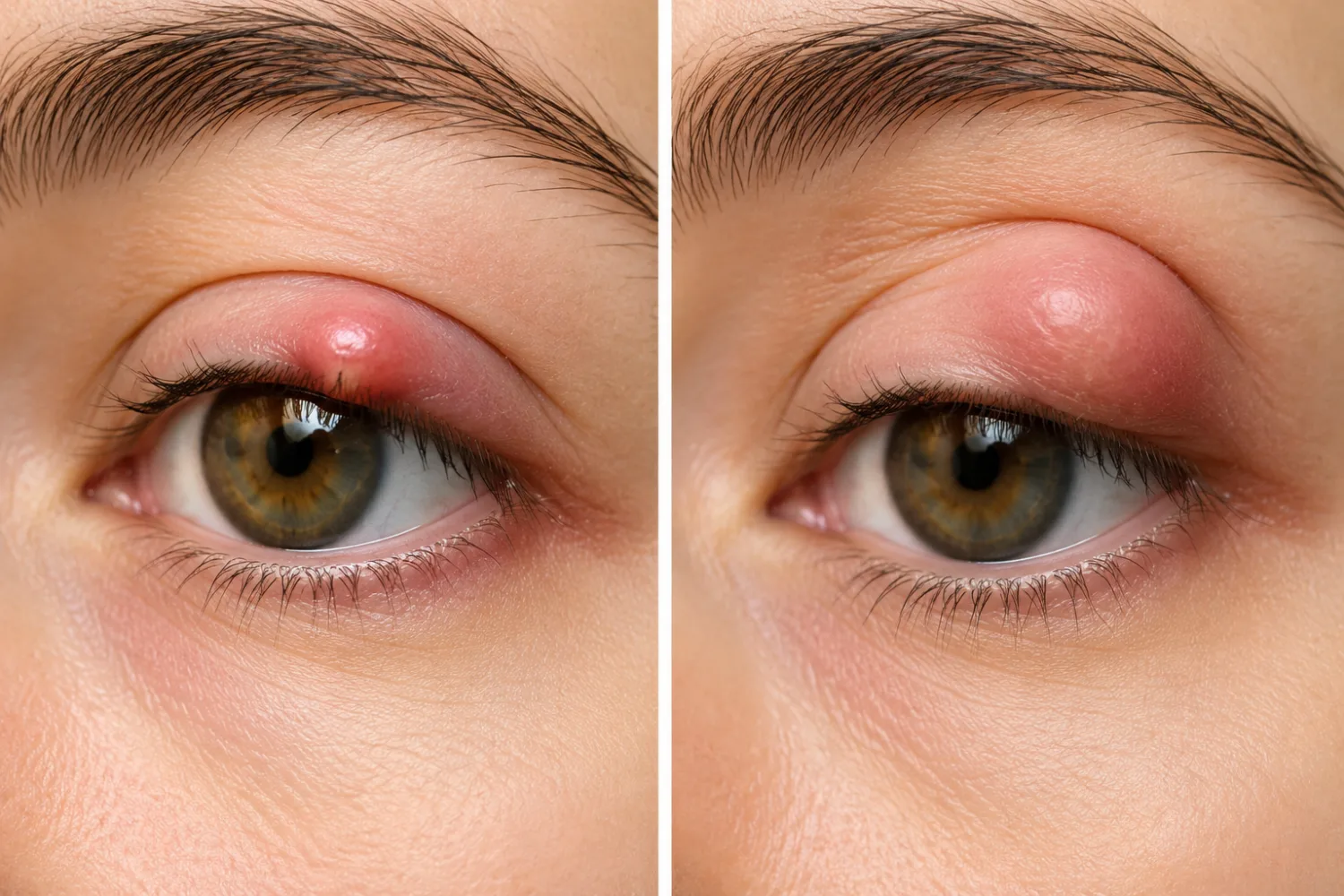
A painful lump or deeper eyelid swelling is not typical myokymia. See our comparison of chalazia and styes.
Allergy
Eye allergy can cause itching, watering, redness and repeated blinking. Rubbing the eyes may further irritate the eyelids.
A twitch without itching, redness or watering is less likely to be caused directly by allergy.
How to stop a common eye twitch
There is no instant switch that reliably stops eyelid myokymia. The most useful approach is to remove likely triggers and give the eyelid time to settle.
Improve sleep for several nights
One early night may not immediately reverse a twitch that developed after prolonged exhaustion. Aim for a consistent sleep schedule across several nights.
Helpful measures include:
- going to bed and getting up at similar times;
- reducing late-evening caffeine;
- avoiding alcohol as a sleep aid;
- limiting stimulating screen use immediately before bed;
- keeping the bedroom cool and dark.
Reduce caffeine gradually
Consider reducing coffee, energy drinks and other stimulants for one or two weeks.
A sudden stop can cause headaches, fatigue and irritability in someone who regularly consumes a large amount. Gradual reduction is often easier.
The goal does not need to be permanent abstinence. It is to see whether the eyelid settles when the total stimulant load is lower.
Take proper screen breaks
Short, regular breaks are more useful than continuing for several hours and then resting once.
During a break:
- look at something in the distance;
- blink slowly several times;
- relax the forehead and jaw;
- adjust glare and screen brightness;
- check that the screen is not positioned too high.
Looking slightly downwards at a screen may leave less of the eye surface exposed and reduce evaporation.
Treat dry-eye symptoms
Preservative-free lubricating eye drops may help when dryness or irritation accompanies the twitch.
A pharmacist or optometrist can advise on a suitable product. Anyone using drops frequently, wearing contact lenses or having persistent redness should seek individual advice.
Do not use whitening drops designed simply to constrict surface blood vessels as a routine dry-eye treatment.
Use a warm compress when the eyelids feel irritated
A comfortably warm compress may help when blepharitis or meibomian gland dysfunction is contributing.
Hold a clean warm flannel or purpose-made eye mask over closed eyelids for several minutes. The compress should feel soothing rather than hot.
Warm compresses are especially useful for blocked eyelid glands. They are not a specific neurological treatment for blepharospasm.
Manage stress without monitoring the eyelid constantly
Relaxation exercises, physical activity and breaks from demanding work may help. Constantly checking the eyelid in a mirror can increase awareness and worry without changing the underlying muscle activity.
A twitch that temporarily stops when attention shifts elsewhere is still a real twitch; it simply suggests that tension and awareness may be amplifying the experience.
Do not massage or press the eye aggressively
Gentle contact with the closed eyelid is unlikely to cause harm, but forceful rubbing can irritate the cornea, worsen allergy and transfer bacteria.
Do not attempt to “hold the muscle still” by pressing directly on the eyeball.
When medication or another medical condition may be involved
Most isolated eyelid twitches are not caused by medicine. Nevertheless, a new twitch can occasionally begin after starting a drug, increasing a dose or combining several stimulating medicines.
Possible contributors can include certain:
- stimulant medicines;
- decongestants;
- asthma medicines;
- antidepressants;
- antipsychotic medicines;
- anti-sickness medicines;
- medicines that affect dopamine activity;
- recreational stimulants.
This does not mean these medicines routinely cause eye twitching or should be stopped.
Do not stop prescribed medication suddenly because of an eyelid twitch. Abruptly stopping antidepressants, antipsychotics, epilepsy medicines, steroids and several other treatments can be harmful. Ask the prescriber or a pharmacist to review the timing, dose and possible alternatives.
Electrolyte disturbances
Significant disturbances in calcium, magnesium, potassium or sodium can affect nerve and muscle function. They usually cause more than a single isolated eyelid flutter.
Possible additional symptoms include:
- widespread cramps or twitching;
- muscle weakness;
- tingling around the mouth or fingers;
- vomiting or severe diarrhoea;
- confusion;
- abnormal heart rhythm;
- seizures in severe cases.
Electrolyte problems are more likely after prolonged vomiting, diarrhoea, certain medicines, kidney disease or significant dehydration.
Does a twitch mean magnesium deficiency?
Usually not. Magnesium deficiency can affect muscles and nerves, but an isolated eyelid twitch is far more commonly associated with tiredness, stress, caffeine or eye irritation.
Taking high-dose magnesium without evidence of deficiency is unlikely to be a reliable cure and can cause diarrhoea. It may also be unsafe in significant kidney disease.
Blood testing is generally more relevant when twitching is widespread, persistent or accompanied by other symptoms or medical risk factors.
Thyroid disease
An overactive thyroid can cause tremor, palpitations, sweating, weight loss and nervous-system overactivity. Thyroid eye disease can produce dryness, swelling, grittiness, double vision or prominent eyes.
A small isolated eyelid twitch without other symptoms is not a typical way to diagnose thyroid disease.
Neurological disease
People often worry that eye twitching means multiple sclerosis, motor neurone disease, Parkinson’s disease or a brain tumour.
A brief isolated eyelid flutter is rarely a sign of these conditions. Neurological assessment becomes more important when twitching occurs with:
- muscle weakness;
- loss of coordination;
- numbness;
- speech or swallowing changes;
- persistent facial spasm;
- muscle wasting;
- abnormal eye movements;
- other progressive neurological symptoms.
What is blepharospasm?
Blepharospasm is repeated involuntary contraction of the muscles that close the eyelids. It is a form of focal dystonia, meaning the nervous system sends abnormal signals that cause muscles in one region to contract when they should not.
The full term is often benign essential blepharospasm. “Benign” means it is not cancerous or usually life-threatening. It does not mean the symptoms are trivial.
Severe blepharospasm can repeatedly force both eyes shut and create functional blindness even though the eyes and optic nerves can still see normally when the lids are open.
How blepharospasm usually begins
The condition may start gradually with:
- increased blinking;
- eye irritation;
- light sensitivity;
- difficulty keeping the eyes open in bright or windy conditions;
- brief episodes of involuntary closure.
Over time, blinking may become stronger and more frequent. Both eyes are typically affected, although one side may feel worse.
This is different from ordinary myokymia, which usually causes a fine flutter in one small part of one eyelid rather than forceful bilateral closure.
What triggers blepharospasm?
Symptoms may be worsened by:
- bright light;
- wind;
- reading;
- watching television;
- driving;
- fatigue;
- stress;
- dry or irritated eyes.
Some people notice temporary improvement while talking, singing, humming, touching part of the face or concentrating on a particular task. These are sometimes called sensory tricks.
Apraxia of eyelid opening
Some people with blepharospasm struggle to reopen the eyes after a spasm even when the eyelid-closing contraction has eased.
This is called apraxia of eyelid opening. It can make walking and other daily activities particularly difficult.
Does blepharospasm affect other facial muscles?
When dystonia also affects the lower face, jaw, tongue or neck, it may be described as segmental cranial dystonia or Meige syndrome.
This is different from hemifacial spasm, which usually affects muscles on only one side of the face.
How is blepharospasm diagnosed and treated?
There is no single blood test or scan that confirms blepharospasm. Diagnosis is based mainly on the movement pattern, clinical examination and exclusion of other causes.
Assessment may involve an ophthalmologist, neurologist, movement-disorder specialist or a clinic specialising in eyelid and facial spasm.
The clinician may ask:
- whether one or both eyes are affected;
- whether the eyelids merely flutter or close forcefully;
- which activities trigger symptoms;
- whether the cheek, mouth or neck also moves;
- which medicines are being taken;
- whether the eyes are dry, painful or light-sensitive;
- how symptoms affect driving, work and walking.
Botulinum toxin injections
Botulinum toxin is the main treatment for troublesome blepharospasm. Small amounts are injected into selected muscles around the eyes.
The treatment reduces the nerve signal reaching the overactive muscles. It does not permanently damage the nerve or cure the underlying dystonia.
Improvement generally begins within several days. The benefit commonly lasts for a few months, after which treatment may need to be repeated.
Possible temporary side effects include:
- bruising or discomfort at injection sites;
- a drooping upper eyelid;
- dry or watery eyes;
- difficulty closing the eyelids fully;
- double vision;
- facial asymmetry.
The dose and injection sites can be adjusted at later appointments according to benefit and side effects.
Treating dry eye and light sensitivity
Lubricating drops, eyelid care and tinted lenses may help associated irritation or light sensitivity.
Dark glasses can be useful outdoors, but wearing very dark lenses constantly indoors may increase light sensitivity over time. Specialist tinted lenses may suit some patients better.
Oral medicines
Tablets are sometimes tried when injections are insufficient or unsuitable, but their benefit is often limited and side effects can be significant.
Possible medicines depend on specialist assessment and may affect alertness, memory, balance or muscle control.
Surgery
Surgery is now uncommon but may be considered for severe blepharospasm that remains disabling despite well-planned botulinum toxin treatment.
Procedures may remove or weaken selected eyelid-closing muscles. Surgery requires specialist assessment because it can affect eyelid closure, tear distribution and the eye surface.
Driving with blepharospasm
Someone whose eyes close unpredictably must not drive until symptoms are adequately controlled and they meet the required vision and safety standards.
Blepharospasm may need to be reported to the DVLA when it affects safe control of a vehicle. The rules depend on severity and response to treatment.
What is hemifacial spasm?
Hemifacial spasm causes involuntary movement of muscles on one side of the face. It often begins around one eye and gradually involves the cheek or corner of the mouth.
The eye may blink or close while the mouth pulls upwards on the same side. Some people notice the cheek twitching at the same time.
This distribution is an important clue. Ordinary eyelid myokymia remains confined to a small part of the eyelid. Blepharospasm usually affects both eyes. Hemifacial spasm affects several muscles on one side of the face.
What causes hemifacial spasm?
In many cases, a small blood vessel presses against the facial nerve close to where it leaves the brainstem. Repeated pulsation can irritate the nerve and trigger involuntary contractions.
Less commonly, facial spasm may be associated with:
- previous facial nerve injury;
- Bell’s palsy and abnormal nerve recovery;
- a structural problem around the nerve;
- another neurological condition.
Assessment is needed because the pattern cannot be diagnosed reliably from the symptom name alone.
Does hemifacial spasm continue during sleep?
It may persist during sleep in some people, which helps distinguish it from certain tics or habit movements.
How is it investigated?
A neurological examination is usually performed. MRI may be arranged to examine the facial nerve, brainstem and nearby blood vessels and to exclude less common structural causes.
How is it treated?
Botulinum toxin injections can weaken the affected facial muscles and reduce spasm for several months.
Microvascular decompression surgery may be considered when a blood vessel is compressing the facial nerve and symptoms are severe. During the operation, the surgeon separates the vessel from the nerve.
Surgery may provide long-term relief but carries important risks and is not suitable or necessary for everyone.
When should eye twitching be checked?
A brief, isolated eyelid twitch can usually be observed at home. Assessment becomes appropriate when the pattern persists, spreads or no longer looks like ordinary myokymia.
Arrange a GP or optician appointment if:
- the twitch continues for more than about two weeks;
- it repeatedly returns over a prolonged period;
- both eyes close involuntarily;
- the twitch spreads into the cheek, mouth or neck;
- the eyelid droops;
- the eye becomes red, painful or persistently irritated;
- there is a new lump or swelling in the eyelid;
- you recently started or changed a medicine;
- symptoms interfere with reading, work, walking or sleep;
- you are worried about the movement pattern.
Request neurological assessment if twitching occurs with:
- persistent movement affecting one side of the face;
- muscle weakness;
- stiffness or abnormal posture;
- muscle wasting;
- difficulty speaking or swallowing;
- problems with coordination;
- numbness or altered sensation;
- movement in several unrelated body areas.
Seek urgent eye care if there is:
- new blurred, reduced or double vision;
- severe pain inside the eye;
- marked sensitivity to light;
- a very red eye;
- a new unequal pupil;
- painful or restricted eye movement;
- a bulging eye;
- a sudden severe headache with eye symptoms.
These symptoms are not explained by a routine eyelid twitch. Our guide to eye pain, red eyes and urgent warning signs explains when to seek same-day care.
Call 999 for possible stroke symptoms
An eye twitch should not cause facial weakness. Use the FAST approach when facial movement begins suddenly:
- Face: one side droops or the smile becomes uneven;
- Arms: one arm is weak or drifts down;
- Speech: speech is slurred, confused or difficult;
- Time: call 999 immediately.
Do not wait to see whether symptoms improve.
Eye twitching in children
Frequent blinking in a child is often harmless, but it is not always the same as adult eyelid myokymia.
Possible causes include:
- a temporary habit or tic;
- dryness or irritation;
- allergy;
- blepharitis;
- an eyelash or foreign material irritating the eye;
- the need for glasses;
- a squint;
- stress or tiredness.
Habit blinking and tics
A motor tic is a repeated movement that a child may be able to suppress briefly, often followed by a growing urge to perform it.
Tics may become more noticeable during excitement, stress or tiredness. They can change over time, with blinking replaced by another facial movement or sound.
A short-lived blinking tic in a child who sees well and has no eye redness or pain is often not serious.
When should a child have an eye examination?
Arrange an optician or GP assessment if:
- blinking continues or becomes more frequent;
- the child rubs the eyes repeatedly;
- the eyes are red, watery or painful;
- the child sits unusually close to screens;
- one eye turns in or out;
- the child reports blurred or double vision;
- there is light sensitivity;
- the movement involves one side of the face;
- teachers or family notice changes in vision or coordination.
When blinking needs urgent attention
Seek urgent help if the child develops sudden facial weakness, severe headache, difficulty walking, confusion, loss of vision, eye injury or a very painful red eye.
Frequently asked questions about eye twitching
What is the most common cause of an eye twitch?
The common eyelid flutter called myokymia is frequently associated with tiredness, stress, caffeine, nicotine, dry eyes or prolonged screen use. Sometimes no clear trigger is found.
How long does a normal eyelid twitch last?
An episode may last seconds or minutes and recur over several days. Arrange an assessment if twitching continues beyond about two weeks or develops unusual features.
Why is my lower eyelid twitching?
The lower eyelid is a common location for harmless myokymia. Sleep loss, stress, caffeine and eye irritation are frequent contributors.
Can the upper eyelid twitch?
Yes. Either eyelid can be affected. A drooping upper eyelid, forceful closure or movement spreading into the face needs further assessment.
Can stress cause eye twitching?
Yes. Stress may increase nervous-system excitability, muscle tension and awareness of the twitch. It is a common trigger but should not automatically explain persistent or spreading facial movement.
Can caffeine cause an eyelid twitch?
Large amounts can contribute in susceptible people. Consider reducing coffee, energy drinks and other caffeinated products for one or two weeks.
Can dehydration cause eye twitching?
Mild dehydration may contribute indirectly through fatigue and eye dryness. Severe dehydration can disturb electrolytes and cause broader symptoms, not just one eyelid twitch.
Does eye twitching mean magnesium deficiency?
Usually not. Magnesium deficiency is only one uncommon possibility and generally produces additional symptoms or occurs with a relevant medical risk factor.
Should I take magnesium for an eye twitch?
There is little reason to take high-dose magnesium solely for a short-lived eyelid flutter. Supplements can cause diarrhoea and may be unsafe with significant kidney disease.
Can vitamin B12 deficiency cause eye twitching?
Vitamin B12 deficiency can affect nerves, but isolated eyelid myokymia is not one of its most characteristic symptoms. B12 assessment is more relevant when there is numbness, balance difficulty, anaemia or another risk factor.
See our guide to vitamin B12 deficiency.
Can dry eyes make an eyelid twitch?
Yes. Dryness and irritation increase blinking and may contribute to eyelid muscle activity. Lubricating drops and screen breaks may help.
Can too much screen time cause twitching?
Screen use can reduce blinking, worsen dryness and contribute to fatigue. It does not normally damage the eyelid nerve.
Does rubbing the eye stop the twitch?
It may briefly alter the sensation, but forceful rubbing can worsen irritation. Treat dryness or allergy rather than repeatedly rubbing the eye.
Can allergies cause eye twitching?
Allergy can cause itching, watering and frequent blinking. Rubbing irritated eyes may make eyelid movements more noticeable.
Can an eyelid bump cause twitching?
A stye, chalazion or inflamed eyelid may cause irritation and increased blinking. A visible bump should be assessed as an eyelid condition rather than assumed to be neurological twitching.
Are milia related to eye twitching?
No. Milia are tiny keratin-filled skin cysts and do not normally affect eyelid muscles or nerves. Read more about milia and safe removal.
Can anxiety cause eye twitching?
Anxiety can contribute through poor sleep, muscle tension and heightened nervous-system activity. Persistent twitching should still be assessed according to its pattern rather than attributed automatically to anxiety.
Is eye twitching a sign of multiple sclerosis?
An isolated eyelid flutter is rarely a sign of multiple sclerosis. MS typically causes other neurological symptoms such as persistent visual disturbance, weakness, numbness or coordination problems.
Is eye twitching a sign of a brain tumour?
A small intermittent eyelid twitch on its own is very unlikely to indicate a brain tumour. Progressive facial spasm, neurological changes, severe headache or other abnormalities require assessment.
Is eye twitching a sign of a stroke?
A routine eyelid twitch is not a typical stroke symptom. Sudden facial drooping, arm weakness or speech difficulty is an emergency and requires an immediate 999 call.
What is the difference between myokymia and blepharospasm?
Myokymia is usually a fine flutter affecting part of one eyelid. Blepharospasm causes repeated involuntary blinking or forceful closure of both eyes.
What is the difference between blepharospasm and hemifacial spasm?
Blepharospasm usually affects both eyes. Hemifacial spasm affects several muscles on one side of the face, often involving the eye and corner of the mouth together.
Can blepharospasm cause blindness?
It does not normally damage the structures responsible for sight. Severe involuntary closure can nevertheless prevent someone from seeing while the eyelids are shut, sometimes described as functional blindness.
How is blepharospasm treated?
Botulinum toxin injections into selected muscles around the eyes are the main treatment. The effect is temporary and injections are commonly repeated every few months.
Is medical Botox for blepharospasm the same as cosmetic Botox?
The active treatment is a form of botulinum toxin, but the injection pattern, dose and clinical goal are different. Medical treatment targets muscles causing involuntary eye closure and should be performed by an appropriately trained clinician.
Can I drive with blepharospasm?
Not when unpredictable eye closure makes driving unsafe. DVLA notification may be required depending on severity and control of symptoms.
When should I see a doctor?
Arrange an assessment when the twitch lasts longer than about two weeks, spreads beyond one eyelid, closes the eye, affects daily activities or occurs with weakness, stiffness or another neurological symptom.