Laser eye surgery can be life-changing for the right person. For many patients, it reduces dependence on glasses or contact lenses and can make daily life, sport, travel and work more convenient.
In the UK, laser eye surgery is usually carried out privately. Suitability depends on far more than simply having blurry vision. A safe decision depends on your prescription, age, corneal thickness, eye health, tear film and whether your vision has been stable over time.
This guide explains who is usually suitable for laser eye surgery, who may be better off avoiding it, what tests are needed before treatment, and what alternatives may be offered in the UK if laser treatment is not the best choice.
What laser eye surgery means
Laser eye surgery, also called laser vision correction, reshapes the cornea, which is the clear front surface of the eye. The aim is to help light focus more accurately on the retina at the back of the eye.
It is mainly used to correct:
- short-sightedness, also called myopia
- long-sightedness, also called hyperopia
- astigmatism
The main goal is to reduce reliance on glasses or contact lenses. It does not always mean you will never need glasses again, especially for reading as you get older.
The NHS has an overview of laser eye surgery and lens surgery, including who may be suitable and possible risks.
Types of laser eye surgery
Common types of laser vision correction include LASIK, surface laser treatments and SMILE-style procedures. The best option depends on your eye measurements, prescription, lifestyle and surgeon assessment.
LASIK
LASIK is one of the best-known forms of laser eye surgery. A thin flap is created in the cornea, the underlying tissue is reshaped with a laser, and the flap is placed back.
Recovery is often quick, but it is not suitable for everyone, especially if the cornea is too thin or the eye surface is not healthy.
PRK, LASEK and other surface laser treatments
Surface laser treatments reshape the cornea without creating a deeper corneal flap. Recovery can be slower and more uncomfortable at first, but these options may be safer for some people with thinner corneas or certain lifestyles.
SMILE and lenticule extraction procedures
SMILE and similar lenticule extraction procedures use a laser to remove a small piece of tissue from within the cornea. They may be suitable for some prescriptions, particularly short-sightedness, depending on the clinic and individual measurements.
Who is usually suitable for laser eye surgery?
In general, the best candidates are adults with a stable prescription, healthy eyes and measurements that fall within a safe treatment range.
You are more likely to be suitable if:
- you are over 18
- your glasses or contact lens prescription has been stable
- your corneas are healthy and thick enough
- your prescription is within a safe laser treatment range
- you do not have significant cataracts or other eye disease
- your tear film and eye surface are healthy enough
- you have realistic expectations
- you understand that reduced dependence on glasses is the aim, not guaranteed perfect vision in every situation
The Royal College of Ophthalmologists provides a patient guide to laser vision correction and a broader page on refractive surgery.
For many people, laser eye surgery is a practical decision rather than purely cosmetic. It may be appealing if you struggle with contact lenses, lead an active lifestyle, play sport, travel often or want more freedom from spectacles.
Prescription range
Suitability depends partly on how strong your prescription is. As a general guide, patients are more likely to be suitable when their prescription is within commonly treated ranges for short-sightedness, long-sightedness and astigmatism.
The Royal College of Ophthalmologists patient information describes typical suitability ranges around:
- up to around -10.00D of short-sightedness
- up to around +4.00D of long-sightedness
- up to around ±6.00D of astigmatism
These are not absolute rules. Some people with higher prescriptions may still be treatable, while others with lower prescriptions may be better suited to a different procedure.
Safety depends not just on the number in your glasses prescription, but also on:
- corneal thickness
- corneal shape
- eye surface health
- pupil size
- dry eye risk
- age
- general eye health
- visual expectations
This is why a quick online self-test or sales call is not enough. A proper suitability assessment should include detailed measurements and discussion with an appropriately qualified surgeon.
The Royal College also provides a refractive surgery patient checklist that is worth reading before any consultation.
Age and laser eye surgery
Age matters, but not in a simple “too young” or “too old” way. The main issue is whether your eyes are stable and whether laser treatment is the best option for your stage of life.
Younger adults
Laser eye surgery is not usually considered before age 18 because the eyes may still be changing. Even after 18, many surgeons want evidence that your prescription has been stable before treating you.
People in their 20s and 30s
This can be a straightforward age group for laser eye surgery, provided the prescription is stable and the eyes are healthy. Many people in this age range seek treatment for myopia or astigmatism.
People in their 40s and beyond
From the mid-40s onwards, natural age-related reading blur becomes more relevant. Even if distance vision is corrected, many people still need reading glasses unless a monovision-style approach is used.
Monovision means one eye is adjusted more for distance and the other more for near vision. It can help some people reduce dependence on reading glasses, but it is not suitable for everyone and usually needs careful trial and discussion.
Older adults
For some older patients, especially where early cataract changes are present, lens-based surgery may be more suitable than laser eye surgery.
If cataracts are becoming relevant, see cataracts symptoms, treatment and surgery options in the UK.
When laser eye surgery may not be suitable
Not being suitable for laser eye surgery does not necessarily mean you cannot have vision correction surgery at all. It may simply mean laser treatment is not the safest or most effective option for your eyes.
You may not be a good candidate if:
- your prescription is still changing
- your corneas are too thin
- your corneas are irregular
- you have keratoconus or suspected corneal weakness
- you have significant cataracts
- you have uncontrolled dry eye or eye surface disease
- you have active eye inflammation or infection
- you have certain retinal or optic nerve problems
- your prescription is outside a safe laser treatment range
- you are pregnant or breastfeeding and your prescription is changing
- your expectations are unrealistic
Some people who struggle with contact lenses are incorrectly assumed to be unsuitable because of dry eye. In reality, contact lens discomfort can sometimes be treated, and laser vision correction may still be suitable for selected patients after proper assessment.
Dry eye, contact lenses and eye surface health
Dry eye is one of the most important parts of any laser suitability assessment. If the eye surface is unhealthy, surgery may be less comfortable and vision quality afterwards may be less predictable.
Many people have mild dryness without realising it, especially if they spend long hours on screens or wear contact lenses regularly.
Mild or treatable dry eye does not automatically rule out surgery. Some patients need the eye surface treated first, while others may need a different procedure chosen more carefully.
A thorough pre-operative assessment should check the tear film, eyelids and cornea before treatment is booked.
For more detail, see dry eye syndrome symptoms, causes and treatment in the UK.
Tests needed before deciding
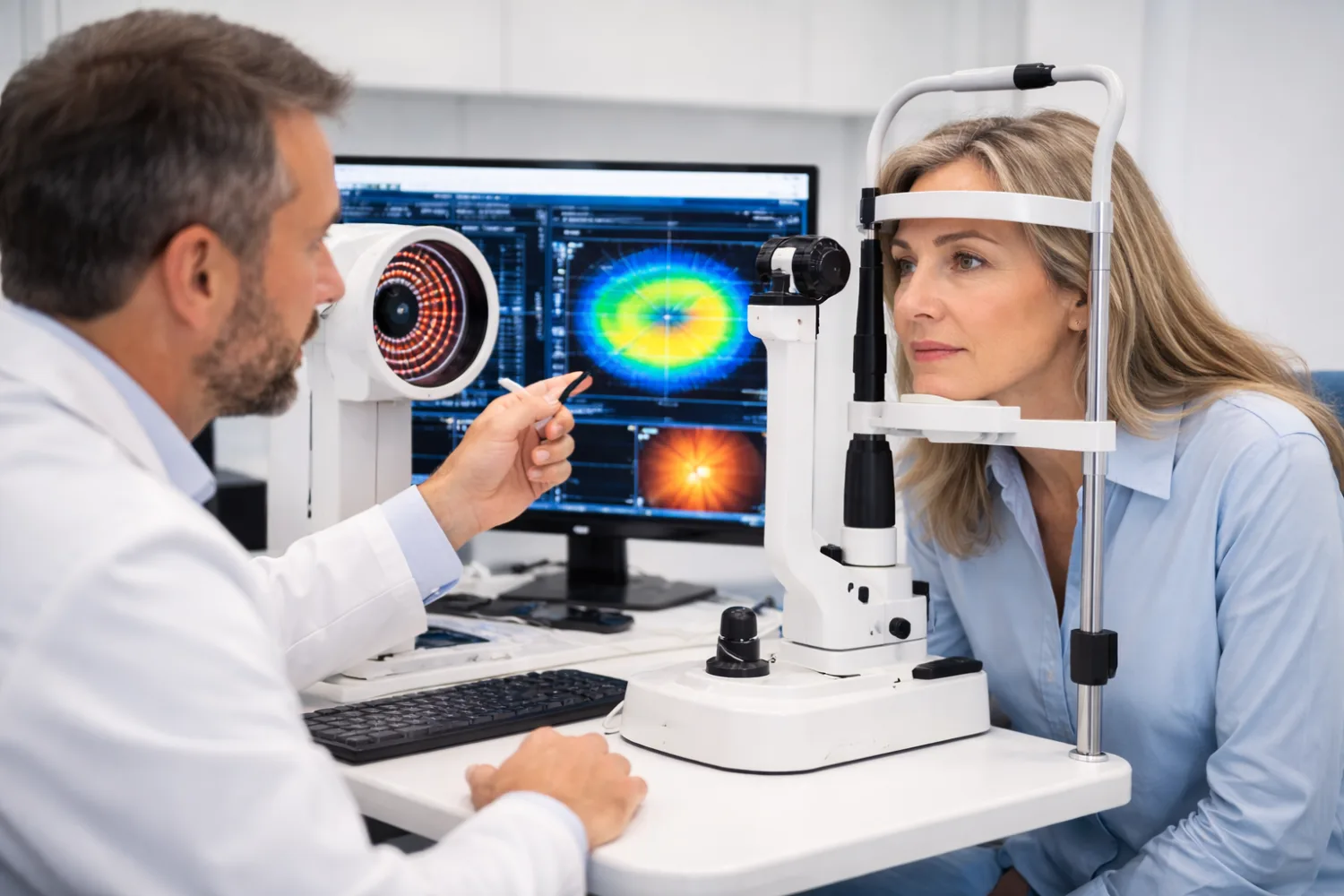
A proper suitability check is more detailed than a routine sight test. The purpose is not just to find out whether you can be treated, but whether treatment is likely to be safe and worthwhile.
Clinics should usually assess:
- glasses prescription
- contact lens history
- refraction measurements
- corneal thickness
- corneal shape and mapping
- pupil size
- tear film and dry eye risk
- eye pressure
- retina and optic nerve health
- general eye health
- medical history and medications
The Royal College advises patients to meet the surgeon who will perform the procedure and to check that the surgeon is appropriately trained, registered and insured. Clinics should also be properly regulated.
For wider context on private treatment decisions, see NHS vs private healthcare in the UK.
Expectations, risks and limitations
One of the biggest reasons people end up disappointed is unrealistic expectations. Laser eye surgery can produce excellent results, but it cannot guarantee perfect vision in every situation for every person.
What laser eye surgery may do
Laser eye surgery may:
- reduce dependence on glasses or contact lenses
- improve unaided distance vision
- make sport, travel or daily routines easier
- reduce problems linked to contact lens wear
What laser eye surgery may not do
Laser eye surgery may not:
- remove the need for reading glasses later in life
- guarantee perfect night vision
- remove every visual symptom
- prevent future cataracts
- prevent age-related eye conditions
- guarantee that enhancement treatment will never be needed
Some patients notice temporary side effects during recovery, such as glare, halos, dry-eye symptoms, blur or fluctuations in visual quality.
A good candidate is not just someone with treatable eyes. It is someone who understands the likely benefits, limitations, recovery period and risks.
Risks and why careful screening matters
Laser eye surgery is generally safe when patients are selected carefully, but it is still surgery and complications can occur.
Possible risks include:
- dry eye symptoms
- glare or halos
- under-correction
- over-correction
- need for a second procedure
- infection or inflammation
- reduced night vision quality
- flap-related complications with LASIK
- corneal haze with some surface treatments
- rare serious loss of vision
Careful screening helps reduce these risks. Suitability should never be reduced to a sales process. A trustworthy assessment should include reasons not to operate, not only reasons to proceed.
Alternatives if laser eye surgery is not suitable
If laser eye surgery is not the right option, other forms of vision correction may still be possible.
Glasses or contact lenses
For some people, the safest option remains glasses or contact lenses, especially if the eyes are changing, dry eye is significant or surgery carries more risk than benefit.
Phakic intraocular lenses
For younger patients with prescriptions outside the usual laser range, phakic intraocular lenses may be considered. These lenses are implanted in the eye without removing the natural lens.
Refractive lens exchange
For older patients, especially those with early cataract changes or age-related reading problems, refractive lens exchange may be more suitable. This involves replacing the natural lens with an artificial lens.
Being told “laser is not right for you” does not necessarily mean nothing can be done. It may mean a different procedure would be safer or more effective.
If referral or specialist assessment is needed, see how hospital referrals work in the UK.
NHS availability and private clinics
In the UK, laser eye surgery is usually available privately rather than routinely through the NHS.
The NHS says laser eye surgery may sometimes be offered if there is an eye condition that could lead to sight loss, or if vision problems cannot be corrected with glasses or contact lenses. Routine laser vision correction for convenience is generally private.
This means most patients compare private clinics, surgeons, technology, aftercare and pricing.
When to be cautious about a clinic
Patients should be cautious if a clinic seems more focused on speed, discounts or sales tactics than proper assessment.
Warning signs include:
- pressure to book quickly
- large discounts that expire immediately
- no opportunity to meet the surgeon before the day of surgery
- unclear surgeon credentials
- unclear regulation or clinic registration
- minimal eye testing before quoting suitability
- guarantees of perfect vision
- risks being brushed aside
- no clear aftercare plan
- unclear costs for follow-up or enhancement procedures
A good provider should explain who is suitable, who is not, what the alternatives are, and what the risks and likely visual outcomes are for your particular eyes.
The Royal College checklist for refractive surgery patients can help you prepare questions before choosing a clinic.
Questions to ask before laser eye surgery
Before agreeing to treatment, ask:
- Am I suitable for laser eye surgery, and why?
- Which procedure do you recommend for me?
- Why is this procedure better than alternatives?
- Who will perform the surgery?
- What are the surgeon’s qualifications and experience?
- What are my personal risks?
- What result should I realistically expect?
- Will I still need glasses for reading or driving?
- What happens if I am under-corrected or over-corrected?
- What aftercare is included?
- What costs extra?
- Who do I contact if I have problems after surgery?
FAQ: laser eye surgery suitability in the UK
Who is a good candidate for laser eye surgery?
A good candidate is usually over 18, has a stable prescription, healthy corneas, suitable eye measurements, no significant eye disease and realistic expectations about the result.
What prescription is too high for laser eye surgery?
There is no single cut-off for everyone. Suitability depends on prescription, corneal thickness, corneal shape and eye health. Higher prescriptions may need alternatives such as phakic lenses or lens surgery.
Can I have laser eye surgery if I have astigmatism?
Many people with astigmatism can be treated, provided the prescription and eye measurements are suitable. Higher or irregular astigmatism needs careful assessment.
Can I have laser eye surgery if I have dry eyes?
Mild or treatable dry eye does not always rule out surgery, but significant dry eye may need treatment first or may make laser surgery unsuitable.
Can contact lens wearers have laser eye surgery?
Yes, many contact lens wearers are suitable. You may need to stop wearing lenses for a period before assessment so the cornea can return to its natural shape.
What age is best for laser eye surgery?
Many patients have treatment in their 20s or 30s once their prescription is stable. People in their 40s and beyond need to consider reading vision and possible lens-based alternatives.
Can laser eye surgery fix reading glasses?
Laser treatment can sometimes be planned with monovision to reduce reading-glasses dependence, but it is not suitable for everyone and does not stop the ageing process of the eye.
Can I have laser eye surgery if I have cataracts?
Significant cataracts usually make laser eye surgery unsuitable. Cataract surgery or lens-based treatment may be more appropriate.
Is laser eye surgery available on the NHS?
Routine laser eye surgery for convenience is generally private in the UK. NHS treatment is usually reserved for specific medical situations where there is a clinical need.
Does laser eye surgery guarantee perfect vision?
No. Many people achieve excellent unaided vision, but perfect vision is not guaranteed. Some people still need glasses for certain tasks or need further treatment.
What tests are needed before laser eye surgery?
Tests usually include prescription measurements, corneal mapping, corneal thickness, tear-film assessment, pupil size, eye pressure and checks of the retina and overall eye health.
How do I choose a laser eye surgery clinic?
Choose a clinic that provides thorough testing, lets you meet the surgeon, explains risks clearly, avoids pressure selling, provides transparent pricing and offers proper aftercare.
Final takeaway
Laser eye surgery can be an excellent option for the right patient, but suitability is never one-size-fits-all. The best candidates are adults with stable vision, healthy eyes, realistic expectations and measurements that make laser treatment safe.
Some people are better suited to lens-based procedures, especially if their prescription is very high, their corneas are not ideal for laser reshaping, or they are older and already developing lens changes.
If you are considering treatment, the safest next step is a detailed suitability assessment with an appropriately qualified refractive surgeon. A good consultation should explain not only whether laser eye surgery is possible, but whether it is genuinely the best option for your eyes.