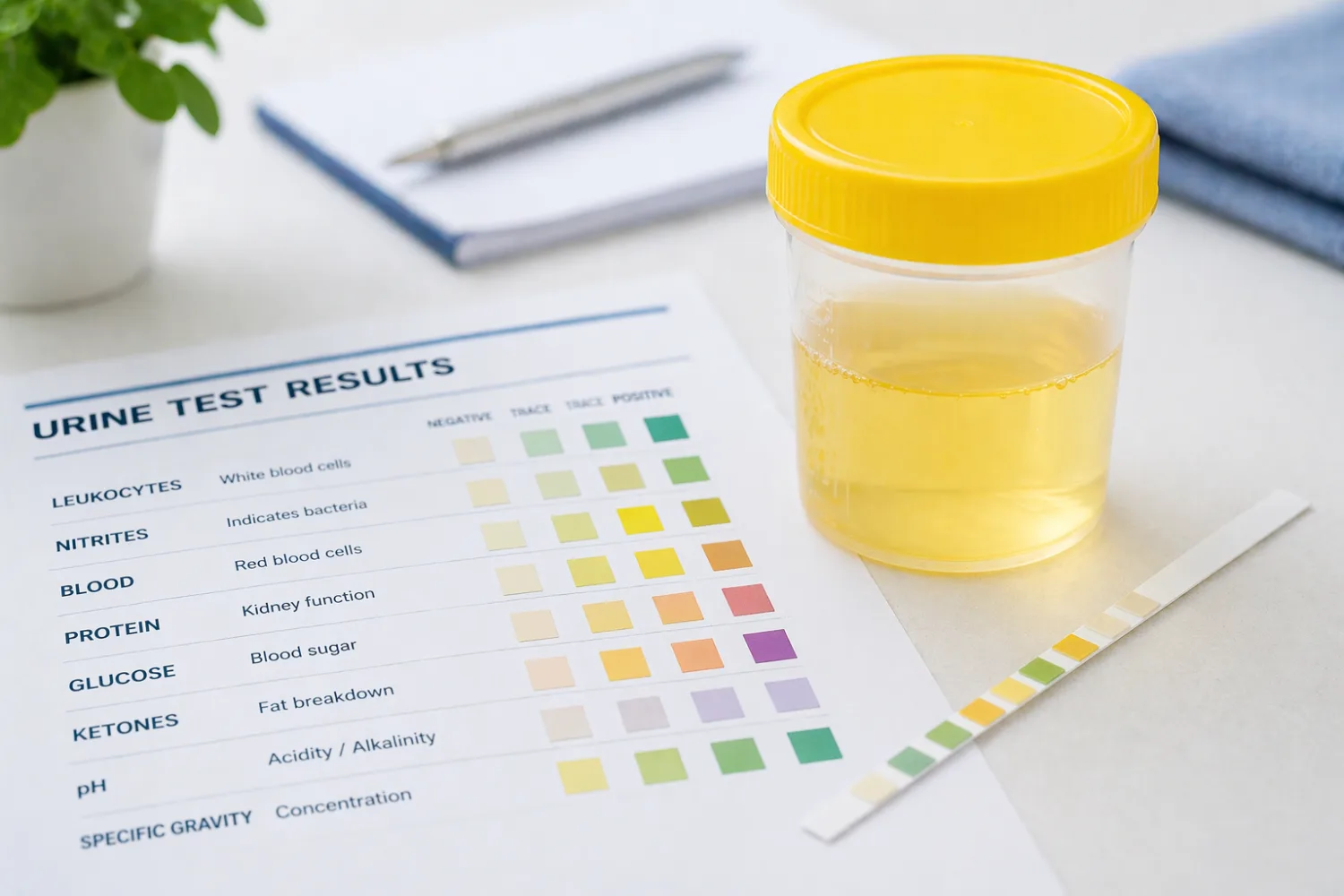
A urine test looks simple. You give a sample, someone dips a strip into it or sends it to the lab, and later you hear words like “nitrites”, “leukocytes”, “blood”, “protein” or “culture positive”. The problem is that these results often sound more precise than they really are. Many patients assume a positive dipstick means a definite infection, or that one abnormal result means something serious must be wrong. In reality, urine tests are useful, but they need context. Urinalysis is used to help detect urinary tract infections, kidney disease and metabolic conditions, and it can involve dipstick testing, microscopy and sometimes chemical analysis.
This guide explains the urine test results UK patients most often see, what they may suggest, what they do not prove on their own, and when it makes sense to speak to a GP. It is written to be practical rather than overly technical, because most people do not need laboratory detail. They need help understanding whether the result fits a UTI, dehydration, kidney concerns, diabetes, pregnancy monitoring or something that simply needs repeating. Urine dipstick analysis is commonly used as a screening tool for things like blood, protein, ketones, glucose, nitrites and leukocytes, but NHS laboratory guidance stresses that dipstick analysis is not diagnostic on its own.
What kind of urine test have you actually had?
One of the biggest sources of confusion is that people say “I had a urine test” when several different types of urine testing exist. A quick dipstick in clinic is different from a laboratory urine culture, and both are different again from a protein measurement, urine albumin test, pregnancy-related urine check or specialist 24-hour urine collection.
Urinalysis can include dipstick screening, microscopic examination and laboratory analysis, while urine culture is specifically used to identify bacteria or yeast in the urine and help guide antibiotic treatment.
Why the type of test matters
A result only makes sense if you know which kind of test it came from. A dipstick can suggest an infection, but it does not confirm one the way a urine culture can. A dipstick can show blood or protein, but further testing is often needed to understand why.
This is very similar to blood tests: one abnormal number is often the start of the conversation, not the end of it. For readers who want the same kind of plain-English approach for blood work, your guide to how to understand blood test results is a natural internal link.
Dipstick, microscopy and culture are not the same thing
A urine dipstick is a quick screening test. A chemically treated strip changes colour depending on what is found in the sample. It can look for markers such as blood, protein, nitrites, ketones, glucose, leukocytes, pH and specific gravity or density.
Microscopy and laboratory analysis can look more closely at cells, crystals, bacteria or other findings. A urine culture goes further by trying to grow and identify bacteria or yeast from the sample. This is often the test people mean when they say, “They sent my urine off.”
What a urine dipstick can show
A urine dipstick can make the result look very definite, but the key thing to remember is that it is a screening tool. It points clinicians in directions. It does not, by itself, settle the diagnosis.
A positive result has to be interpreted alongside symptoms, age, pregnancy status, past history and sometimes a lab test.
A good real-life example is someone with burning when they pee, frequency, urgency and lower abdominal discomfort. A dipstick showing nitrites and leukocytes fits a likely UTI. Compare that with someone who feels completely well, has no urinary symptoms, but a dipstick happens to show something minor during a routine check. Those two situations are not interpreted in the same way.
Leukocytes in urine
If your result mentions leukocytes or leukocyte esterase, it means the test has detected white blood cells or a marker associated with them. This often suggests inflammation or infection somewhere in the urinary tract, which is why leukocytes are commonly discussed in suspected UTIs. NHS laboratory dipstick guidance includes leukocytes among the standard markers checked when screening urine.
But leukocytes do not equal infection every time. They can sometimes appear because of sample contamination, irritation, inflammation or the way the sample was collected. This is especially important if the sample was not a clean midstream sample.
So if someone has a positive leukocyte result but no symptoms at all, the answer is not automatically “you have a UTI”. This is one reason doctors often care about symptoms just as much as the strip. Burning, urgency and frequency with leukocytes are more meaningful than leukocytes alone in a well person.
Nitrites in urine
Nitrites on a dipstick are often more suggestive of a bacterial urinary infection because some bacteria convert nitrates in urine into nitrites. If nitrites are positive in someone with classic urinary symptoms, that often strengthens the case for a UTI. NHS laboratory guidance uses nitrite as one of the key markers considered when urine is being screened for likely infection.
Still, nitrites are not perfect. A negative nitrite result does not rule out a UTI, and a positive one still has to fit the clinical picture. Some bacteria do not produce nitrites, and sample timing matters too. So nitrites are useful, but not magical.
Blood in urine
Seeing blood on a urine result often causes immediate worry, and understandably so. Blood in urine, also called haematuria, can be visible to the eye or only detected on testing. NHS guidance says blood in urine is not usually caused by anything serious, but it must be checked by a GP.
There are lots of possible explanations. A urine infection can cause blood. Kidney stones can cause blood. Vigorous exercise, menstrual contamination, prostate problems, kidney inflammation and other causes can also do it. Sometimes it is seen only on a dipstick, and further confirmation may be needed.
The key distinction is whether the blood is a one-off, whether you have symptoms, and whether it is visible. Visible blood in urine deserves proper medical attention even if you otherwise feel well. Blood picked up only on dipstick may still need follow-up, particularly if it persists. Kingston and Richmond NHS information notes that haematuria may be microscopic or macroscopic and that persistence matters.
This is a very strong topic in its own right, so this article should naturally link to blood in stool as a related “don’t ignore bleeding” symptom guide and, if you later create one, a dedicated blood-in-urine page would make perfect sense.
Protein in urine
Protein in urine can be one of the more important findings, but again, it depends on the amount and the situation. Small temporary amounts can appear with fever, strenuous exercise or acute illness. Persistent protein in urine can point towards kidney problems and usually needs further assessment. NHS pregnancy guidance also highlights urine protein testing because it can be relevant in the diagnosis of pre-eclampsia.
NHS laboratory guidance says a positive protein result on dipstick should be investigated further with laboratory testing rather than left at the screening stage.
A good example is the pregnant patient whose urine is checked at antenatal visits. Protein on a dipstick in pregnancy does not automatically mean pre-eclampsia, but it is important enough that midwives and GPs take it seriously, especially if blood pressure is raised. Outside pregnancy, persistent protein in urine may lead to kidney blood tests, blood pressure checks and urine protein-to-creatinine or albumin-to-creatinine testing.
Glucose in urine
If glucose shows up in urine, it can suggest high blood sugar levels, because glucose may spill into urine when blood glucose is elevated enough. Dipstick guidance includes glucose as one of the routine parameters screened for in urinalysis.
That said, urine glucose is not the modern gold-standard way of diagnosing diabetes. If glucose is found in urine, clinicians often follow up with blood tests such as glucose or HbA1c. This is another example of why screening tests and confirmatory tests are different things. A urine finding can point in the right direction, but it usually does not finish the investigation.
This topic pairs naturally with your blood-test guide, because patients with urine glucose findings often end up needing blood sugar interpretation too.
Ketones in urine
Ketones in urine can sound alarming because people associate them with diabetic ketoacidosis, but ketones are not always a sign of emergency. They can appear if someone is fasting, vomiting, dehydrated, eating a very low-carbohydrate diet, or not getting enough calories. Dipstick screening commonly includes ketones for exactly this reason: they may reflect metabolic stress rather than one single diagnosis.
The result becomes more significant when it appears in the right context, such as a person with diabetes who is unwell, has high blood sugar and is feeling sick or breathless. In that situation, ketones need prompt attention. In a person who has barely eaten for 24 hours because of a stomach bug, the meaning is different.
pH and specific gravity
Urine pH reflects how acidic or alkaline the urine is. Specific gravity or specific density gives a clue about how concentrated the urine is. These can sometimes help doctors think about hydration, kidney handling of urine, or stone risk, but they are usually not the most important part of a standard urine test result. NHS laboratory dipstick guidance includes both pH and specific density as standard parameters.
Patients often focus on these because they look scientific, but in routine practice they are rarely the main answer to the clinical question. A concentrated urine sample, for example, may simply reflect mild dehydration rather than a disease.
What a urine culture result means
A urine culture is different from a dipstick. Instead of simply screening for clues, the laboratory tries to grow and identify bacteria or yeast from the sample. Lab Tests Online UK explains that urine culture is used to diagnose UTIs and help guide antibiotic treatment by identifying the organism present.
If the culture grows a significant organism and the symptoms fit, that is much more convincing evidence of a UTI than a dipstick alone. The lab may also report which antibiotics the bacteria are sensitive to, which helps if first-line treatment is not suitable or has not worked.
Why culture results can still be confusing
Cultures can also be confusing. A contaminated sample may not give a clean answer. A culture may show bacteria in someone who does not actually have a symptomatic infection. And if antibiotics were started early, the culture can come back less clear than expected.
Why bacteria in urine does not always mean infection
This is especially important in older adults. NHS patient guidance notes that in people over 65, routine urine dipstick testing becomes less reliable, and many older adults may have bacteria in their urine without actually having a UTI. That is why a positive dipstick or even bacteria in urine should not automatically trigger antibiotics if there are no compatible symptoms.
This point cannot be stressed enough. Treating a lab result without treating the patient can lead to overdiagnosis and unnecessary antibiotics. In older adults especially, confusion, falls or general decline may have many causes, and a positive urine test on its own is not always the explanation.
When urine test results do and do not fit a UTI
A urine result is most convincing for a UTI when it matches symptoms. Typical urinary symptoms include burning when passing urine, increased frequency, urgency, suprapubic discomfort and sometimes visible blood. NHS guidance on UTIs uses symptoms as the core of diagnosis, with urine testing as supportive evidence rather than a replacement for clinical judgment.
A classic example is a woman with stinging when peeing, needing to go constantly, and lower abdominal discomfort, whose dipstick shows leukocytes and nitrites. That fits a straightforward UTI quite well. Another patient may have a positive dipstick but no urinary symptoms at all, in which case the significance is much less clear.
When the result points away from a simple UTI
Sometimes the result pushes clinicians to think about other causes. Blood without infection symptoms may lead to haematuria follow-up. Persistent protein may point towards kidney disease. Glucose may lead to diabetes testing. Recurrent sterile leukocytes may need a broader look at irritation, inflammation or contamination. Urinalysis is used to help detect kidney disease and metabolic conditions as well as infections, which is exactly why the same test can point in very different directions depending on the pattern.
This is one reason patients should try not to force every urine result into the “it’s just a UTI” box. The strip is not only about infection.
Pregnancy, older adults and sample quality
Urine testing can be especially important in pregnancy, harder to interpret in older adults, and affected by how the sample was collected.
Pregnancy and urine tests
Urine testing in pregnancy is common and has slightly different stakes. The NHS says a urine sample is usually requested at antenatal appointments and can be checked for protein using a dipstick; if protein is present, further testing may be needed as part of checking for pre-eclampsia.
That does not mean every trace of protein in pregnancy equals danger, but it does mean pregnant patients should not casually ignore urine findings. Blood pressure, symptoms and repeat testing all matter.
Older adults and urine tests
In older adults, urine tests need particular care. Bacteria in urine can be present without a true symptomatic infection, and a positive urine test alone may not explain confusion, falls or general decline.
This does not mean urine symptoms should be ignored. It means the result needs to be interpreted alongside the whole person, their symptoms and other possible causes.
Why the sample itself matters so much
Urine samples are easy to contaminate. If the sample is not collected midstream, if it sits around too long, or if menstrual blood or vaginal discharge gets into it, the result can become much harder to interpret. That is why clinicians often ask for a clean-catch midstream sample, especially when they are trying to confirm infection. Lab Tests Online UK also notes that urine culture depends on proper collection because the goal is to identify what is really in the urinary tract, not contamination from outside.
This may sound like a boring technical detail, but it is actually one of the commonest reasons results come back confusing rather than useful.
When to see a GP about urine test results
You should contact a GP if urine test findings come with urinary symptoms, visible blood in the urine, persistent pain, fever, flank pain, pregnancy, repeated infections, or if blood or protein keeps showing up on tests. NHS advice is explicit that blood in urine should be checked by a GP even though it is not usually caused by anything serious.
It is also sensible to follow up if you have a result but do not understand whether it was a dipstick screen or a lab-confirmed result, especially if you were given antibiotics or told to repeat the sample. If access is the main problem, a useful internal next step is how to get a GP appointment quickly in the UK. And for straightforward symptom-led advice, some readers may also benefit from when to see a pharmacist instead of a GP.
When urine-related symptoms are more urgent
Urgent medical advice is needed if urine symptoms come with fever, vomiting, pain in the sides or back, confusion, pregnancy, inability to pass urine, or signs of severe illness. The NHS includes fever, flank pain and feeling very unwell among the reasons a UTI may be more serious and require prompt treatment.
Visible blood in urine, especially if persistent or unexplained, should also not be left to drift. It may not be serious, but it is important enough to check properly.
The bottom line
Urine test results can be helpful, but they are often less definitive than patients expect. A dipstick is a screening tool, not a final diagnosis. Leukocytes and nitrites may support a UTI, but symptoms still matter. Blood in urine needs checking. Protein in urine often needs follow-up. Glucose and ketones may point beyond the urinary tract altogether. And a urine culture is much more specific than a quick strip test.
The most useful question is rarely “Is this positive or negative?” It is: what type of urine test was this, and does the result fit what is actually happening to me? Once you understand that, urine results become much easier to interpret and much less likely to send you into a panic.
Frequently asked questions
What do leukocytes in urine mean?
Leukocytes usually suggest white blood cells in the urine, which can happen with infection or inflammation. They are often seen in UTIs, but on their own they do not prove infection.
Do nitrites always mean a UTI?
Nitrites often make a UTI more likely, especially if you also have burning, urgency and frequency. But they are still interpreted alongside symptoms and are not perfect on their own.
Is blood in urine always serious?
Not always, but it should always be checked. NHS guidance says blood in urine is not usually caused by anything serious, but you must get it checked by a GP.
What does protein in urine mean?
Protein can appear temporarily during illness, fever or after heavy exercise, but persistent protein in urine may point to kidney problems and usually needs more testing. Protein in pregnancy can also be important when checking for pre-eclampsia.
What is the difference between a dipstick and a urine culture?
A dipstick is a quick screening test that looks for clues such as leukocytes, nitrites, blood or protein. A urine culture is a lab test that tries to grow and identify bacteria or yeast to confirm infection and guide treatment.
Can bacteria in urine be harmless?
Yes, especially in older adults. NHS patient guidance notes that many older adults can have bacteria in urine without it meaning they have a true urinary tract infection.
What does glucose in urine mean?
It can suggest raised blood sugar and may prompt follow-up blood testing for diabetes, but it is not usually used alone to make the diagnosis.
When should I follow up a urine result?
You should follow it up if you have urinary symptoms, visible blood, persistent pain, repeated abnormal results, pregnancy, or if blood or protein keeps appearing on tests. Visible blood in urine should always be checked.